Guide
Claude Monet Biography: His Life in Paintings, 1840–1926
From teenage caricaturist in Le Havre to the old man of Giverny painting a pond on canvases the size of walls: Monet's life decade by decade, through the key picture of each period.
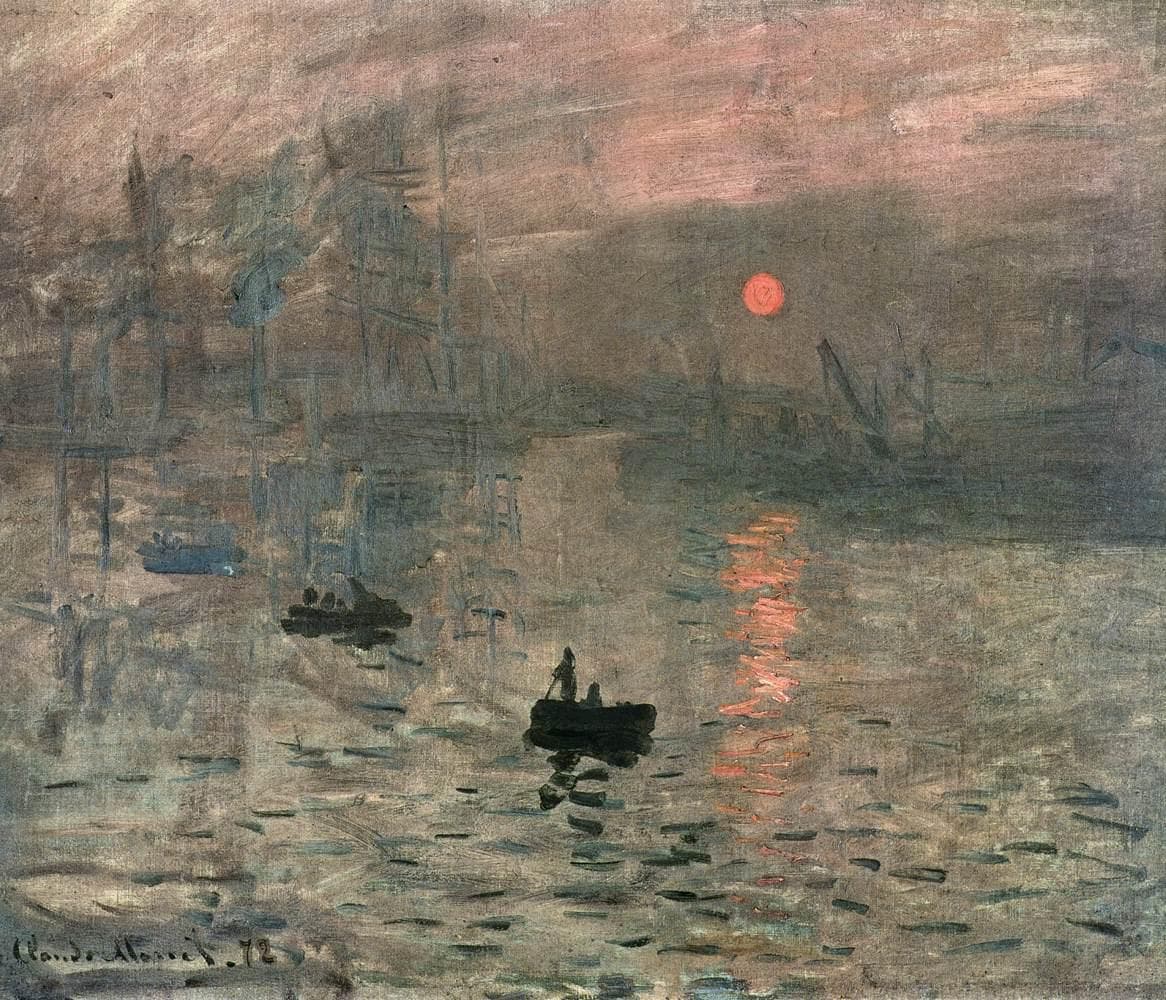
A Claude Monet biography in brief: born in Paris on 14 November 1840 and raised in Le Havre, Monet became the central painter of French Impressionism, the movement named after his Impression, Sunrise (1872), and he died at Giverny on 5 December 1926, aged eighty-six. In a career of more than sixty years he painted about 2,000 pictures, according to the catalogue raisonné compiled by Daniel Wildenstein, along with pastels and drawings.
His life falls into clear chapters, each tied to a place: the Normandy coast, Paris and the forest of Fontainebleau, Argenteuil, Vétheuil, and finally Giverny, where he lived for forty-three years. This timeline follows those chapters through one or two key canvases each; the works below are in chronological order. For his methods, see how Monet painted, and for the artist page, Claude Monet.
View at Rouelles, Le Havre
Claude Monet · 1858
La Pointe de la Hève at Low Tide
Claude Monet · 1865
The Picnic
Claude Monet · 1865–66
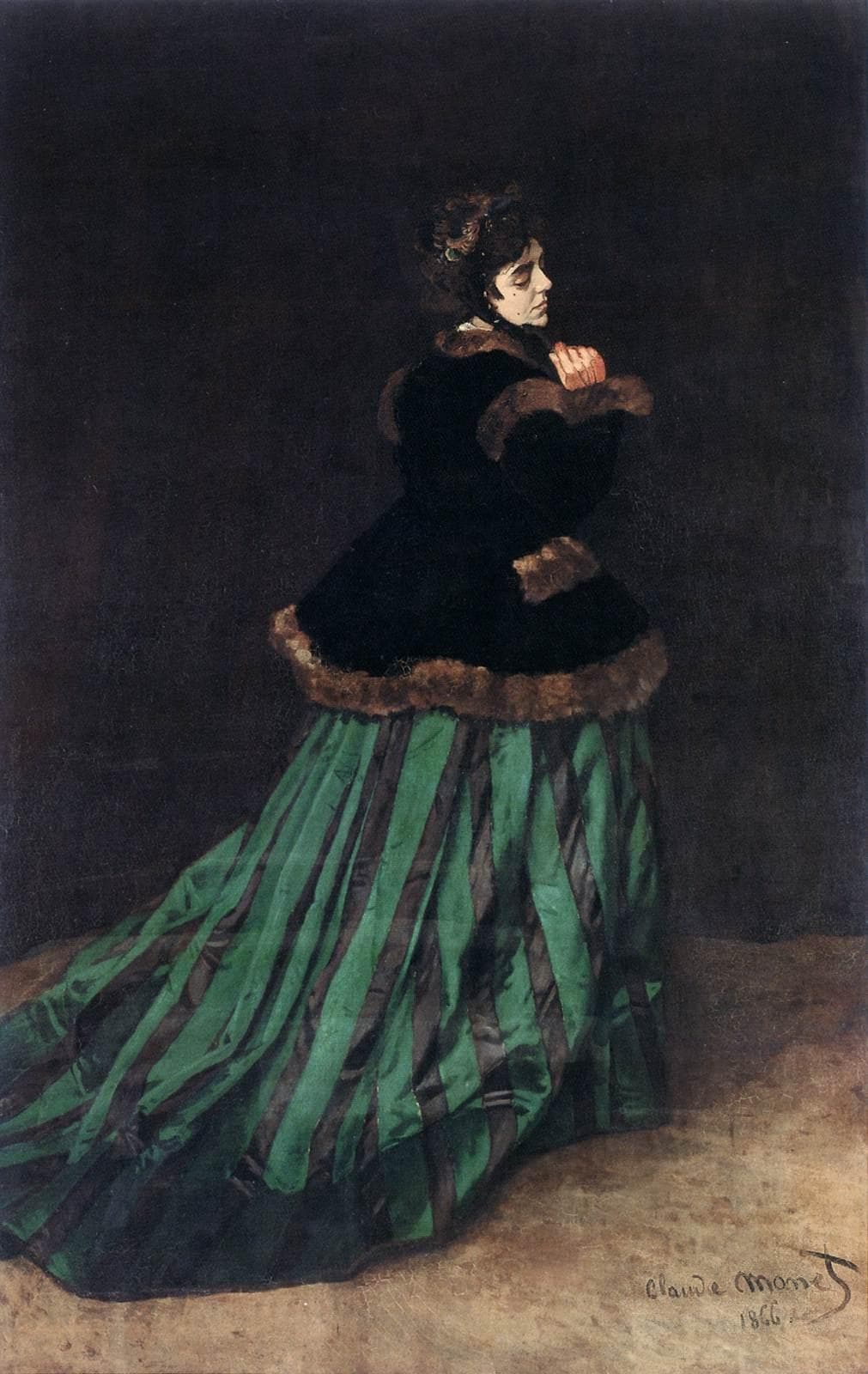
Camille (The Woman in the Green Dress)
Claude Monet · 1866
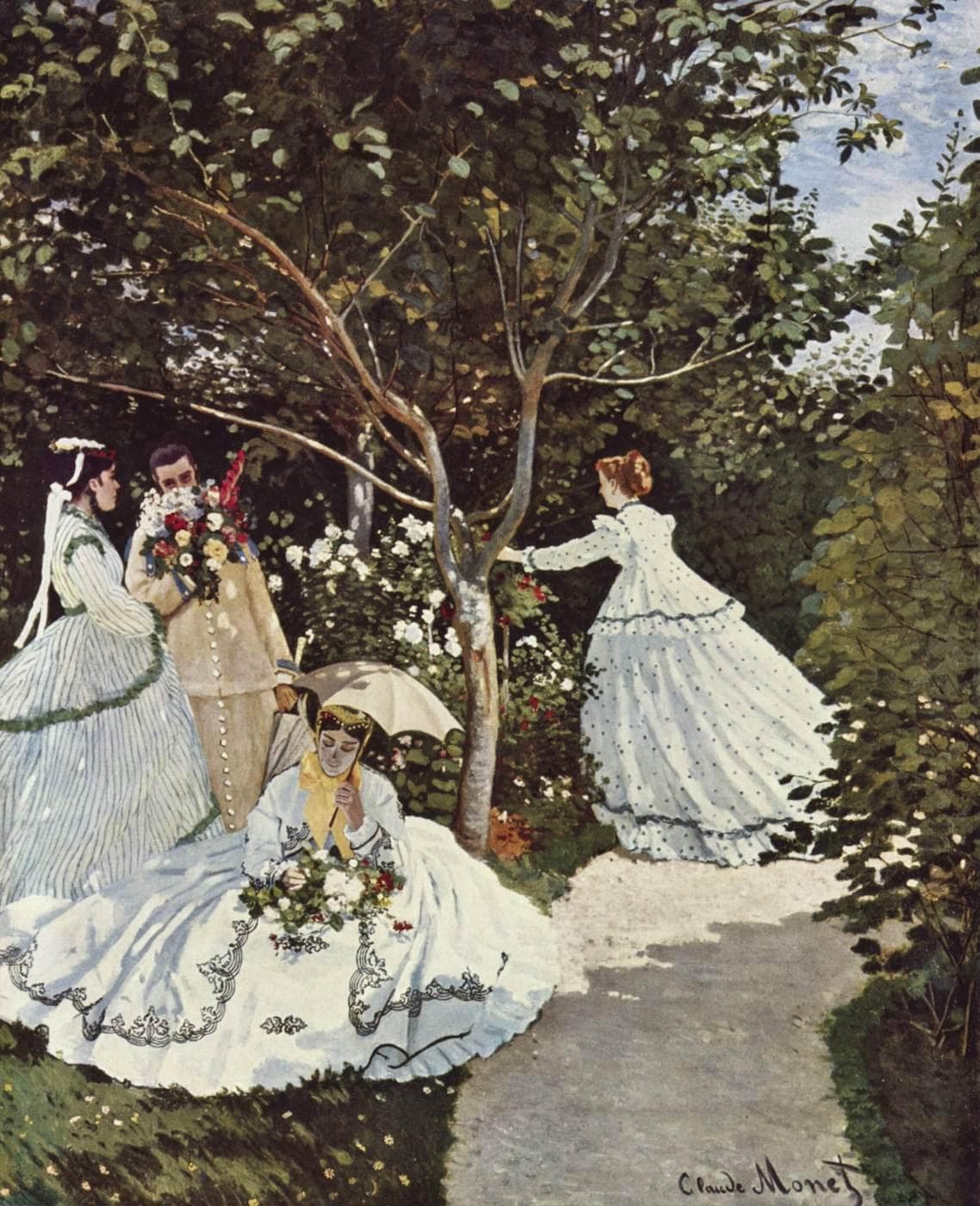
Women in the Garden
Claude Monet · 1866–67
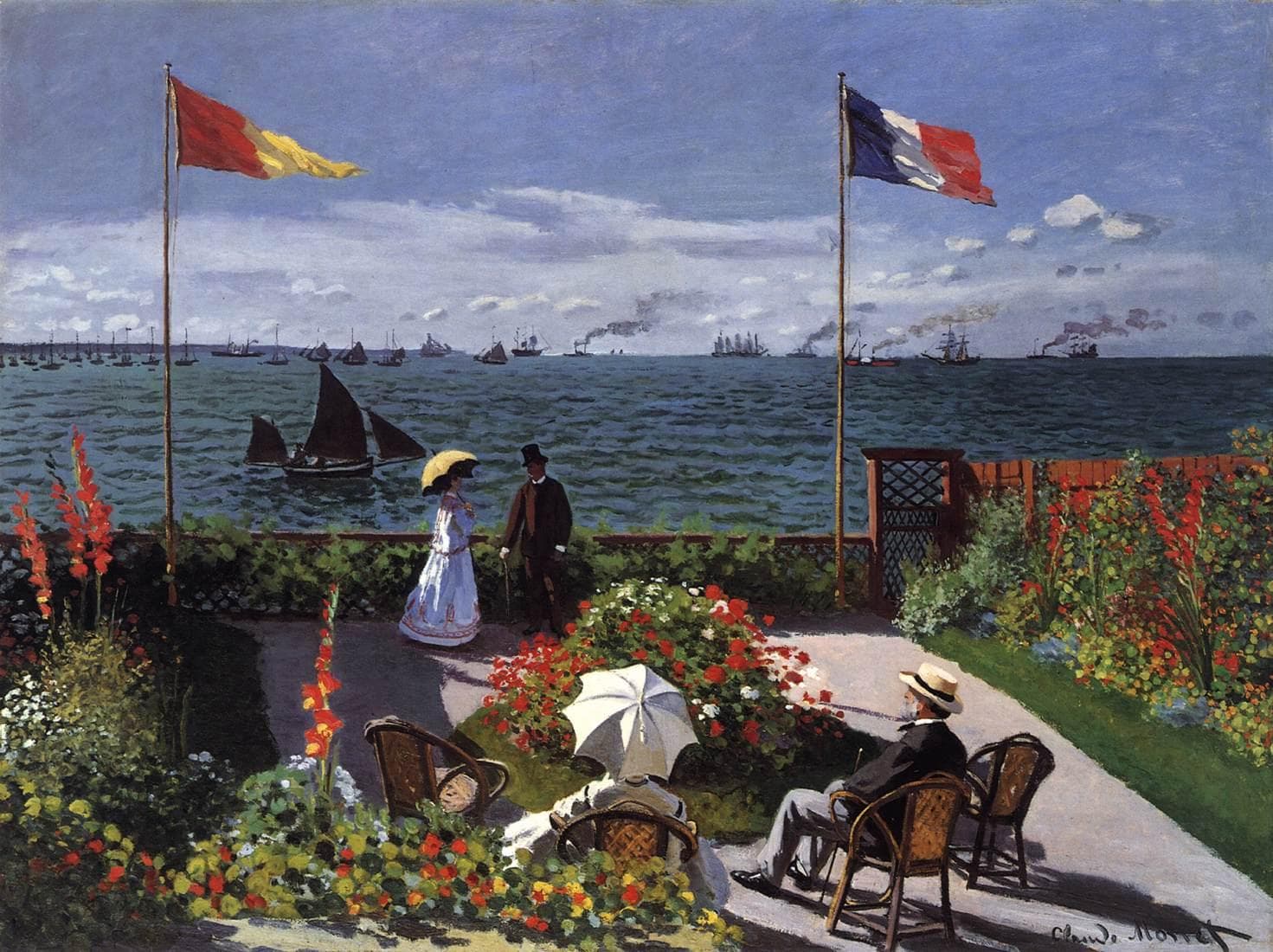
Garden at Sainte-Adresse
Claude Monet · 1867
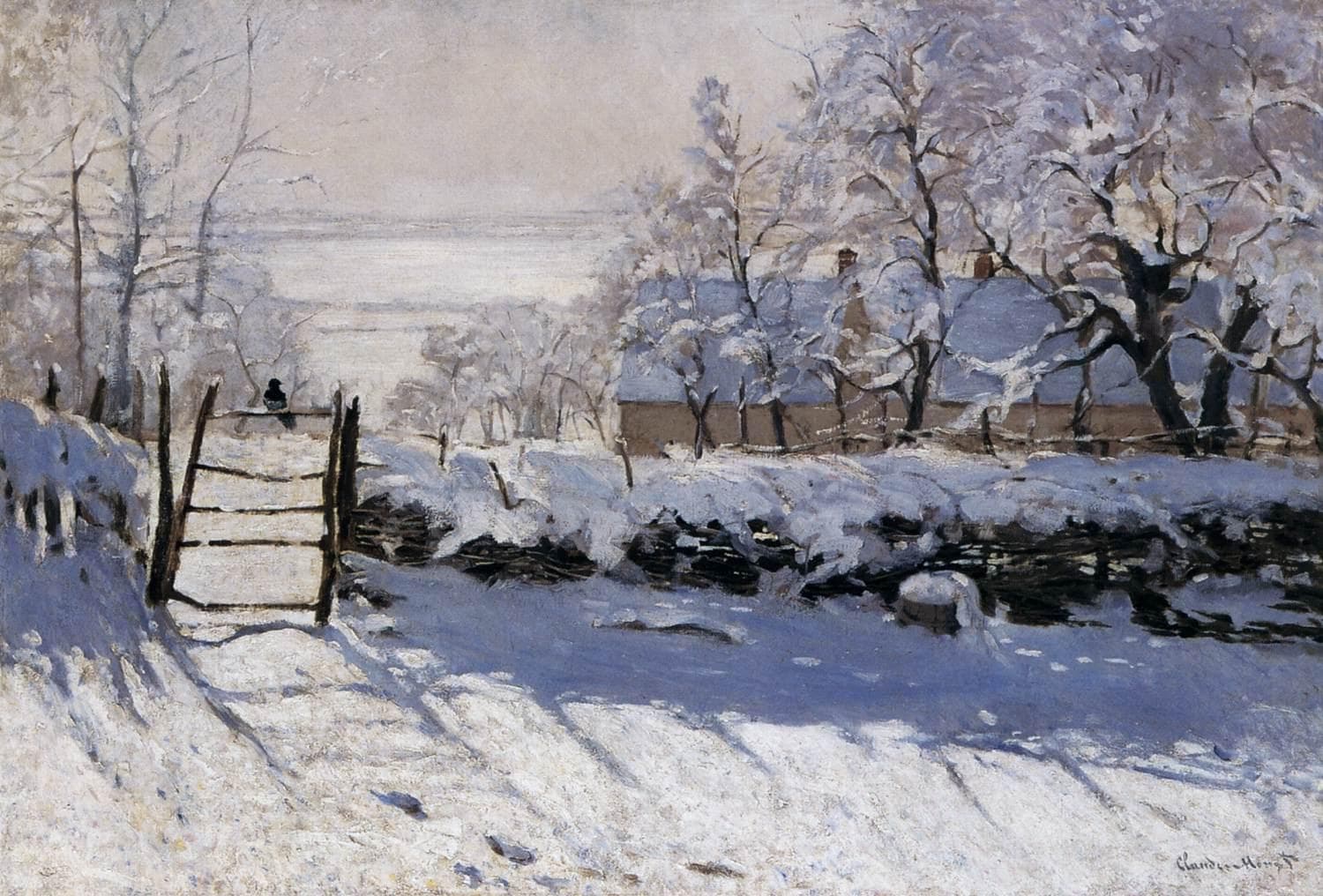
The Magpie
Claude Monet · 1868–69
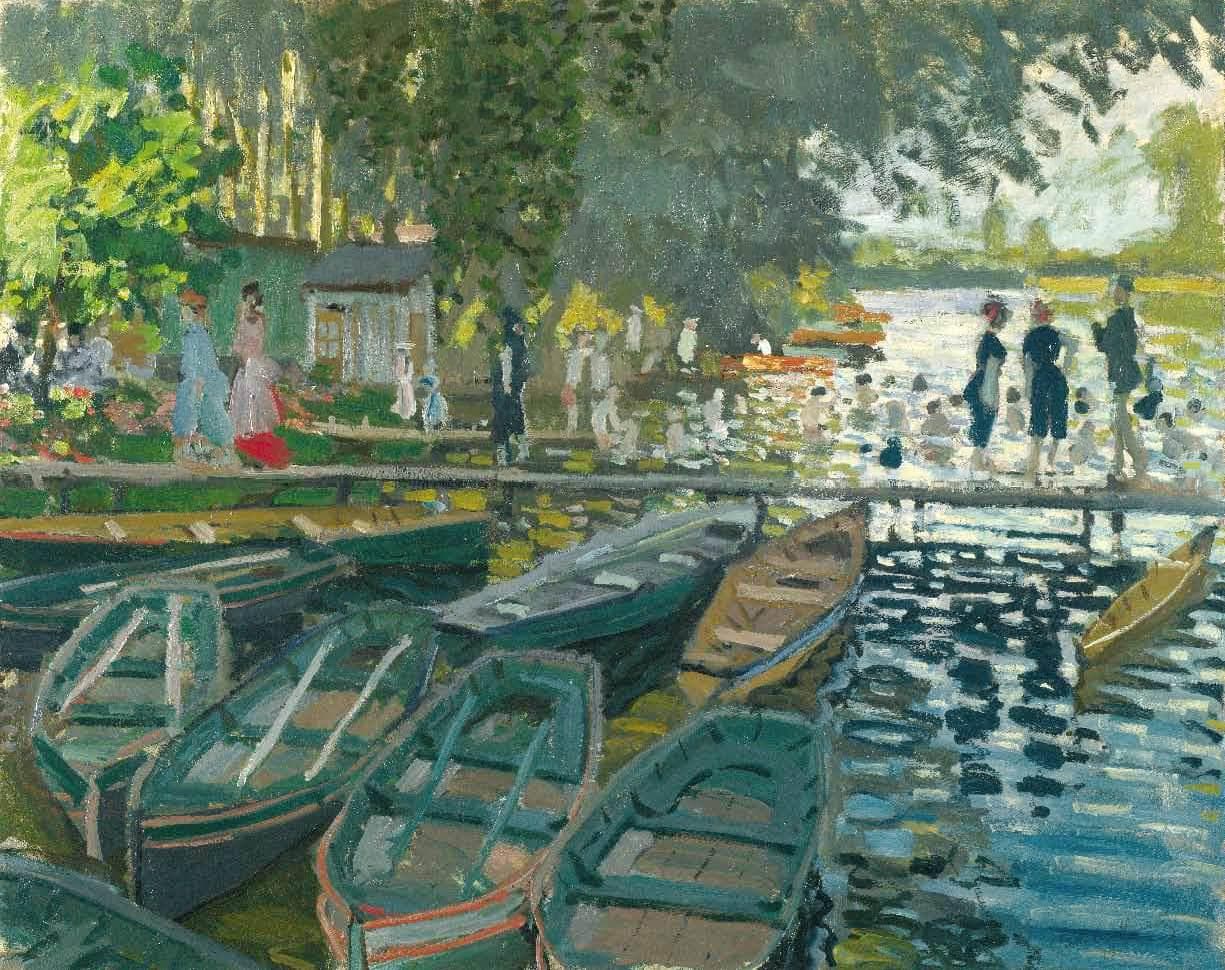
Bathers at La Grenouillère
Claude Monet · 1869
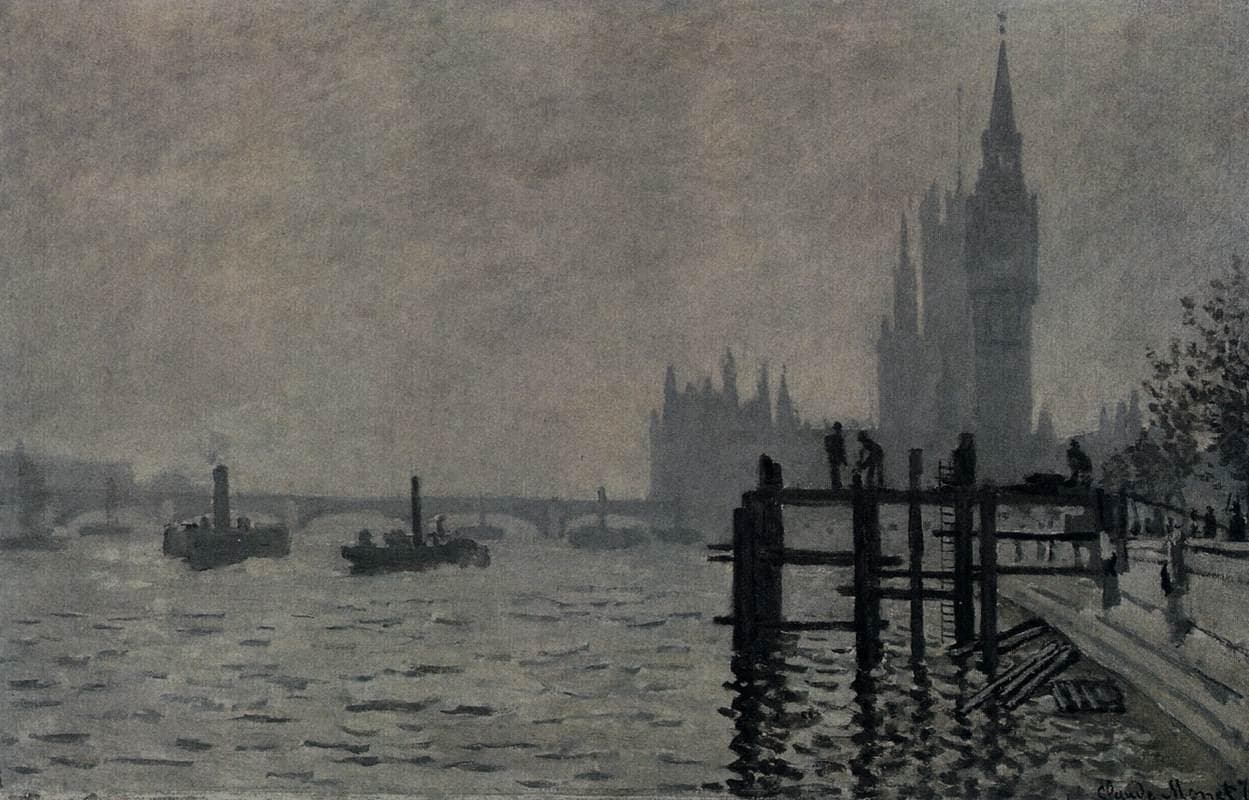
The Thames below Westminster
Claude Monet · c. 1871
Impression, Sunrise
Claude Monet · 1872
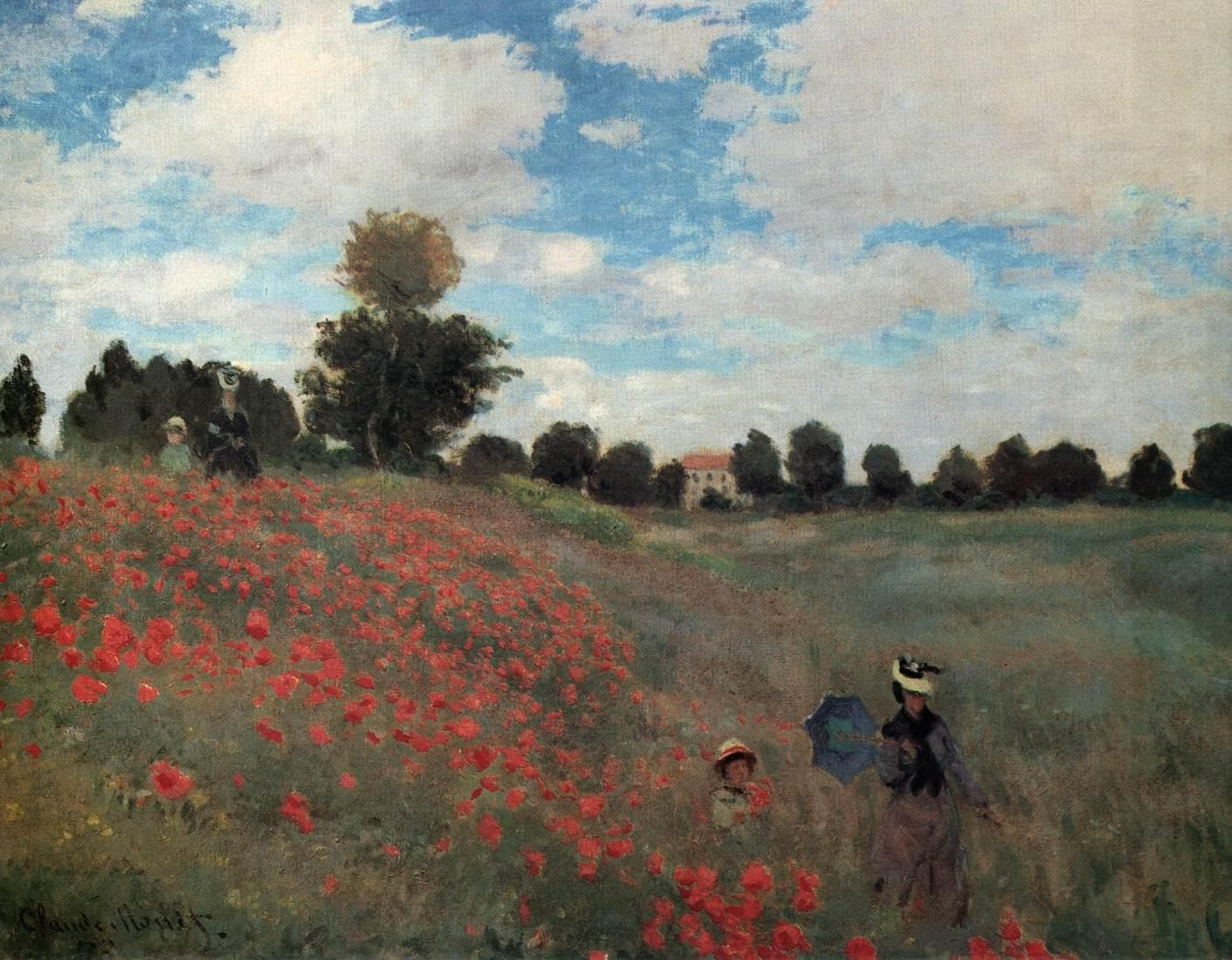
Poppy Field (Poppies at Argenteuil)
Claude Monet · 1873
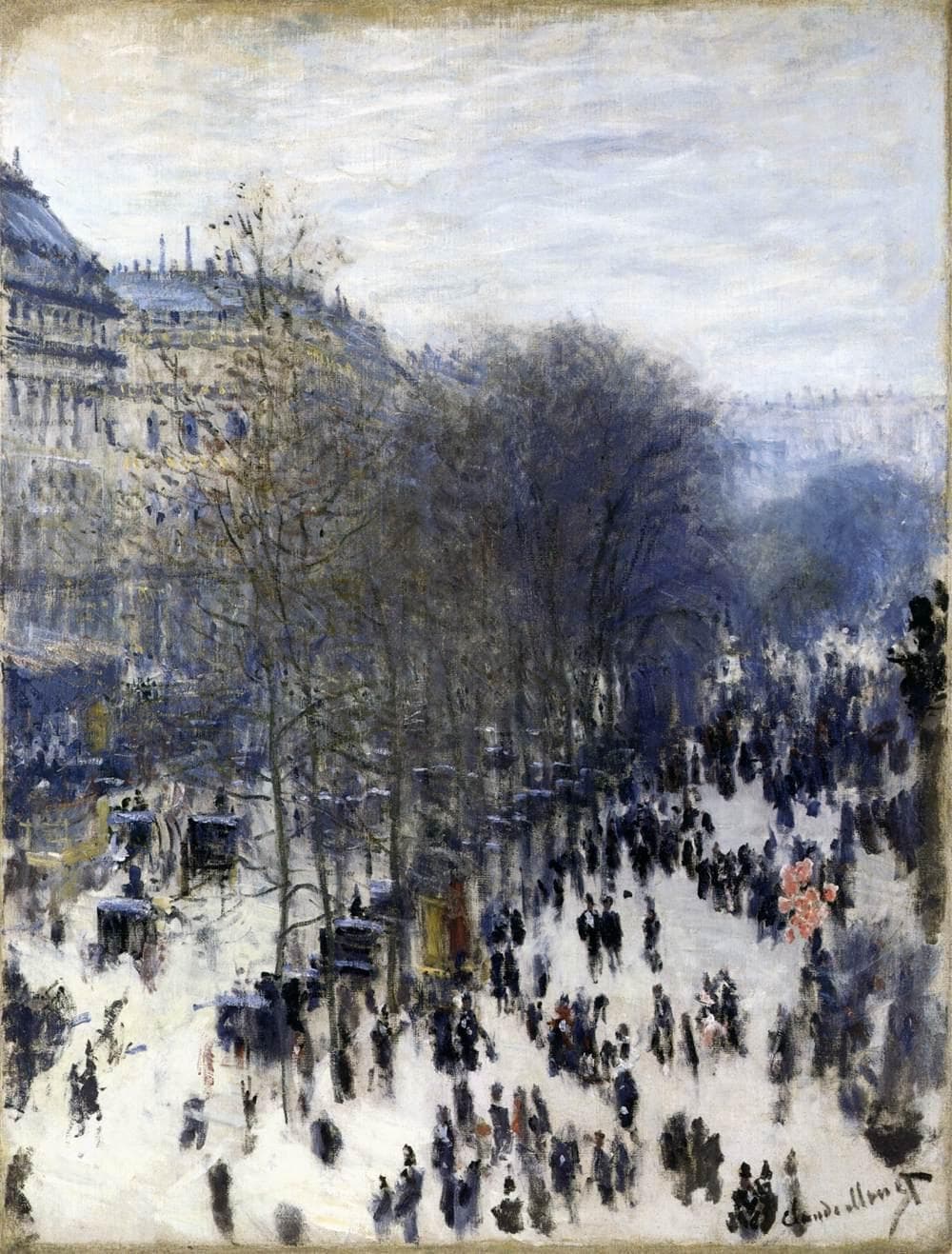
Boulevard des Capucines
Claude Monet · 1873–74

Woman with a Parasol – Madame Monet and Her Son
Claude Monet · 1875
La Japonaise (Camille Monet in Japanese Costume)
Claude Monet · 1876
La Gare Saint-Lazare
Claude Monet · 1877
Camille Monet on Her Deathbed
Claude Monet · 1879
The Breakup of the Ice at Lavacourt
Claude Monet · 1880
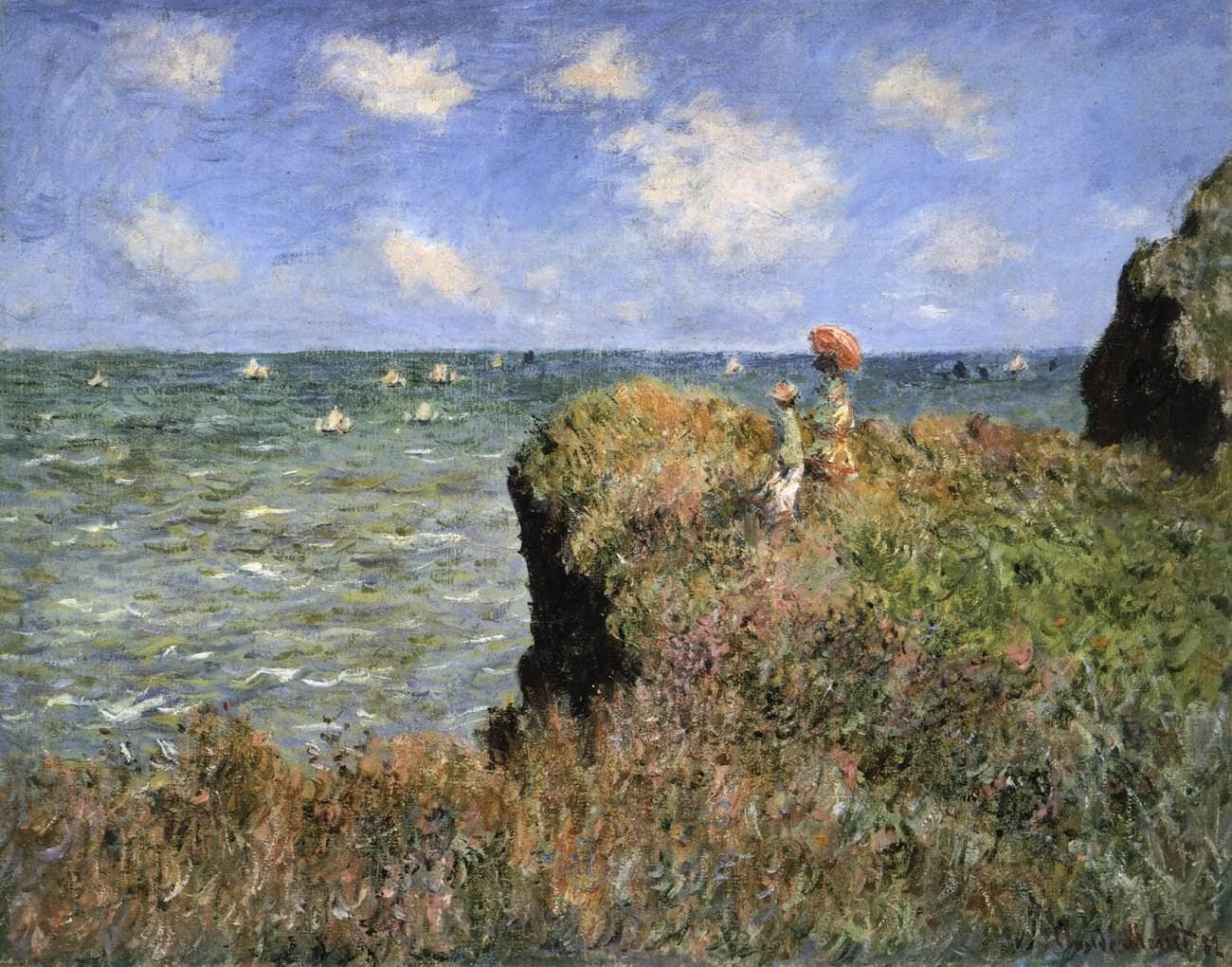
Cliff Walk at Pourville
Claude Monet · 1882
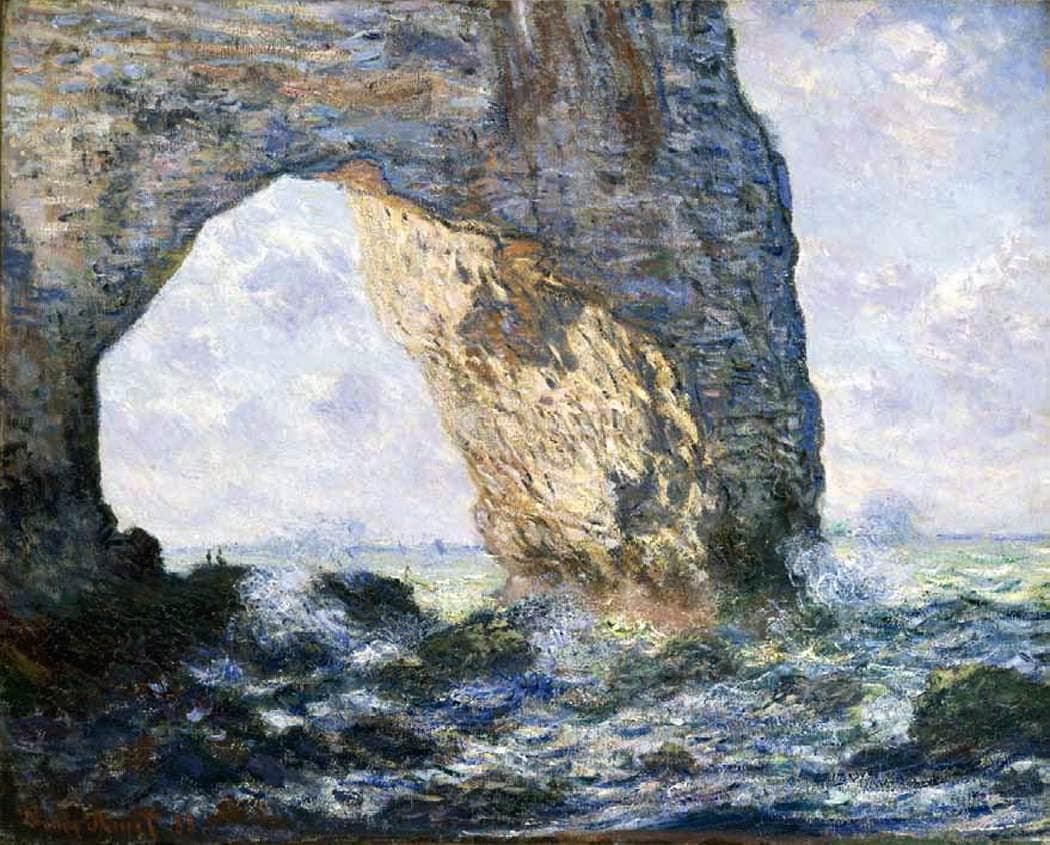
The Manneporte (Étretat)
Claude Monet · 1883
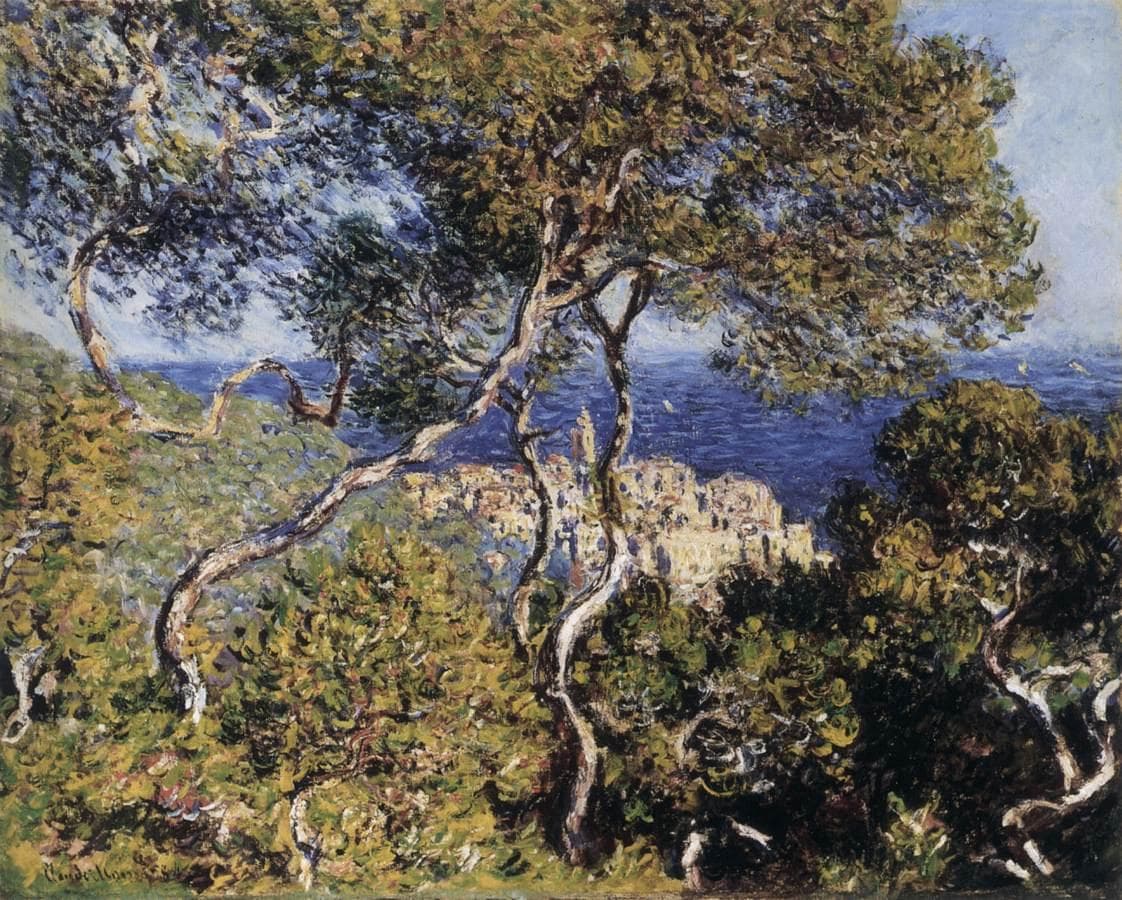
Bordighera
Claude Monet · 1884
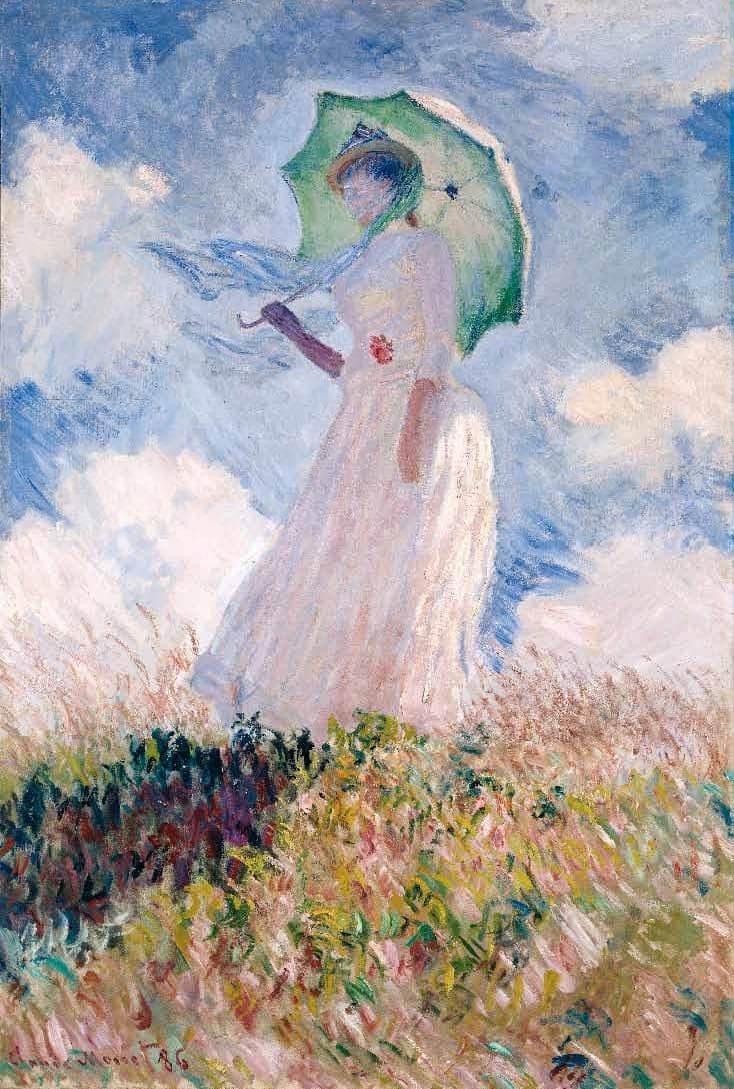
Woman with a Parasol, Facing Left
Claude Monet · 1886
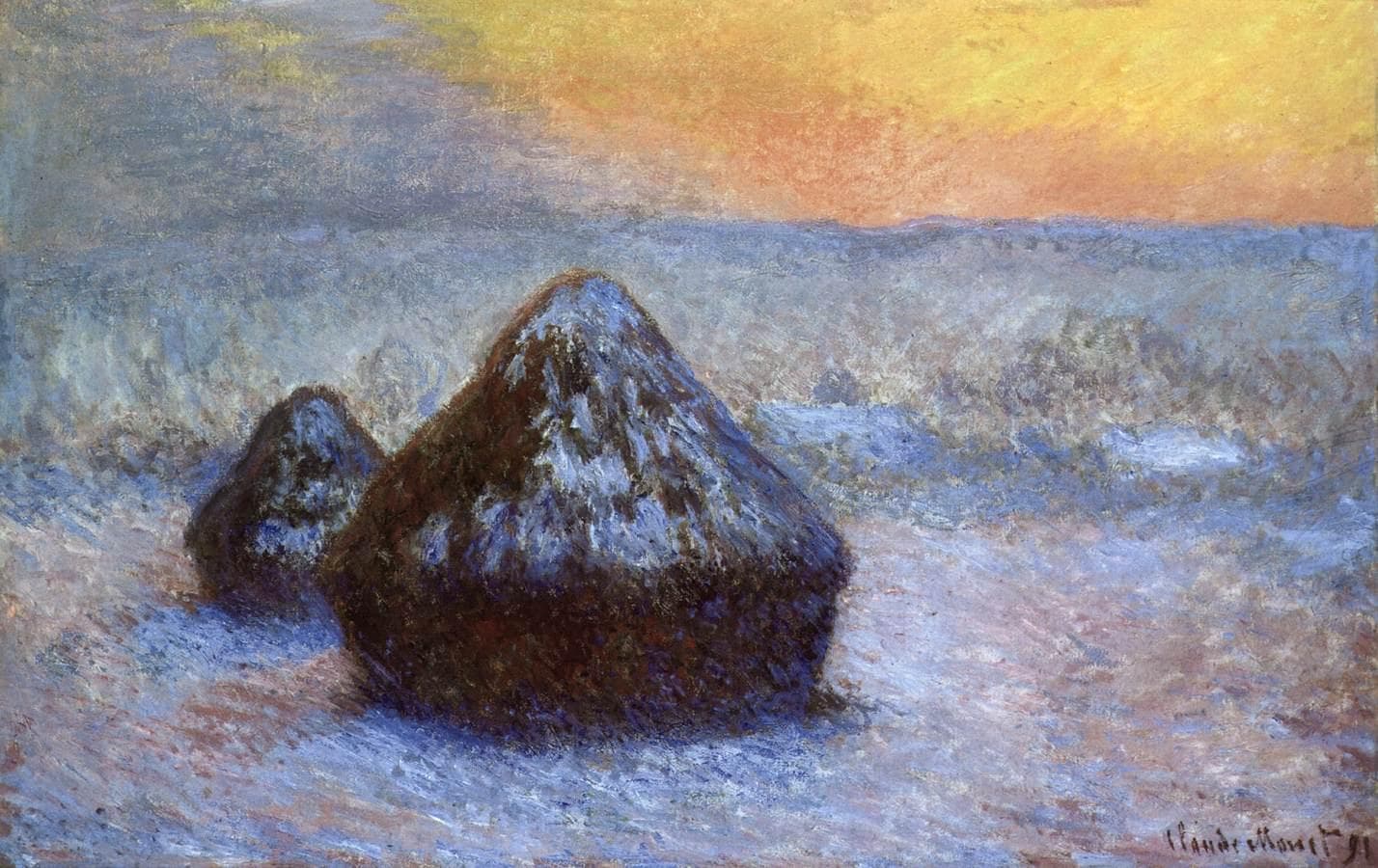
Stacks of Wheat, Sunset, Snow Effect
Claude Monet · 1890–91
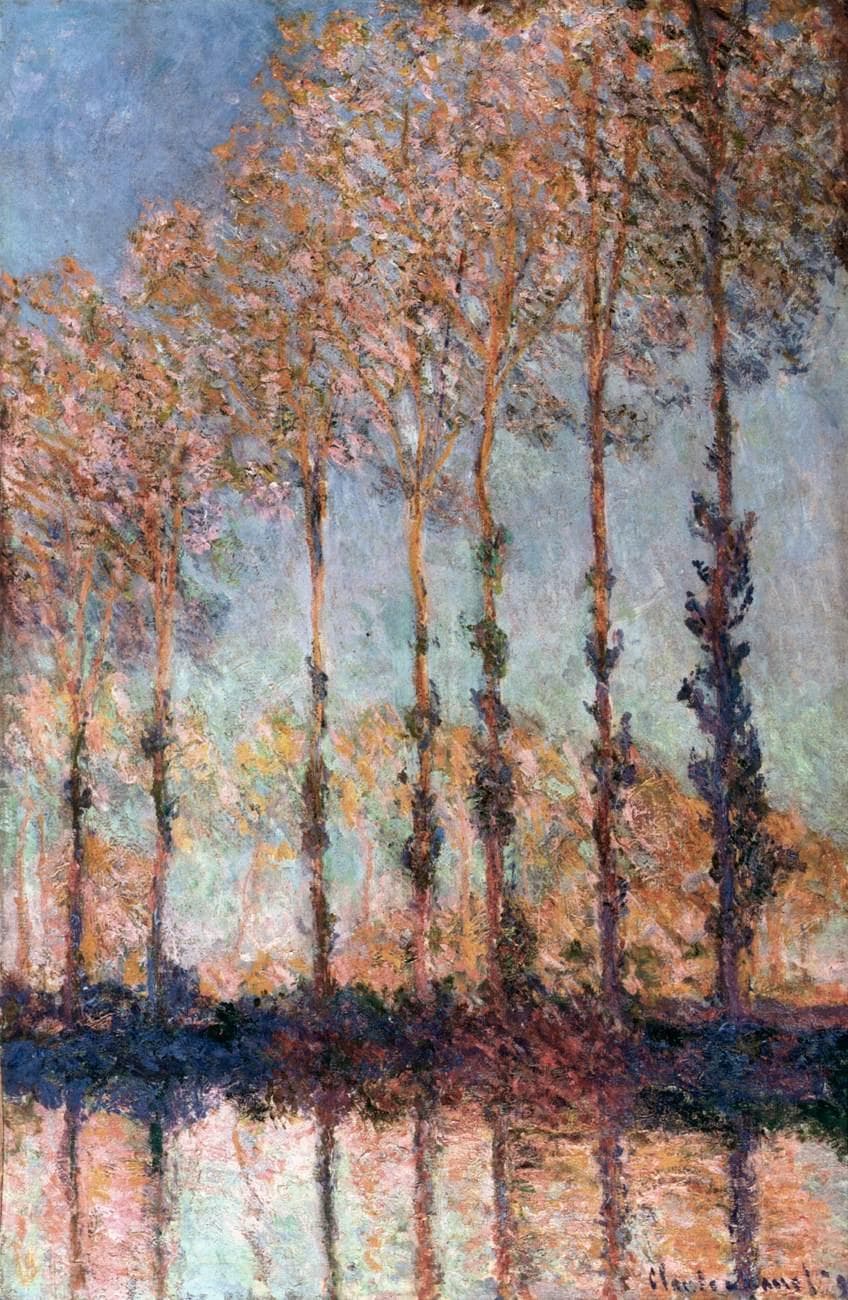
Poplars on the Banks of the River Epte
Claude Monet · 1891
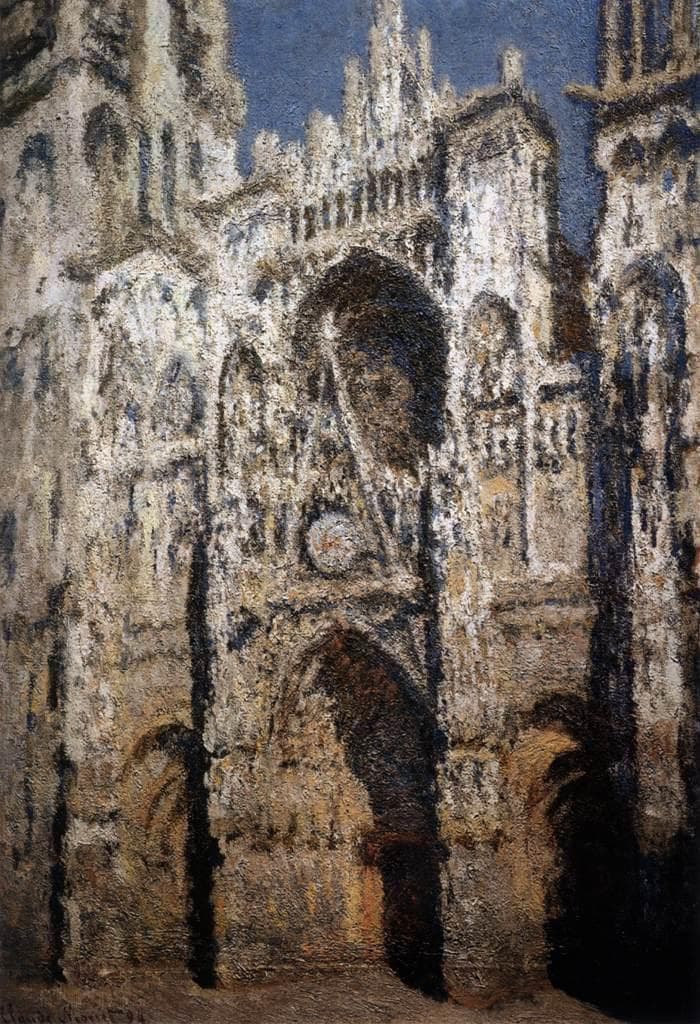
Rouen Cathedral in Full Sunlight
Claude Monet · 1893

Bridge over a Pond of Water Lilies
Claude Monet · 1899
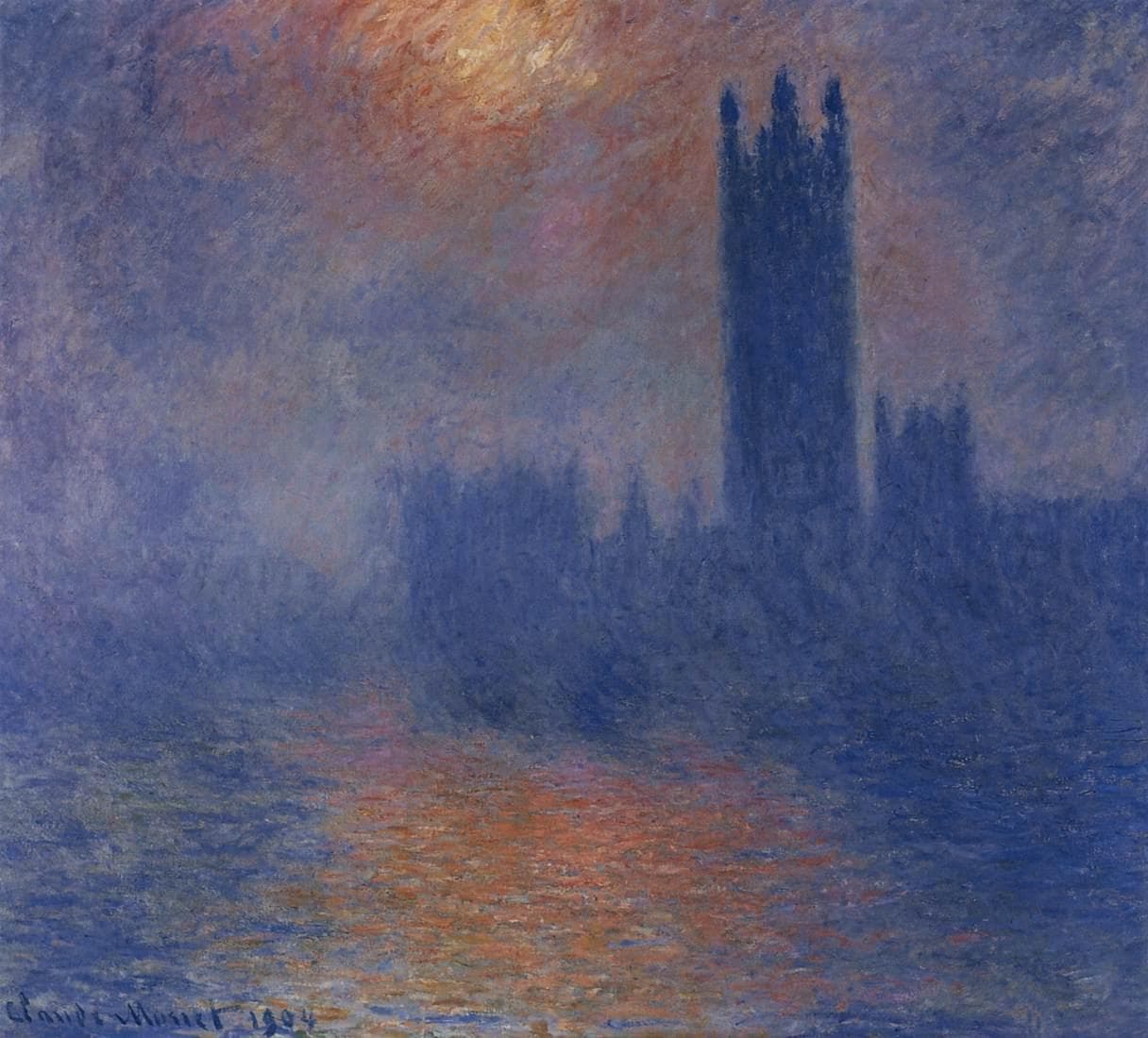
The Houses of Parliament in London
Claude Monet · 1904

Sunset in Venice
Claude Monet · 1908–12
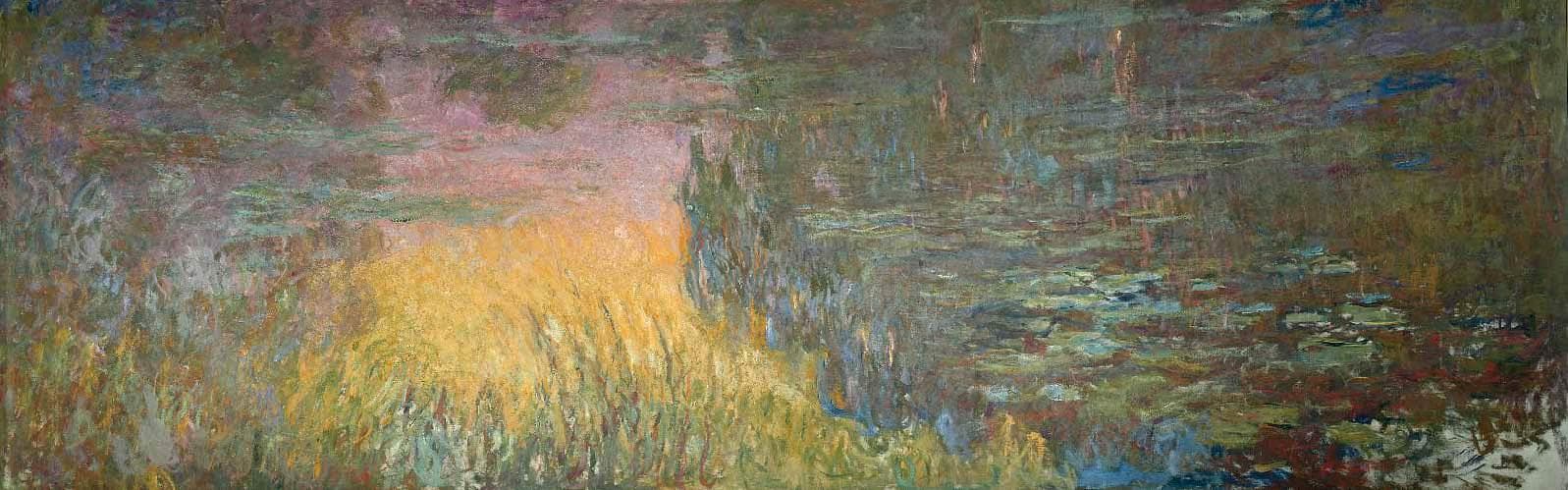
Water Lilies: Setting Sun
Claude Monet · 1914–26
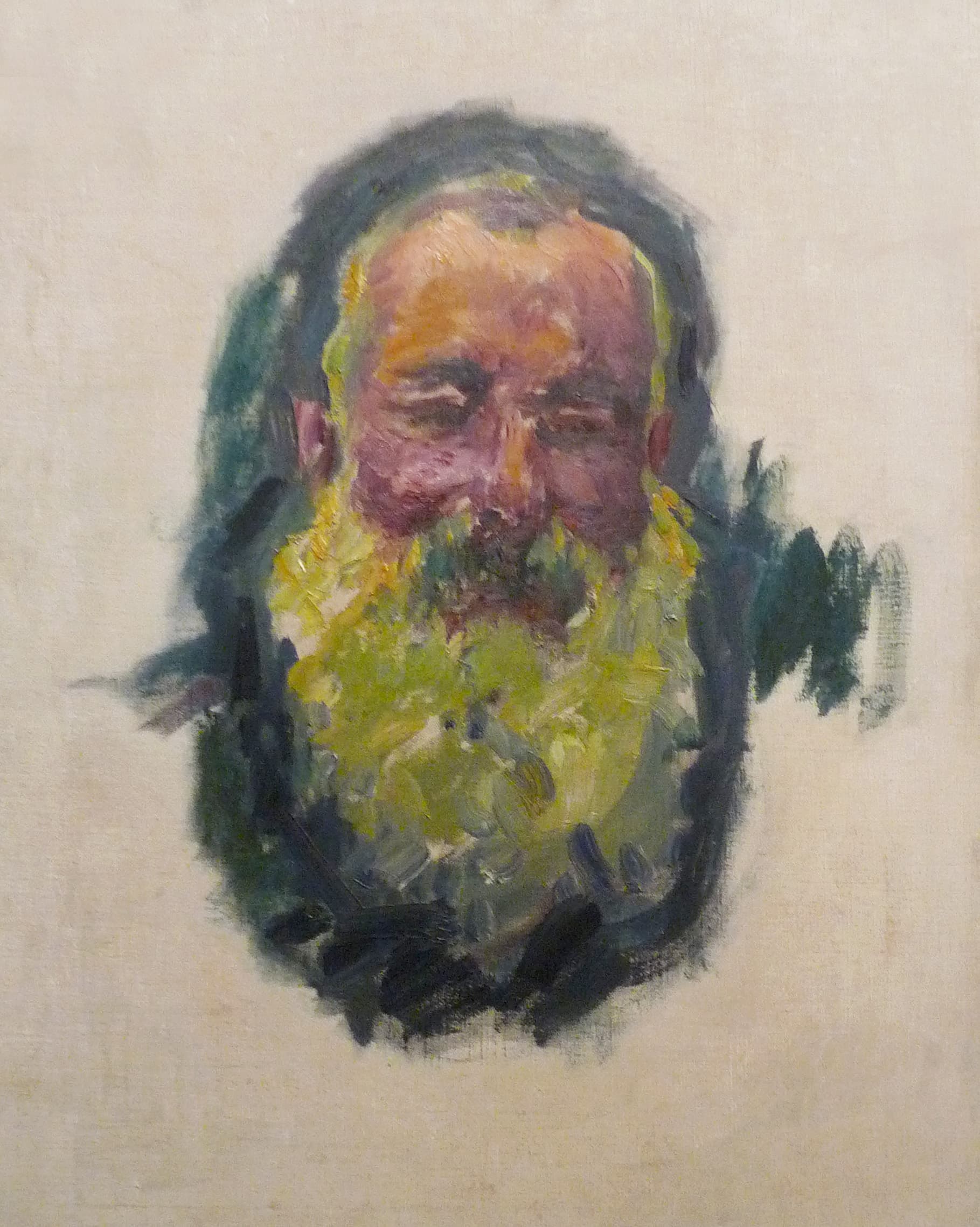
Self-Portrait (1917)
Claude Monet · 1917
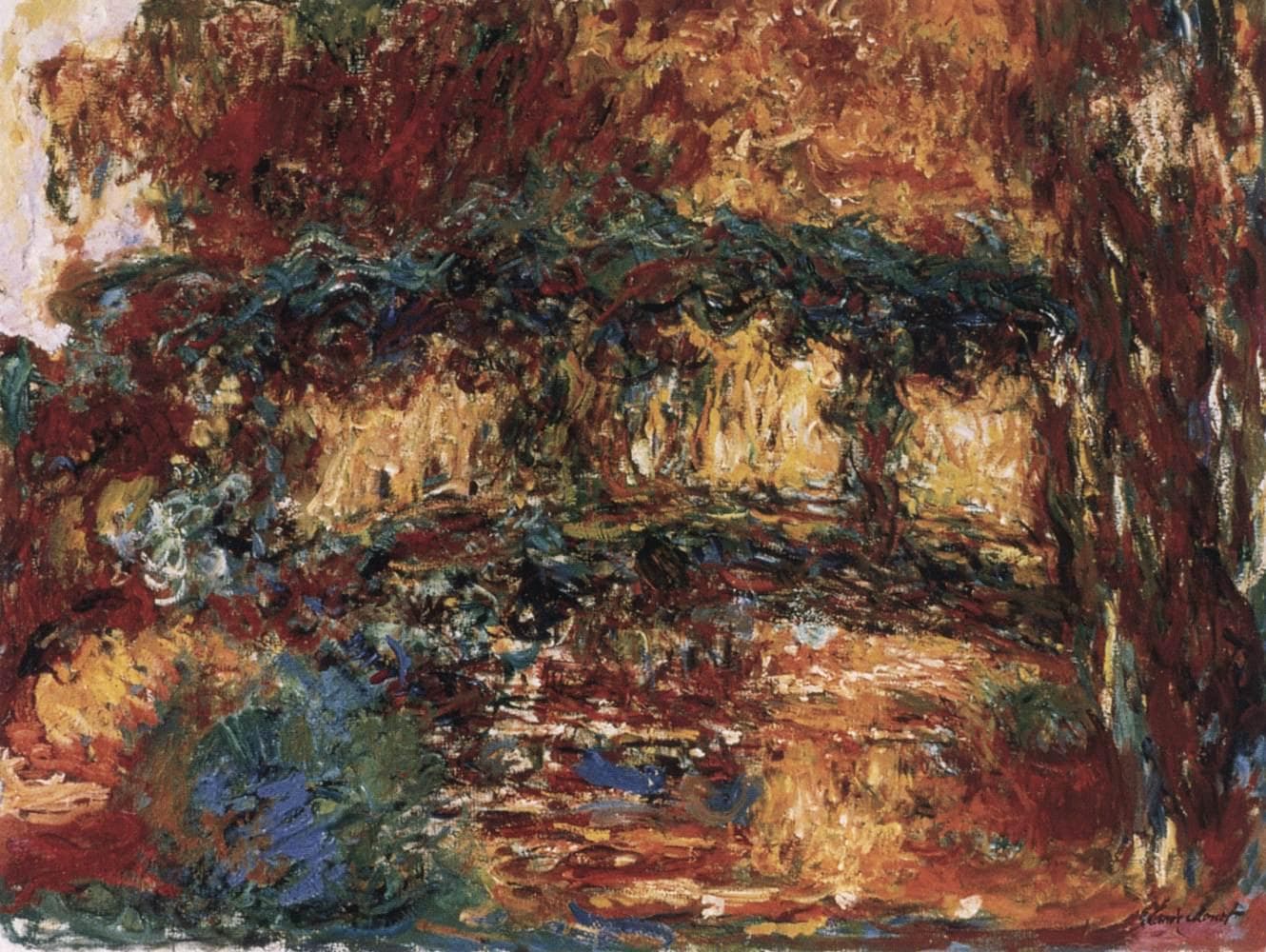
The Japanese Bridge
Claude Monet · c. 1923–25
1840s–1850s: Le Havre and Boudin
Oscar-Claude Monet was born in Paris, but when he was about five his family moved to Le Havre, at the mouth of the Seine, where his father joined a relative's ship-supply business. He was a restless pupil and a gifted draftsman, and by fifteen he was selling caricatures of local worthies, displayed in the window of a framer's shop. In the same window hung seascapes by Eugène Boudin, who met the boy around 1856 and persuaded him to paint outdoors, in front of the subject.
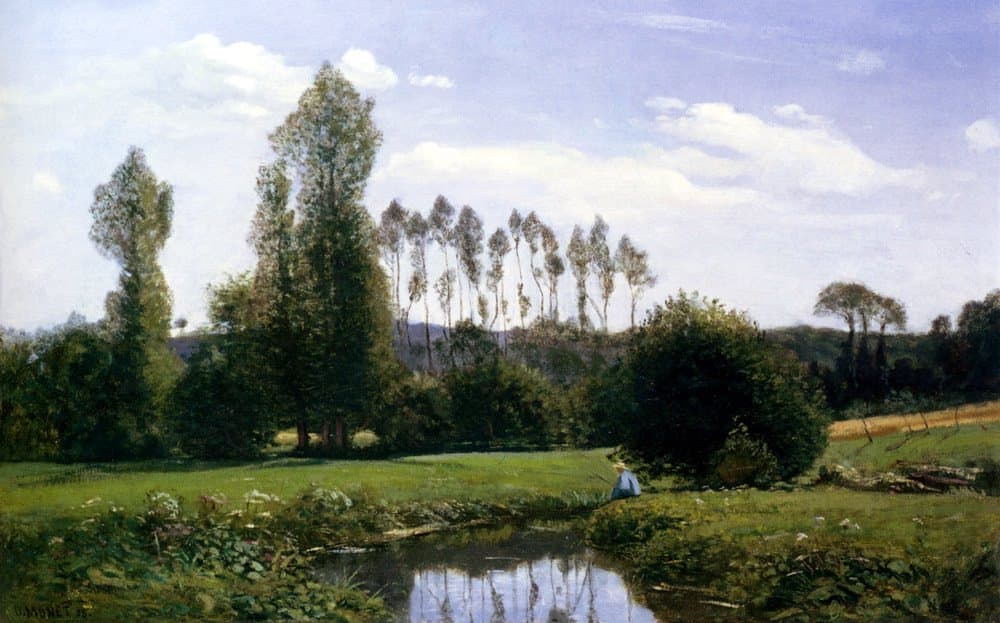
Monet later said it was as if a veil had been torn from his eyes. One of his earliest known paintings, View at Rouelles (1858), a small river landscape near Le Havre, was made in that spirit. His mother died in 1857; his aunt Marie-Jeanne Lecadre, herself an amateur painter, became his main supporter.
1860s: Paris, the Salon and Camille
In 1859 Monet moved to Paris, studied at the informal Académie Suisse, where he met Camille Pissarro, and then served in the army in Algeria in 1861–62 until illness sent him home. Back in Paris he entered the studio of Charles Gleyre, where he met Pierre-Auguste Renoir, Alfred Sisley and Frédéric Bazille. With them he painted in the forest of Fontainebleau and on the Normandy coast, where the Dutch painter Johan Barthold Jongkind became a second mentor.
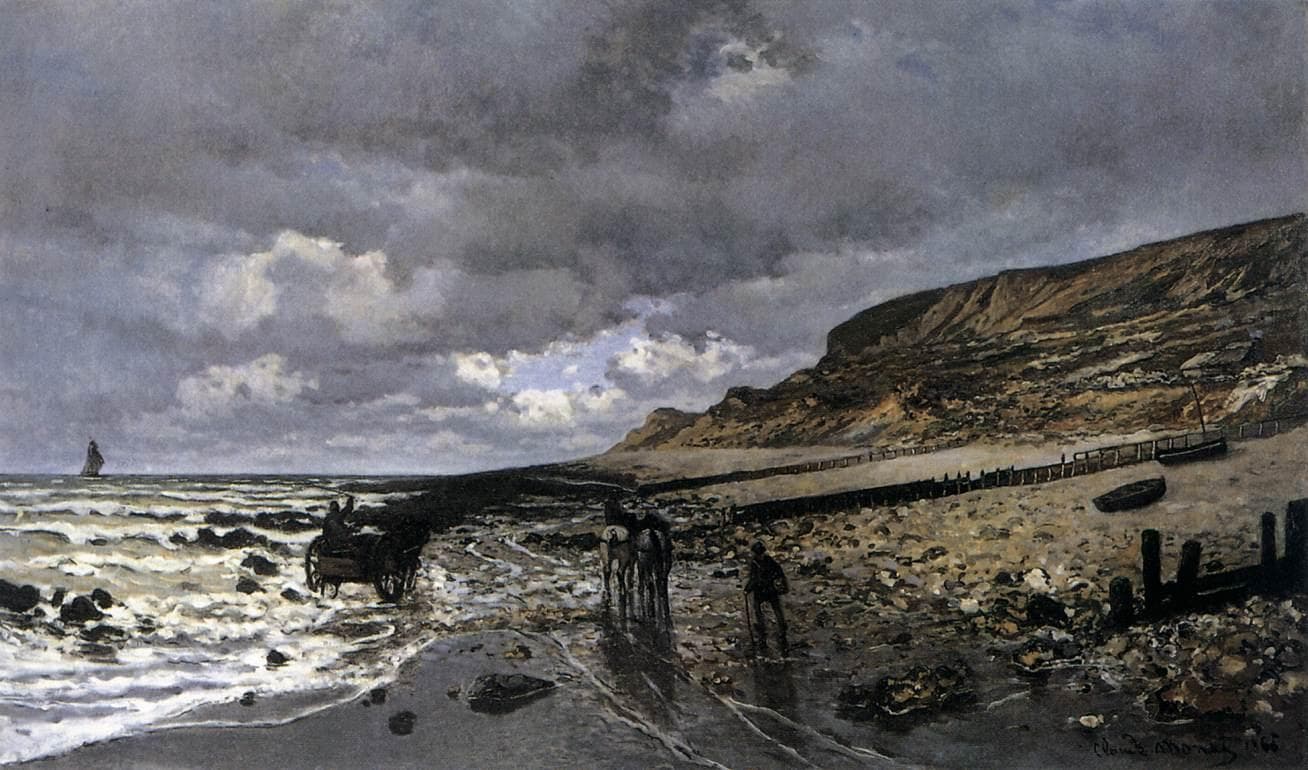
Success came quickly at first. The Salon of 1865 accepted two seascapes, including La Pointe de la Hève at Low Tide, and in 1866 his life-size portrait of Camille Doncieux, Camille (The Woman in the Green Dress), was a hit. Camille became his model, then his partner; their son Jean was born in 1867.
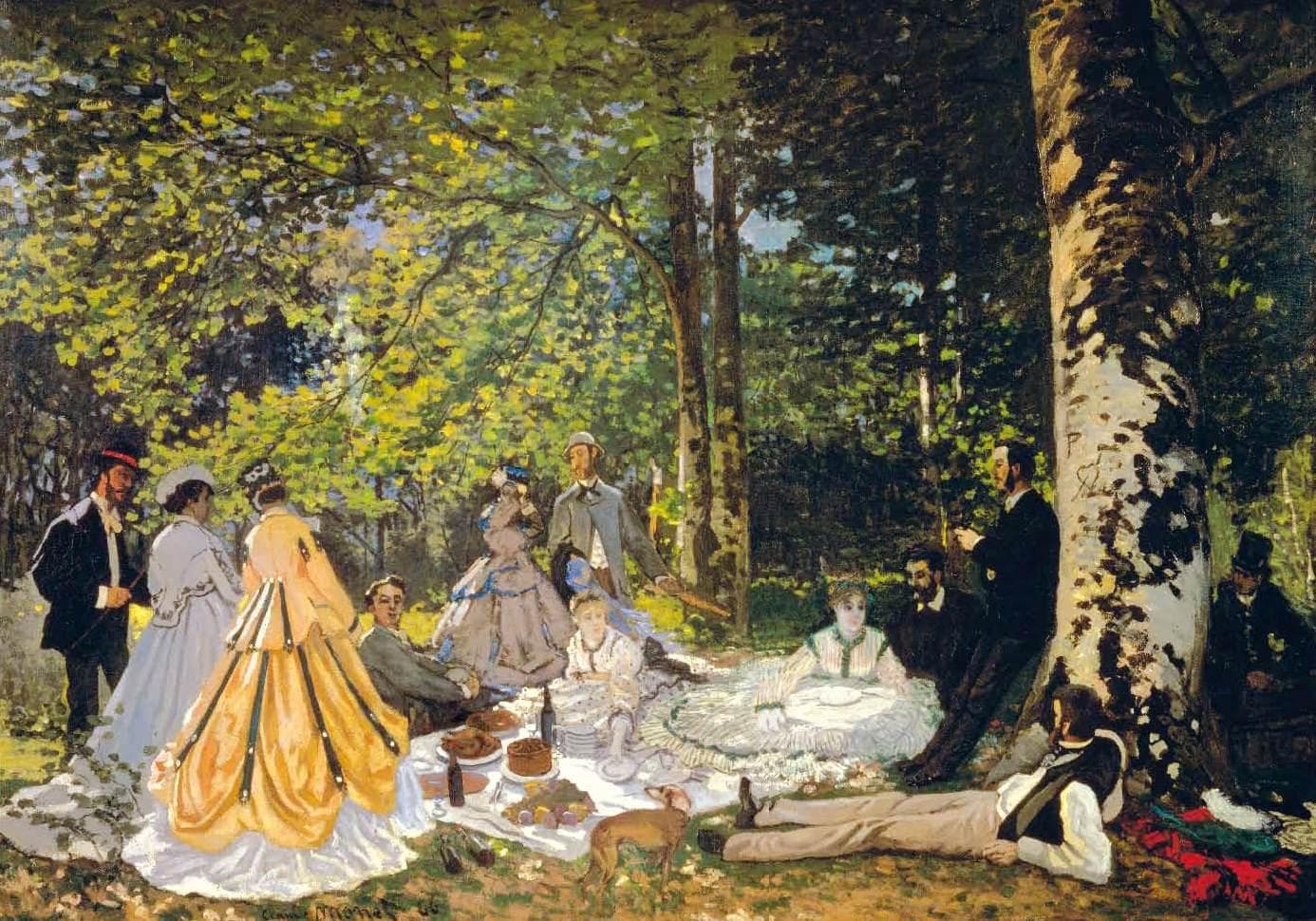
The great outdoor figure paintings of these years, the unfinished Luncheon on the Grass and Women in the Garden (rejected by the Salon of 1867), were too ambitious for the jury and for his finances. He was often desperately poor. In the summer of 1869, painting beside Renoir at the bathing place of La Grenouillère, he worked out the broken, flickering brushwork of Impressionism; see Bathers at La Grenouillère.
1870s: London, Argenteuil and Impressionism
Monet married Camille in June 1870. When the Franco-Prussian War began, he fled to London, where he met the dealer Paul Durand-Ruel, and then went on to the Netherlands. In December 1871 the family settled at Argenteuil, a small industrial town on the Seine just northwest of Paris, and stayed there until 1878. These were the happiest years of his early career: regattas, bridges, his garden, Camille and Jean in the poppies.
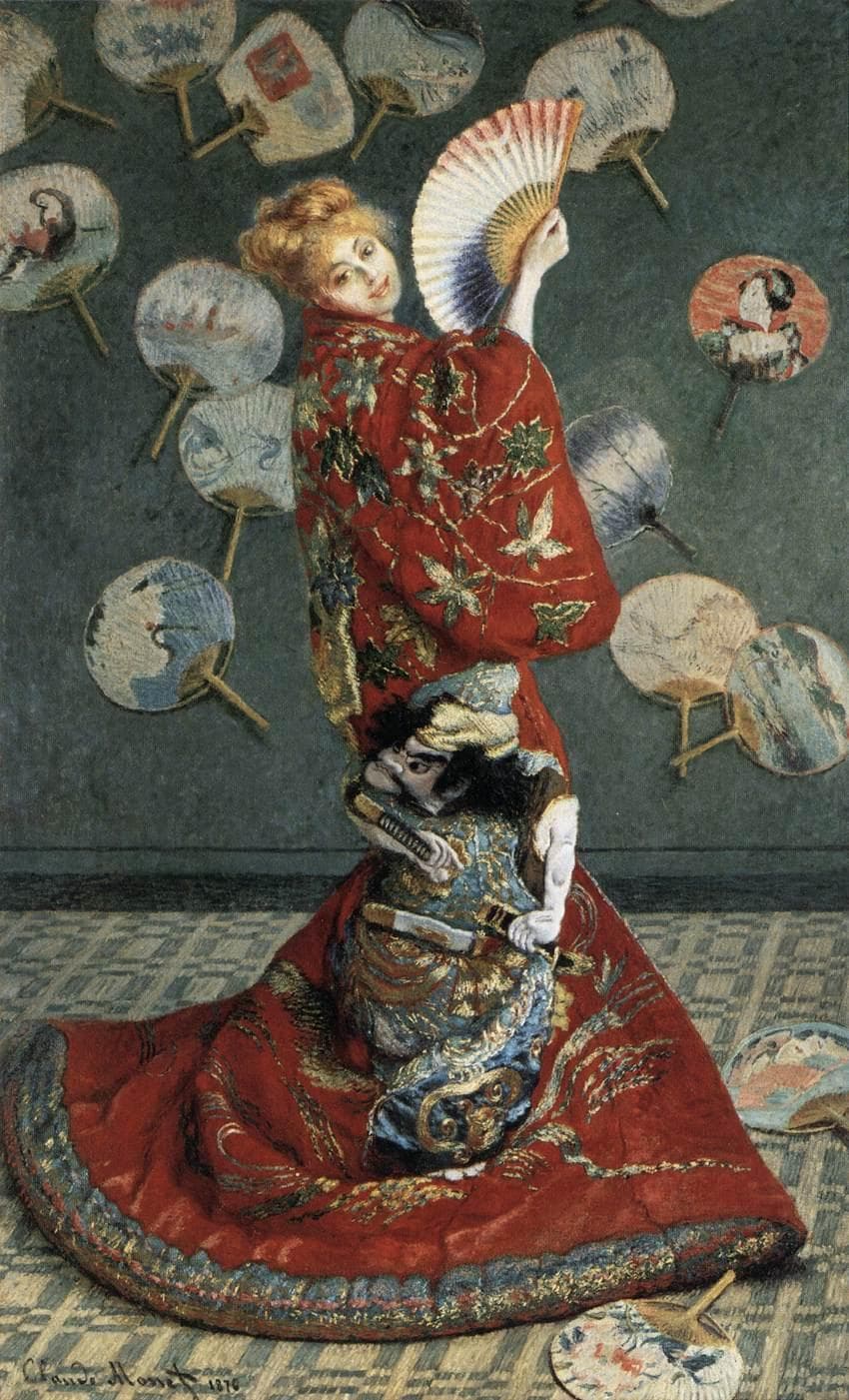
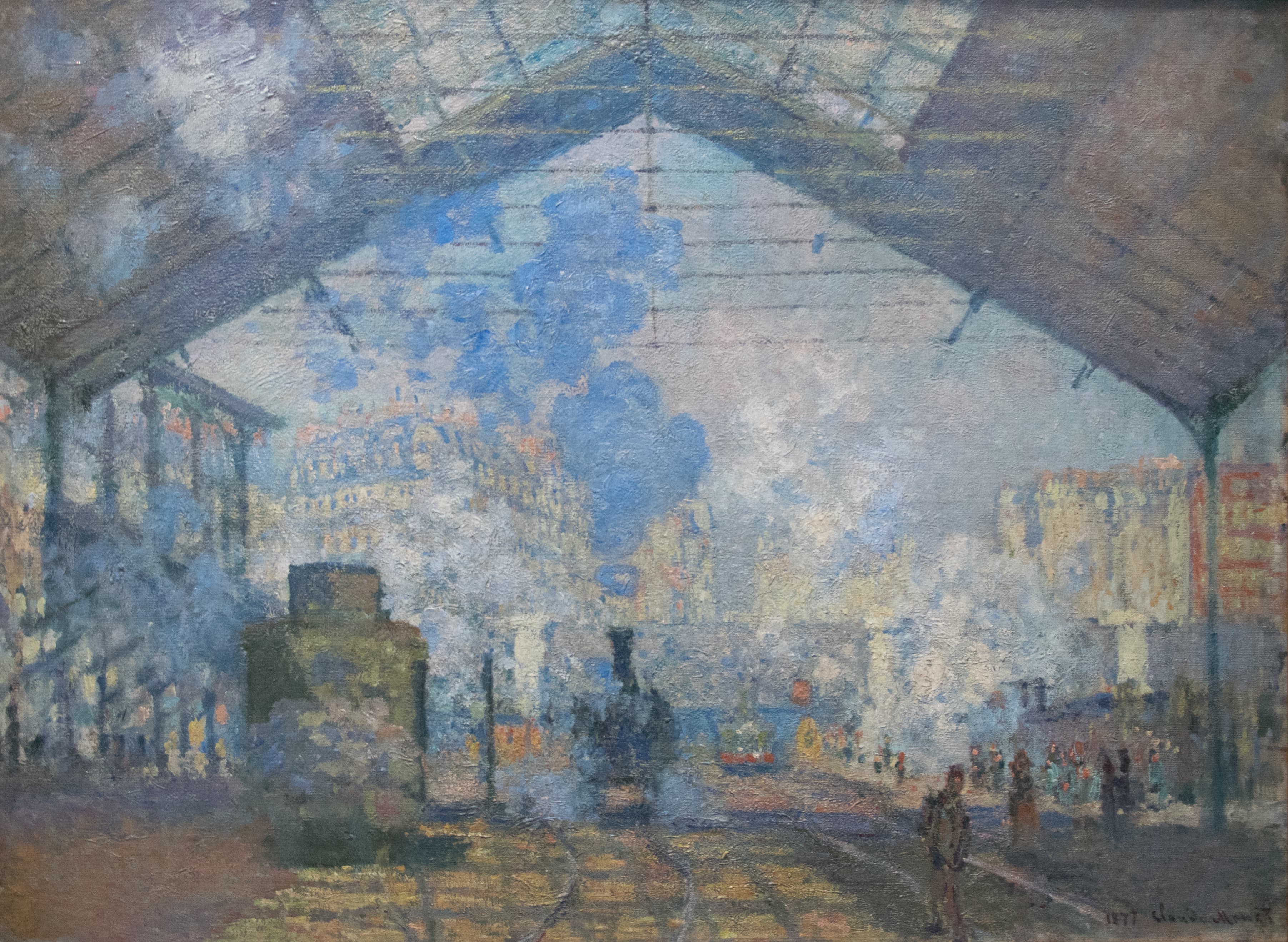
In April 1874 Monet and his friends, refused or tired of the Salon, held their own exhibition in the former studio of the photographer Nadar on the boulevard des Capucines. Monet showed Impression, Sunrise, a view of Le Havre harbor at dawn, and the critic Louis Leroy used its title to mock the whole group as Impressionists. The name stuck. Monet showed at most of the Impressionist exhibitions that followed: La Japonaise in 1876, the Gare Saint-Lazare pictures in 1877. See Monet at Argenteuil for the decade's river pictures, and Woman with a Parasol (1875) for its best-loved figure painting.
By 1878 money had run out again. A second son, Michel, was born that March, and the family moved to Vétheuil, sharing a house with Alice Hoschedé, wife of his bankrupt patron Ernest Hoschedé, and her six children.
1878–1881: Vétheuil, death and ice
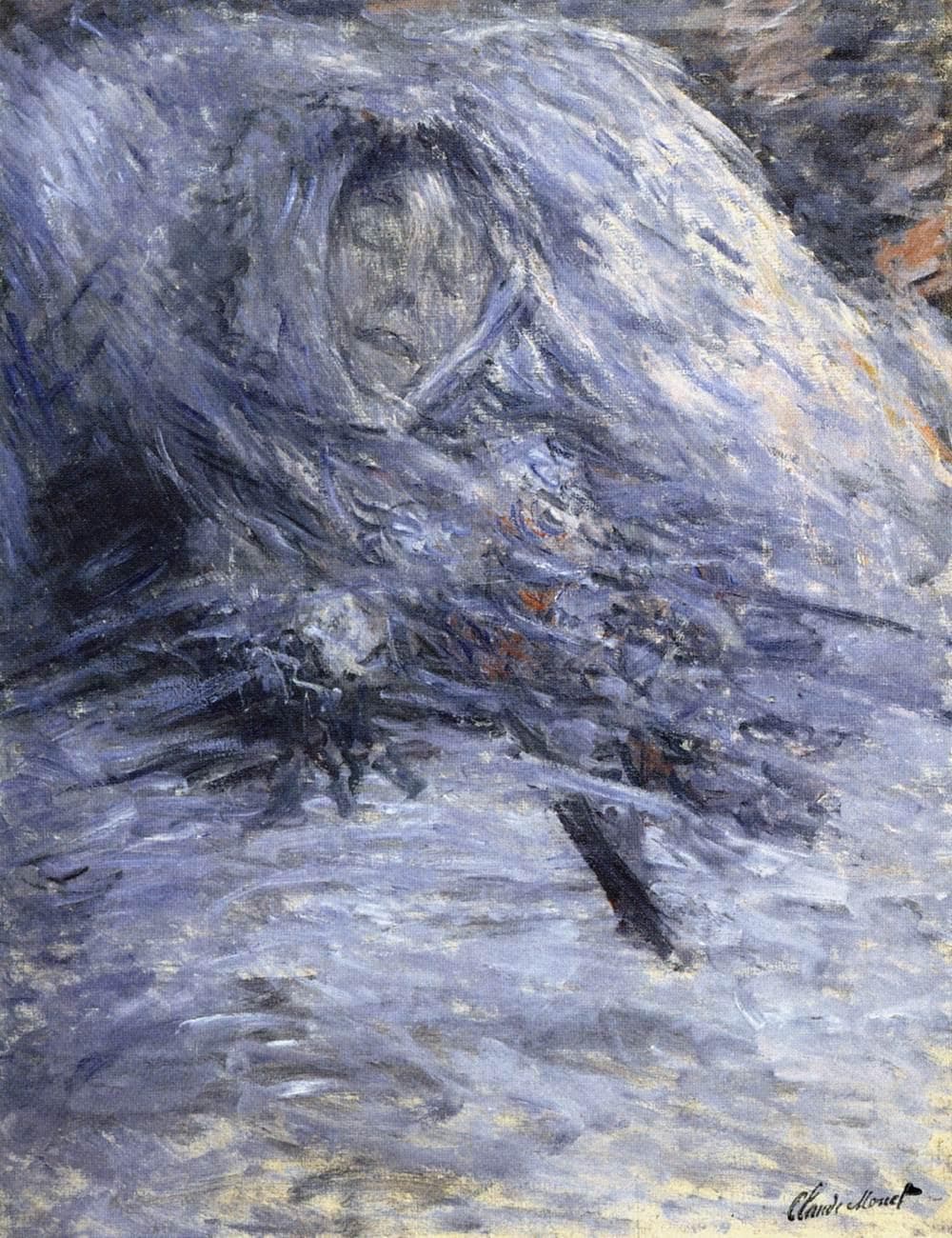
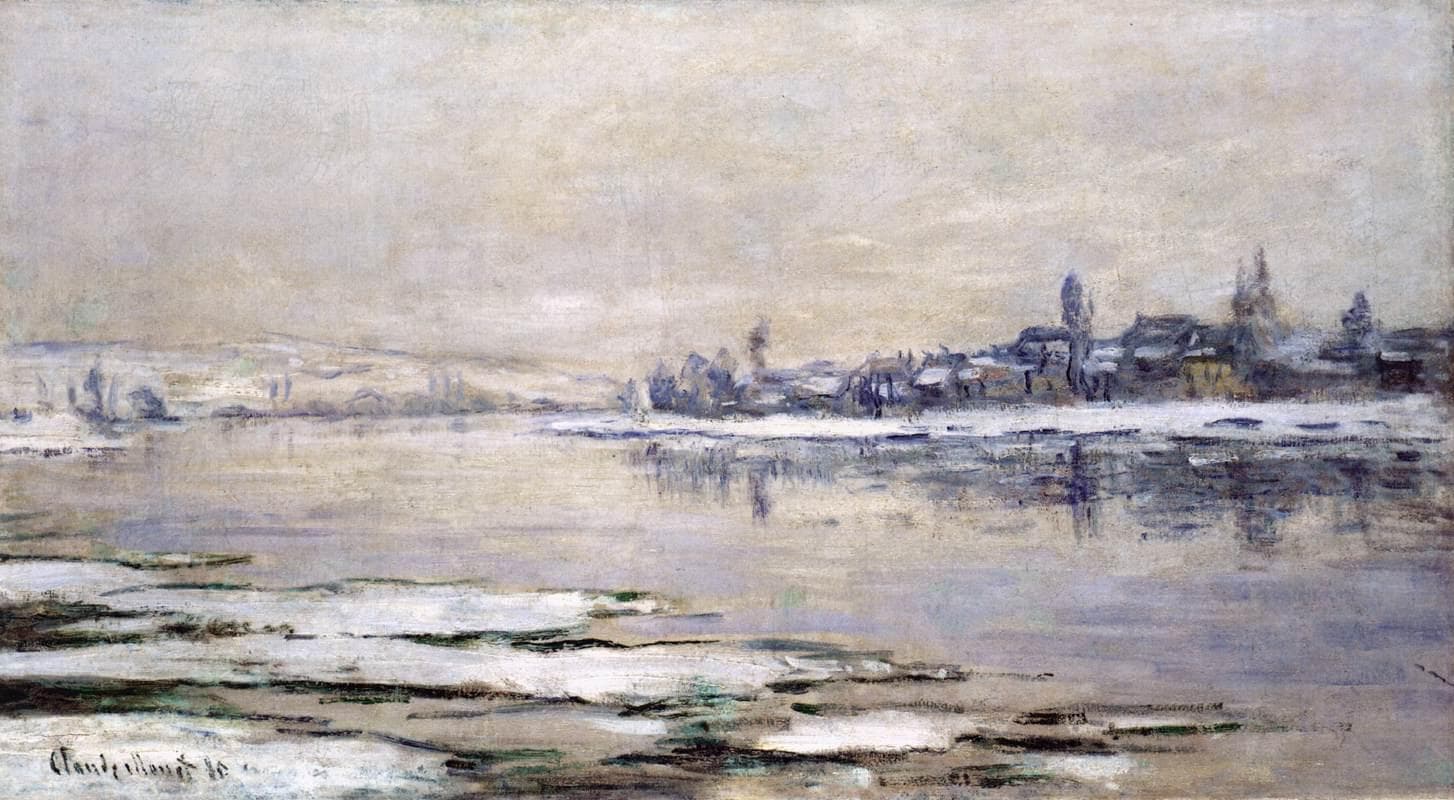
Camille died at Vétheuil on 5 September 1879, aged thirty-two, and Monet painted her on her deathbed. That winter the Seine froze and then broke up, and he painted the ice floes again and again. In 1880 he broke with the group exhibitions and sent work to the Salon. Alice stayed, caring for both families' children. See Monet at Vétheuil.
1880s: the coast, the south and Giverny
After a spell at Poissy, Monet, Alice and the eight children moved in April 1883 to a rented house at Giverny, a village where the Epte meets the Seine, about seventy kilometers from Paris. It would be his home for the rest of his life. The 1880s were a decade of travel and of sales.
He painted the cliffs of Pourville, Varengeville and Étretat (see the Normandy coast), the wild coast of Belle-Île in 1886, the Riviera at Bordighera in 1884 and Antibes in 1888 (see Monet on the Mediterranean), and the Creuse valley in 1889. Durand-Ruel opened the American market with a New York exhibition in 1886, and by the end of the decade Monet was prosperous. In 1889 a joint exhibition with Auguste Rodin confirmed his standing.
1890s: the series
In 1890 Monet bought the Giverny house, and in 1892, after Ernest Hoschedé's death, he married Alice. Now he could work as he wanted: on series of a single motif, painted on many canvases at once as the light changed. The Haystacks in a field beside his house were shown at Durand-Ruel's gallery in 1891 and sold quickly.
The Poplars on the Epte followed in 1891–92, and the Rouen Cathedral façades in 1892–94, exhibited in 1895. In 1893 he bought land across the road and began to dig the lily pond and build the Japanese footbridge. He also traveled to Norway in 1895 and painted the Mornings on the Seine in 1896–97.
1900s: London, the pond and Venice
Monet spent three winters in London in 1899–1901, painting the Thames in fog (see Monet in London), and showed the results in 1904. At home, the water garden became his subject: the footbridge pictures of 1899–1900, then close-up water lilies, shown in 1909 as a series of water landscapes. In autumn 1908 he and Alice went to Venice, his last painting journey.
1910s–1926: grief, cataracts and the Grandes Décorations
The last period began with loss. Alice died in 1911, and his elder son Jean in 1914. In 1912 he was diagnosed with cataracts in both eyes, which over the next decade dimmed and yellowed his vision.
Yet from 1914, in a vast new studio at Giverny, he began the largest project of his life: the panoramic Water Lilies, which he offered to France the day after the 1918 Armistice and which now fill two rooms of the Musée de l'Orangerie. He had a cataract operation on one eye in 1923, after which he repainted some of the work he had done half-blind. His stepdaughter Blanche Hoschedé-Monet, Jean's widow, kept house and cared for him.
Monet died at Giverny on 5 December 1926 and was buried in the village churchyard. His friend Georges Clemenceau, it is said, refused to let a black cloth cover the coffin, replacing it with a flowered one.
Claude Monet facts at a glance
- Born: 14 November 1840, Paris. Died: 5 December 1926, Giverny.
- Paintings: about 2,000, per the Wildenstein catalogue raisonné, plus pastels and drawings.
- Married: Camille Doncieux (1870; she died 1879), then Alice Hoschedé (1892; she died 1911).
- Children: Jean (1867–1914) and Michel (1878–1966); and six Hoschedé stepchildren.
- Most famous works: Impression, Sunrise, the Water Lilies, Woman with a Parasol, the Haystacks and Rouen Cathedral series. See famous Monet paintings.
- Largest collection: the Musée Marmottan Monet, Paris; see where to see Monet's paintings.
Questions & answers
How many paintings did Monet paint?
Claude Monet painted about 2,000 pictures over more than sixty years, according to the catalogue raisonné compiled by Daniel Wildenstein, plus pastels and drawings. Around 250 of them are Water Lilies. Many survive in series: about 25 Haystacks, more than 30 Rouen Cathedrals and close to 100 London views.
When and where was Claude Monet born?
Monet was born Oscar-Claude Monet in Paris on 14 November 1840. His family moved to Le Havre on the Normandy coast when he was about five, and he grew up there, which is why the sea and the Seine estuary run through his early work.
How did Monet die?
Monet died at his home in Giverny on 5 December 1926, aged eighty-six, after a period of illness usually attributed to lung cancer. He had suffered from cataracts since 1912 and had surgery in 1923. He is buried in the churchyard at Giverny.
Who were Monet's wives?
Monet married Camille Doncieux, his model and the mother of his sons Jean and Michel, in 1870; she died at Vétheuil in 1879. In 1892 he married Alice Hoschedé, who had lived with him since 1878 with her six children. Alice died in 1911.
Why is Monet called the father of Impressionism?
His painting Impression, Sunrise gave the movement its name at the first group exhibition in 1874, and he pursued its aims, painting light and atmosphere directly from nature, more consistently and for longer than anyone else, from the 1860s to the 1920s.