Place
Monet in London: The Thames Paintings, 1870–1904
A refugee in 1871, a hotel guest at the Savoy thirty years later: how London's river and fog gave Claude Monet some of his strangest, most beautiful pictures.
Monet in London means two very different stays. In 1870–71 Claude Monet fled the Franco-Prussian War to London, where he painted the Thames, the new Embankment and the parks, and met the dealer Paul Durand-Ruel. Between 1899 and 1901 he came back three times, working from a room at the Savoy Hotel and a terrace at St Thomas' Hospital, and produced close to a hundred canvases of Waterloo Bridge, Charing Cross Bridge and the Houses of Parliament dissolving in fog.
The early pictures are records of a city seen by a young exile. The later ones are among the most radical things he ever painted: stone, iron and smoke reduced to colored air. This page gathers the London pictures in the archive and points to the three Monet series that grew out of them.
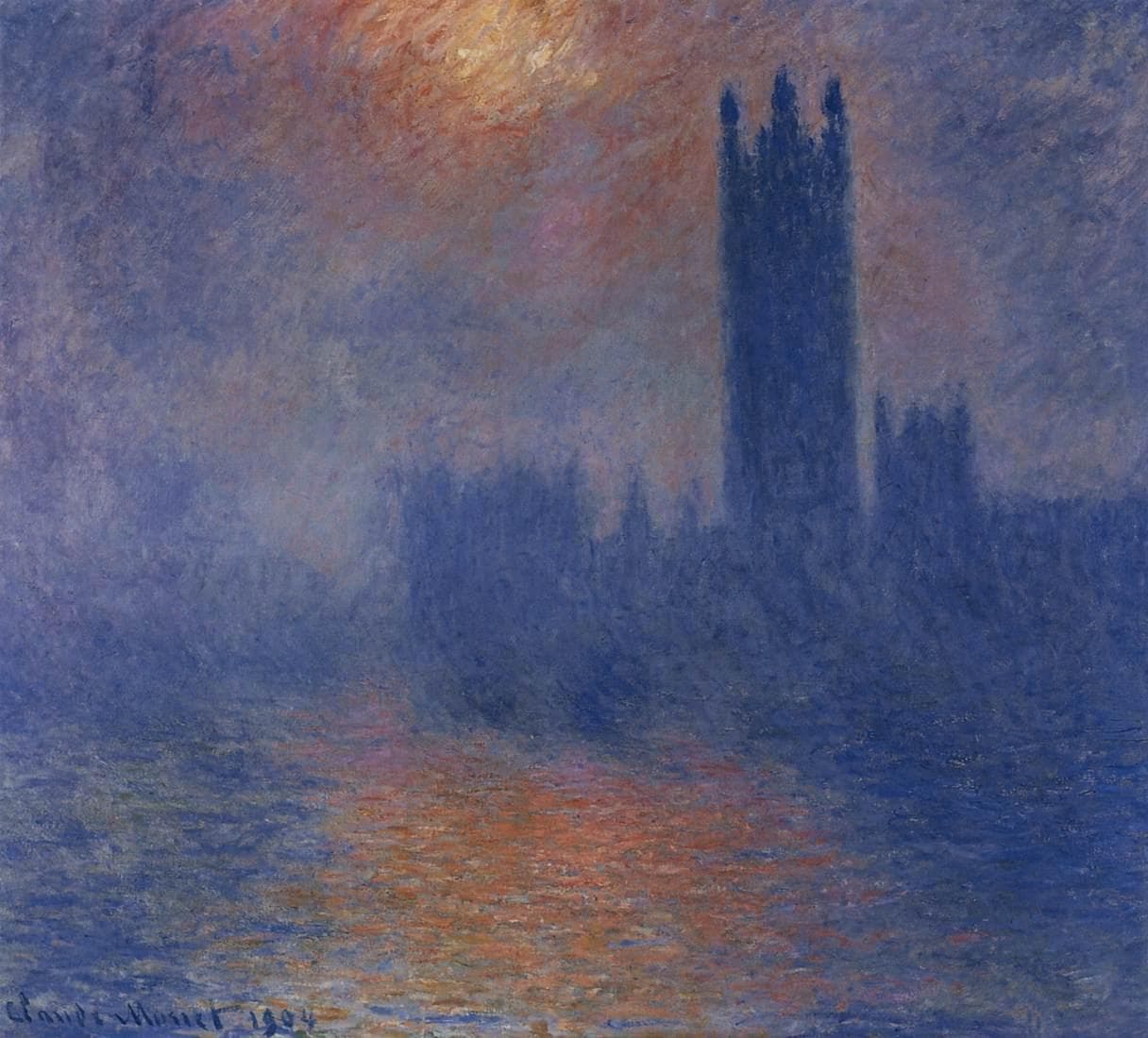
The Houses of Parliament in London
Claude Monet · 1904
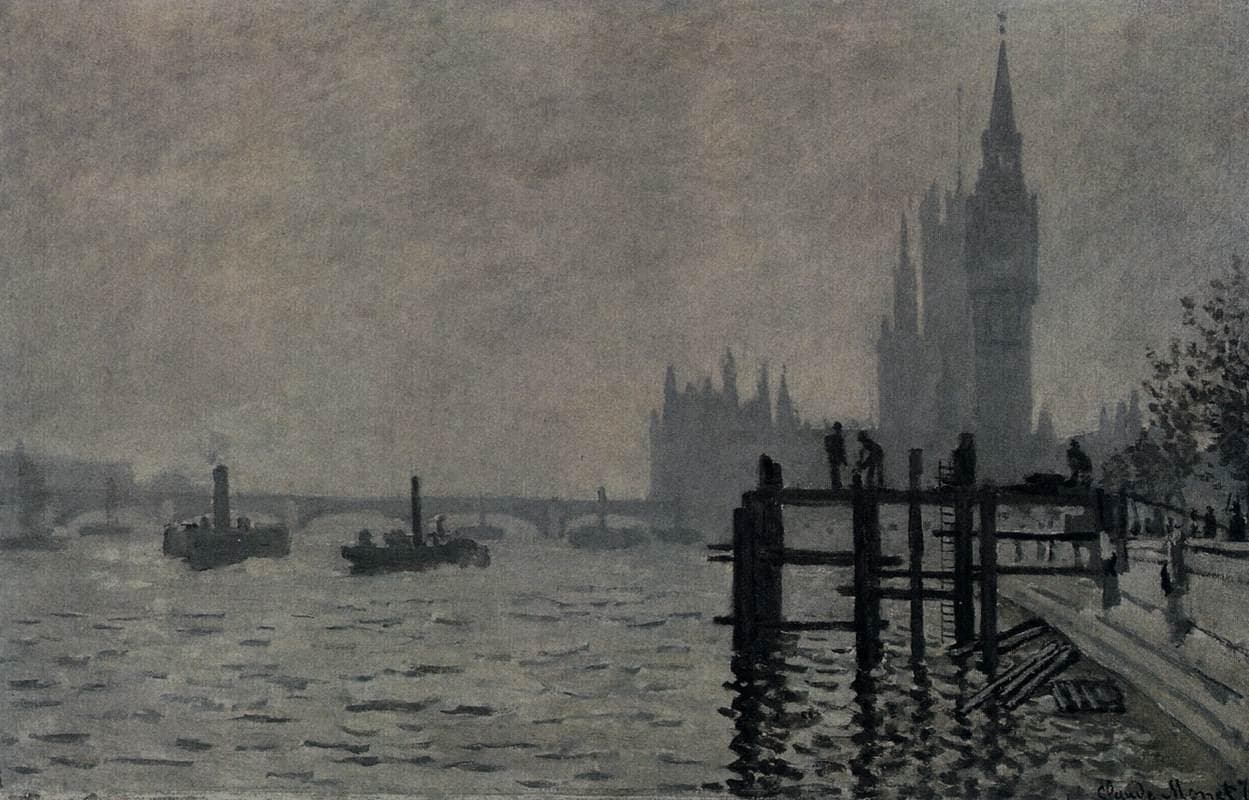
The Thames below Westminster
Claude Monet · c. 1871
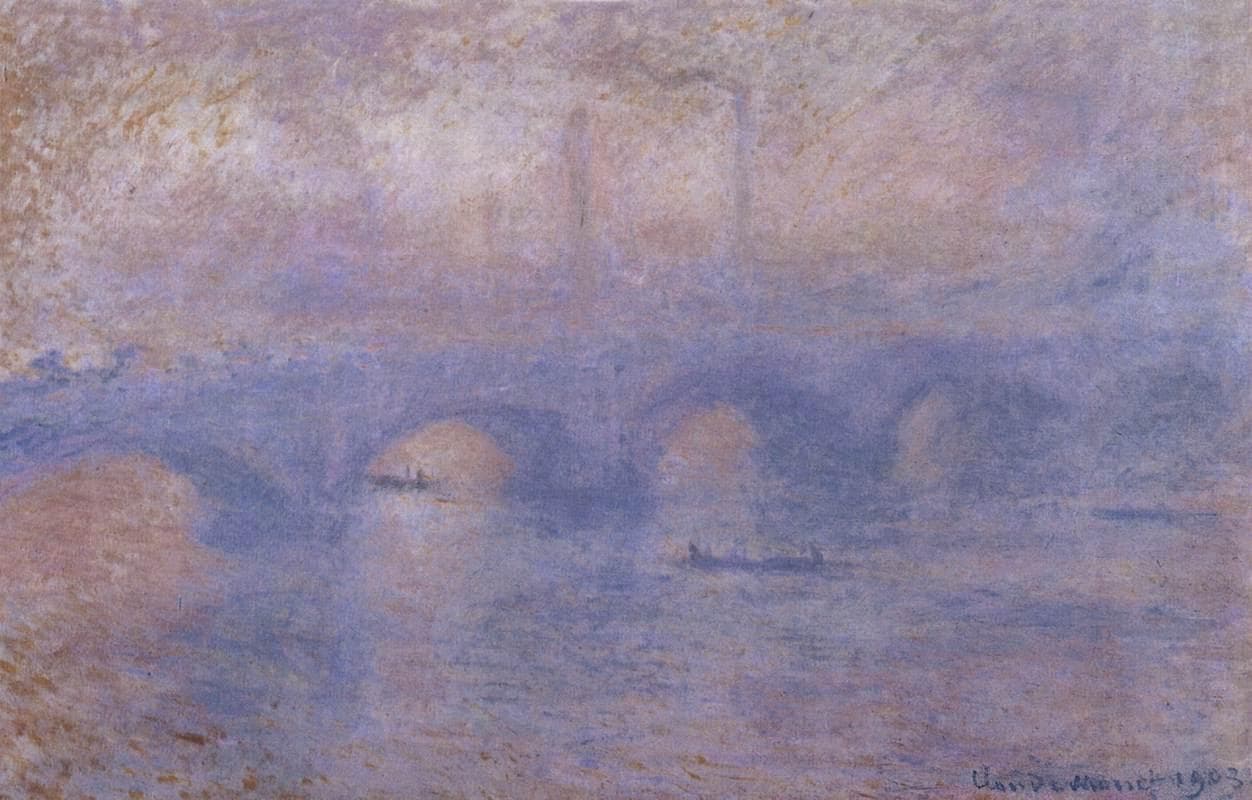
Waterloo Bridge, Effect of Fog
Claude Monet · 1903
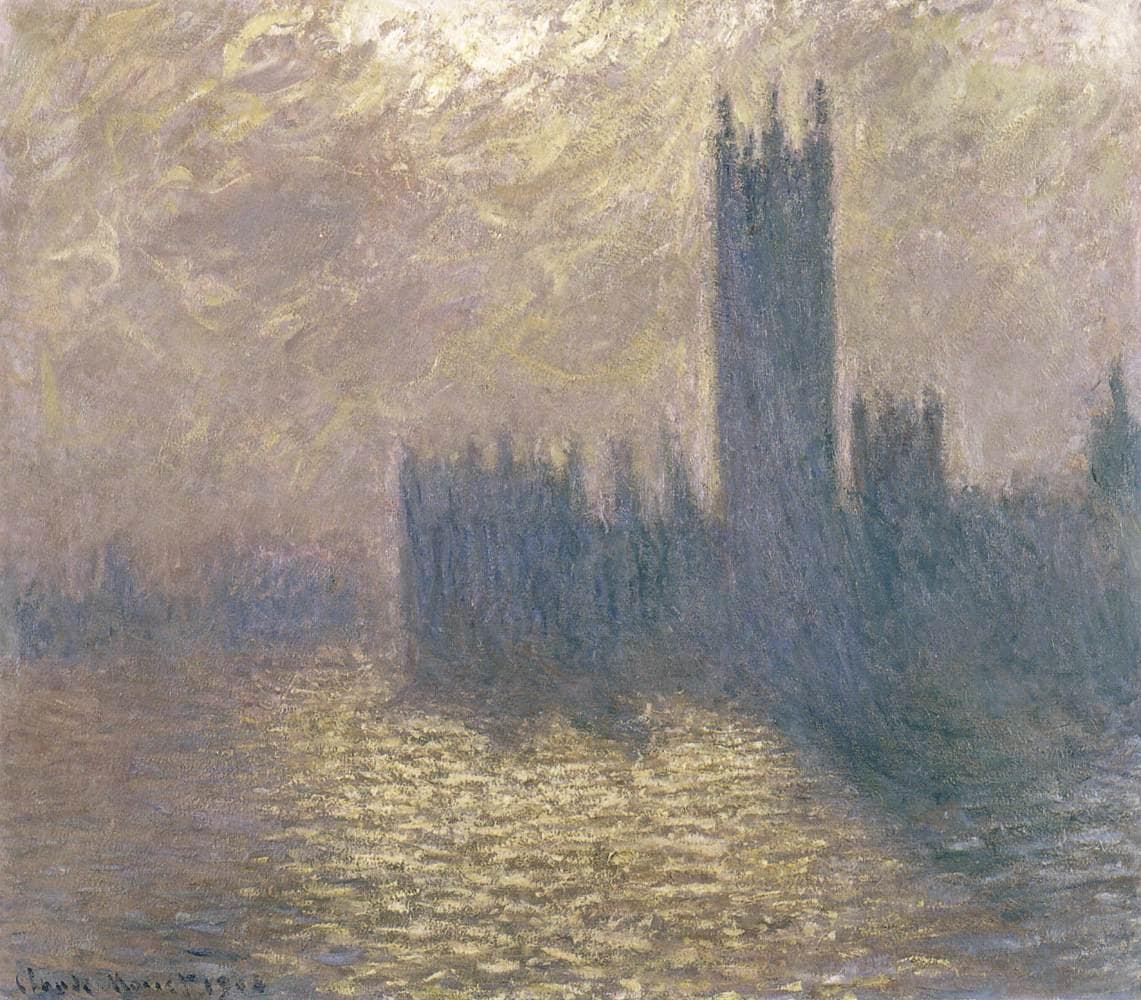
The Houses of Parliament, London
Claude Monet · 1904
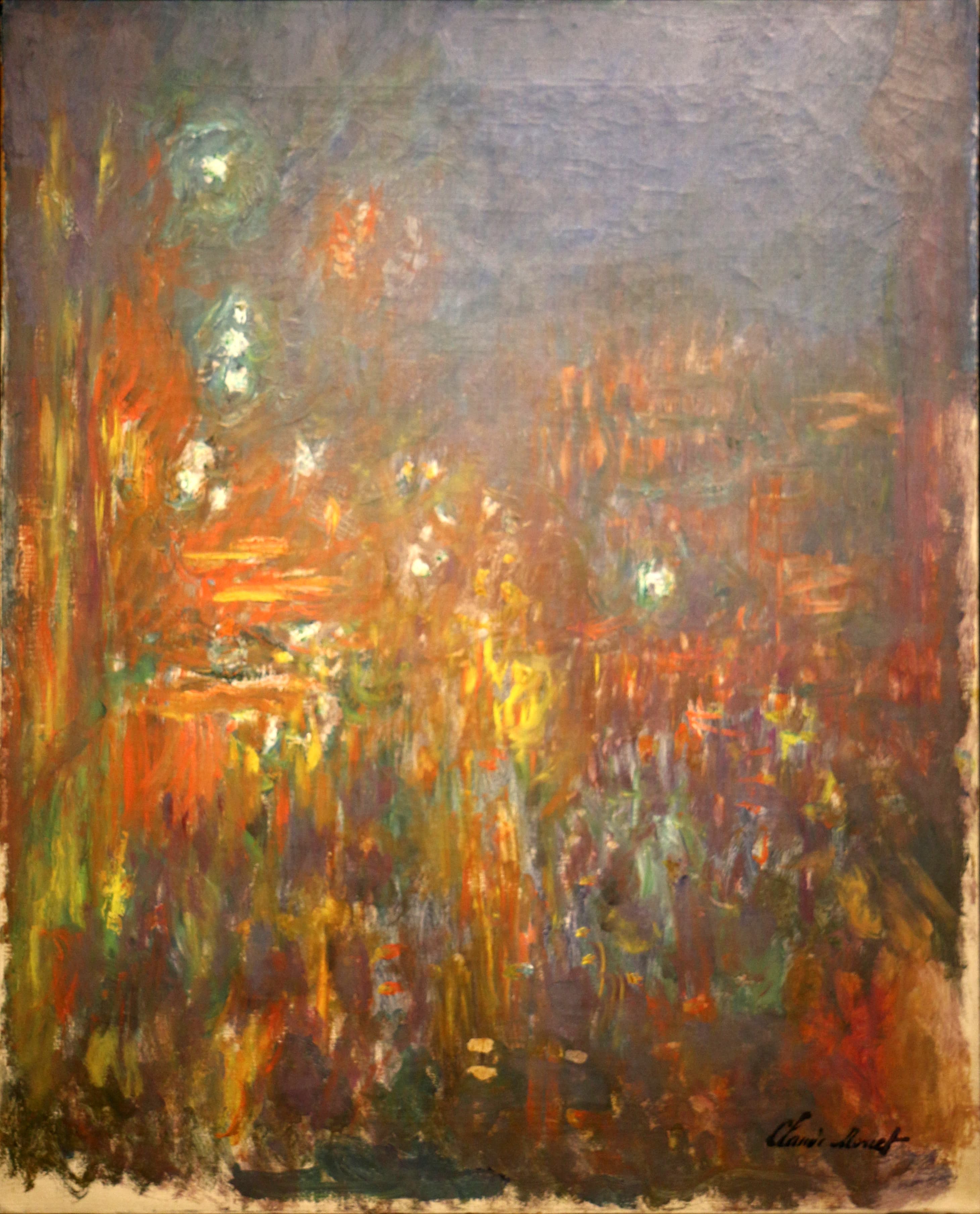
Leicester Square, by Night
Claude Monet · 1901
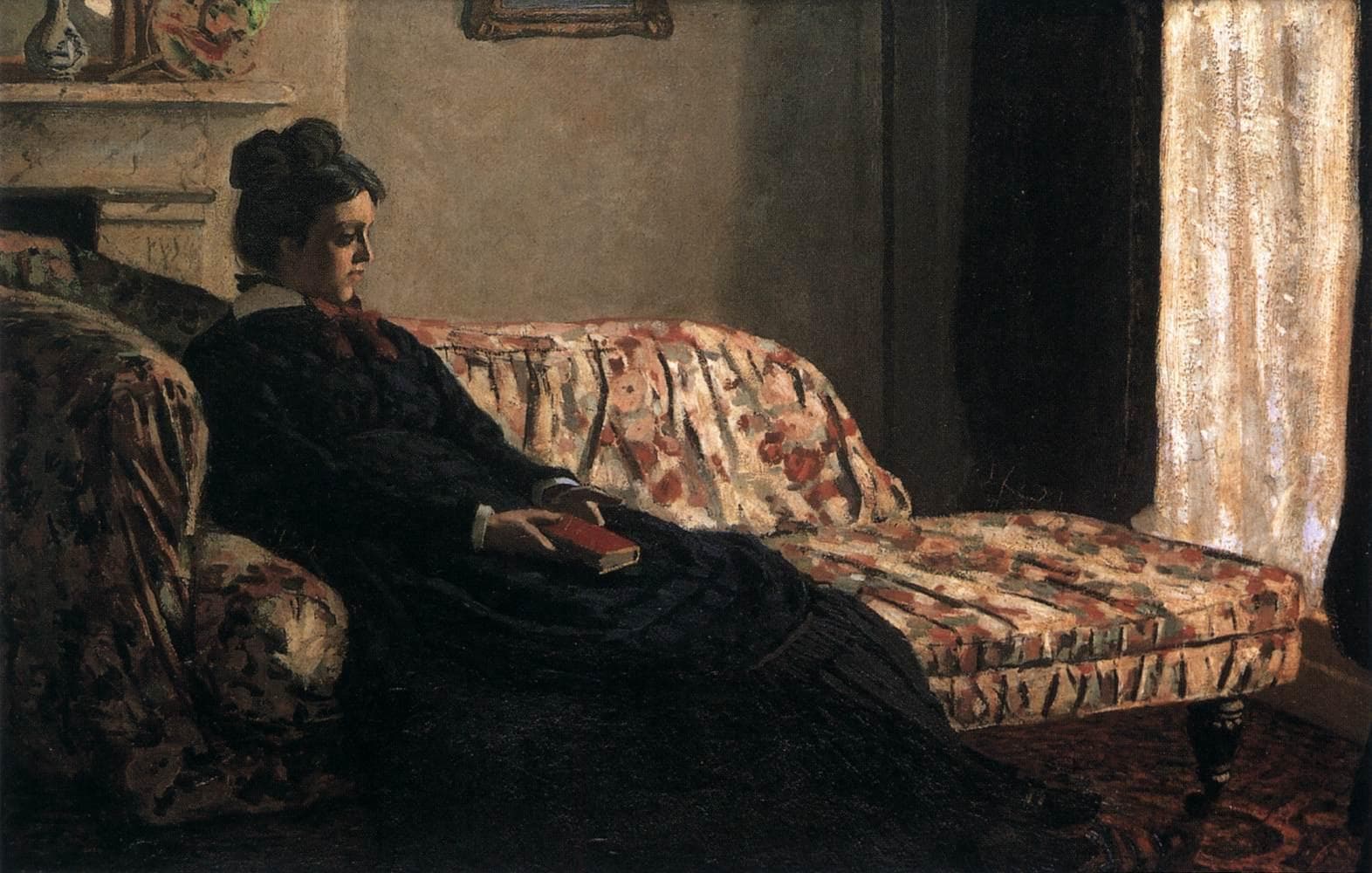
Meditation (Madame Monet on the Sofa)
Claude Monet · c. 1871
The first visit: exile on the Thames (1870–71)
When war broke out between France and Prussia in July 1870, Monet had just married Camille Doncieux and was painting the beach at Trouville. By the autumn he had crossed the Channel, leaving Camille and their son Jean to follow. London was not a choice made for art. It was a refuge, shared with Camille Pissarro and other French painters who had escaped the fighting and then the Paris Commune.
The stay mattered for two reasons. The landscape painter Charles-François Daubigny, also in London, introduced Monet to Paul Durand-Ruel, who had moved his stock to a gallery in New Bond Street. Durand-Ruel became the dealer who would carry the Impressionists through the next two decades and, eventually, sell them in New York.
And Monet looked closely at English painting. He and Pissarro visited the museums; Turner and Constable were there to be seen. Monet later played down any debt to Turner, and scholars still argue about how much he took, but the fogs of his London pictures of 1900 make the question hard to avoid.
The key canvas of this first visit is The Thames below Westminster (1871, National Gallery, London). Monet stands on the south side of the river looking north towards the Houses of Parliament, which rise as a pale gray silhouette in spring haze. In the foreground a wooden jetty and workmen on the new Victoria Embankment, then still under construction, give the picture its dark structure. Everything modern in it, the steamers, the granite wall, the bridge, sits inside a soft veil of light. Thirty years later he would return to almost exactly this subject and push the veil until it swallowed the building.
From the same months comes the small interior known as Meditation, or Camille Monet on the Couch (c. 1871, Musée d'Orsay): Camille in a dark dress on a sofa, a book in her lap, the room's pale curtains and a Japanese fan behind her. It is a quiet, private picture, a reminder that the London months were also a young family's months in rented rooms. After London, Monet went to the Netherlands, painting at Zaandam, before returning to France and settling at Argenteuil at the end of 1871.
The return: the Savoy and St Thomas' (1899–1901)
Monet came back to London in the autumn of 1899, partly to visit his son Michel, who was living there. He stayed at the Savoy Hotel on the Embankment and asked for a room high up, facing the river. From his balcony he could look left, downstream, to Waterloo Bridge, and right, upstream, to Charing Cross railway bridge, with the towers of Westminster beyond. He returned in February to April 1900 and again in early 1901, each time in winter, because winter was when the fog was thickest.
For the Houses of Parliament he needed a different viewpoint. He found it across the river at St Thomas' Hospital, where he was allowed to work from a terrace or a room overlooking the Thames. From there the Palace of Westminster stands against the western sky, and at the end of the day the sun sets behind the Victoria Tower. That is why so many of his Parliament canvases are backlit: the building is a dark violet or blue cut-out, and the light comes through the fog at you.
Monet worked on many canvases at once, switching from one to another as the light changed, sometimes within minutes. He wrote to his wife Alice about the frustration of it. The fog would lift, the sun would come out, and the canvas he had been working on no longer matched anything. He told friends that he loved London only in winter, and that without its fog it would not be beautiful at all. The coal smoke of a city of six million people, which Londoners called a pea-souper, was for him a medium of color: yellow, mauve, rose and green, depending on the hour.
Three series and one night picture
Out of these visits came three groups, each with its own page in the archive.
- The Houses of Parliament, roughly twenty canvases painted from St Thomas' Hospital. The best known show the Gothic towers as a silhouette against a sunset or a sun breaking through fog, as in London, the Houses of Parliament, Sun Breaking Through the Fog (1904, Musée d'Orsay), where a disc of orange light burns through a blue-violet atmosphere and throws a broken path across the water. The version in Lille, The Houses of Parliament, London (Stormy Sky), is rougher and windier, its sky full of churning cloud.
- Waterloo Bridge, the largest group, around forty canvases looking downstream from the Savoy. The arches of John Rennie's granite bridge form a low horizontal band, with the chimneys of the south bank behind. In Waterloo Bridge, Effect of Fog (1903, State Hermitage Museum), the bridge is barely more than a darker streak in a field of pink and lilac.
- Charing Cross Bridge, more than thirty canvases looking upstream at the iron railway bridge, with trains marked by puffs of white steam and the Westminster towers as ghosts in the distance.
Alongside the series is a rarity: Leicester Square, by Night (1901, Musée Granet, Aix-en-Provence). Monet almost never painted at night. Here the lights of the square's theaters and signs explode as loose patches of orange, red and yellow against a dark blue mass. It is unfinished, or at least left at the stage of a sketch, and it shows how far his brush could go when there was no daylight to describe.
Painted in London, finished at Giverny
Monet did not finish the London pictures on the spot. He took the canvases home and worked on them for years in his studio at Giverny, sometimes, it seems, with the help of photographs. He knew critics prized work done from nature, and when Durand-Ruel raised the question he answered that whether his London pictures were painted from nature or not was nobody's business. But the series method made it inevitable. A canvas begun on a particular afternoon of fog could only be completed by remembering that afternoon, and by making the whole group agree as a set.
The result was shown in May and June 1904 at Durand-Ruel's gallery in Paris under the title Vues de la Tamise à Londres, thirty-seven canvases dated 1900 to 1904. Critics compared them to music. Several went to American collectors, which is why so many London Monets are now in museums in the United States, while others reached Russia, Germany and Japan. The dates on the canvases, mostly 1903 and 1904, are the years he finished them, not the years he stood by the river.
How to recognize a London Monet
The motifs are few and fixed: the long low arches of Waterloo Bridge, the lattice of Charing Cross, the spiky Gothic outline of Westminster. What changes is everything around them. Look for a high, square-ish canvas, a horizon set low or in the middle, and a surface covered with short, dragged strokes of closely related color that merge at a distance. Black is almost absent. The darkest passages are deep blues and violets, and the light is often a single concentrated point, the sun, around which the colors of the fog radiate.
Compare these with the Venice pictures of 1908, his only other city series painted abroad. In Venice the buildings again float on water and dissolve in light, but the air is clear and warm. London is the cold, smoky counterpart, and many viewers find it the deeper of the two.
Where to see Monet's London paintings
The London paintings are scattered. Musée d'Orsay in Paris has a Parliament canvas, the Palais des Beaux-Arts in Lille another, and the Hermitage a Waterloo Bridge. In the United States, the Art Institute of Chicago holds a Houses of Parliament, a Charing Cross Bridge and two Waterloo Bridges, the Museum of Fine Arts, Boston has a Charing Cross Bridge, and the Metropolitan Museum of Art has The Houses of Parliament (Effect of Fog). In London itself the National Gallery shows The Thames below Westminster. For a full museum list, see where to see Monet's paintings.
Questions & answers
When was Monet in London?
Claude Monet was in London twice. He fled there during the Franco-Prussian War in 1870–71, then returned for three winter campaigns in 1899, 1900 and 1901, when he painted the Thames from the Savoy Hotel and St Thomas' Hospital. He finished those canvases at Giverny and exhibited them in Paris in 1904.
Where did Monet stay in London?
On his later visits Monet stayed at the Savoy Hotel on the Victoria Embankment, in a room high above the river. From there he painted Waterloo Bridge downstream and Charing Cross Bridge upstream. For the Houses of Parliament he worked across the Thames at St Thomas' Hospital, looking west toward the sunset.
How many London paintings did Monet make?
Close to a hundred canvases came out of the 1899–1901 visits: around forty of Waterloo Bridge, more than thirty of Charing Cross Bridge and roughly twenty of the Houses of Parliament. Exact counts vary because Monet abandoned or reworked some. Thirty-seven were shown at Durand-Ruel in Paris in 1904.
Why did Monet paint London in fog?
Monet said London was beautiful only in winter, because of its fog. The coal smoke and river mist turned bridges and buildings into silhouettes and filled the air with colored light, yellow, rose, mauve and green by turns. Fog let him paint what interested him most: the atmosphere between his eye and the subject.
Can you see Monet's London paintings in London?
Yes, but only a few. The National Gallery holds The Thames below Westminster (1871), from his first stay. Most of the 1899–1904 Thames series is in Paris, Lille, Saint Petersburg and American museums such as Chicago, Boston and the Metropolitan Museum of Art in New York.