Place
Monet on the Mediterranean: Bordighera and Antibes, 1884 and 1888
Two winters in the south that forced a painter of gray northern skies to find a palette, as he put it, of diamonds and jewels.
Monet painted the Mediterranean on two long winter campaigns: at Bordighera on the Italian Riviera, with side trips to Dolceacqua and Menton, from January to April 1884, and at Antibes on the French Riviera from January to May 1888. Monet at Bordighera painted palms, lemon gardens and the old town above a violet sea; Monet at Antibes painted the walled town across the bay, the snowy Alps behind it, and lone pines bent over the water.
Both trips were shocks. Claude Monet had spent twenty years learning to paint the soft, damp light of the Seine and the Channel. In the south the light was hard, the shadows blue and the colors almost too intense to put on canvas. The fifty-odd pictures he brought home from each trip were his brightest yet, and they sold well. This page collects the Riviera canvases in the Monet archive.
A scouting trip with Renoir (December 1883)
In December 1883, a few months after moving to Giverny, Monet traveled along the Mediterranean coast with Pierre-Auguste Renoir, from Marseille toward Genoa. The trip lasted only a couple of weeks, but it convinced him that he had to come back and work there properly. He also decided he had to come back alone. He wrote to his dealer Paul Durand-Ruel asking him not to mention the plan to Renoir: painting side by side had been useful when they were young, at La Grenouillère, but now he wanted to see the south through his own eyes.
Bordighera (January–April 1884)
Monet arrived at Bordighera, a small resort just across the Italian border favored by English winter visitors, in mid-January 1884, and stayed until early April. He took a room at the Pension Anglaise and walked the hills and gardens every day. The richest motif was the private garden of Francesco Moreno, a local landowner, full of palms, olive trees and lemon trees, which Monet was allowed to paint.
The light defeated him at first. In letters to Alice Hoschedé he complained that it was terrible, that one would need a palette of diamonds and precious stones, and that he was scraping canvases off and starting again. He gradually raised his whole key. Shadows became blue and violet, not brown; the sea turned turquoise and ultramarine; the mountains were lilac and rose.
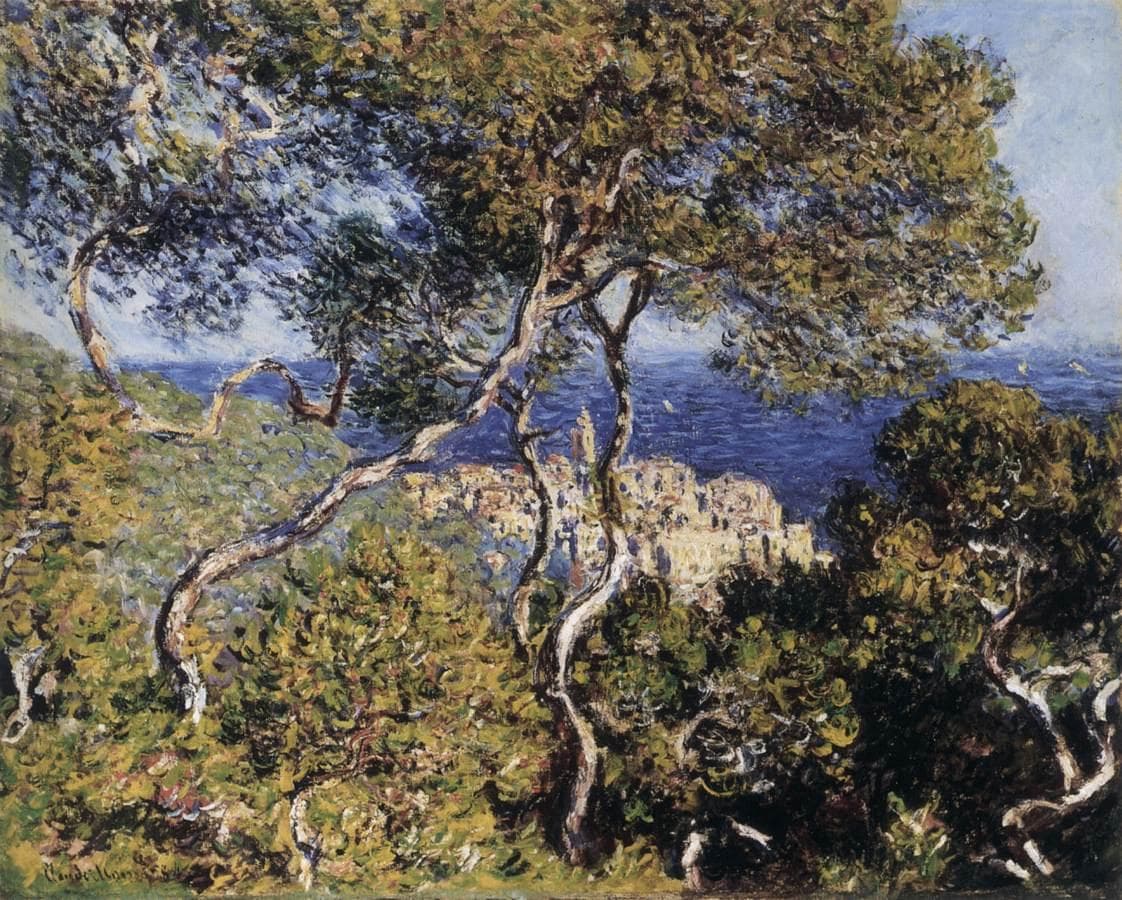
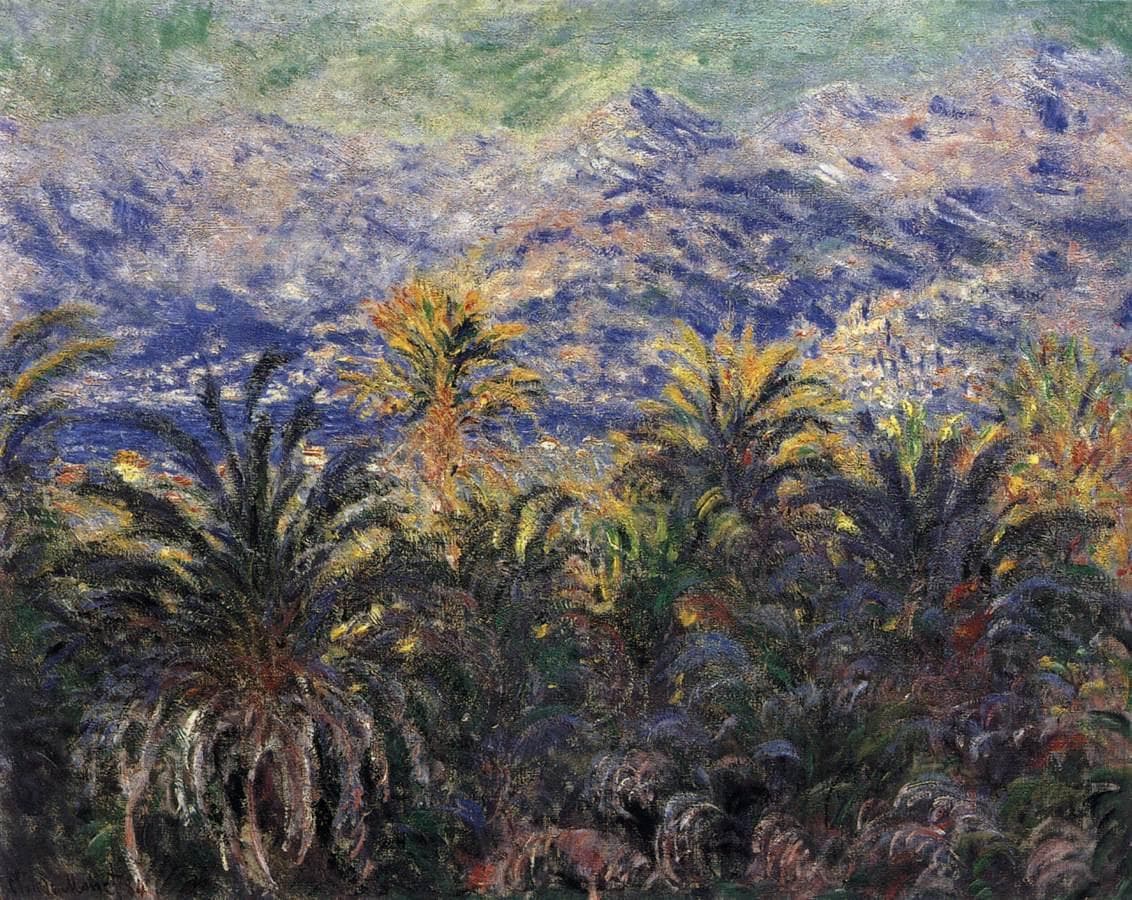
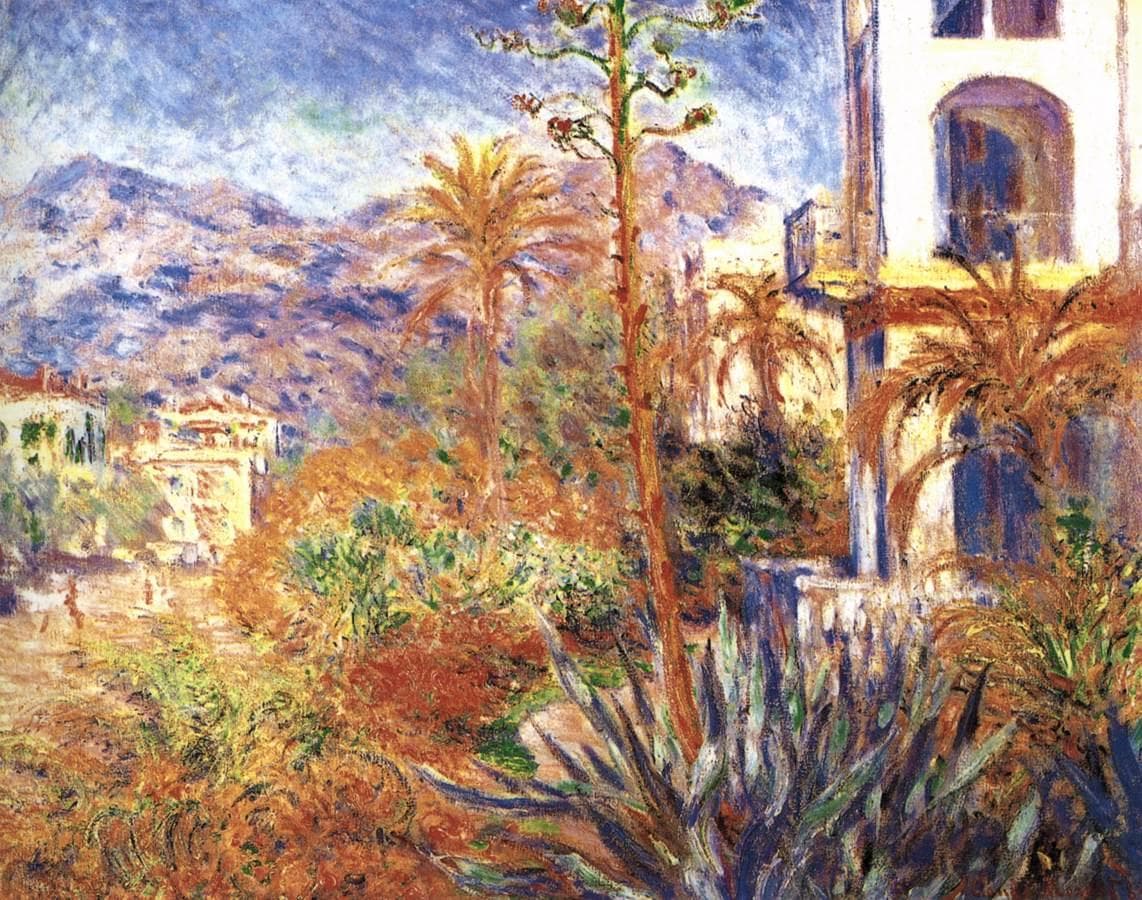
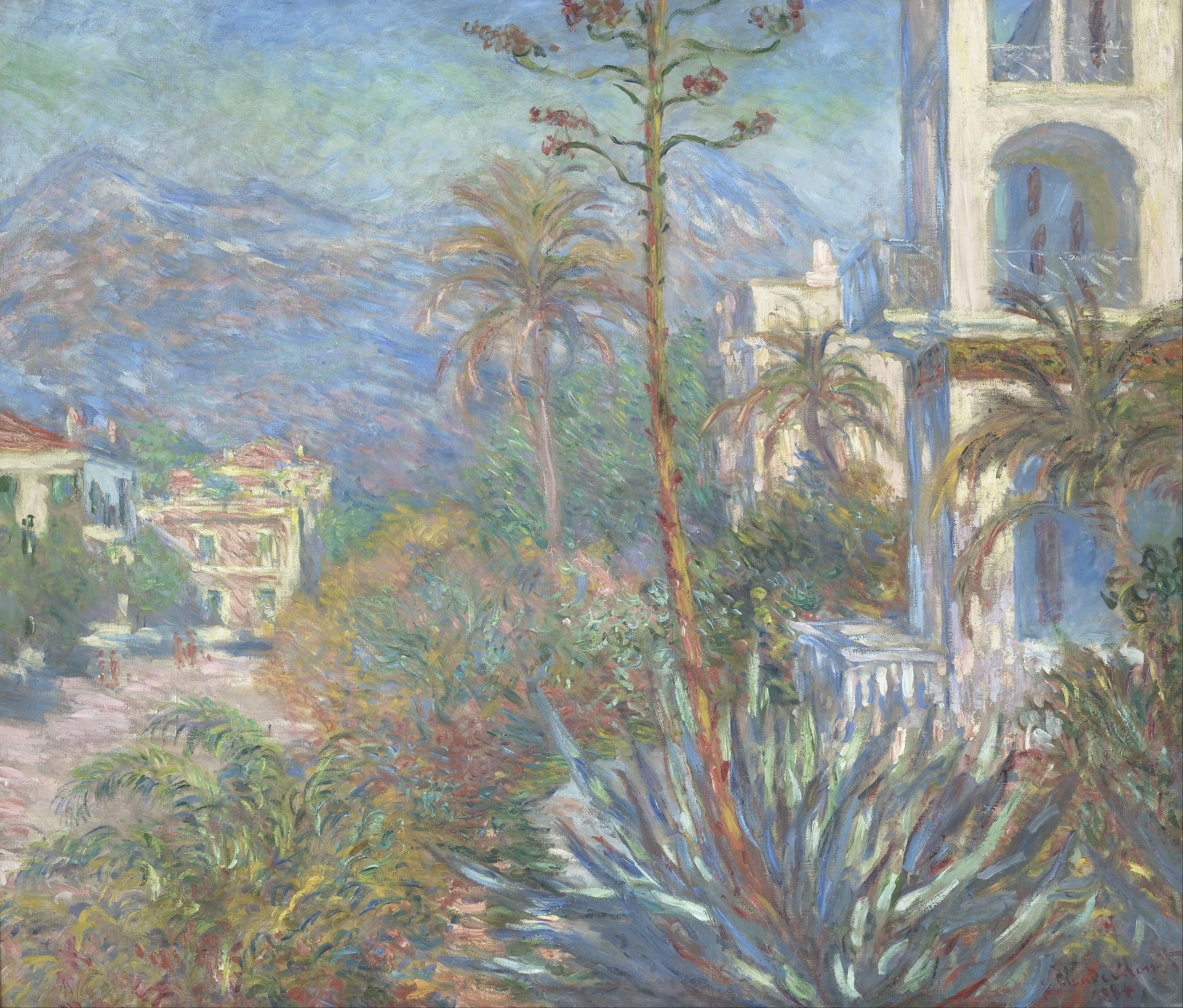
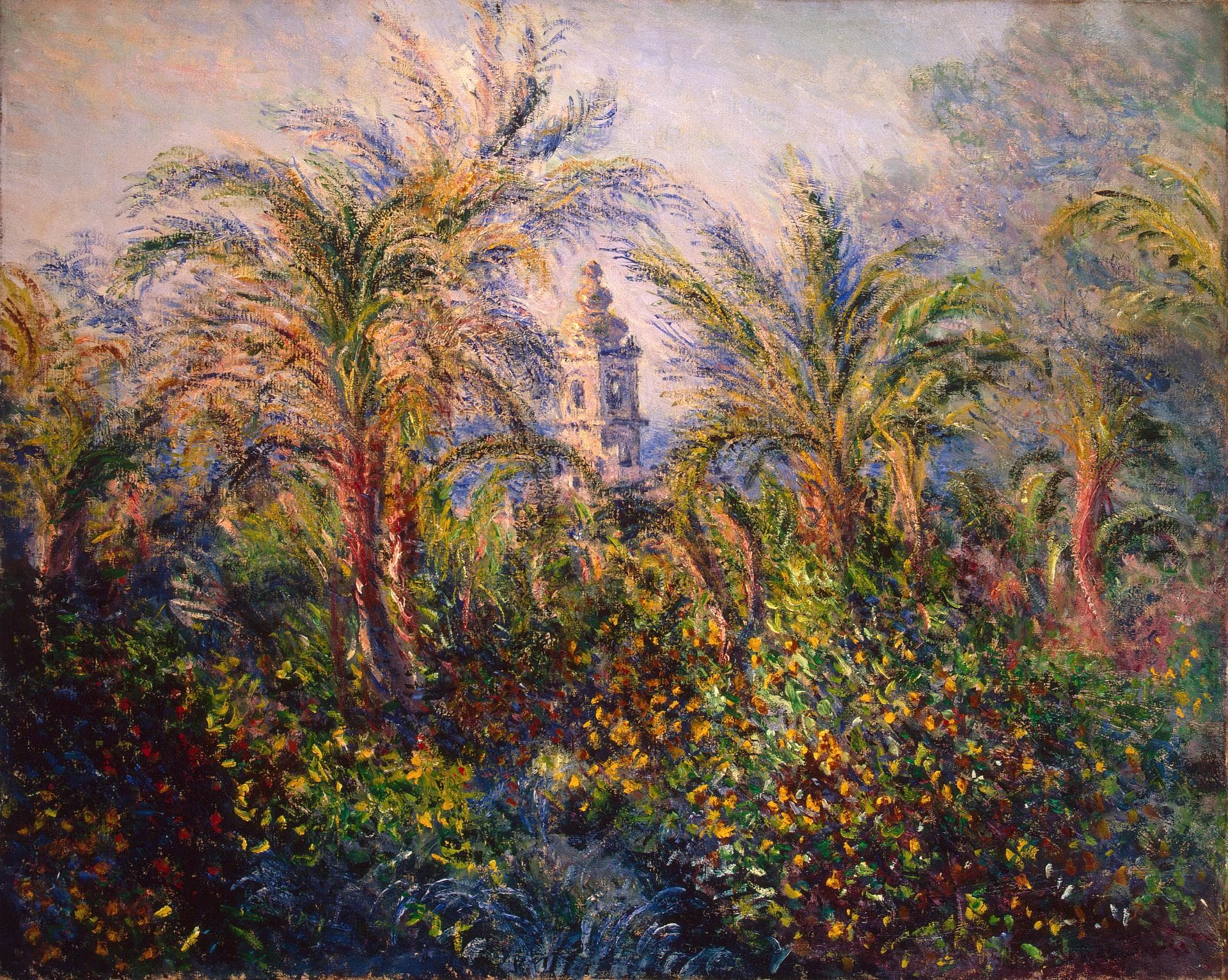
The pictures he made are some of the most decorative of his career. In Bordighera (Art Institute of Chicago) a screen of twisted pine trunks frames the old town on its hill and the blue sea beyond, the branches writhing across the top of the canvas in a way that recalls Japanese prints. Palm Trees at Bordighera (Metropolitan Museum of Art) is a thicket of palms, their fronds rendered in fast, spiky strokes of green and yellow, under lilac mountains. Villas in Bordighera (Santa Barbara Museum of Art) and Villas at Bordighera (Musée d'Orsay) set white houses among palms and a flowering agave, and Garden at Bordighera, Impression of Morning (Hermitage Museum) dissolves the garden in early light.
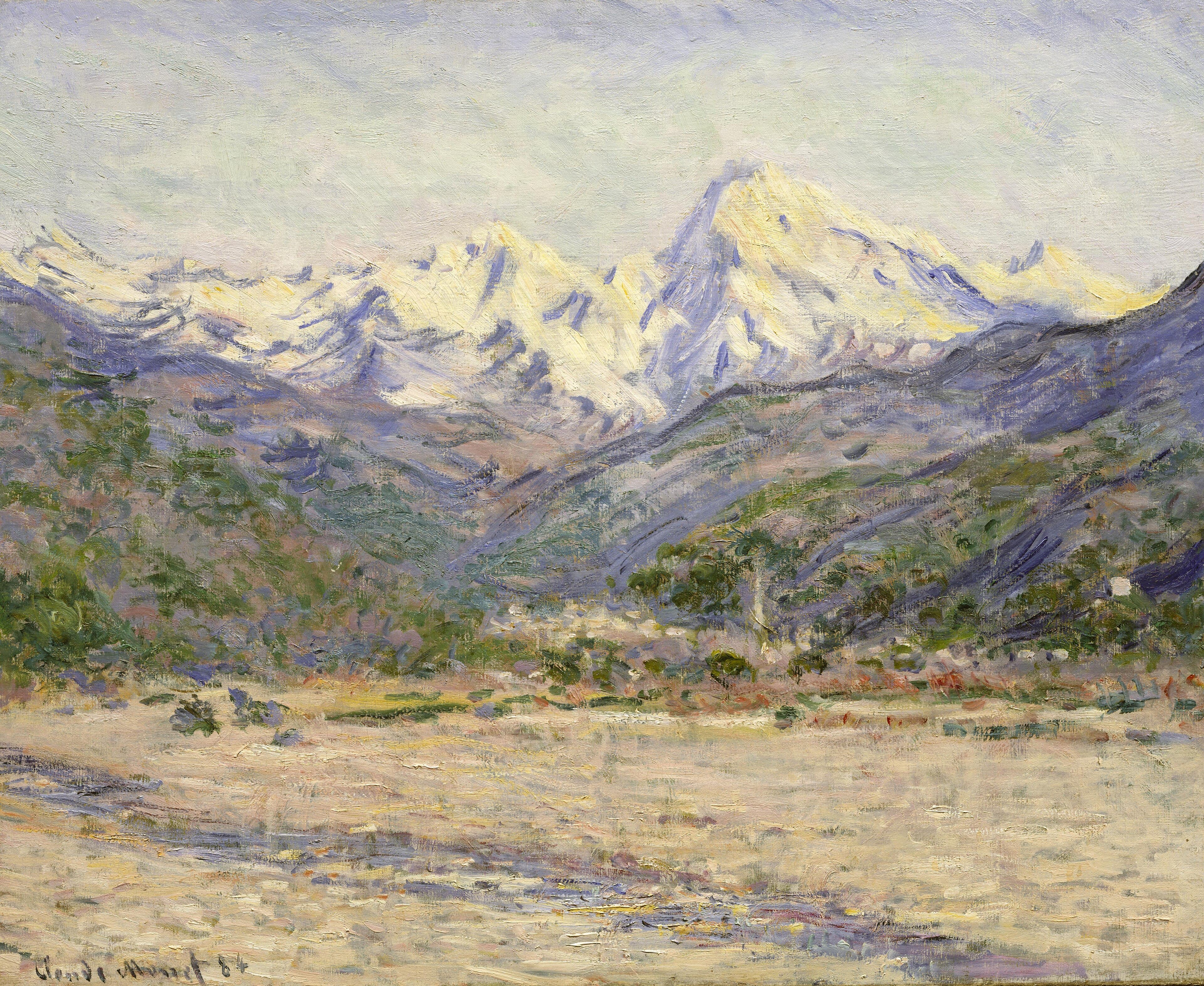
Monet also walked inland. The Valley of the Nervia (Metropolitan Museum of Art) looks up the river valley behind Bordighera toward the mountains, and he painted the medieval castle and single-arched bridge of Dolceacqua, a village a few miles up the valley. On the way home in April he stopped at Menton and painted the headland of Cap Martin, a group now partly in the Museum of Fine Arts, Boston.
He brought back roughly fifty canvases. Durand-Ruel showed some of them in Paris, and the brighter palette surprised critics who had thought of Monet as a painter of mist.
Antibes (January–May 1888)
Four years later Monet went south again, this time to Antibes, on the French Riviera between Cannes and Nice. He stayed from January to May 1888 at the Château de la Pinède, a residence that took in artists, on the Cap d'Antibes.
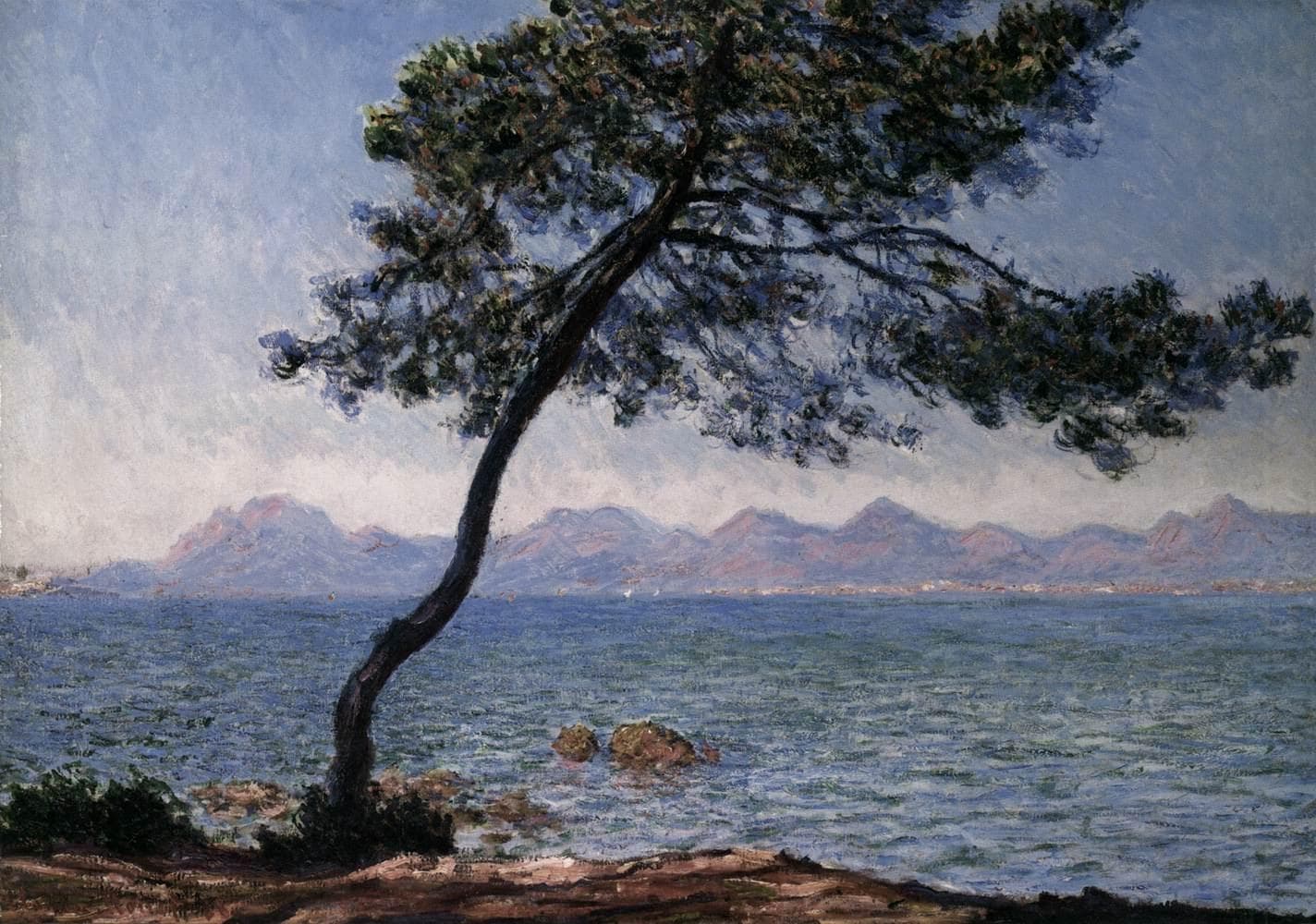
The Antibes pictures are calmer and more unified than those from Bordighera. Monet chose a few motifs and painted them repeatedly. The most important is the view across the bay to the old walled town and its fort, with the snow-capped Maritime Alps beyond: pink stone, a strip of turquoise sea and a white line of mountains, seen at different hours.
The other is the shoreline pine, a single tree leaning over the water. In Antibes (1888, The Courtauld Gallery, London) one dark, twisting pine fills the left side of the canvas, its foliage spreading across a pale sky, with the sea and pink mountains behind it. The composition is almost a quotation from Hokusai and Hiroshige, whose prints Monet collected.
He wrote to Alice that what he was doing was sweet: white, pink and blue, enveloped in a magical air. He also worried constantly about the mistral, which blew his easel over, and about the weather changing before he could finish.
Theo van Gogh and the Antibes exhibition
When Monet returned in May, Theo van Gogh, who ran the modern department of the dealers Boussod, Valadon & Cie in Paris, bought ten of the Antibes canvases and showed them at the gallery in June 1888. It was a success. The poet Stéphane Mallarmé admired them; some critics found them too bright. Theo kept his brother Vincent, then painting in Arles, informed about the show.
The Antibes exhibition was a step toward the great series of the 1890s. Monet had shown a group of pictures of a few motifs, under different lights, as a set. Two years later he would do the same thing with the Haystacks, with far more radical results.
What the south changed
The Riviera canvases are not Monet's most famous, but they mark a change in his color. After Bordighera, his palette never returned to the browns and grays of the 1870s. The blue and violet shadows, the high-keyed greens and the decorative arabesques of trees reappear at Giverny, in the poplars and the garden pictures, and finally in the water garden itself.
They also show his discomfort with picturesque subjects. He knew the Riviera was a tourist cliché and worked hard to avoid the postcard view, choosing odd angles, screens of trees and close-ups. The same instinct would make him refuse to paint Venice for decades, until his single visit of 1908 (see Monet in Venice).
Where to see Monet's Riviera paintings
The Bordighera and Antibes pictures are widely scattered, many of them in American museums because Durand-Ruel sold them in New York. The Art Institute of Chicago, the Metropolitan Museum of Art and the Museum of Fine Arts, Boston each hold several; the MFA has a strong Antibes group. In Europe, look for them at The Courtauld Gallery in London, the Musée d'Orsay and the Musée Marmottan Monet in Paris, and the Hermitage in Saint Petersburg. For a full guide, see where to see Monet's paintings.
Questions & answers
When did Monet paint at Bordighera?
Claude Monet worked at Bordighera on the Italian Riviera from mid-January to early April 1884, after a scouting trip along the coast with Renoir in December 1883. He painted palm gardens, the old town, the Nervia valley and Dolceacqua, and brought home about fifty canvases.
When did Monet paint Antibes?
Monet stayed at Antibes, on the French Riviera, from January to May 1888, at the Château de la Pinède on the Cap d'Antibes. He painted the old town and fort across the bay with the Alps behind, and pine trees on the shore. Theo van Gogh exhibited ten of the pictures in Paris that June.
Where is Monet's Bordighera painting?
The best-known canvas titled Bordighera (1884), showing twisted pines framing the old town and the sea, is in the Art Institute of Chicago. Other Bordighera pictures are in the Metropolitan Museum of Art, the Musée d'Orsay, the Musée Marmottan Monet, the Hermitage and the Santa Barbara Museum of Art.
Why are Monet's Mediterranean paintings so bright?
The southern light was far stronger than in Normandy. Monet said he would need a palette of diamonds and jewels to paint it. He raised his whole color key, using turquoise and ultramarine seas, rose and lilac mountains, and blue and violet shadows, a palette he kept for the rest of his career.
Did Monet paint Menton and Cap Martin?
Yes. On his way home from Bordighera in April 1884, Monet stopped near Menton and painted the headland of Cap Martin, with the coast road and mountains. One of these canvases, Cap Martin, near Menton, is in the Museum of Fine Arts, Boston.