Image: Marunuma Art Park, Japan; reproduction via Wikimedia Commons · Public domain · via Wikimedia Commons
Realism
View at Rouelles, Le Havre
Claude Monet, 1858
View at Rouelles is the earliest known painting by Claude Monet, made in 1858 at age 17 under Eugène Boudin's guidance in the countryside outside Le Havre. It is in the Marunuma Art Park in Japan.
- Artist
- Claude Monet
- Date
- 1858
- Medium
- Oil on canvas
- Dimensions
- 46 × 65 cm
- Collection
- Marunuma Art Park, Asaka, Saitama, Japan
- Movement
- Realism
- Catalogue
- Wildenstein 1
Painted at Étretat and the Normandy Coast
What you are looking at
A small stream winds toward the viewer through a summer meadow. Its surface is dark and glassy, catching the blue of the sky and the pale trunks along its banks. On the far side, a stand of tall, thin poplars rises in a ragged row against white cumulus clouds, and a pair of taller trees on the left almost touches the top of the canvas. A dense, rounded bush sits on the right bank, and beside it, very small, a figure in a pale blue shirt crouches or sits at the water's edge. Beyond the trees, low hills close the valley and a strip of yellow field catches the light at the right.
Everything is described with patience. The leaves are built up in small dabs, the grasses in the foreground are picked out with flecks of white flowers, and the clouds have soft, rounded edges. It is a careful, quiet picture, the work of a beginner who is trying to get things right rather than trying to be new.
Where and when it was painted
This is the earliest painting by Claude Monet that is known to survive, and it is listed as number 1 in Daniel Wildenstein's catalogue raisonné. Monet was seventeen. In Le Havre he was already known as a caricaturist, selling portrait sketches through a local stationer's and framing shop. Eugène Boudin, the painter of beaches and skies, saw the drawings there and urged the boy to paint outdoors.
In the summer of 1858 Boudin took Monet into the countryside at Rouelles, a valley on the north-eastern edge of Le Havre. The stream is usually said to be the Rouelles or the Lézarde. Monet painted this view following Boudin's example, and he later said that watching Boudin work was the moment his eyes were opened. The picture is signed "O. Monet": he was still signing as Oscar, his first name, before he dropped it in his early twenties.
The canvas is too assured to be his first attempt at oil paint, and he had probably been practicing for some months. But it is the first picture to survive, and it records the lesson that shaped his career.
The canvas belongs to the same Le Havre world as Monet's later Normandy coast pictures: the light off the Channel, the big skies Boudin loved, the valleys behind the port.
How it was painted
The technique is that of a Realist landscape of the 1850s, closer to Boudin and the Barbizon painters than to anything Monet would do a decade later. The composition is classical: a foreground of grass and water, a middle ground of trees, a distant line of hills, and a sky that takes up nearly half the canvas. The stream acts as a path for the eye, drawing it from the bottom edge into the meadow.
What hints at the future is the sky. The clouds are painted with real attention to how light catches their tops and softens their undersides, and the reflections in the stream repeat the blue and white above. Monet's lifelong subject, the way water gives back the sky, is already here in a modest form.
First exhibition
In August 1858 the painting was accepted at a municipal exhibition in Le Havre, where Boudin also showed views of the Rouelles valley. A local critic remarked that the young painter's work resembled Boudin's, which Monet took as praise. In 2019 the picture travelled to the Denver Art Museum for the exhibition Claude Monet: The Truth of Nature, where it hung beside a Boudin of the same countryside.
How it compares with Monet's later work
Set it next to the seascapes he painted only six years later, such as La Pointe de la Hève, Sainte-Adresse or The Beach at Honfleur, and the change is striking: broader strokes, stronger contrasts, a sharper sense of weather. The farm subjects of the early 1860s, like Farm in Normandy, sit between the two. Rouelles is the starting point of that whole journey.
Where to see it
The painting is in the Marunuma Art Park in Asaka, Saitama Prefecture, Japan. It is seldom lent, which makes its 2019 appearance in Denver one of the few recent chances to see it outside Japan. For the museums that hold Monet's work around the world, see where to see Monet's paintings.
Questions & answers
What was Claude Monet's first painting?
View at Rouelles, painted in 1858 when Monet was seventeen, is the earliest known surviving painting by him. It is number 1 in the Wildenstein catalogue raisonné. He painted it outdoors near Le Havre on an outing with Eugène Boudin, who encouraged him to paint from nature.
Where is View at Rouelles today?
It is in the Marunuma Art Park in Asaka, Saitama Prefecture, Japan. It was lent to the Denver Art Museum in 2019 for the exhibition Claude Monet: The Truth of Nature, where it hung next to a Boudin of the same area.
Where is Rouelles?
Rouelles is a valley and former village on the north-eastern edge of Le Havre in Normandy, now part of the city. The stream in the painting is usually identified as the Rouelles or the Lézarde, which flow through the area.
Why is the painting signed O. Monet?
Monet was born Oscar-Claude Monet and went by Oscar as a young man. He signed early works "O. Monet" and dropped the Oscar in his early twenties, after which he signed "Claude Monet".
More by the artist
Claude Monet

Bridge over a Pond of Water Lilies
Claude Monet · 1899

Woman with a Parasol – Madame Monet and Her Son
Claude Monet · 1875

Sunset in Venice
Claude Monet · 1908–12

La Grenouillère
Claude Monet · 1869

Beach in Pourville
Claude Monet · 1882

Springtime
Claude Monet · 1872

Boating on the River Epte
Claude Monet · 1890

The Seine at Asnières (Hermitage)
Claude Monet · 1873
Kindred works
You may also study
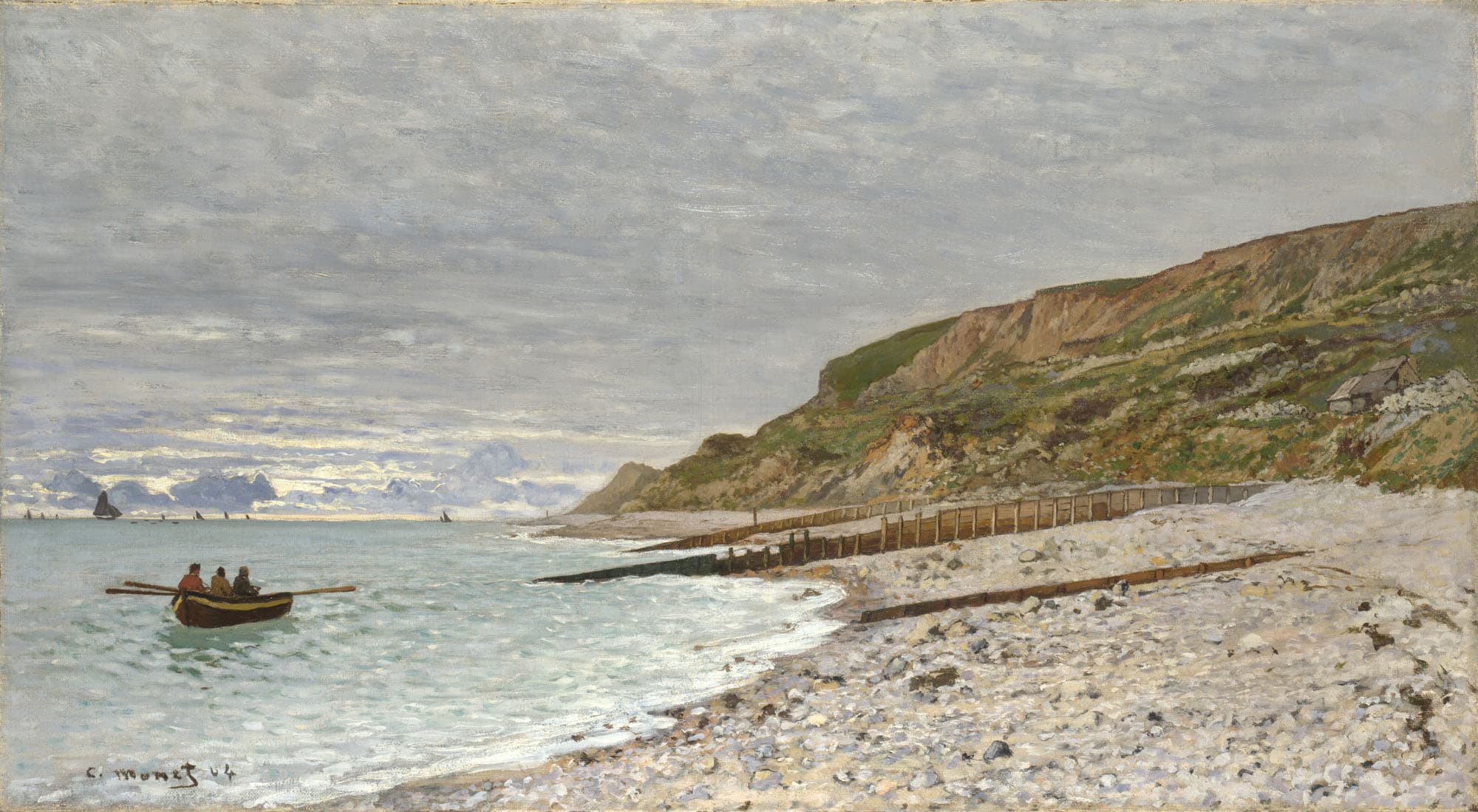
La Pointe de la Hève, Sainte-Adresse
Claude Monet · 1864
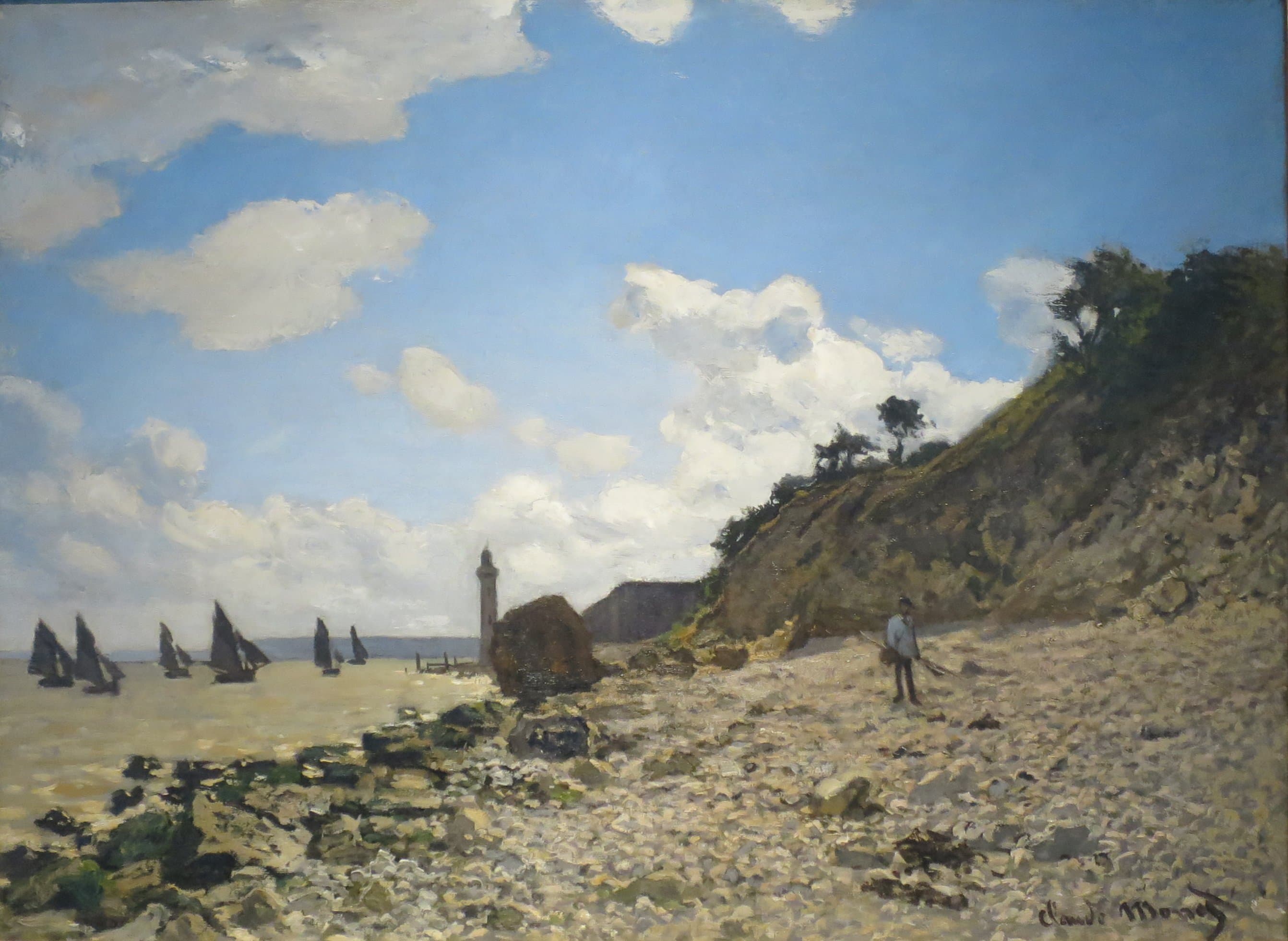
The Beach at Honfleur
Claude Monet · 1864–66
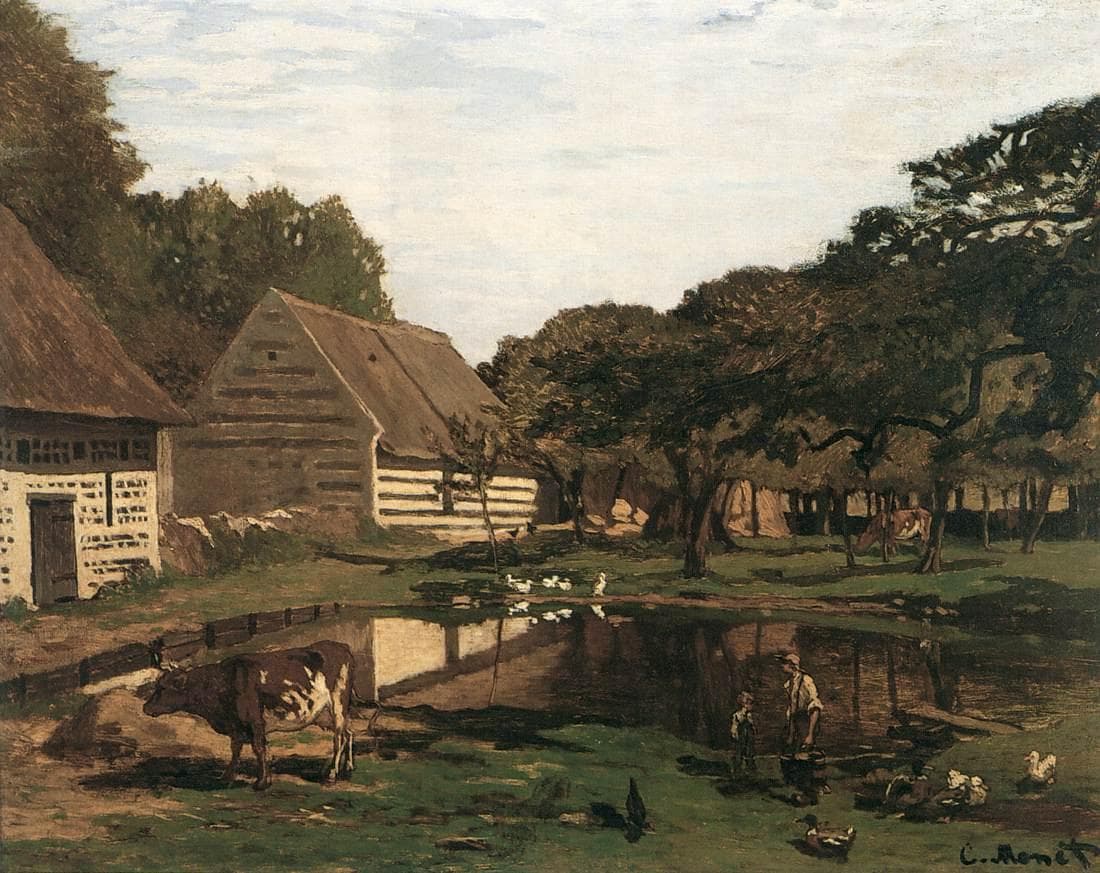
Farmyard in Normandy
Claude Monet · c. 1863
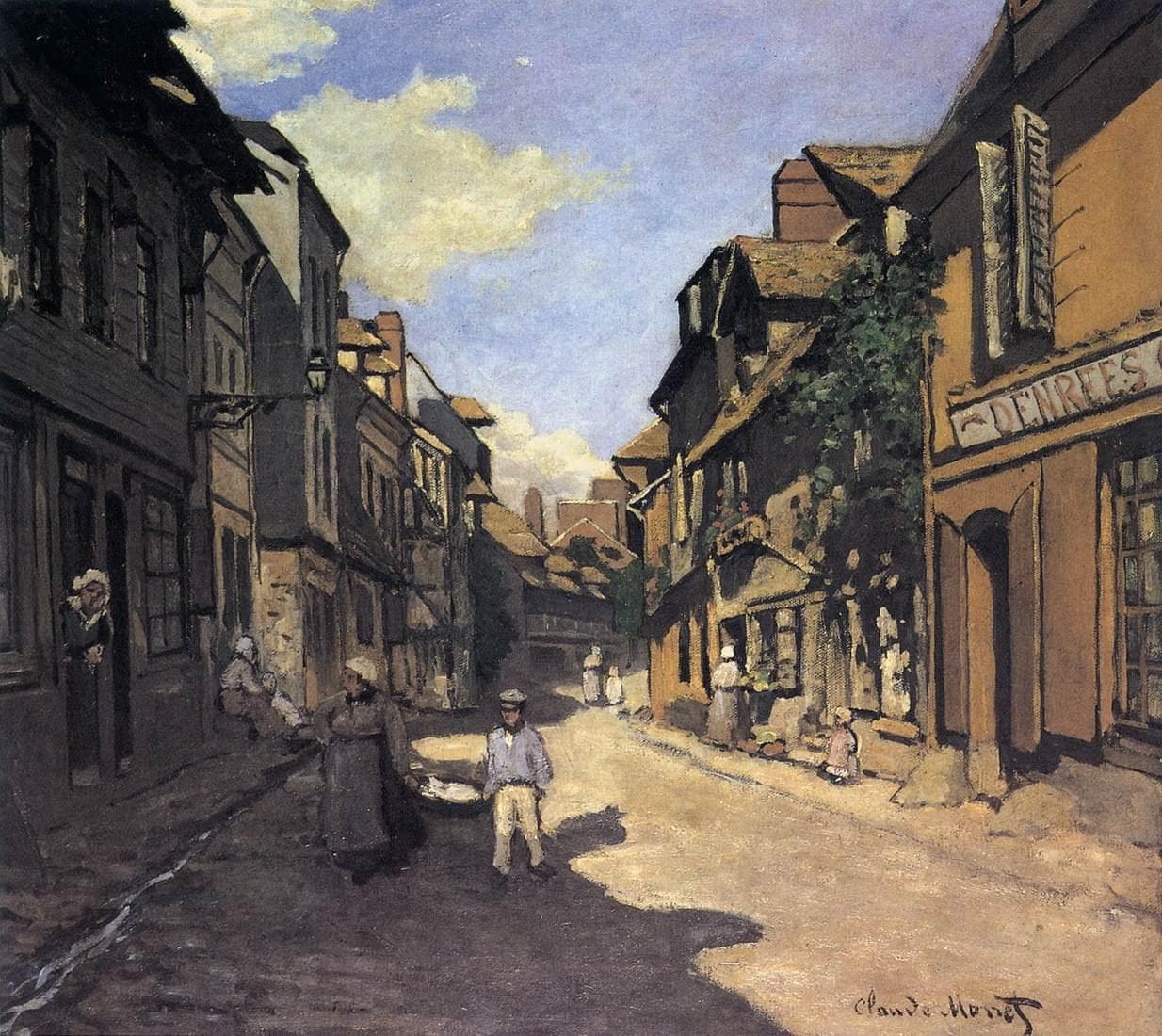
Rue de la Bavolle, Honfleur
Claude Monet · 1864

The Scream
Edvard Munch · 1893

Ophelia
John Everett Millais · 1851–52

The Great Wave off Kanagawa
Katsushika Hokusai · c. 1830–32
The Birth of Venus
Sandro Botticelli · c. 1484–1486