Impressionism
Bathers at La Grenouillère
Claude Monet, 1869
Bathers at La Grenouillère is Claude Monet's 1869 painting of rowing boats and swimmers at a Seine bathing place near Bougival, painted beside Renoir. This version is in the National Gallery, London; another is in the Metropolitan Museum of Art.
- Artist
- Claude Monet
- Date
- 1869
- Medium
- Oil on canvas
- Dimensions
- 73 × 92 cm
- Collection
- National Gallery, London, United Kingdom
- Movement
- Impressionism
- Catalogue
- Wildenstein W 135
Bathers at La Grenouillère is Claude Monet's 1869 painting of hired rowing boats, a plank walkway and swimmers at La Grenouillère, a riverside bathing place and floating café on the Seine near Bougival, west of Paris. Painted in late summer 1869 while Renoir worked beside him, the canvas, 73 by 92 centimeters, is in the National Gallery in London and is number 135 in Wildenstein's catalogue. It is the London version of a motif Monet painted more than once that season; the other surviving canvas is in the Metropolitan Museum of Art.
What does Bathers at La Grenouillère show?
The bottom half of the picture belongs to the boats. Eight or so rowing boats for hire are moored side by side, their bows pointing toward us and running off the bottom edge, so that we look down into their hulls at the floorboards and thwarts. Most are painted a deep bottle green with red or orange lines along the gunwales; one, at center right, is a warm tan, and a smaller yellow skiff floats loose at the far right. Monet sets them at slightly different angles, which gives the foreground a crowded, jostling rhythm, like cabs at a rank.
Above them a narrow plank walkway runs straight across the canvas from left to right, a hard horizontal that cuts the picture in two. At left, under the trees, figures in summer clothes stroll near a small wooden bathing hut: a woman in pale blue, another in pink with a red skirt, a man in dark clothes. At right, three bathers in dark, close-fitting costumes stand on the planks at the water's edge, two of them in red caps, while the river beyond is dotted with the heads and shoulders of swimmers, each a single blob of flesh color. A pair of red boats lies against the far bank.
The trees close over the top of the picture in a dense canopy of greens, from acid yellow-green at upper left to a cooler blue-green at center, and at upper right they open on a bright, hazy patch of sky and the far bank.
How was La Grenouillère painted?
The water is why this picture matters. Between and beyond the boats Monet lays down the river's surface in separate, horizontal strokes of near-black, slate blue, white and pale green, set side by side and never blended. Up close they read as a pattern of dashes; from a few steps back they become broken reflections on moving water, with the dark shapes of the boats and the light of the sky shivering together. Under the walkway the strokes turn yellow-green where the reflected foliage meets sunlit ripples.
Everything else is handled with the same speed. The figures are a few touches each, the trees are scrubbed in, and the boats are drawn with long, loaded strokes that follow their curves. This is a picture made on the spot, in one or a few sessions, and it keeps the look of a sketch.
Monet himself seems to have thought of it that way. In a letter to his friend Frédéric Bazille that September he wrote that he had a "dream," a large painting of the bathing place for the Salon, and that he had made only some poor sketches for it. If that big canvas was ever finished, it does not survive.
Monet and Renoir at La Grenouillère
Monet was living nearby at Saint-Michel, above Bougival, with Camille and their two-year-old son Jean, and money was desperately short. Pierre-Auguste Renoir, staying with his parents at Louveciennes, came over to paint with him, and for a few weeks the two set up their easels side by side, sometimes looking at the same scene from almost the same spot. Renoir's canvases of the place are softer and more interested in the people; Monet's are more concerned with structure and with the surface of the river. Art historians have long treated these weeks as the moment when the broken, rapid touch of Impressionism took shape.
La Grenouillère, "the frog pond," was a café-restaurant on a moored barge beside a small island in the Seine, near Croissy and Bougival. It offered changing huts, bathing, boats for hire and dancing, and the railway made it an easy outing from Paris. Contemporary writers described it as fashionable and a little disreputable, a place where clerks, artists, boating men and women of uncertain reputation mixed. Monet keeps that social world small and distant, more a scatter of color than a story.
The other version and later pictures
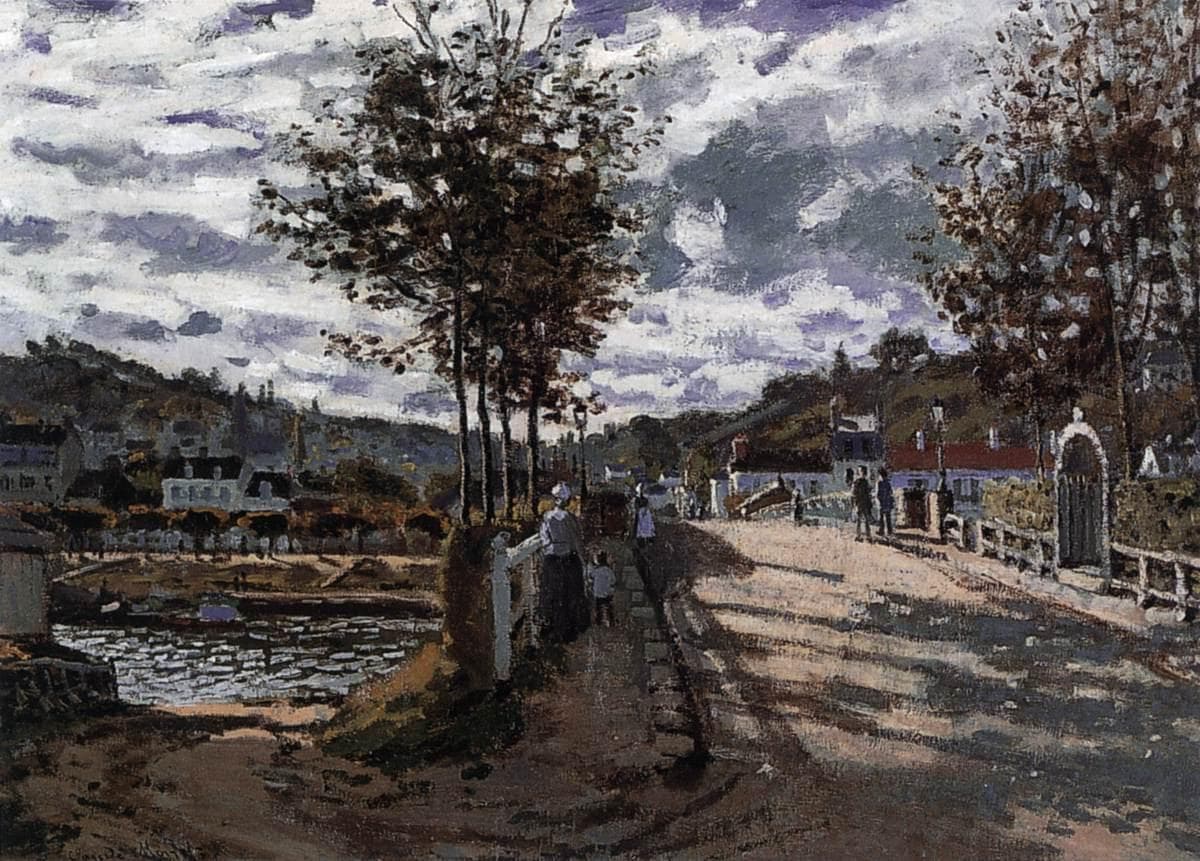
The Metropolitan Museum's La Grenouillère is taken from a little to the left and centers on the tiny round island, nicknamed the "Camembert," with a single tree, linked to the café by walkways; see Monet at the Met. The London picture is more tightly framed on the boats and the bathing area. That same year Monet painted The Bridge at Bougival just upstream, and within three years the lessons of this water would carry into The Basin at Argenteuil and the regatta pictures of Argenteuil.
Where is La Grenouillère by Monet today?
The painting is in the National Gallery, London (NG6456), which bought it in 1979. It hangs with the gallery's Impressionist collection, and admission is free. For other museums with major holdings, see where to see Monet's paintings, and for his life and work as a whole, Claude Monet.
Questions & answers
Where is Monet's La Grenouillère?
This version, Bathers at La Grenouillère, with rowing boats in the foreground, is in the National Gallery in London (NG6456), which bought it in 1979. A second Monet canvas of the same place, centered on the small round island with its single tree, is in the Metropolitan Museum of Art in New York.
When and where was La Grenouillère painted?
Monet painted it in late summer 1869 at La Grenouillère, a floating café and bathing place beside a small island in the Seine near Croissy and Bougival, west of Paris. He was living nearby at Saint-Michel, short of money, and Renoir often came over to paint beside him.
What does La Grenouillère show and why is it important?
It shows hired rowing boats, a plank walkway, strolling visitors and swimmers at a popular Parisian day-trip spot. Its importance lies in the water, painted in separate unblended strokes of dark blue, white and green. That rapid broken touch, worked out here with Renoir, became a foundation of Impressionism.
How many versions of La Grenouillère did Monet paint?
Two Monet canvases of La Grenouillère from 1869 survive: this one in the National Gallery, London, and the Met's version in New York, which centers on the little island nicknamed the Camembert. Monet called them sketches for a large Salon picture of the bathers that, if finished, does not survive.
More by the artist
Claude Monet

Bridge over a Pond of Water Lilies
Claude Monet · 1899

Woman with a Parasol – Madame Monet and Her Son
Claude Monet · 1875

Sunset in Venice
Claude Monet · 1908–12

La Grenouillère
Claude Monet · 1869

Beach in Pourville
Claude Monet · 1882

Springtime
Claude Monet · 1872

Boating on the River Epte
Claude Monet · 1890

The Seine at Asnières (Hermitage)
Claude Monet · 1873
Also painted in 1869
The same year
Kindred works
You may also study
The Bridge at Bougival
Claude Monet · 1869
The Basin at Argenteuil
Claude Monet · 1872
Regatta at Argenteuil
Claude Monet · c. 1872
On the Bank of the Seine, Bennecourt
Claude Monet · 1868

The Scream
Edvard Munch · 1893

Ophelia
John Everett Millais · 1851–52

The Great Wave off Kanagawa
Katsushika Hokusai · c. 1830–32
The Birth of Venus
Sandro Botticelli · c. 1484–1486