Impressionism
The Houses of Parliament in London
Claude Monet, 1904
London, the Houses of Parliament, Sunlight Breaking through the Fog (1904) is a painting by Claude Monet of Westminster as a blue silhouette under an orange sun. It is in the Musée d'Orsay, Paris.
- Artist
- Claude Monet
- Date
- 1904
- Medium
- Oil on canvas
- Dimensions
- 81.5 × 92.5 cm
- Collection
- Musée d'Orsay, Paris, France
- Movement
- Impressionism
- Catalogue
- Wildenstein 1610
Painted at Monet in LondonMore at Monet at the Musée d'Orsay
What you are looking at
The Palace of Westminster is a single shape, a flat silhouette of deep blue and violet. The Victoria Tower rises on the right, its pinnacles just a few ragged strokes against the sky; a second, lower tower stands beside it, and the long Gothic roofline runs off to the left until it melts into fog. The sky is a hazy violet-blue, warming at upper center into a patch of orange and gold where the sun is trying to break through.
Its light falls on the Thames below in a broad column of orange, red and pink strokes, broken by the ripples, set against water as blue as the building. The left side of the canvas is almost empty, fog over fog, and the signature and date, "Claude Monet 1904," are at lower left.
The French title is Londres, le Parlement. Trouée de soleil dans le brouillard, "a break of sunlight in the fog." Claude Monet began the canvas in London in 1900–01 and finished it at Giverny. It measures 81.5 by 92.5 centimeters, is number 1610 in Wildenstein's catalogue, and is in the Musée d'Orsay, Paris.
Where and when
Monet made three working stays in London, in the autumn of 1899 and the late winters of 1900 and 1901, lodging at the Savoy Hotel. In the mornings he painted Waterloo and Charing Cross bridges from his hotel windows. In the late afternoon he crossed to St Thomas' Hospital, on the south bank, and from a terrace or room there painted the Houses of Parliament facing him across the river, with the sun going down behind them. See Monet in London.
He worked on many canvases at once, switching as the fog and light changed, and wrote to Alice of despair at the speed of the effects. He loved the London fog, saying that without it the city would not be beautiful. He then spent three years reworking the canvases at Giverny, partly from memory, and in May 1904 showed thirty-seven Thames views at Durand-Ruel's gallery in Paris, including this one.
How it was painted
The trick of the picture is that the building has almost no detail. Look closely and the windows and pinnacles are only suggested by slightly darker strokes within the blue. Monet is painting light from behind a solid object, what is called contre-jour, and the fog turns stone into color.
The surface is dense and worked over, the result of repeated sessions in London and in the studio. Strokes of blue, violet and rose are laid on top of one another, often dragged so the color beneath shows through. The reflection is the most vivid passage: the orange of the sun breaks into short horizontal strokes on the water, mixed with blue and violet, so the column of light seems to tremble. The color pairing, orange against blue, is one of the strongest contrasts of complementaries in the series. Notice that the sun itself is not a disc but a smear of thick, pale yellow and orange paint brushed in a loose circle near the top edge, the brightest spot on the canvas.
The series and how this version differs
Monet painted the Houses of Parliament about nineteen times, varying the hour, the fog and the sun: see the Houses of Parliament series. In The Houses of Parliament, Stormy Sky in Lille, the palette turns to pale yellow and grey and the sky churns. Here the mood is quieter and more saturated, a single break of sun in a blue world.
The same fog fills his other London series, among them Waterloo Bridge, Effect of Fog and the Waterloo Bridge pictures. His first London view of Parliament, painted during the Franco-Prussian War, is The Thames below Westminster of 1871.
Where to see it
The painting is in the Musée d'Orsay: see Monet at the Musée d'Orsay. Other Parliament canvases are in Lille, Chicago, New York, Washington and elsewhere. For the artist, see Claude Monet.
Questions & answers
Where is Monet's Houses of Parliament with the sun breaking through the fog?
It is in the Musée d'Orsay, Paris, under the title Londres, le Parlement. Trouée de soleil dans le brouillard. Dated 1904, it measures 81.5 by 92.5 centimeters and is catalogued by Wildenstein as number 1610.
Where did Monet paint the Houses of Parliament from?
From St Thomas' Hospital on the south bank of the Thames, opposite Westminster, during stays in London in 1899–1901. He worked in the late afternoon, when the sun set behind the building, and finished the canvases at Giverny.
What does this Houses of Parliament painting show?
Westminster's towers and roofline as a deep blue silhouette in fog, an orange sun breaking through the haze above, and its reflection as a column of orange strokes on the blue Thames.
How many Houses of Parliament paintings did Monet make?
About nineteen, each under different light and weather: sunset, fog, storm and sun breaking through. Many were shown with other Thames views at Durand-Ruel's gallery in Paris in May 1904.
More by the artist
Claude Monet

Bridge over a Pond of Water Lilies
Claude Monet · 1899

Woman with a Parasol – Madame Monet and Her Son
Claude Monet · 1875

Sunset in Venice
Claude Monet · 1908–12

La Grenouillère
Claude Monet · 1869

Beach in Pourville
Claude Monet · 1882

Springtime
Claude Monet · 1872

Boating on the River Epte
Claude Monet · 1890

The Seine at Asnières (Hermitage)
Claude Monet · 1873
Also painted in 1904
The same year
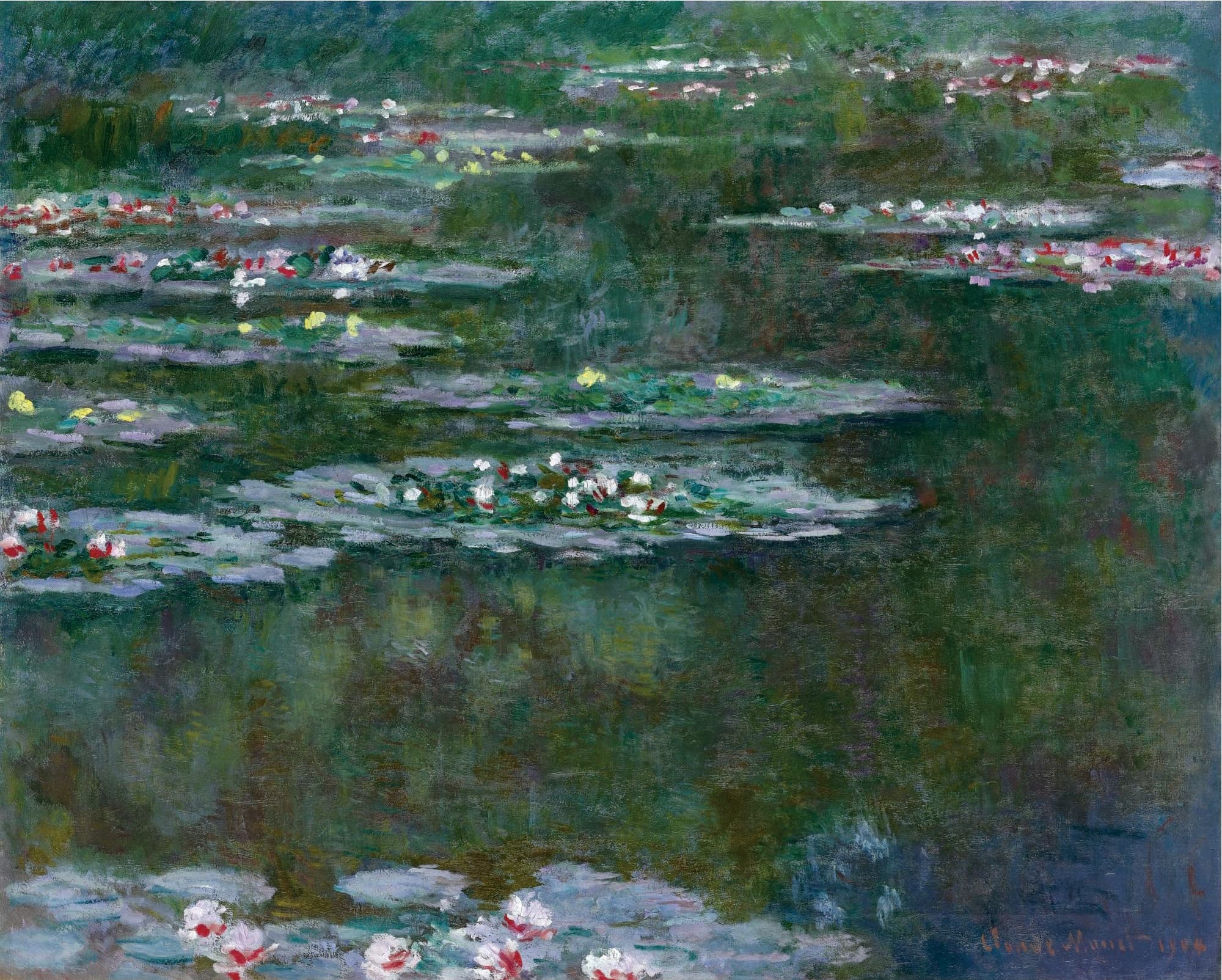
Kindred works
You may also study
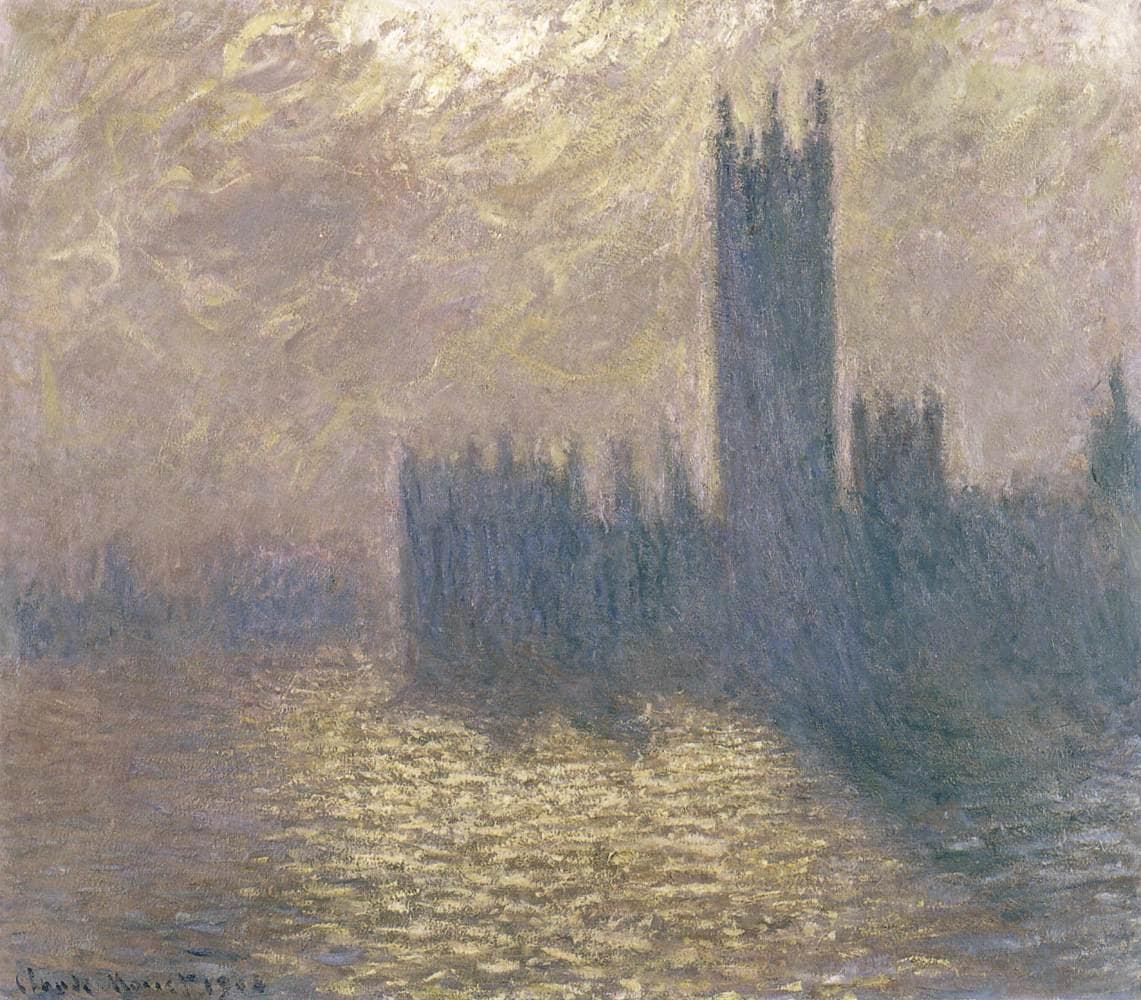
The Houses of Parliament, London
Claude Monet · 1904
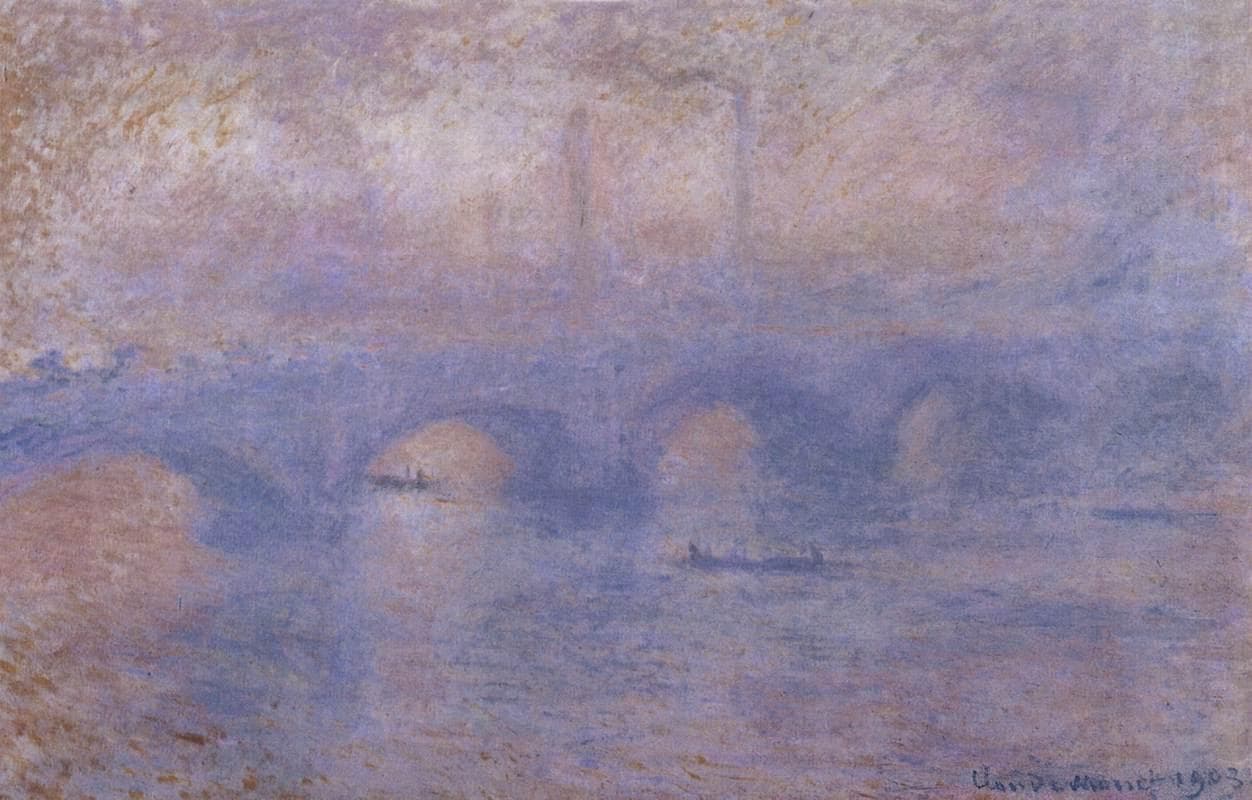
Waterloo Bridge, Effect of Fog
Claude Monet · 1903
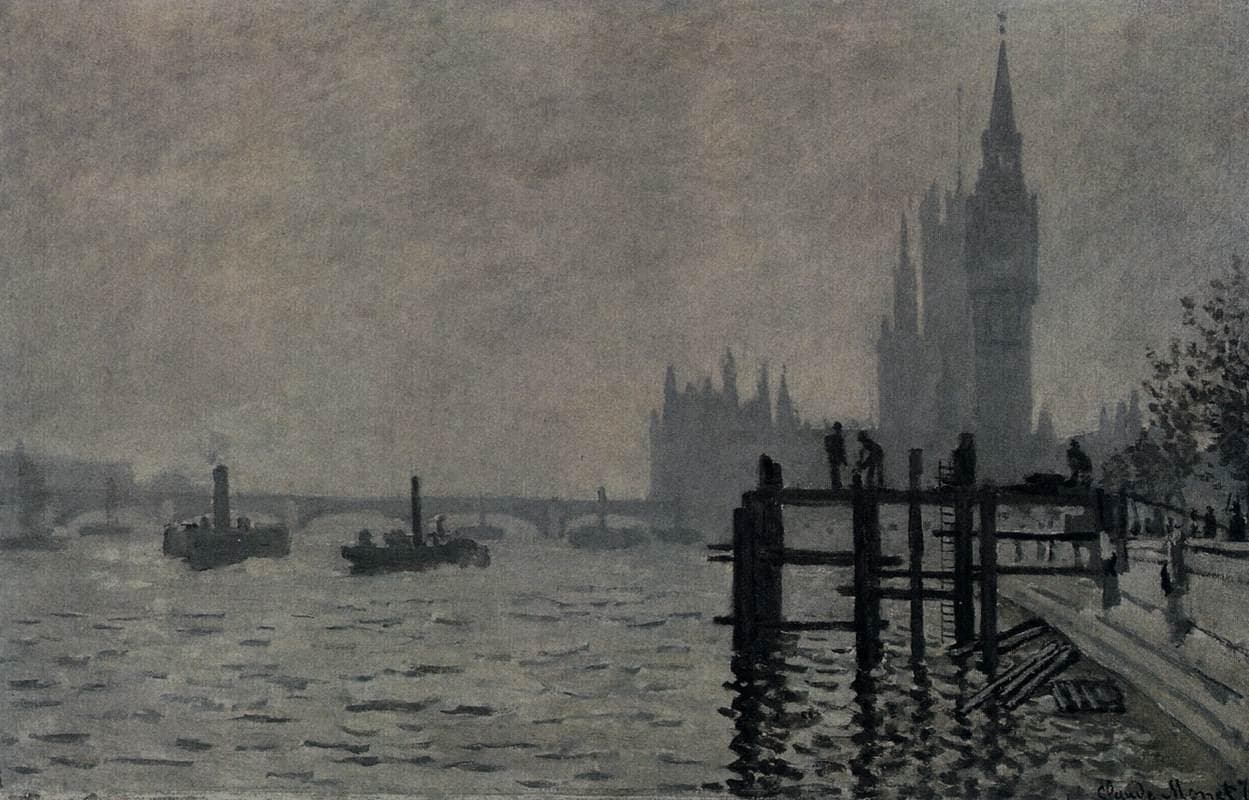
The Thames below Westminster
Claude Monet · c. 1871
The Grand Canal in Venice
Claude Monet · 1908

Ophelia
John Everett Millais · 1851–52

The Great Wave off Kanagawa
Katsushika Hokusai · c. 1830–32
The Birth of Venus
Sandro Botticelli · c. 1484–1486
The School of Athens
Raphael · 1509–1511