Series
Monet's Gare Saint-Lazare: The Railway Station Paintings of 1877
Twelve canvases of steam, iron and glass in the Paris terminus, Monet's first series and the most modern subject of Impressionism.
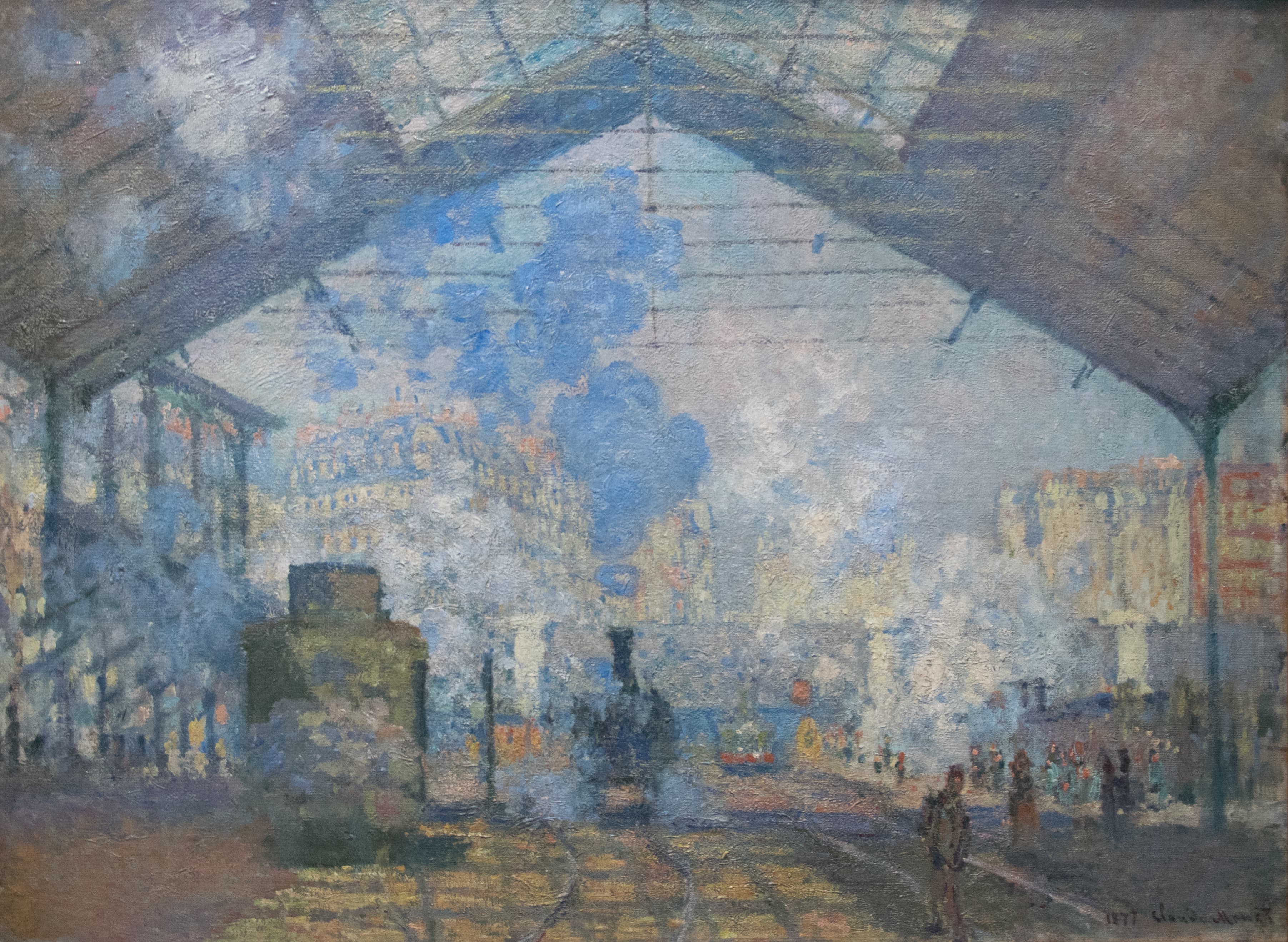
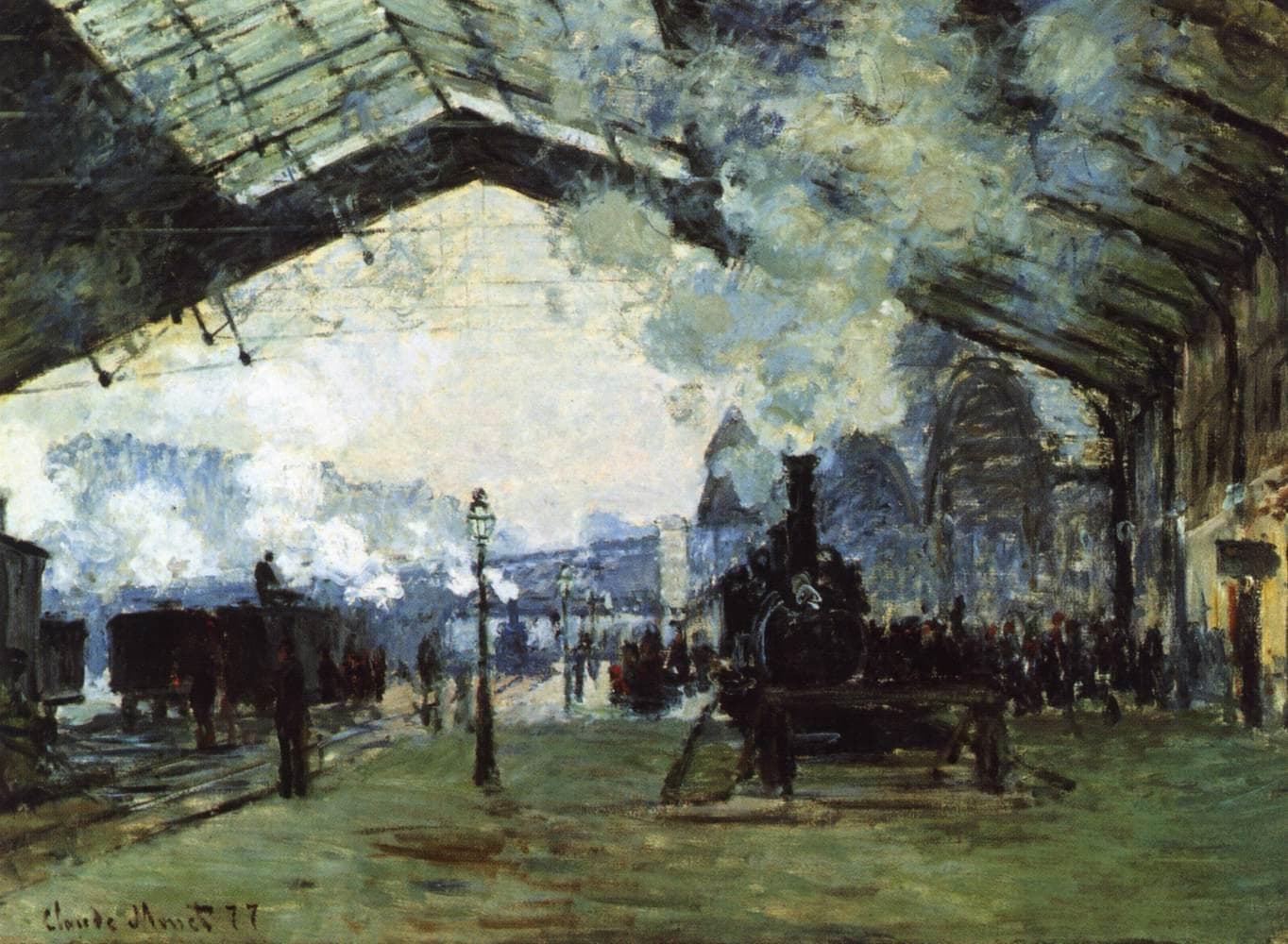
Monet's Gare Saint-Lazare paintings are a group of twelve views of the Saint-Lazare railway station in Paris, painted between January and April 1877, inside the great train shed and on the tracks outside it. Seven of them were shown at the third Impressionist exhibition in April 1877. They are often called Monet's first series, the first time he painted one motif again and again, and they are his boldest answer to the question of what a modern painter should paint: not forests or ruins, but locomotives and steam.
Today the best-known version, La Gare Saint-Lazare, from Gustave Caillebotte's collection, is in the Musée d'Orsay, Paris. Others are in the Musée Marmottan Monet, the National Gallery in London, the Art Institute of Chicago, the Harvard Art Museums and the Landesmuseum in Hanover, with the rest in private collections.
The complete set
All 10 known canvases
From the catalogue raisonné. Works with a full close reading are marked ✦.
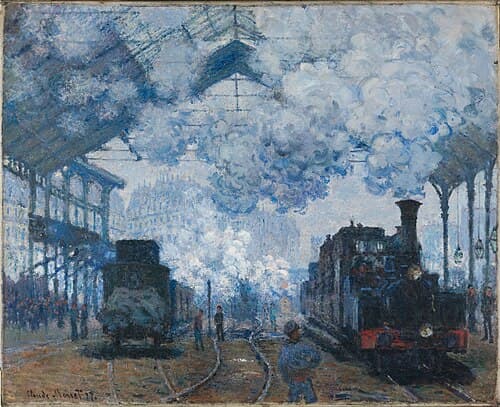
✦The Gare Saint-Lazare: Arrival of a Train
1877 · Fogg Museum
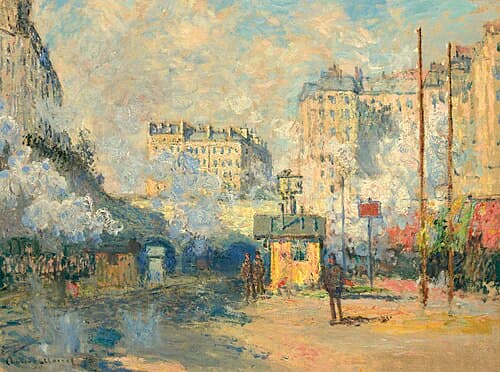
Exterior of Saint-Lazare station, sun effect
1877
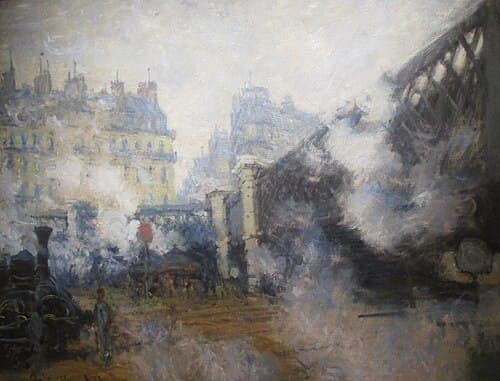
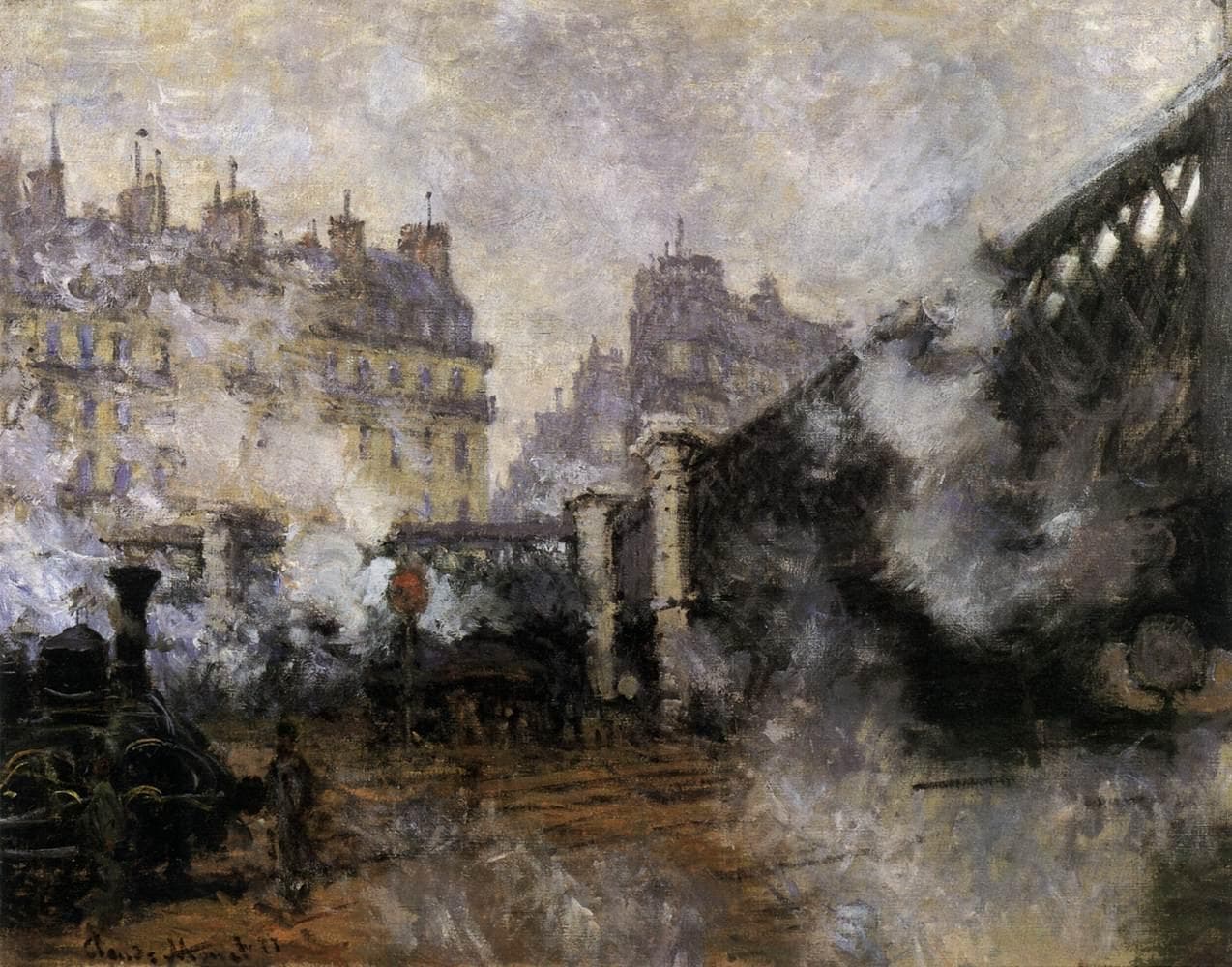
✦Pont de l'Europe, gare Saint-Lazare
1877 · Musée Marmottan Monet
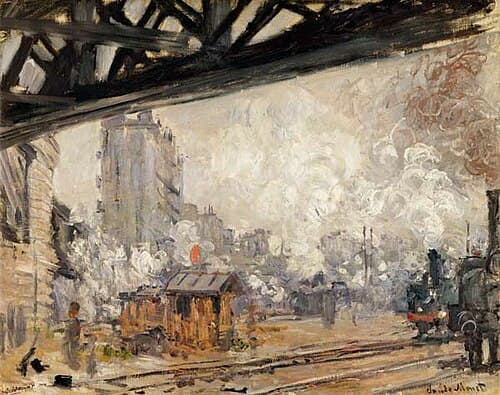
La Gare Saint-Lazare, vue extérieure
1877
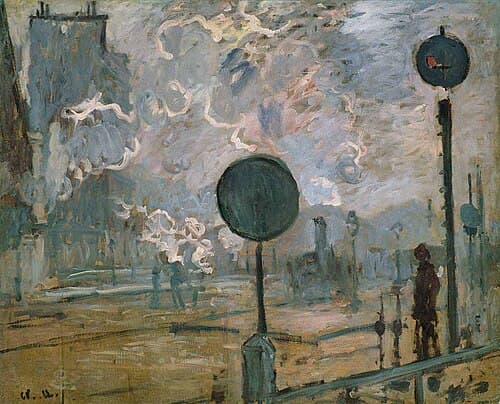
Exterior of Gare Saint-Lazare, The Signal
1877 · Landesmuseum Hannover
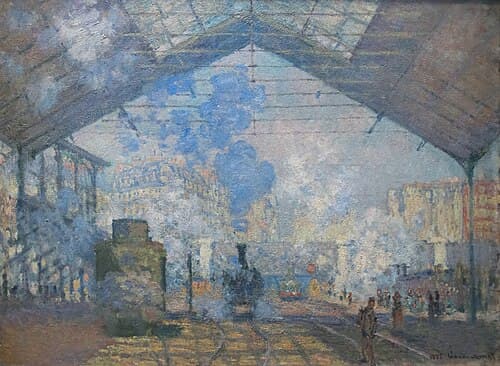
✦La Gare Saint-Lazare
1877 · Musée d'Orsay
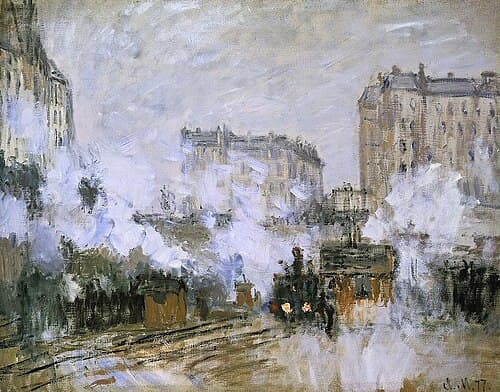
Exterior of Saint-Lazare train station, arrival of a train
1877
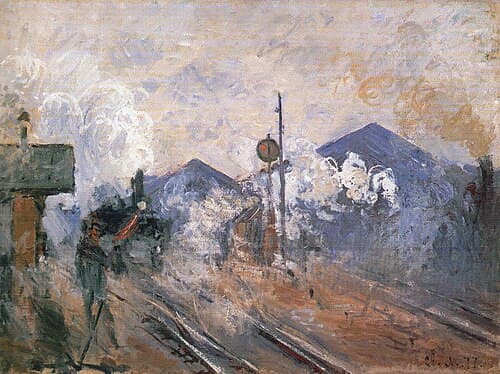
Train Tracks at the Saint-Lazare Station
1877 · Pola Museum of Art
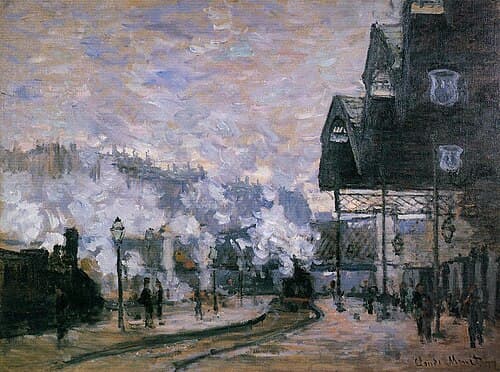
Saint-Lazare Station, the Western Region Goods Sheds
1877
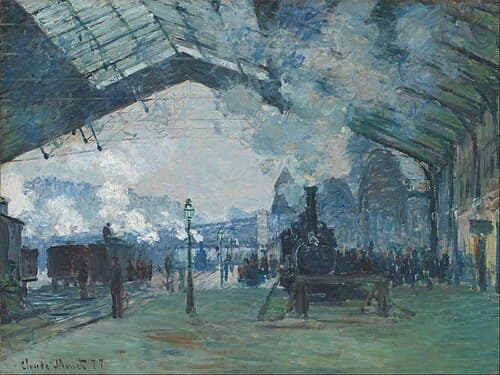
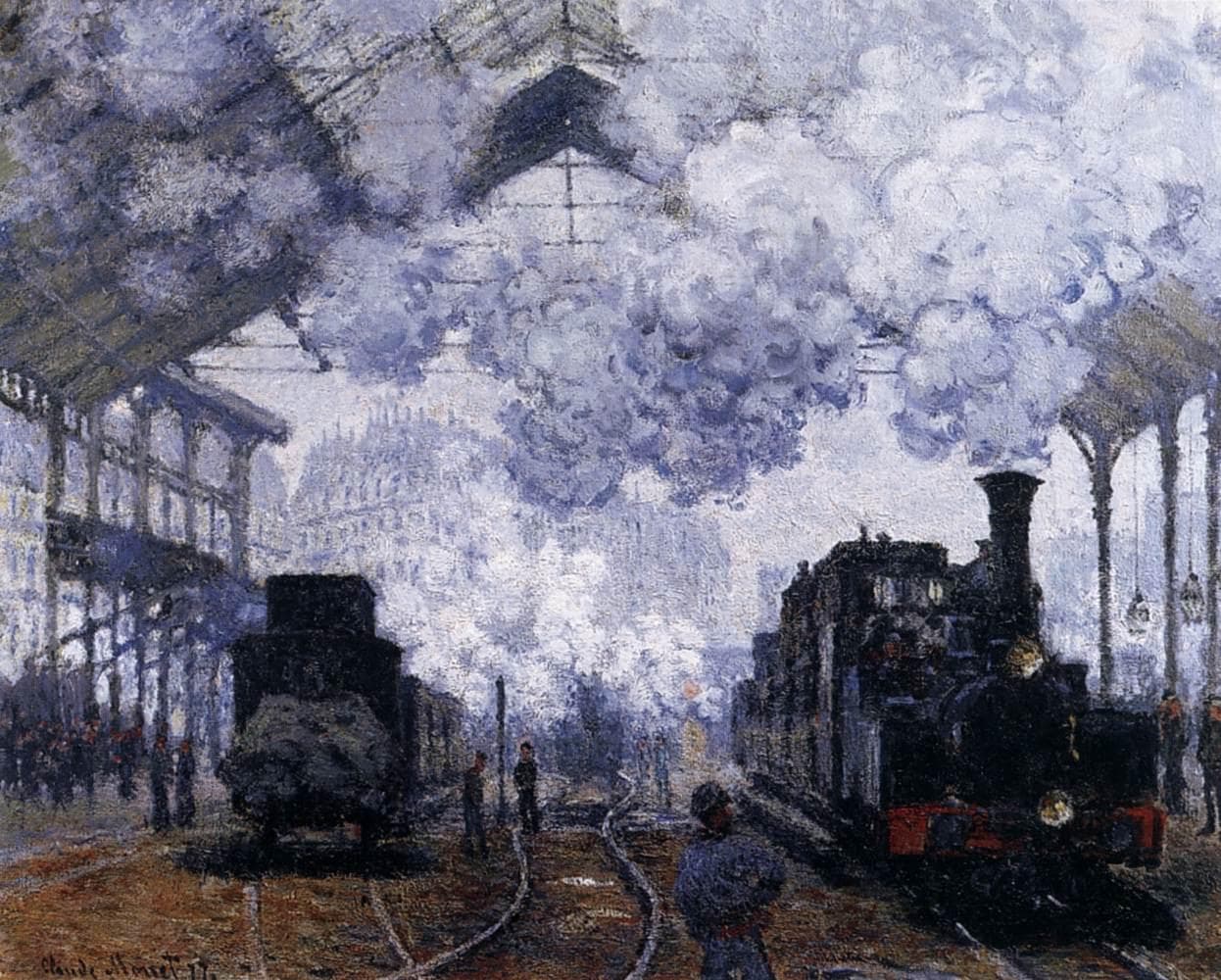
✦Arrival of the Normandy Train, Gare Saint-Lazare
1877 · Art Institute of Chicago
What the Gare Saint-Lazare paintings show
Saint-Lazare was the oldest and busiest railway terminus in Paris, the station for trains to the western suburbs, to Rouen and Le Havre and the Normandy coast. It was also Monet's own station: he took the train from it to and from Argenteuil, where he had lived since 1871. Its train shed, rebuilt in the 1850s and 1860s, was a vast roof of iron and glass over the platforms, open at the end to the tracks and the city.
Monet painted it from several points. Inside, he looked down the platforms toward the open end of the shed, so that the roof forms a great triangle or pair of slopes against a bright sky, with locomotives arriving or waiting below. Outside, he painted the tracks fanning out beneath the iron Pont de l'Europe, with the tall apartment buildings of the new Paris beyond.
In every view the real subject is steam. Locomotive smoke rises in blue, white and gray clouds, fills the roof, drifts through the sunlight, and softens the iron and stone into a single atmosphere. People appear as small dark marks: railwaymen, passengers on the platform.
How Monet came to paint the station
According to a story Renoir told years later, Monet dressed in his finest clothes, presented his card to the director of the Western Railway, and announced that he was the painter Claude Monet and had decided to paint the station. The director, impressed, gave him the run of the platforms, and the trains were stopped and their fireboxes stoked so that they would give off more smoke. How much of this is true is unknown, but Monet clearly did have permission to set up his easel inside the station and on the tracks.
He also had help from Gustave Caillebotte, who is said to have paid the rent on a small flat near the station, in the rue Moncey, which Monet used as a base. Caillebotte himself had painted the Pont de l'Europe in 1876, and Édouard Manet had shown a railway scene near the same spot in The Railway of 1873. The station and its surroundings were a subject of the moment.
How the versions differ
The twelve canvases vary in viewpoint, size and finish.
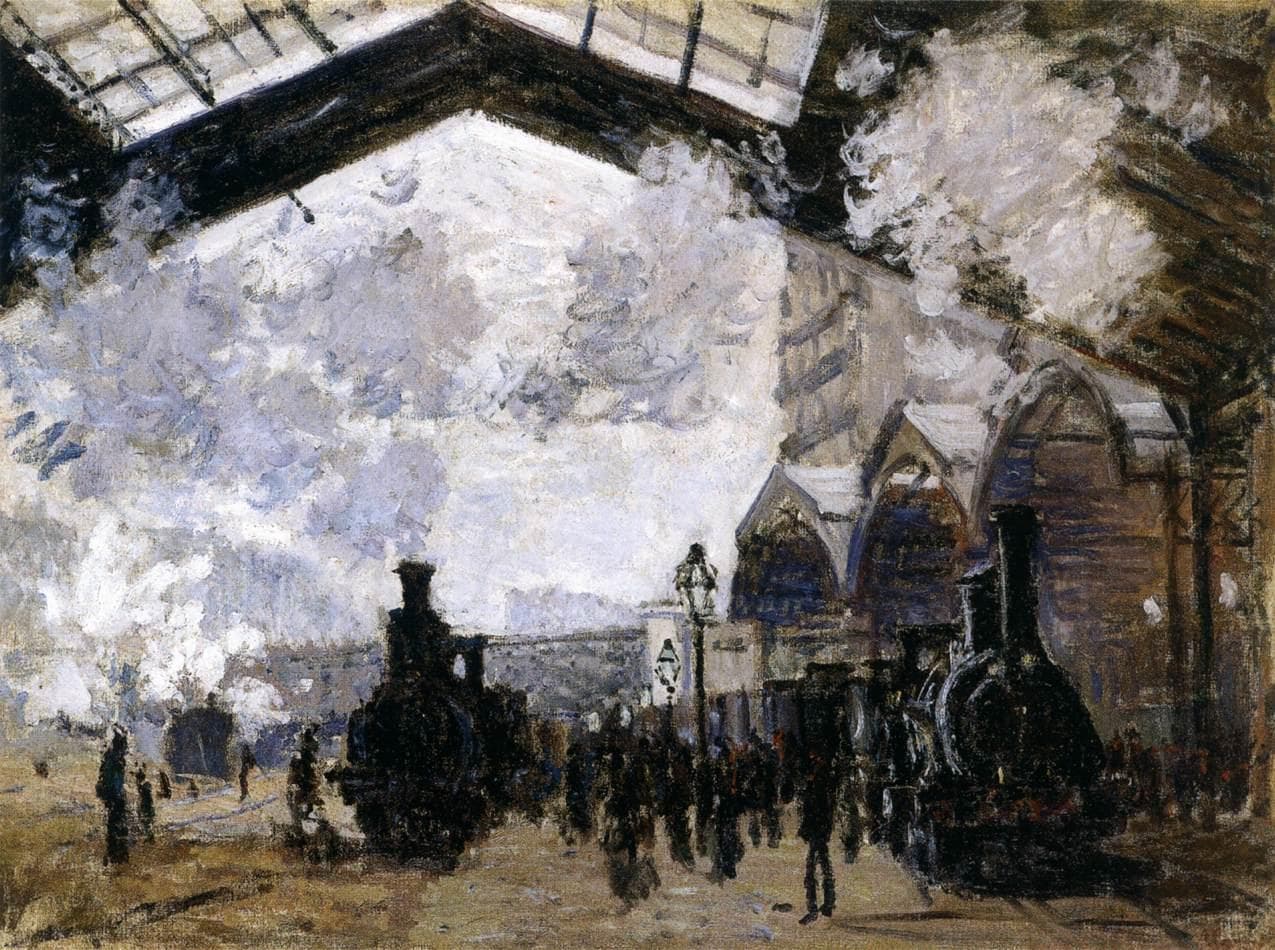
- Inside the shed: the Orsay's La Gare Saint-Lazare and the National Gallery's The Gare Saint-Lazare look along the platforms under the glass roof, with engines in a haze of steam and bright daylight beyond. The Orsay picture is the largest and most finished, about 75 by 104 centimeters.
- Arrivals: in Arrival of a Train at Harvard and The Train from Normandy in Chicago, a locomotive comes head-on toward us, its lamps and dark front framed by smoke.
- Outside, by the bridge: in the Marmottan's Pont de l'Europe, the iron bridge cuts across the top of the canvas, and a locomotive and its cloud of steam fill the center.
- Signals and tracks: other canvases look out over the tracks, with signals and points, toward the bridge and the city.
The light changes too, from bright winter sun striking the steam to gray days when the whole picture is a muted harmony of blue and brown. Some versions are worked up to a high finish; others are rapid, sketch-like studies.
How they were painted
Monet painted fast, on site, with the speed the subject demanded. He used broad, fluid strokes for the smoke, laying wet paint into wet paint so that the clouds of steam have soft edges, and crisper dark lines for the ironwork and engines. White and pale blue dominate. In places the canvas texture shows through thin paint; elsewhere, especially in the sunlit steam, the paint is thick.
Twelve canvases of one place in three months was something new for Monet. It anticipated the method of the 1890s, when he would paint the Haystacks, Poplars and Rouen Cathedral in long runs. But in 1877 the pictures still differ in viewpoint as well as light; the later series fix the viewpoint and change only the hour and weather.
The station and the new Paris
The pictures belong to the city Baron Haussmann had remade in the 1850s and 1860s. The Pont de l'Europe, completed in 1868, was a star-shaped iron bridge where six streets met above the tracks, and the apartment blocks behind it were brand new. Painting this district meant painting the most up-to-date Paris there was. Monet treated it exactly as he treated a riverbank at Argenteuil, as a place where light and moving air could be observed, and in doing so he made the machine age a fit subject for landscape painting.
The 1877 exhibition
Monet showed seven of the station paintings at the third Impressionist exhibition, in rooms on the rue Le Peletier in April 1877, hung together as a group. The critics were divided. Some mocked the subject; others saw it as the clearest statement yet of what the new painting was about. Émile Zola wrote that one could hear the rumble of the trains and see the smoke rolling under the roof, and that this was painting of today, finding in modern stations the poetry that earlier artists had found in forests and rivers.
Caillebotte bought the large Orsay picture. It came to the French state with his bequest in 1894, one of the paintings that made his gift so controversial, and it hung in the Musée du Luxembourg, then the Louvre and the Jeu de Paume, before reaching the Orsay in 1986.
Where to see Monet's Gare Saint-Lazare paintings
- Musée d'Orsay, Paris: La Gare Saint-Lazare, the largest version.
- Musée Marmottan Monet, Paris: Pont de l'Europe, Gare Saint-Lazare.
- National Gallery, London: The Gare Saint-Lazare.
- Art Institute of Chicago: The Train from Normandy.
- Harvard Art Museums (Fogg Museum), Cambridge, Massachusetts: Arrival of a Train.
- Landesmuseum Hannover: a view of the tracks with a signal.
- The remaining canvases are in private collections.
The station still operates, though the shed Monet painted has been altered. For more on Monet's Paris and his Argenteuil years, see Monet at Argenteuil; for other museums, Where to See Monet's Paintings; and for the painter, Claude Monet.
Questions & answers
How many Gare Saint-Lazare paintings did Monet make?
Monet painted twelve views of the Gare Saint-Lazare in Paris between January and April 1877. He showed seven of them at the third Impressionist exhibition in April 1877. The canvases vary in viewpoint, size and finish.
Where is Monet's La Gare Saint-Lazare?
The largest and best-known version, La Gare Saint-Lazare (1877), is in the Musée d'Orsay in Paris, from the bequest of Gustave Caillebotte. Other versions are in the Musée Marmottan, the National Gallery in London, the Art Institute of Chicago, the Harvard Art Museums and the Landesmuseum Hannover.
Why did Monet paint a train station?
The station was a modern subject, a temple of iron, glass and steam at the heart of the new Paris, and it gave him a moving, changing atmosphere to paint: clouds of smoke catching sunlight under a glass roof. It was also the station he used to travel between Paris and Argenteuil.
What did Zola say about the Gare Saint-Lazare paintings?
Émile Zola praised them in 1877 as truly modern painting. He wrote that you could hear the trains and see the smoke rolling under the roof, and that painters now had to find poetry in railway stations as their fathers had found it in forests and rivers.
Is the Gare Saint-Lazare series Monet's first series?
It is often called his first series, because he painted one place a dozen times in a few months. Unlike the later Haystacks or Rouen Cathedral, though, the station canvases change viewpoint as well as light; the strict single-viewpoint series began in 1890–91.