Impressionism
The Picnic
Claude Monet, 1865–66
The Picnic (Le Déjeuner sur l'herbe) in Moscow is Claude Monet's 1866 oil study for his huge, abandoned picnic painting, and the only record of the whole composition. It is in the Pushkin State Museum of Fine Arts, Moscow.
- Artist
- Claude Monet
- Date
- 1865–66
- Medium
- Oil on canvas
- Dimensions
- 130 × 181 cm
- Collection
- Pushkin State Museum of Fine Arts, Moscow, Russia
- Movement
- Impressionism
- Catalogue
- Wildenstein 62
What you are looking at
A party of fashionable young Parisians has spread a white cloth on the ground in a forest clearing. Around it, women in wide crinolines sit and stand with men in suits, boaters and bowler hats. At left a woman in a striking yellow-gold dress trimmed with black stands with her back to us; beside her another wears pale grey-white, and a man in a black coat with a red-banded hat looks on. The cloth is laid with a pie, a roast, bread, fruit and bottles of wine, and a small brown dog sniffs at the edge.
At the right, a young man in a dark waistcoat stretches out on the grass, propped on an elbow, and another, bearded, leans against a great beech tree whose pale, mottled trunk divides the right side of the picture. Further right, half hidden, a man in a top hat sits in the shade beside a heap of red and white cloth. Above them all, the forest canopy filters the sunlight into patches of bright yellow-green that fall on dresses, faces and the cloth. Monet signed and dated the canvas "66" at lower left.
This is Claude Monet's complete oil study, 130 by 181 centimeters, for a much larger painting he never finished. It is number 62 in Wildenstein's catalogue and is in the Pushkin State Museum of Fine Arts, Moscow.
Where and when
In 1865, aged 24, Monet set out to make his name at the Salon with a vast picture of modern life: a picnic in the forest of Fontainebleau, near the village of Chailly-en-Bière, with life-size figures on a canvas about four by six meters. The title deliberately echoed Édouard Manet's scandalous Déjeuner sur l'herbe of 1863, but Monet's version had no nude. It was a scene of ordinary contemporary leisure, painted with real sunlight.
He made studies in the forest during the spring and summer of 1865, including views of the road through the woods in Le Pavé de Chailly and of the great trees in The Bodmer Oak. His friend Frédéric Bazille posed for several of the men, and Camille Doncieux, Monet's future wife, for some of the women. This full study was worked up in the studio, probably over the winter, as a model for the big canvas.
How it was painted
Notice the light. Patches of sun fall through the leaves onto the white cloth and the dresses, and Monet paints them as separate, brighter shapes rather than as gradual shading. That is the problem he was trying to solve: how to paint figures outdoors in real, broken light, without the even studio illumination of academic painting.
The figures are built from broad, flat areas of color with crisp edges: the yellow dress is a few large planes of ochre and gold divided by black bands, the men's coats single masses of black. The still life on the cloth is painted with quick, thick touches, and the beech trunk is a pattern of cream, grey and dark green patches that reads as bark from a distance. The influence of Courbet, who visited and offered advice, is clear in the solidity of the figures; Manet's flat, frank color is there too.
What happened to the big picture
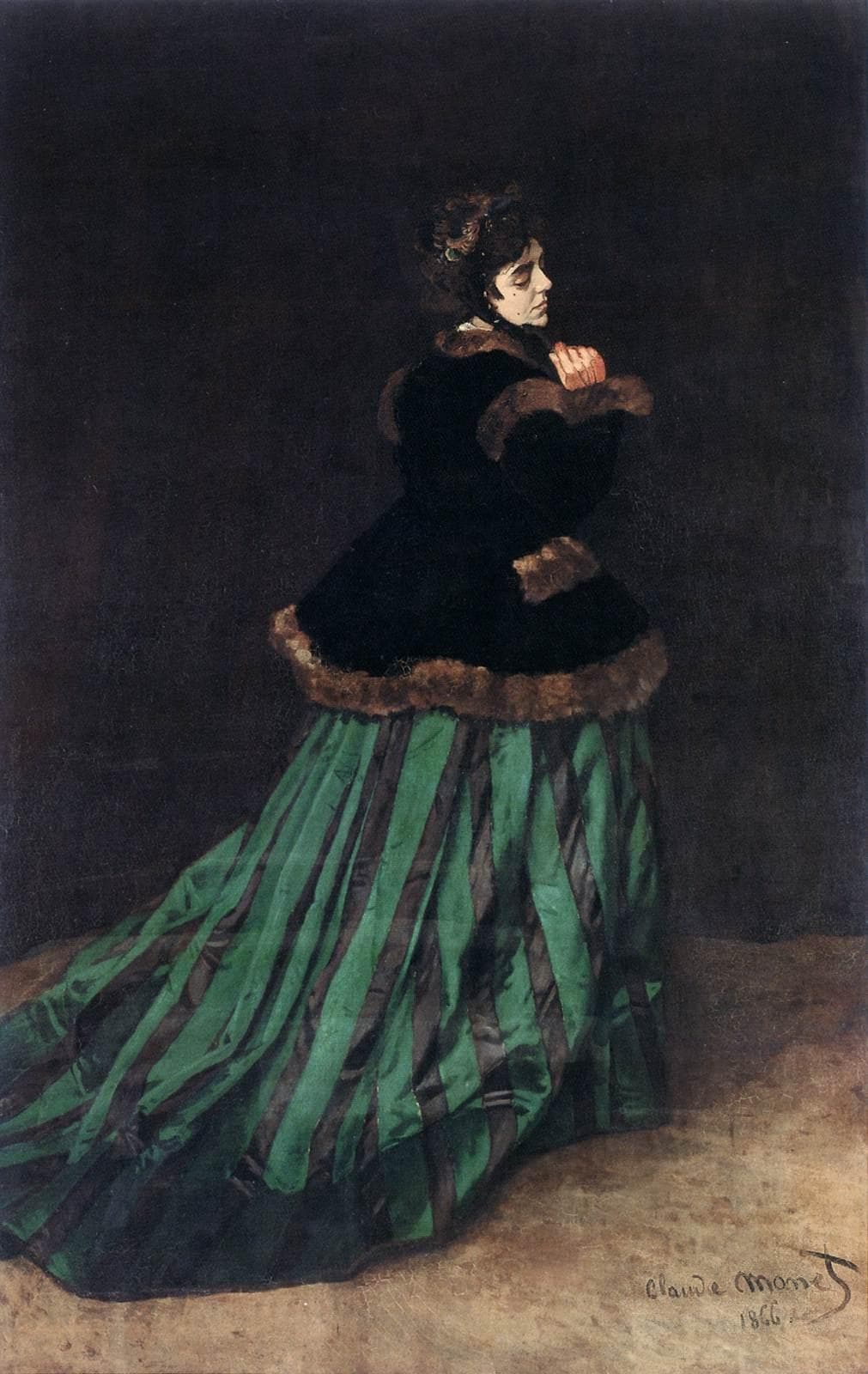
Monet could not finish the huge canvas in time for the Salon of 1866 and abandoned it, sending instead the portrait Camille (Woman in Green Dress). In 1878 he left the big canvas with his landlord at Argenteuil as security for unpaid rent; when he recovered it in 1884 it was damaged by damp. He cut it up, and two fragments survive in the Musée d'Orsay: see Le Déjeuner sur l'herbe (two surviving fragments) and the central fragment. The Moscow study is the only record of the whole design. The next year he tried again, on a smaller scale, with Women in the Garden.
Where to see it
The study is in the Pushkin Museum, Moscow, which received it from the collection of the merchant Sergei Shchukin, nationalized after the Russian Revolution. For other museums, see where to see Monet's paintings, and for the artist, Claude Monet.
Questions & answers
Where is Monet's Le Déjeuner sur l'herbe?
The complete oil study, dated 1866, is in the Pushkin State Museum of Fine Arts in Moscow (130 by 181 centimeters, Wildenstein 62). The two surviving fragments of the huge final canvas are in the Musée d'Orsay, Paris.
When and where was The Picnic painted?
Monet worked on the project in 1865–66, making studies in the forest of Fontainebleau near Chailly-en-Bière. This full-size composition study is dated 1866 and was finished in the studio as a model for the enormous final picture.
What does Monet's Picnic show?
A party of fashionably dressed young men and women picnicking on a white cloth in a sunlit forest clearing, with food, wine and a small dog, beneath a canopy of leaves and beside a large beech tree.
Why did Monet cut up his Déjeuner sur l'herbe?
He abandoned the giant canvas in 1866, later left it with a landlord as security for rent, and found it damaged by damp when he recovered it in 1884. He cut away the ruined parts and kept two fragments, now in the Musée d'Orsay.
More by the artist
Claude Monet

Bridge over a Pond of Water Lilies
Claude Monet · 1899

Woman with a Parasol – Madame Monet and Her Son
Claude Monet · 1875

Sunset in Venice
Claude Monet · 1908–12

La Grenouillère
Claude Monet · 1869

Beach in Pourville
Claude Monet · 1882

Springtime
Claude Monet · 1872

Boating on the River Epte
Claude Monet · 1890

The Seine at Asnières (Hermitage)
Claude Monet · 1873
Also painted in 1866
The same year
Kindred works
You may also study
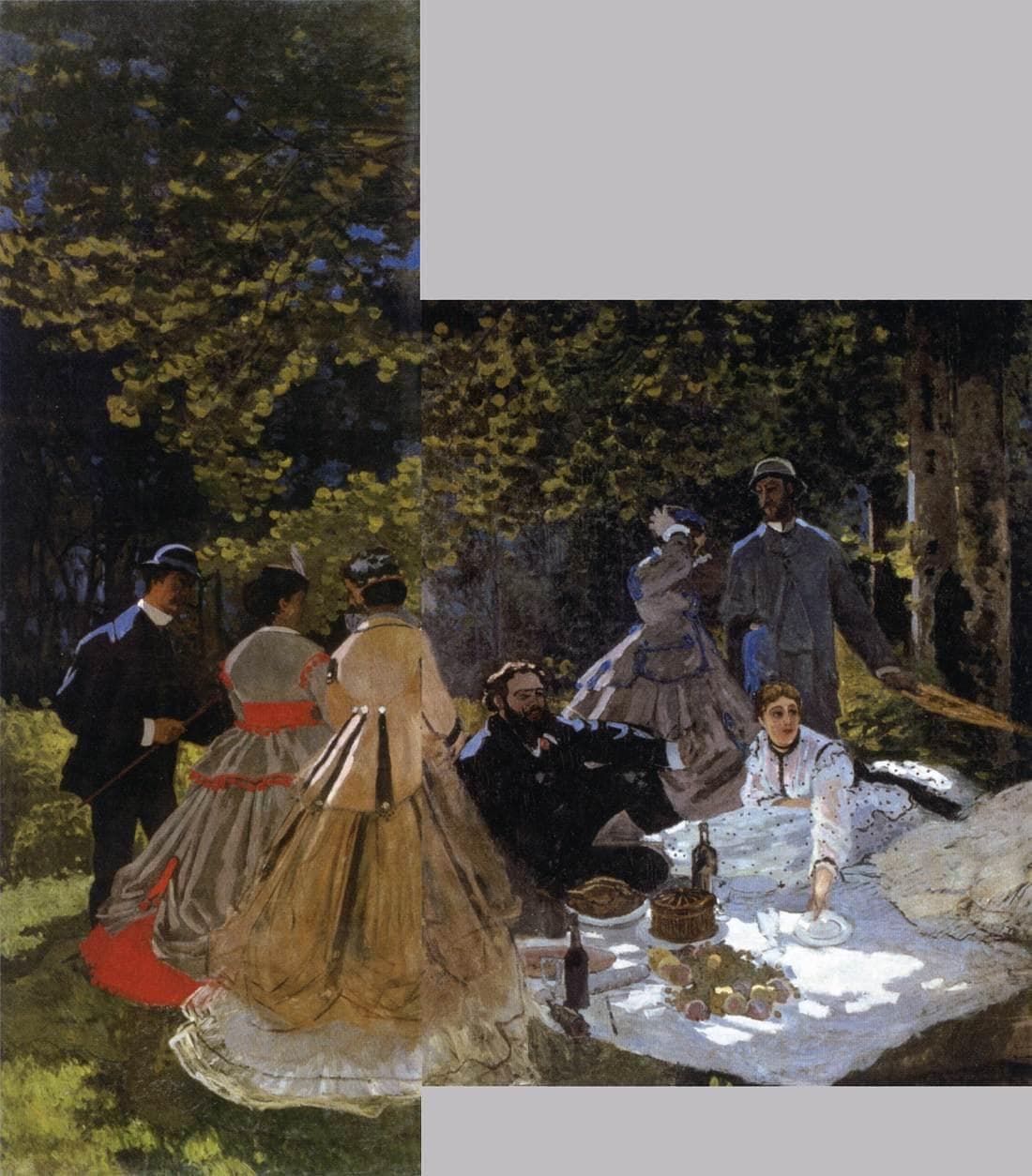
Le Déjeuner sur l'Herbe (two surviving fragments)
Claude Monet · 1865–66
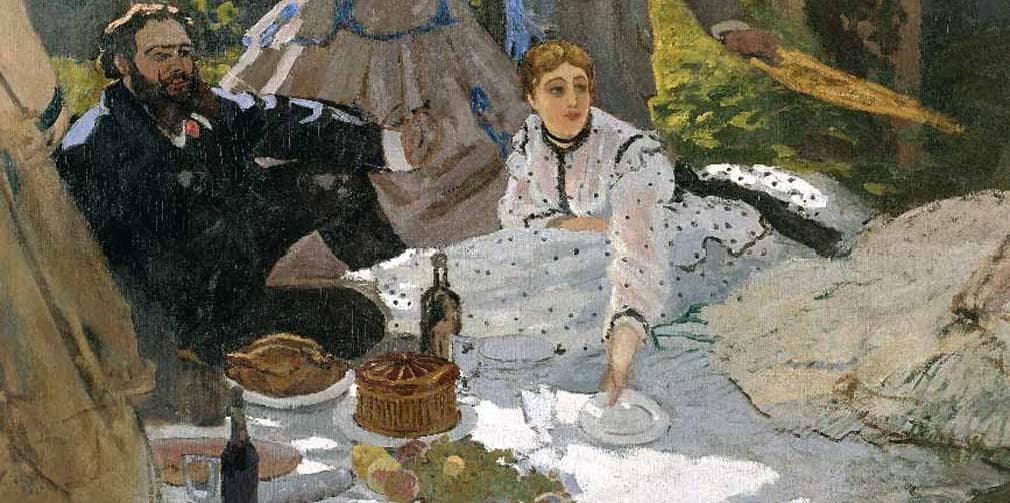
Picnic (detail)
Claude Monet · 1865–66
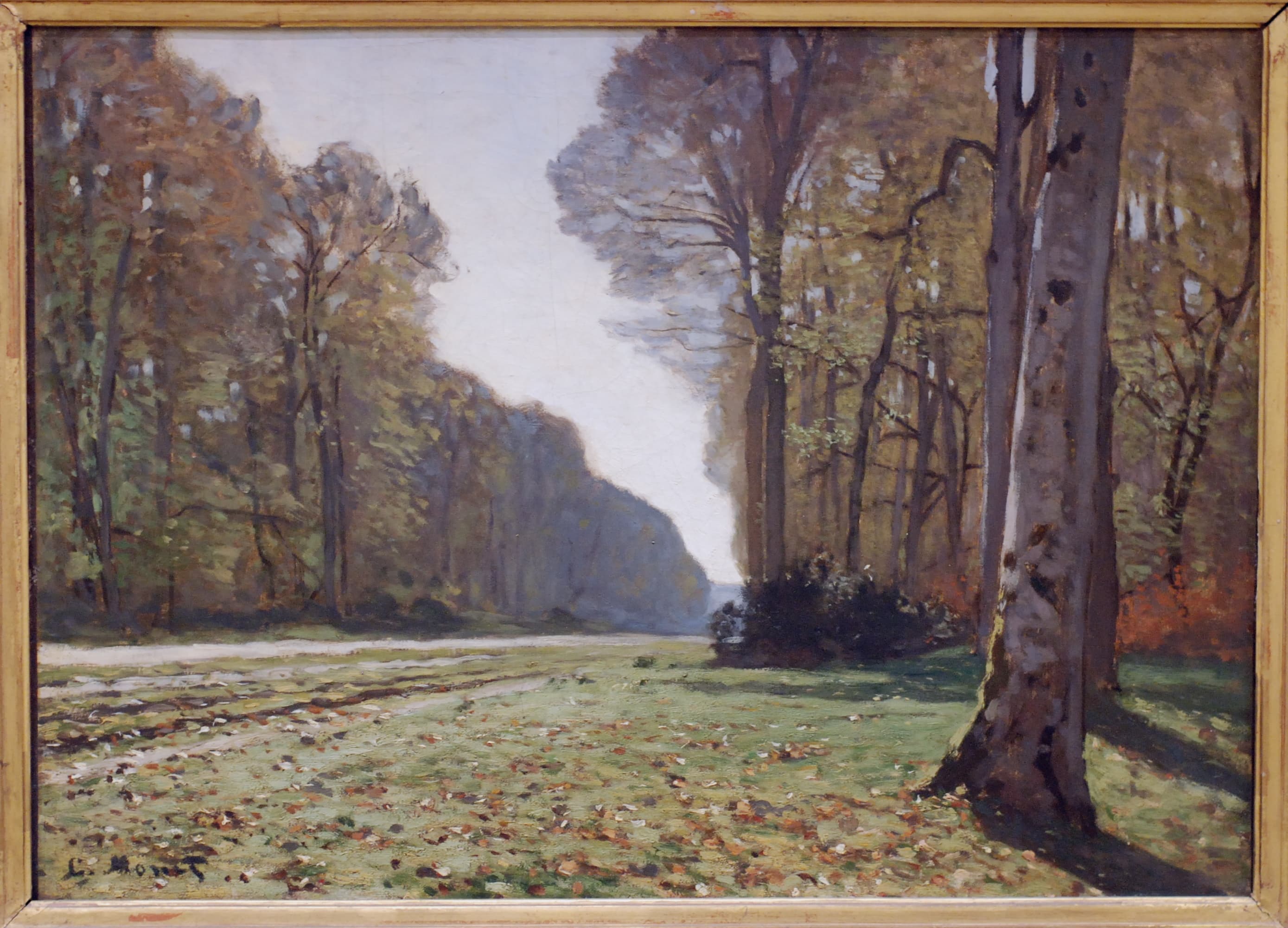
Le Pavé de Chailly
Claude Monet · c. 1865
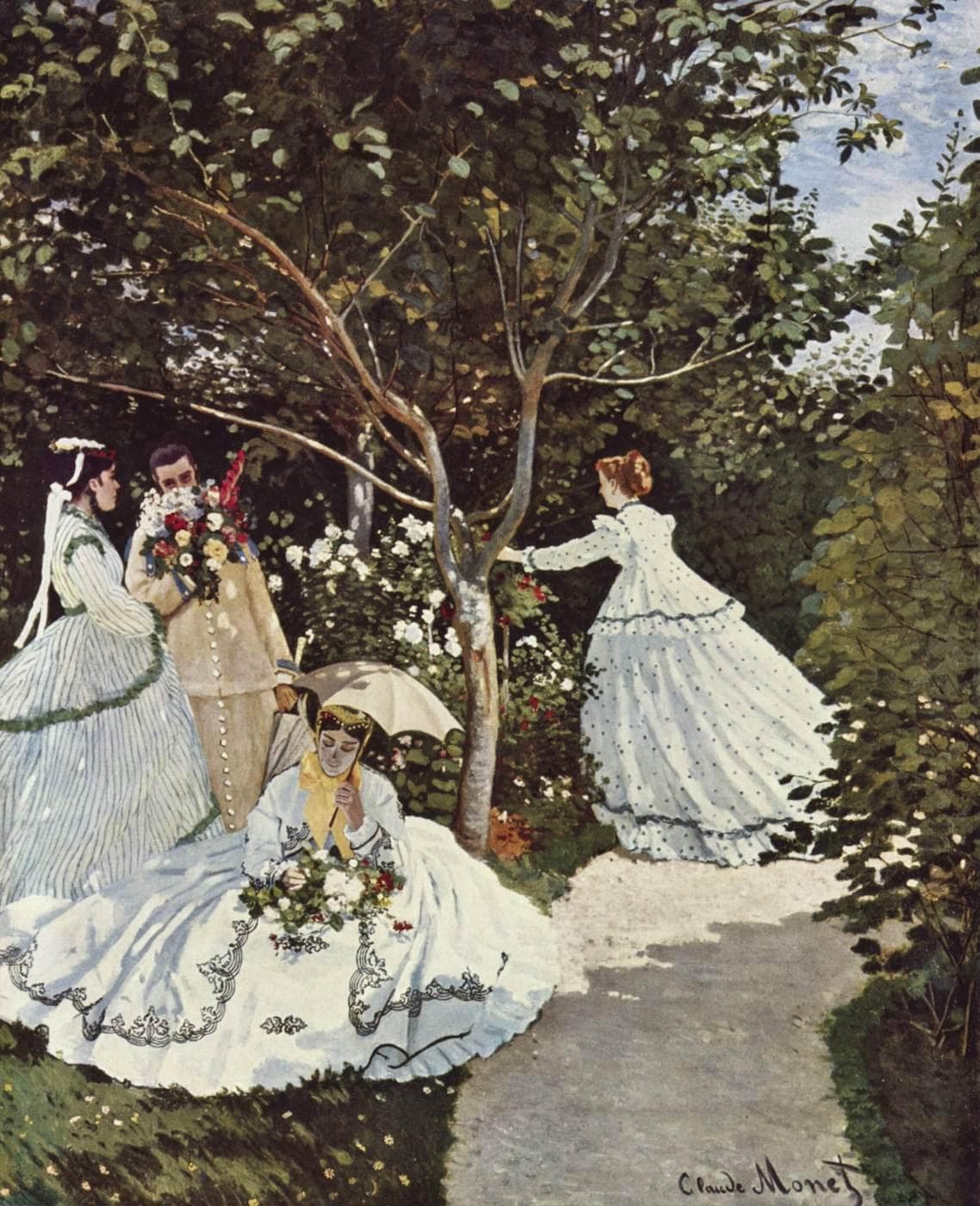
Women in the Garden
Claude Monet · 1866–67

Venus de Milo
Alexandros of Antioch · c. 150–125 BC

The Scream
Edvard Munch · 1893

Ophelia
John Everett Millais · 1851–52

The Great Wave off Kanagawa
Katsushika Hokusai · c. 1830–32