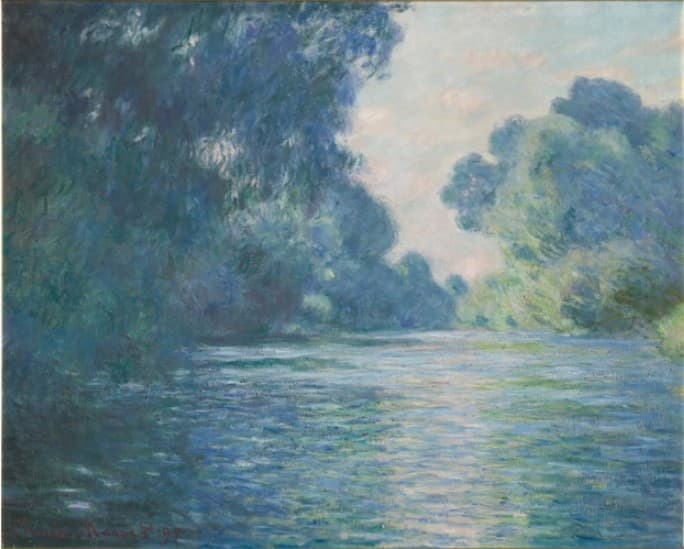
Series
Mornings on the Seine: Monet's Dawn Series at Giverny, 1896–97
Before sunrise, from a boat at the mouth of the Epte, Monet painted the same bend of the river as mist rose and the light came up.
Mornings on the Seine (Matinées sur la Seine) is a series of about twenty paintings by Claude Monet of a quiet branch of the Seine near his home at Giverny, painted at dawn from his boat-studio in the summer of 1896 and again in the summer of 1897. Each canvas shows the same view, trees on both banks and their reflections meeting in still water, as night mist turns to morning light.
The series falls between Rouen Cathedral and the London views, and it leads directly to the Water Lilies. Versions are now in the Musée d'Orsay in Paris (Arm of the Seine near Giverny), the Metropolitan Museum, the Art Institute of Chicago, the Museum of Fine Arts, Boston, the North Carolina Museum of Art and other museums and private collections.
The complete set
All 11 known canvases
From the catalogue raisonné. Works with a full close reading are marked ✦.
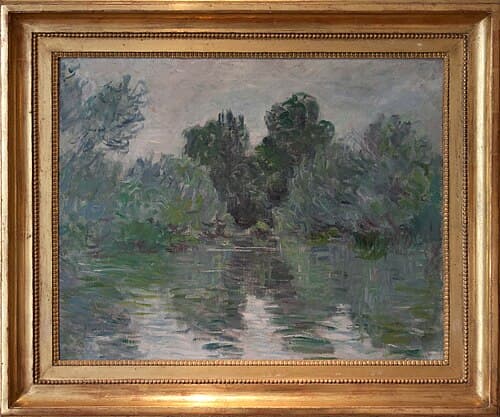
Un bras de Seine près de Vétheuil
1878 · Musée des Beaux-Arts de Tours
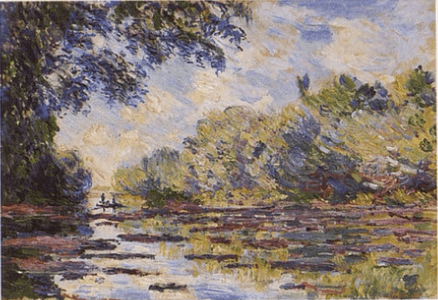
Bras de Seine à Giverny
1885 · Musée Marmottan Monet
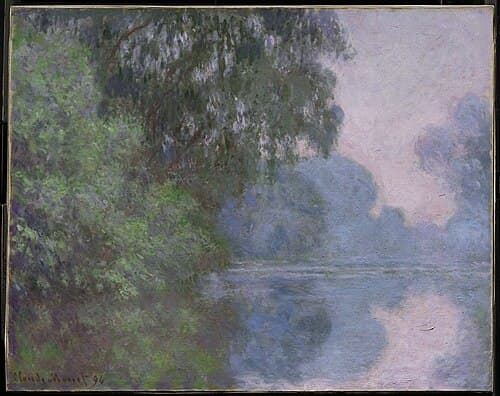
Morning on the Seine, near Giverny
1896 · Museum of Fine Arts Boston
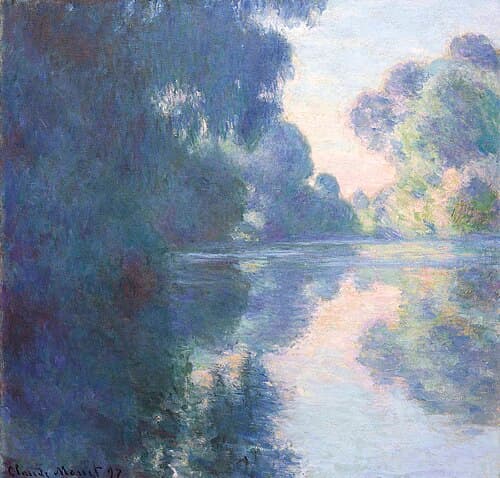
Matinée sur la Seine
1897 · Acquavella Galleries
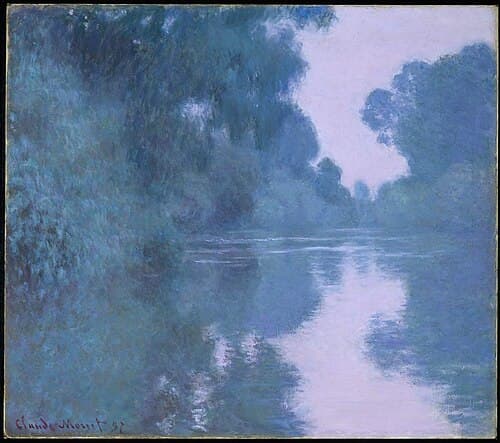
Morning on the Seine, near Giverny
1897 · Museum of Fine Arts Boston
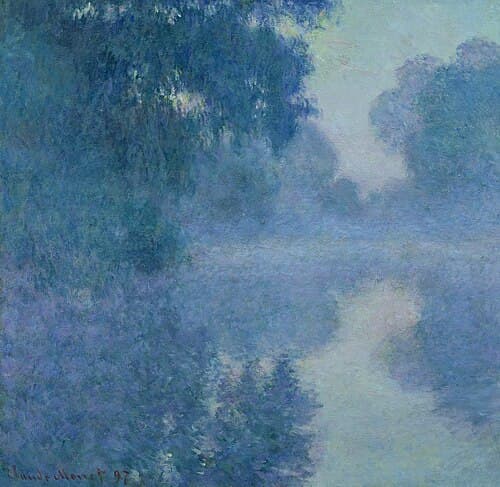
Bras de Seine près de Giverny, soleil levant
1897 · Musée Marmottan Monet
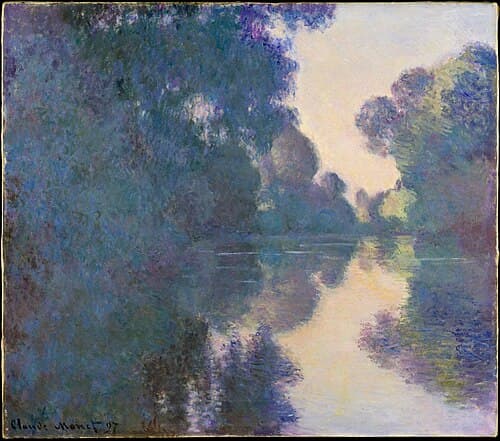
Morning on the Seine near Giverny
1897 · Metropolitan Museum of Art
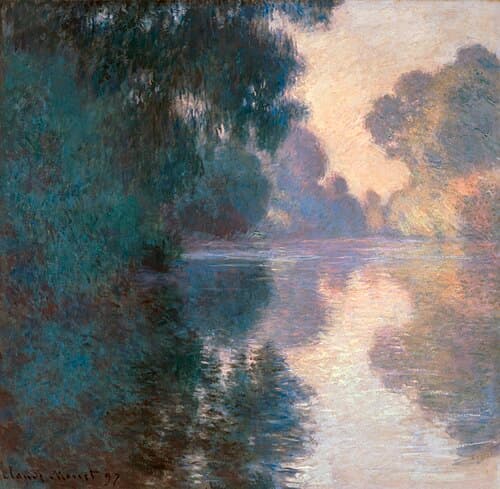
Morning on the Seine, Good Weather
1897 · White House
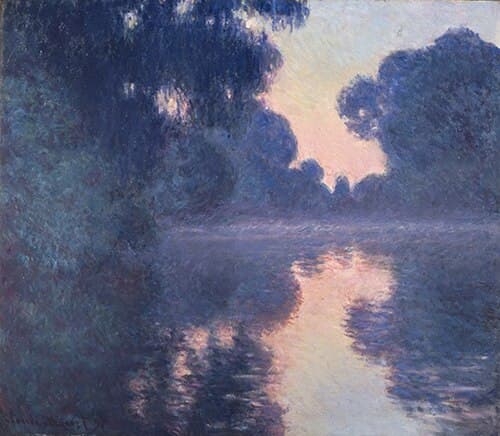
Morning on the Seine
1897 · Hiroshima Museum of Art
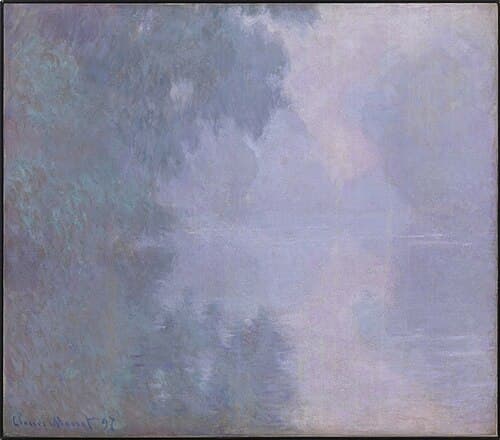
Morning on the Seine, Giverny
1897 · Mead Art Museum
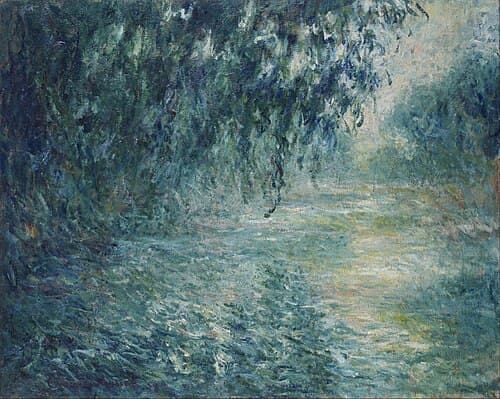
Morning on the Seine
1898 · National Museum of Western Art
What the Mornings on the Seine show
The view is of a backwater of the Seine where the river Epte flows into it, a short way from Monet's house. Trees hang over the water on both sides, the left bank often in deep shadow, the right more open, and the channel runs away from us toward a pale gap of sky. The water is so still that every tree is doubled. In most canvases the line between bank and reflection is hard to find, and the picture is divided almost symmetrically into an upper half of trees and sky and a lower half that repeats it.
Nothing happens. There are no boats, no people, no buildings. The only event is the arrival of light: the moment before dawn when everything is blue and violet, the first pink in the mist, the moment the sun begins to burn off the haze and the greens appear.
How Monet painted them
Monet began the series in the summer of 1896 and took it up again the following summer, when he worked on it intensively. A journalist, Maurice Guillemot, who visited Giverny in August 1897, described Monet getting up before half past three in the morning, walking down to the river and rowing out to his studio boat, where a group of canvases was waiting, around fourteen at the time of the visit. Each was assigned to a particular stage of the light, and Monet moved from one to the next as the morning advanced, painting each for only a short while before the effect changed.
The canvases are nearly square or slightly wider than they are tall, about 80 by 90 centimeters, and painted with soft, blended strokes and thin, often scraped layers. The colors are close in value: blues, mauves, lilacs and silvery greens, with only the faintest warmer notes. The mist is not painted over the landscape but built into it, so that trees and water merge.
How the versions differ
The series is a record of about two hours of each summer morning.
- Before dawn: the whole canvas is a deep, almost uniform blue-violet, with the trees as darker masses and barely any difference between bank and water.
- Mist: the scene is veiled in a pale gray-lilac haze, as in the Art Institute of Chicago's Branch of the Seine near Giverny (Mist).
- First light: a band of pink or pale yellow appears at the far end of the channel, and the haze begins to glow.
- Clearer morning: greens and blues separate, the reflections sharpen and the trees regain their shape, as in the Orsay's Arm of the Seine near Giverny.
Because the composition barely changes, small differences in color become the whole story. Seen side by side, the canvases work like a slow time-lapse.
Why the series matters
Monet's earlier series pictured a solid object under changing light: a stack of wheat, a row of poplars, a cathedral front. In the Mornings on the Seine the object almost disappears. Trees, water and air become a single surface of color, and the reflection is as important as the thing reflected. That is the direct prelude to the Water Lilies, in which, from 1903, Monet dropped bank and horizon altogether.
The series is also unusually quiet. After the effort of Rouen, where Monet had wrestled with stone and sunlight, these pictures are soft and contemplative. Critics at the time compared them to music, and to the poetry of the Symbolists, with its taste for dreamlike states and twilight. Monet's friend the critic Gustave Geffroy wrote about them in that vein.
Monet in 1896–97
The Mornings were not Monet's only work of these years. In the winters of 1896 and 1897 he went back to the Normandy coast, to Pourville and Varengeville near Dieppe, where he had painted in 1882, and made new series of the cliffs, the customs officer's cottage and the church at Varengeville. Pictures such as Steep Cliffs near Dieppe and On the Cliff at Dieppe share the soft, close-valued color of the river mornings.
Monet was then in his mid-fifties, prosperous, and increasingly able to choose his motifs and work on them for months. The winter on the coast and the summer on the river made a single cycle of work, and both fed into the exhibition of 1898. For the coastal pictures, see Étretat and the Normandy Coast.
Exhibition and sale
Monet showed a group of the Mornings on the Seine at his large exhibition at the Galerie Georges Petit in Paris in June 1898, together with other recent series. They were well received, and the series was dispersed to collectors over the following years.
Where to see Mornings on the Seine
- Musée d'Orsay, Paris: Arm of the Seine near Giverny (1897). See Monet at the Orsay.
- Metropolitan Museum, New York: Morning on the Seine near Giverny (1897). See Monet at the Met.
- Art Institute of Chicago: Branch of the Seine near Giverny (Mist) (1897). See Monet at the AIC.
- Museum of Fine Arts, Boston: a Morning on the Seine of 1897. See Monet at the MFA Boston.
- North Carolina Museum of Art, Raleigh: The Seine at Giverny, Morning Mists.
- Other canvases are in museums in Japan and in private collections.
The place today
The river at Giverny has changed since the 1890s, with new banks and roads, but the confluence of the Epte and the Seine is still a wooded, quiet spot a short walk from Monet's house. Visitors to the house and garden can follow the riverside paths and see the kind of light, early on a summer morning, that Monet painted. Earlier pictures of the Seine nearby, from the winter of 1893, include Ice Floes and Morning Haze, which show the same interest in mist and reflection in a different season.
For more on the place, see Giverny: Monet's House and Garden; for other museums, Where to See Monet's Paintings; and for the painter, Claude Monet.
Questions & answers
How many Mornings on the Seine did Monet paint?
Monet painted about twenty canvases of the Mornings on the Seine, working from his boat near Giverny in the summers of 1896 and 1897. Counts vary slightly depending on which closely related views are included.
Where were the Mornings on the Seine painted?
On a quiet arm of the Seine near the mouth of the river Epte, a short distance from Monet's house at Giverny in Normandy. Monet painted from his studio boat, moored in the channel, before and just after sunrise.
Where can I see Monet's Mornings on the Seine?
Versions are in the Musée d'Orsay in Paris, the Metropolitan Museum in New York, the Art Institute of Chicago, the Museum of Fine Arts, Boston, the North Carolina Museum of Art and other museums, with some in private collections.
What time did Monet paint the Mornings on the Seine?
At dawn. A visitor in August 1897 reported that Monet rose before 3:30 a.m. to reach his boat in the dark and worked on a series of canvases in turn as the mist lifted and the light grew, finishing in the early morning.
How do the Mornings on the Seine relate to the Water Lilies?
They are the bridge between them. In the Mornings on the Seine, trees and their reflections merge into one surface of color with almost no subject. In the Water Lilies, begun as a series soon after, Monet dropped the bank and sky entirely and painted only the surface of water.