Museum
Monet at the Orangerie: The Water Lilies Rooms in Paris
Two oval rooms, eight panoramic canvases and no corners: the Water Lilies Monet gave France the day after the Armistice, and how to see them.
The Monet Orangerie rooms hold Claude Monet's Water Lilies (Nymphéas) cycle, eight huge compositions of his Giverny pond that he gave to the French state in 1918 and that were installed, after his death, in two oval galleries of the Musée de l'Orangerie in the Tuileries Garden, Paris, opened in May 1927. Each composition is about two meters high, the longest close to seventeen meters, and together they wrap the walls in roughly ninety meters of painted water, sky and reflection.
The Musée de l'Orangerie water lilies are the culmination of thirty years of work on one motif and the closest Monet came to a single, total work of art. The museum holds nine Monets in all: the eight Grandes Décorations and one earlier canvas of Argenteuil. This page explains what you are looking at, how the rooms came to be and how to visit.
The collection
All 7 works in the collection
From the catalogue raisonné. Works with a full close reading are marked ✦.

The Water Lilies - Clear Morning with Willows
1920
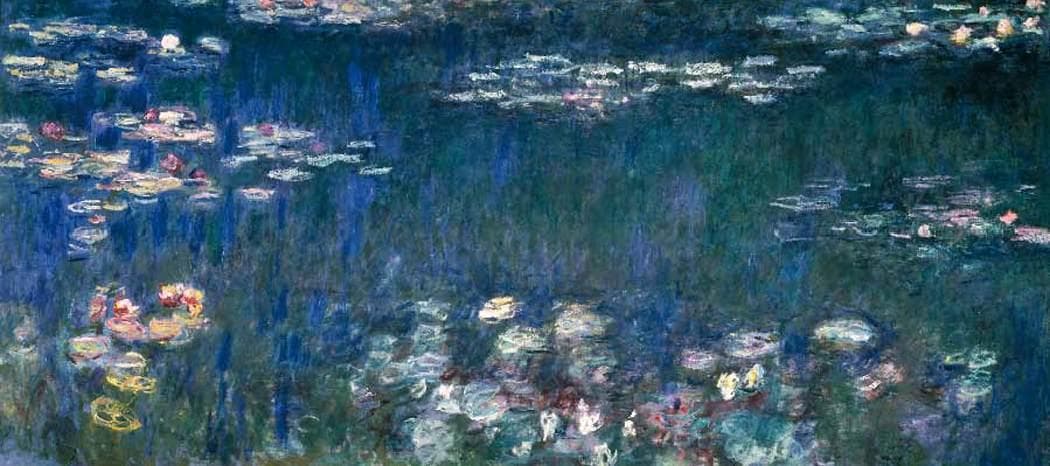
✦The Water Lilies - Green Reflections
1920

The Water Lilies - Morning
1920
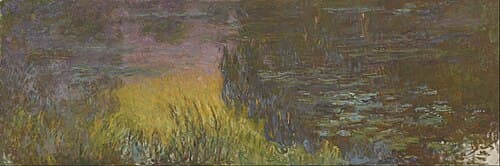
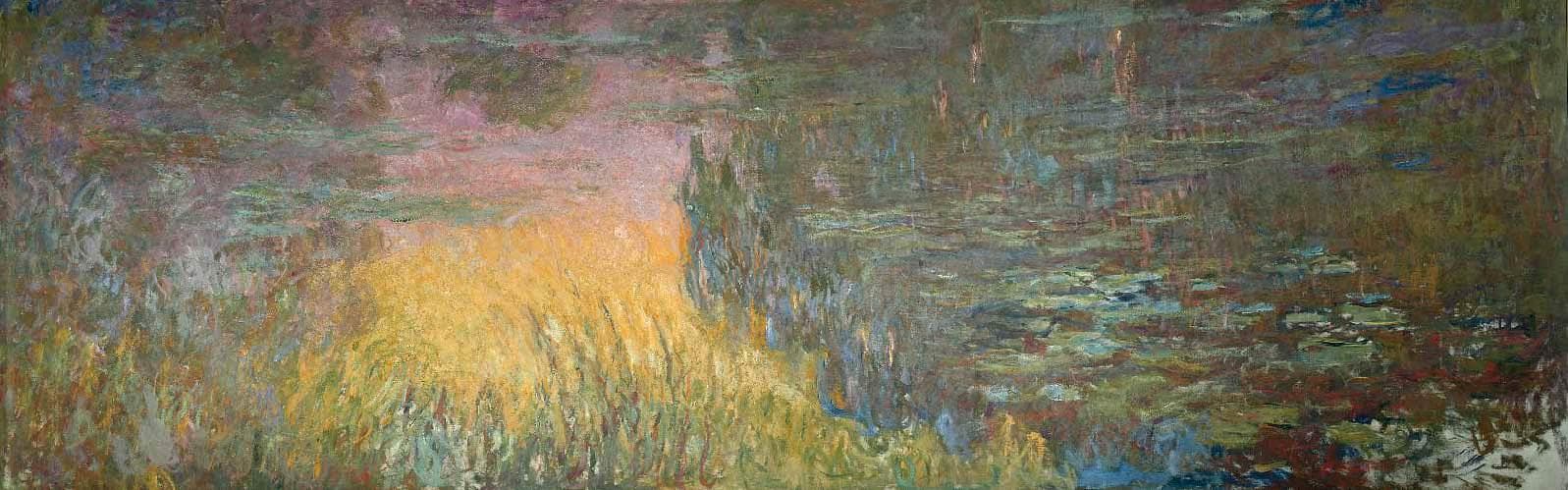
✦The Water Lilies - Setting Sun
1920

The Water Lilies - The Two Willows
1920
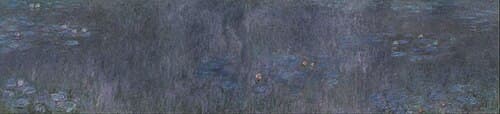
The Water Lilies - Tree Reflections
1920

The clouds
1920
A gift for peace
On 12 November 1918, the day after the Armistice ended the First World War, Monet wrote to his old friend Georges Clemenceau, then prime minister, offering two of his large water-lily panels to the nation as a monument to the victory. Clemenceau went to Giverny and persuaded him to think bigger. Over the next years the gift grew into a whole decorative cycle, and in April 1922 Monet signed a formal deed of donation. The state agreed to house the paintings in the Orangerie, a nineteenth-century greenhouse for orange trees at the western end of the Tuileries Garden, rebuilt to Monet's specifications.
Monet kept working on the panels until his death at Giverny on 5 December 1926, aged eighty-six. He repainted them, held back from delivering them, and despaired over his failing eyesight; his cataract operation in 1923 delayed the work further. Only after he died were the canvases taken to Paris. The rooms opened to the public on 17 May 1927.
What you are looking at
The two rooms are oval, lit from above by natural daylight through a glass ceiling, and the canvases are mounted directly on the curved walls, so there are no corners and no fixed point of view. Monet wanted the visitor to feel surrounded by water, with, as he put it, the illusion of an endless whole, a wave without horizon and without shore. The two ovals together trace the shape of the infinity sign, and they are aligned east to west, along the path of the sun.
Room 1 holds four compositions in which the pond is seen largely without the trees around it: Morning, Clouds, Green Reflections and Setting Sun. In Water Lilies: Green Reflections the surface is a deep green-blue field scattered with lily pads and pink blossoms, the reflections of overhanging foliage falling into it as dark vertical shadows. In Water Lilies: Setting Sun the pond catches the low evening light, gold and orange flaring in the middle of a violet and blue surface. The room moves from morning on one side to evening on the other.
Room 2 brings in the trees. Tree Reflections, Clear Morning with Willows, Morning with Willows and The Two Willows frame the water with the dark, heavy trunks of weeping willows, whose trailing branches hang down into the picture like curtains. The Two Willows, the largest composition, runs across one end wall.
Look close and the paint is surprisingly rough: thick, dragged strokes, scumbled layers, bare passages where earlier colors show through. Step back to the middle of the room and it resolves into water, sky, cloud, lily and reflection. That double experience, abstract surface up close and immersive illusion at a distance, is what made the cycle so important to painters after 1945.
Rediscovery
The rooms were not an immediate success. In 1927 the late Monet seemed old-fashioned to a Paris interested in Cubism and Surrealism, and the Orangerie was often nearly empty. During the Second World War the rooms were damaged, and afterward the museum's upper floor was used for other collections. The paintings' reputation changed in the 1950s, when American Abstract Expressionists and their critics saw in the huge, edgeless canvases a forerunner of their own work. The painter André Masson called the Orangerie the Sistine Chapel of Impressionism.
In the 1960s the Orangerie installed the collection of the dealer Paul Guillaume and his widow Domenica Walter above the Monet rooms, cutting off the overhead daylight. A long renovation from 2000 to 2006 removed that floor, restored the skylights and moved the Walter-Guillaume collection to a new lower level. Since 2006 the Water Lilies have been seen again as Monet intended, in changing natural light.
The other Monet at the Orangerie
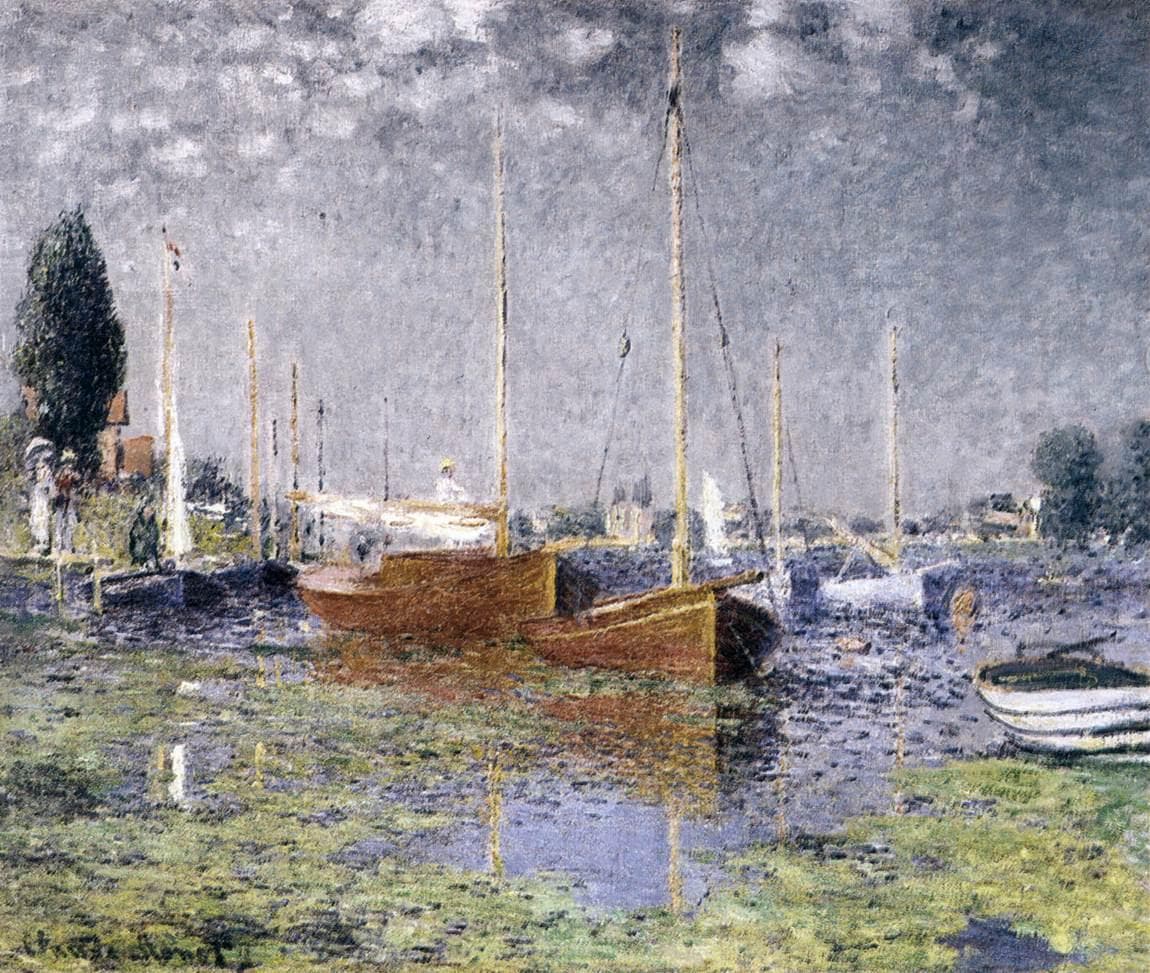
Downstairs, the Walter-Guillaume collection includes one further Monet: Red Boats at Argenteuil (1875), two red-hulled sailing boats moored on the Seine under a gray sky. It is worth seeing for the contrast. Fifty years separate it from the Water Lilies, and you can measure in a few steps how far Monet traveled from the quick, bright river views of Argenteuil to the vast, slow surfaces upstairs.
Visiting the Orangerie Water Lilies
- Where: the Musée de l'Orangerie is in the Jardin des Tuileries, on the Seine side of the Place de la Concorde, in Paris's 1st arrondissement.
- Opening times: the museum's website lists it as open Monday and Wednesday to Sunday, 9 am to 6 pm, and closed on Tuesdays. Check the official site before you go; hours change on holidays and during exhibitions, and booking a ticket online in advance is recommended.
- What to see first: go straight up to the two oval Water Lilies rooms on the main floor. Spend time in the center of each room, then walk the walls close up. Go early or late in the day: the rooms are quietest then, and the daylight changes the colors noticeably.
- Then: the Walter-Guillaume collection on the lower level, with Renoir, Cézanne, Matisse, Picasso, Soutine and the single Argenteuil Monet.
Current exhibition (verified on the museum's website): Monet, painting time (Monet, peindre le temps), from 30 September 2026 to 25 January 2027, marks the centenary of Monet's death with almost forty paintings, mostly lent by the Musée d'Orsay and the Musée Marmottan Monet. It traces his treatment of time from the Impressionist years through the series to the last Water Lilies, and it then travels to Tate Modern in London, from 25 February to 27 June 2027.
Where the Water Lilies story continues
The Orangerie panels are the end of the Water Lilies series, about 250 paintings of the pond made from 1897 onward. Many of the studies and abandoned panels from the last years are at the Musée Marmottan Monet, a short metro ride away, and others are in New York, Cleveland, Saint Louis, Kansas City and Zurich. To see the place itself, visit Monet's garden at Giverny, about an hour from Paris. For other museums, see where to see Monet's paintings.
Questions & answers
How many Water Lilies are in the Musée de l'Orangerie?
The Orangerie holds eight Water Lilies compositions by Claude Monet, arranged four to a room in two oval galleries. Each is about two meters high and between roughly six and seventeen meters long; together they cover about ninety meters of wall. The museum also has one earlier Monet, Red Boats at Argenteuil.
Why are Monet's Water Lilies in the Orangerie?
Monet offered water-lily panels to France on 12 November 1918, the day after the Armistice, as a monument to peace. His friend Georges Clemenceau helped turn the gift into a full cycle, and the state rebuilt the Orangerie in the Tuileries to Monet's design. The rooms opened in May 1927.
Is the Orangerie open on Tuesdays?
No. According to the museum's website, the Musée de l'Orangerie is closed on Tuesdays and open the other days from 9 am to 6 pm. Hours can change for holidays and exhibitions, so check the official site and book a ticket before visiting.
How long do you need at the Orangerie?
Allow at least an hour: thirty to forty-five minutes in the two Water Lilies rooms, where it is worth sitting and watching the daylight change, and time for the Walter-Guillaume collection downstairs. During the 2026–27 Monet exhibition, add another hour.
What is the Monet exhibition at the Orangerie in 2026?
Monet, painting time (Monet, peindre le temps) runs at the Musée de l'Orangerie from 30 September 2026 to 25 January 2027, for the centenary of Monet's death. It gathers almost forty paintings, mainly from the Orsay and Marmottan, then travels to Tate Modern, London, in February 2027.