Image: Los Angeles County Museum of Art; photograph by a Wikimedia Commons contributor · Public domain · via Wikimedia Commons
Impressionism
Nymphéas (Water Lilies), c. 1897–98
Claude Monet, c. 1897–98
Nymphéas is one of Claude Monet's first paintings of water lilies, made about 1897–98: two pale blossoms and a scatter of lily pads floating on dark water in his pond at Giverny. It is in the Los Angeles County Museum of Art.
- Artist
- Claude Monet
- Date
- c. 1897–98
- Medium
- Oil on canvas
- Dimensions
- 66.04 × 104.14 cm
- Collection
- Los Angeles County Museum of Art, Los Angeles, United States
- Movement
- Impressionism
- Catalogue
- Wildenstein 1501
What you are looking at
There is no bank, no sky and no horizon: only water seen from close above. Two lily blossoms, one higher and to the right, one just below it, glow pale yellow and white with pink and orange at their centers. Around them float broad, flat lily pads, painted in blue-green and grey-blue with lighter edges where the light catches their rims. One big pad lies at the left, another at the center bottom, a third at the lower right, cut off by the frame. The water between them is dark, a murky mix of olive green, violet and brown.
The light seems to come from above and slightly to the left. The pads reflect the sky as a cool, milky blue, while the water absorbs it. The blossoms are the only warm notes, and Monet gives them a slight halo of pink and red where they meet the dark water.
The thing to notice is the cropping. Pads at the edges are cut off, and the composition has no center of gravity except the two flowers. This is not a view of a pond but a fragment of its surface, and the frame could have been placed anywhere.
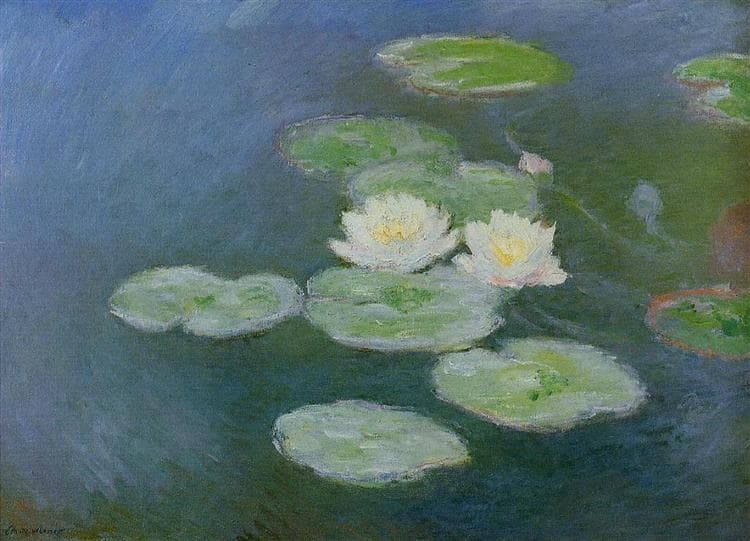
The mood is quiet and slightly somber. The water is not the bright mirror of the later pond pictures but a deep, shadowed pool, and the blossoms seem to float in a pocket of light. It may be late in the day; the companion study at the Marmottan is explicitly an evening effect.
Where and when it was painted
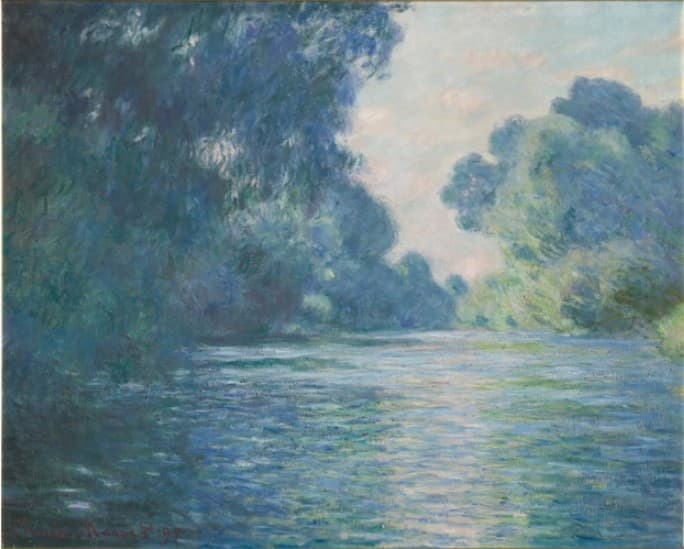
Monet bought a plot of land across the road and railway line from his house at Giverny in 1893 and, after obtaining permission to divert a stream, dug a pond there and planted it with water lilies. At first he painted the garden rarely. In the summer of 1897, the same summer as his dawn views of the Seine, such as Arm of the Seine near Giverny, he made a small group of close-up studies of the lilies on the pond. This canvas is one of them, together with Water Lilies, Evening Effect at the Musée Marmottan Monet.
These early studies came before the famous Japanese bridge pictures of 1899–1900, such as Bridge over a Pond of Water Lilies at the Met, and long before the great decorations of the 1910s and 1920s. For the full arc of the subject, see Monet's Water Lilies, and for the house and garden, Giverny: Monet's house and garden.
How it was painted
The canvas measures 66.04 by 104.14 centimeters (26 by 41 inches); some databases list those numbers as centimeters by mistake. The horizontal format suits the drifting arrangement of pads. Monet paints each pad as a broad, flattened oval with a few strokes, and the blossoms with thick, small, curling touches, so the flowers stand out physically from the surface as well as by color. The dark water is thin and dragged, leaving the brushmarks visible.
Compared with his later Water Lilies, this early canvas is darker and more contained. The flowers and pads are still distinct objects, described one by one; the reflections of sky and trees that would dominate from 1903 onward, in pictures such as Water Lilies (1904), are barely present. The subject is already clear, though: a horizontal surface seen from above, without a horizon.
Monet seems to have regarded these first lily canvases as private experiments. He did not build an exhibition around them, and it was 1909 before he showed a group of pictures of the pond's surface alone. Looking back at them now, they are the first sketches for the subject that would occupy the last three decades of his life.
Where to see it
The painting is catalogued by Wildenstein as number 1501 and entered the Los Angeles County Museum of Art's collection in 1962 (accession M.62.8.13). Check the museum's website for whether it is currently on view. See where to see Monet's paintings and the Claude Monet page.
Questions & answers
Where is Monet's 1897 Nymphéas?
It is in the Los Angeles County Museum of Art (LACMA), accession M.62.8.13, in the collection since 1962. Check LACMA's website for whether it is currently on view.
How big is LACMA's Monet Nymphéas?
It measures 26 by 41 inches, or 66.04 by 104.14 centimeters. Some online databases list it as 26 by 41 centimeters, which is an error: the figures are inches.
When did Monet first paint water lilies?
He dug his water-lily pond at Giverny in 1893 and made his first close-up studies of the lilies around 1897–98, including this canvas and Water Lilies, Evening Effect at the Marmottan. The Japanese bridge pictures followed in 1899–1900.
What does this Nymphéas show?
Two pale yellow and white water lilies and several blue-green lily pads floating on dark olive and violet water, seen from close above with no bank, sky or horizon.
More by the artist
Claude Monet

Bridge over a Pond of Water Lilies
Claude Monet · 1899

Woman with a Parasol – Madame Monet and Her Son
Claude Monet · 1875

Sunset in Venice
Claude Monet · 1908–12

La Grenouillère
Claude Monet · 1869

Beach in Pourville
Claude Monet · 1882

Springtime
Claude Monet · 1872

Boating on the River Epte
Claude Monet · 1890

The Seine at Asnières (Hermitage)
Claude Monet · 1873
Also painted in 1897
The same year
Kindred works
You may also study
Water Lilies, Evening Effect
Claude Monet · 1897
Arm of the Seine near Giverny
Claude Monet · 1897
Water Lilies (1904)
Claude Monet · 1904
Water Lily Pond, Green Harmony
Claude Monet · 1899

The Scream
Edvard Munch · 1893

Ophelia
John Everett Millais · 1851–52

The Great Wave off Kanagawa
Katsushika Hokusai · c. 1830–32
The Birth of Venus
Sandro Botticelli · c. 1484–1486