Image: Uffizi Gallery, via Google Arts & Culture · Public domain · via Wikimedia Commons
Early Renaissance
The Birth of Venus
Sandro Botticelli, c. 1484–1486
The Birth of Venus is Sandro Botticelli's painting of the goddess Venus arriving on a scallop shell, blown ashore by the winds, made in Florence around 1484–1486. It hangs in the Uffizi Gallery in Florence.
- Artist
- Sandro Botticelli
- Date
- c. 1484–1486
- Medium
- Tempera on canvas
- Dimensions
- 172.5 × 278.5 cm
- Collection
- Uffizi Gallery, Florence, Italy
- Movement
- Early Renaissance
What you are looking at
Venus stands on the edge of a giant scallop shell that has carried her across a pale green sea. She is naked, her weight on one leg, one hand at her breast and the other gathering her long golden hair across her lap. To the left, two winged wind gods, locked in an embrace, blow her toward the shore; roses tumble through the air around them. To the right, a young woman in a white dress patterned with cornflowers runs forward with a flowered cloak, ready to cover the goddess as she lands.
Nothing here is meant to be literal. The sea is a pattern of small V-shaped waves, the shoreline is a few flat inlets, and the shell floats rather than sails. Venus's neck is too long, her shoulders slope impossibly, and her left arm joins her body at an angle no anatomy book would accept. Botticelli cared about line more than mass: the contour of the body, the rhythm of the drapery, the streaming hair. The result is weightless.
Who is in the painting?
- Venus, goddess of love and beauty, born from the sea foam. In the myth told by the Greek poet Hesiod she rose from the sea after the castration of the sky god Uranus, and drifted to the island of Cyprus (or Kythera).
- Zephyr, the west wind, cheeks puffed, and the female figure holding him, usually identified as Aura (a breeze) or Chloris, the nymph Zephyr married, who became Flora.
- A Hora, one of the goddesses of the seasons, probably Spring, with myrtle around her neck and a sash of roses.
Botticelli's direct source was probably poetry rather than ancient art. Angelo Poliziano, the Medici court poet, described a carved scene of Venus's birth in his Stanze (1475–78), including the shell, the zephyrs and the Horae waiting on the shore. The painting reads almost as an illustration of those lines.
How it was made
Botticelli (c. 1445–1510) painted in tempera, pigment bound with egg, on canvas. That was unusual for a large picture in Florence at the time, when panels were standard, and suggests the painting was made for a villa or a private room rather than a church. He used gold to pick out highlights in Venus's hair, the wings of the winds and the leaves of the orange trees on the right. A layer of gesso under the paint gives the whole surface its chalky, luminous tone.
The pose of Venus comes from antiquity. It is the Venus Pudica ("modest Venus") type, covering herself with her hands, which Botticelli could have known from ancient statues in Florentine collections such as the Medici Venus.
Who commissioned The Birth of Venus?
No contract survives. The painting is first recorded by Giorgio Vasari in the mid-sixteenth century, at the Medici villa of Castello outside Florence, which belonged to Lorenzo di Pierfrancesco de' Medici, a cousin of Lorenzo the Magnificent. Many scholars think he or his circle commissioned it, possibly as a companion to Botticelli's Primavera, which Vasari saw in the same villa, but this is not documented. The orange trees, a plant associated with the Medici, support the connection.
You will often read that the model for Venus was Simonetta Vespucci, a celebrated Florentine beauty who died in 1476. It is a romantic story with no evidence behind it.
What does The Birth of Venus mean?
On one level it is a mythological picture made for a sophisticated owner who knew his classical poetry. On another, many historians read it through the Neoplatonic philosophy of Marsilio Ficino and his circle in Medici Florence. For them, Venus had two natures: the earthly Venus of physical love and the heavenly Venus, who stood for divine beauty and drew the soul toward God. The calm, untouched goddess, arriving rather than seducing, fits the heavenly ideal. Other scholars warn against reading too much philosophy into a work that may simply celebrate love and beauty for a wedding or a villa.
What is undeniable is its daring. It is one of the first large-scale paintings since antiquity to make a female nude from pagan myth its sole subject, and it did so in a city where the preacher Savonarola would soon burn "vanities" in the main square.
Reception and legacy
Botticelli fell out of fashion after his death and was rediscovered in the nineteenth century, when the Pre-Raphaelites and critics like Walter Pater made him a cult figure. Since then The Birth of Venus has become one of the most recognized images in the world, quoted by Andy Warhol, on the Italian 10-cent euro coin, and in fashion and film. Compare it with William-Adolphe Bouguereau's academic reworking of the theme, La Naissance de Vénus, and with other ideals of beauty in the Renaissance such as the Mona Lisa.
Where to see The Birth of Venus
The painting is in the Uffizi Gallery in Florence, in the rooms devoted to Botticelli on the second floor, near the Primavera. It has been in the Uffizi since 1815. Expect crowds; the earliest morning slot is the calmest time to see it.
Questions & answers
Where is The Birth of Venus today?
It is in the Uffizi Gallery in Florence, Italy, displayed in the Botticelli rooms alongside his Primavera. It has been in the Uffizi since 1815, after centuries at the Medici villa of Castello outside the city.
What does The Birth of Venus mean?
It shows the goddess of love arriving on land after her birth from the sea, blown by the west wind and greeted by a goddess of the seasons. Many scholars read it through Florentine Neoplatonism, where Venus stands for a divine beauty that lifts the soul.
Who painted The Birth of Venus and when?
Sandro Botticelli painted it in Florence around 1484–1486, in tempera on canvas. The patron is not documented, but it is first recorded in a villa owned by Lorenzo di Pierfrancesco de' Medici.
Who was the model for Botticelli's Venus?
Nobody knows. The popular claim that she was Simonetta Vespucci, who died in 1476, has no documentary support. Botticelli based the pose on the ancient Venus Pudica statue type and idealized the face.
Why is Venus standing on a shell?
In ancient myth Venus was born from sea foam and carried ashore. The scallop shell, an attribute of the goddess in Roman art, became her vessel, and Poliziano's poem describing the scene, written in Medici Florence, included it.
Kindred works
You may also study
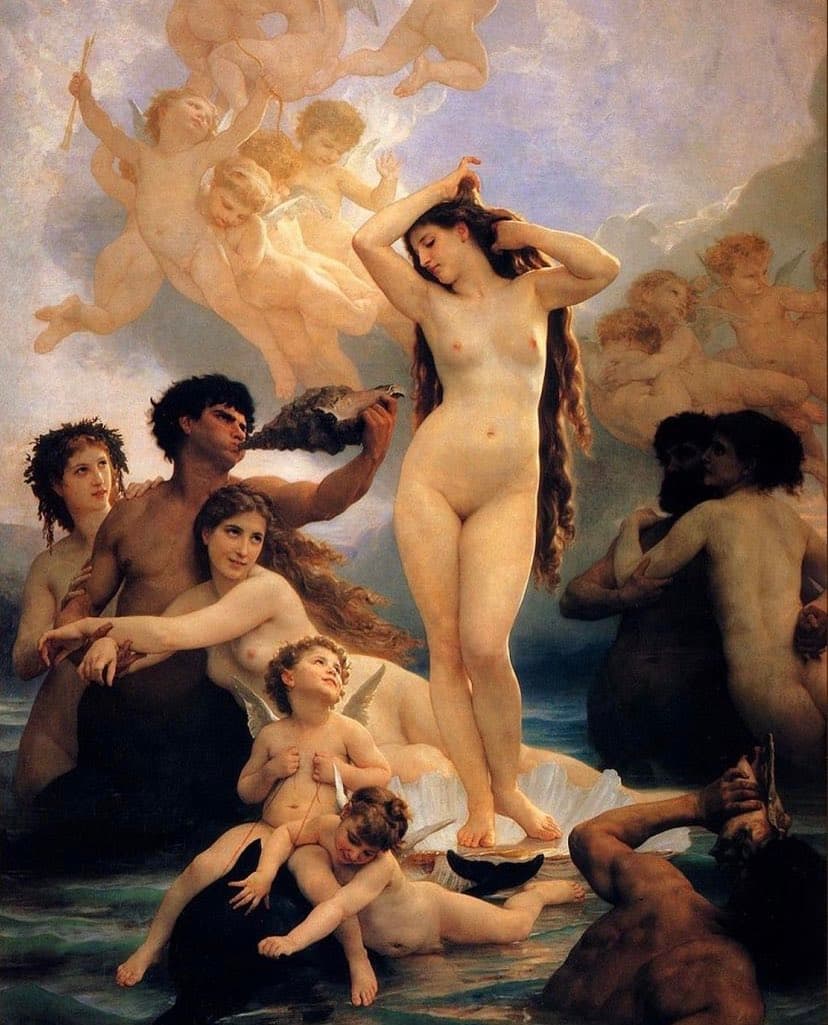
The Birth of Venus
William-Adolphe Bouguereau · 1879
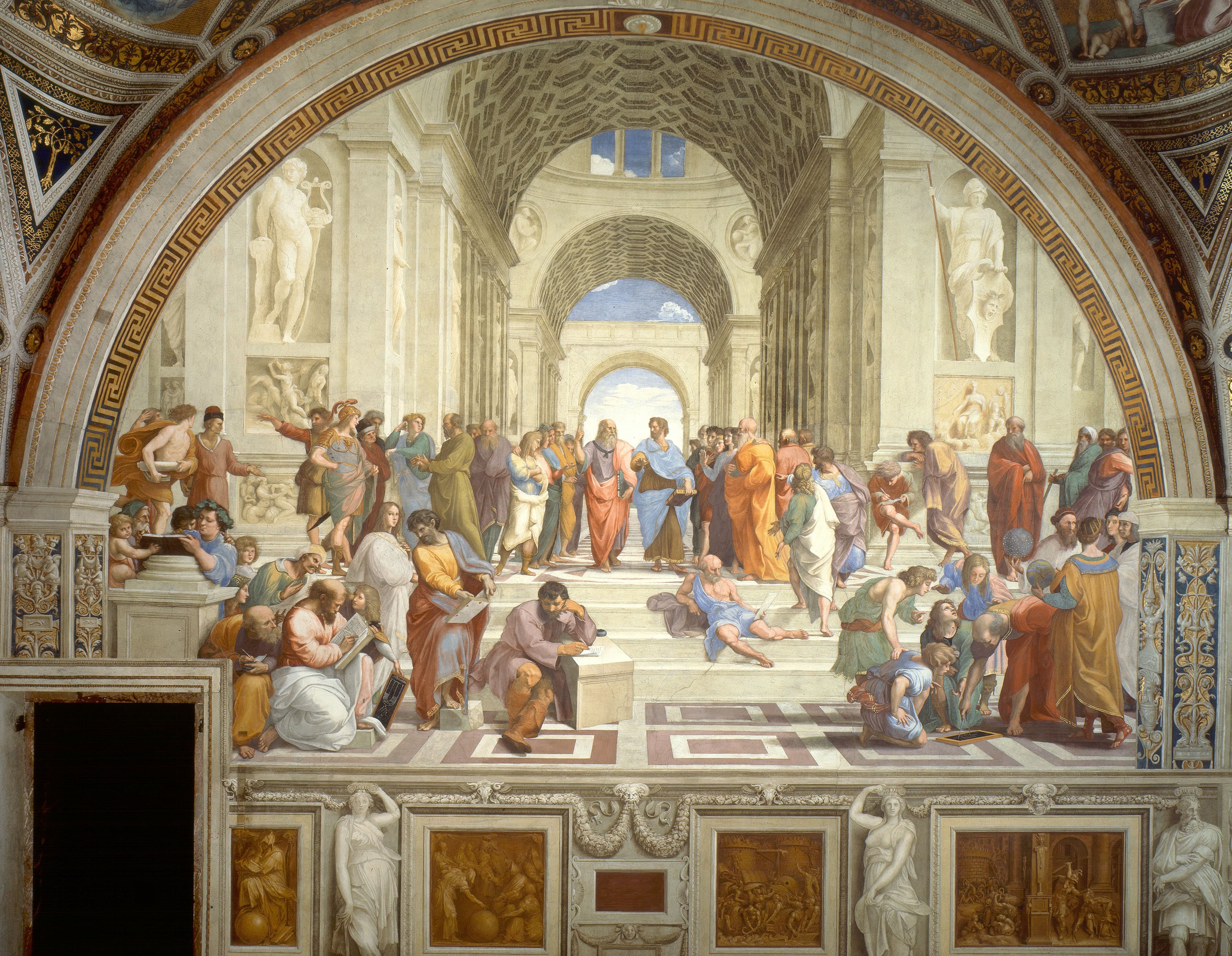
The School of Athens
Raphael · 1509–1511

Venus de Milo
Alexandros of Antioch · c. 150–125 BC
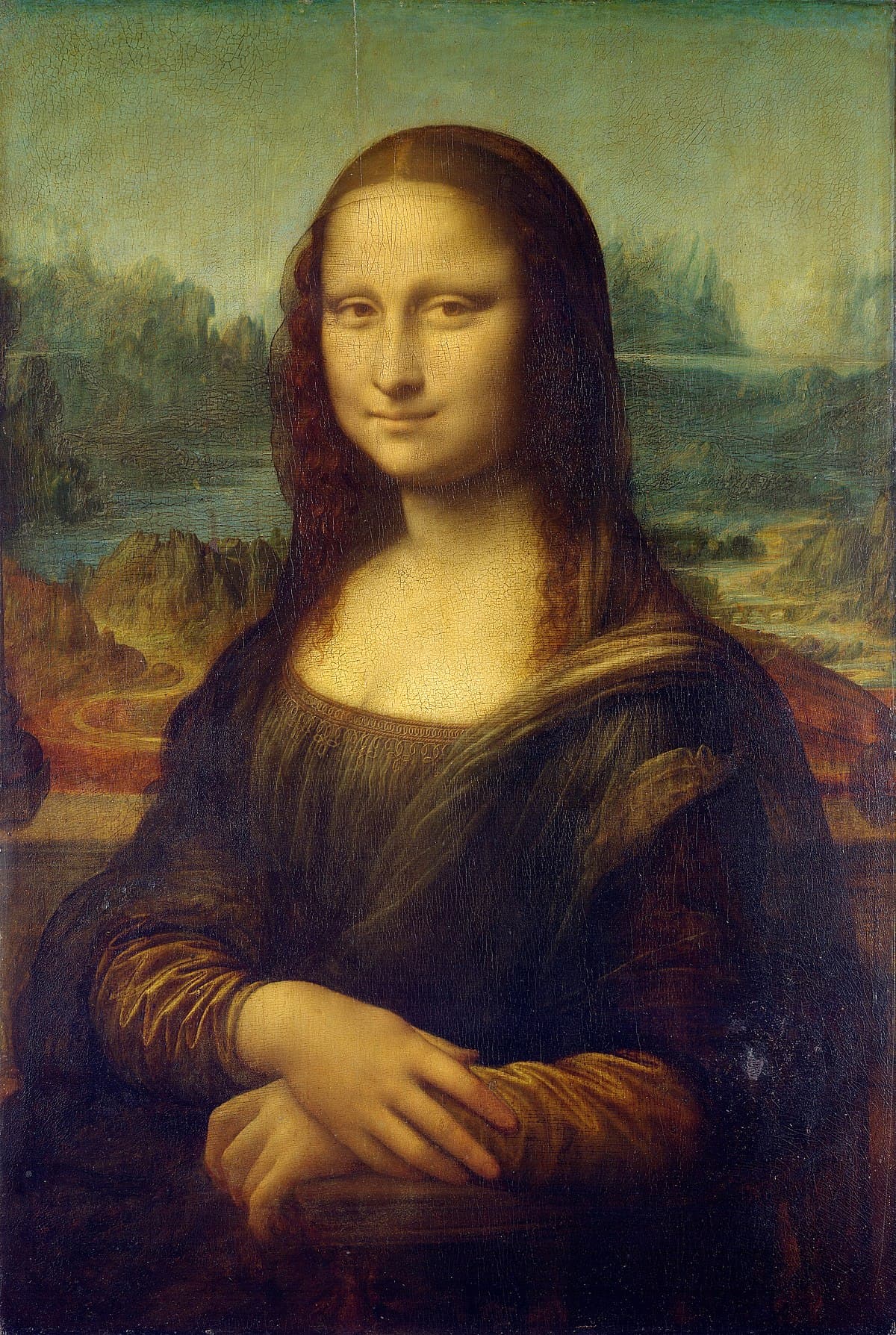
Mona Lisa
Leonardo da Vinci · c. 1503–1519
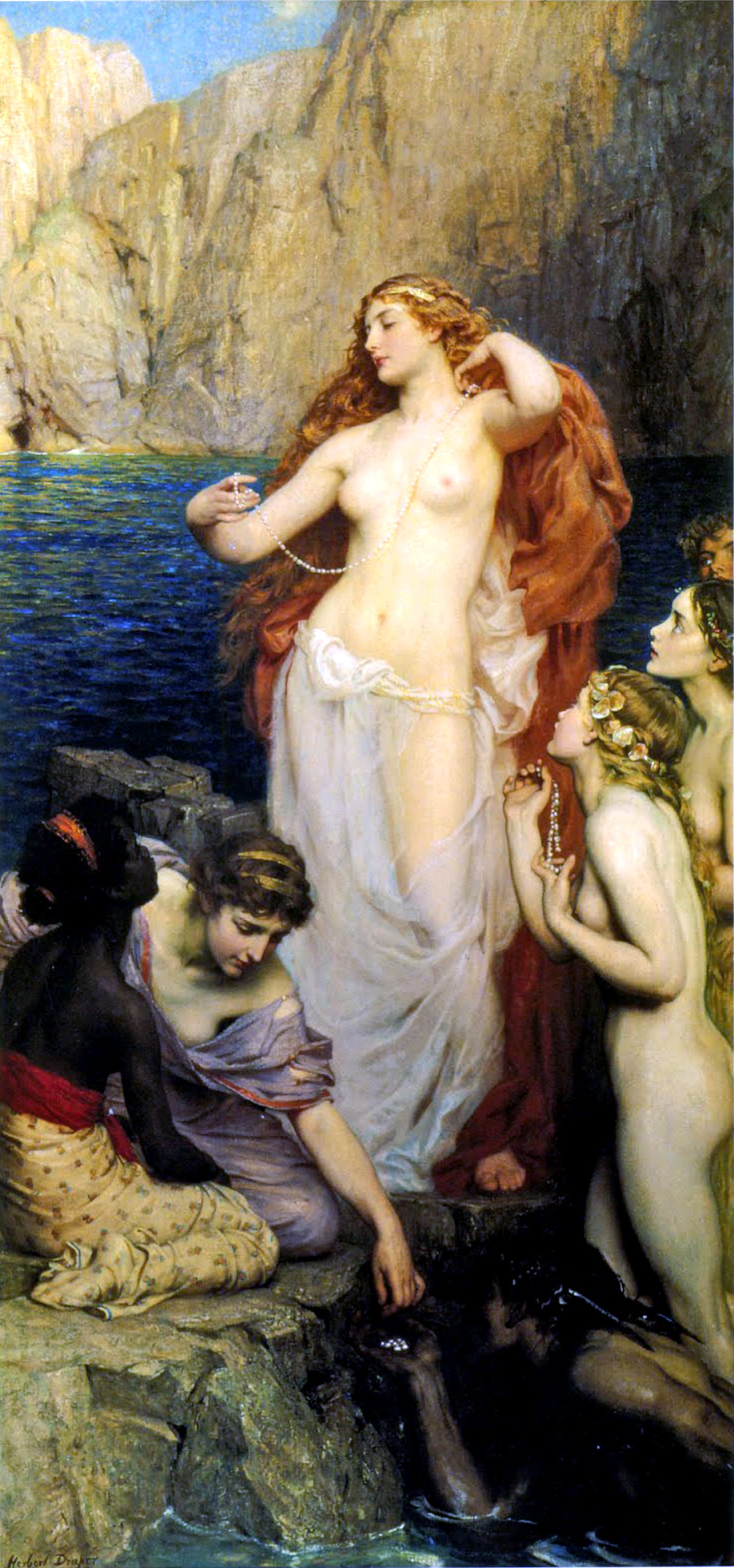
The Pearls of Aphrodite
Herbert James Draper · 1907

Bridge over a Pond of Water Lilies
Claude Monet · 1899

Nymphs Dancing to Pan's Flute
Joseph Tomanek
The Thinker
Auguste Rodin · Modeled 1880–82; enlarged 1902–03; this cast 1904