Image: Musée d'arts de Nantes · Public domain · via Wikimedia Commons
Impressionism
Water Lilies in Giverny
Claude Monet, 1917
Water Lilies in Giverny (Les Nymphéas à Giverny) is a 1917 canvas by Claude Monet showing his lily pond under a pale golden light, with small rafts of pads and pink flowers. It is in the Musée d'arts de Nantes in western France.
- Artist
- Claude Monet
- Date
- 1917
- Medium
- Oil on canvas
- Dimensions
- 100.3 × 200.5 cm
- Collection
- Musée d'arts de Nantes, Nantes, France
- Movement
- Impressionism
- Catalogue
- Wildenstein 1886
Water Lilies in Giverny (Les Nymphéas à Giverny) is a wide canvas, about one meter by two, that Claude Monet signed and dated in 1917. It shows the surface of the lily pond in his garden at Giverny under a soft, golden light, and it is one of the treasures of the Musée d'arts de Nantes.
What you are looking at
The first impression is of haze. Most of the canvas is a shimmering field of ochre, straw yellow, lilac and pale green, with no sharp edges anywhere. This is the water, but almost all we see in it is reflection: the warm color of sunlit foliage from the banks and the grayish mauve of the sky, mixed together as if the light itself were floating on the pond.
The lilies are placed around the edges, leaving the center open. At upper left a scattered group of pads carries small red and pink flowers. Along the bottom a longer chain of rounded green pads, some outlined in lilac, drifts from the center toward the right, and a few pink blossoms sit at the far right edge. Single pads float in the upper right. Faint vertical streaks of green and gray run down through the middle: the reflections of plants and of the weeping willow on the bank. The signature, Claude Monet 1917, is at lower right.
Where and when it was painted
In 1917 Monet was 76 and painting mostly in the large studio he had built at Giverny two years earlier, while the First World War continued. He was working toward the vast decorative panels later installed in the Orangerie, and canvases of this two-meter width were part of that process: complete paintings in themselves that also tested color harmonies for the larger work. The pond and garden are described on our Giverny hub.
How it was painted
Compared with earlier water lilies, the paint here is thin and dry, scumbled across the canvas so that the weave and earlier layers show through. Monet built the golden tone by laying yellow and ochre over a cooler, lilac base, which gives the picture its glow. The lily pads are touched in with a loaded brush on top, in short curved strokes, so they sit physically above the hazy water. His cataracts were advancing in these years and his color was shifting toward warmer yellows and browns, but this canvas still holds a careful balance of warm and cool.
Look closely at the lower chain of pads and the brushwork changes: here the strokes are heavier and more opaque, with lilac edges that catch the light. Monet often finished a canvas this way, strengthening the nearest forms last so that the eye has a firm place to start before it drifts into the haze above. The open middle of the picture, where almost nothing happens, is the part he wanted you to look at longest.
The series and how this version differs
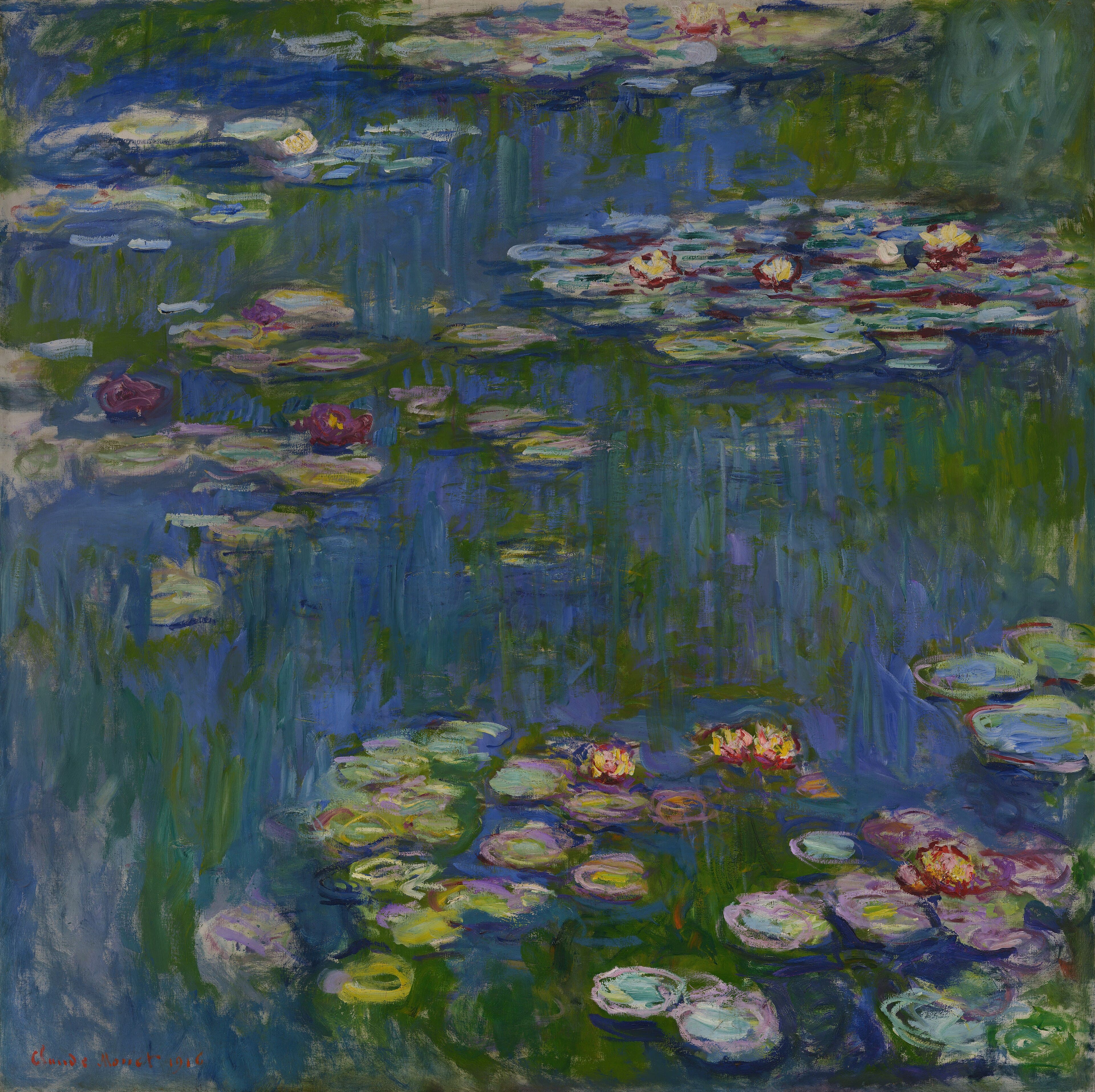
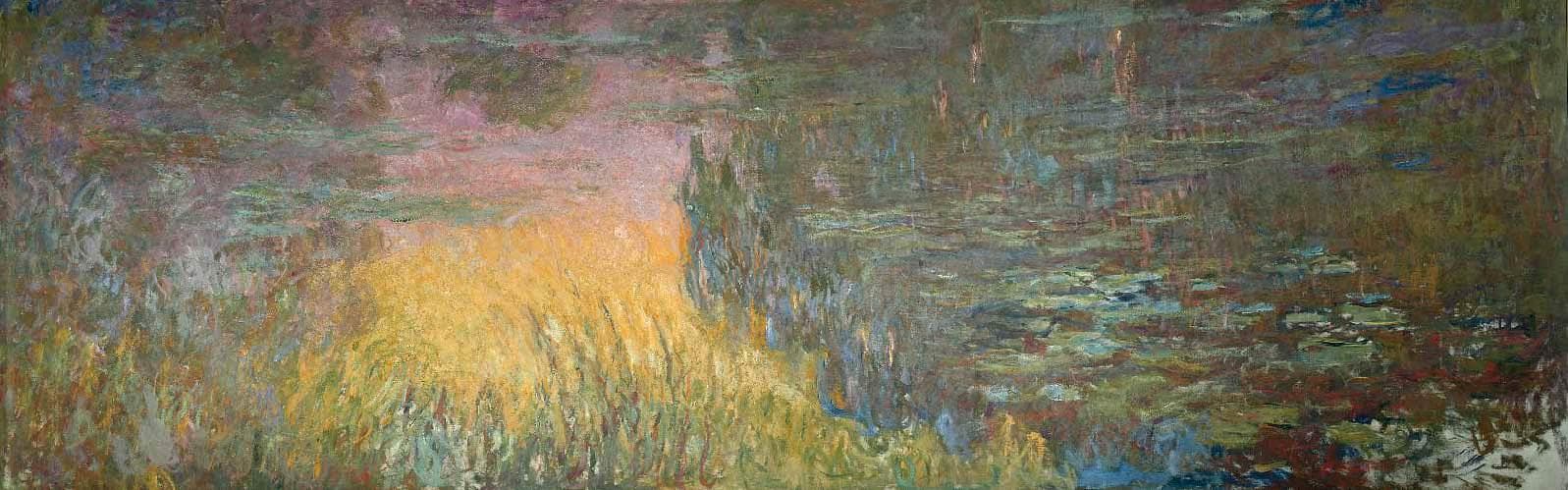
Monet's water lilies, about 250 canvases made from 1897 to 1926, are gathered on our Water Lilies hub. The Nantes picture is one of the most luminous and least dense of the wartime group. Set it beside the deep blue Water Lilies of 1916 in Tokyo and the difference is a change of weather and of hour: midday blue there, a gold, late-afternoon light here. The open center and lilies pushed to the margins anticipate the Orangerie panels such as Setting Sun, and the long MoMA triptych carries the same idea to mural scale.
Where to see it
The painting is in the Musée d'arts de Nantes, which reopened in 2017 after a major renovation and expansion. It is one of the few late water lilies on public view in a French regional museum. For the Paris collections and others worldwide, see where to see Monet's paintings.
Questions & answers
Where is Monet's Water Lilies in Giverny?
It is in the Musée d'arts de Nantes, the fine arts museum of Nantes in western France. The canvas, about one meter by two, is one of the best-known works in the museum's collection and one of the few late Monet water lilies in a French museum outside Paris.
When was Water Lilies in Giverny painted?
Monet signed and dated it 1917, lower right. He painted it at his home in Giverny during the First World War, when he was working on the large water-lily decorations that were later installed in the Musée de l'Orangerie in Paris.
What does Water Lilies in Giverny show?
It shows the surface of Monet's lily pond, filled with golden and lilac reflections of foliage and sky. Small rafts of green pads with pink and red flowers float at the edges, leaving the center open, and faint vertical streaks reflect the plants on the bank.
How is it different from Monet's other water lilies?
It is unusually light and warm, painted in thin, dry layers of ochre, yellow and lilac with the lilies pushed to the margins. Earlier canvases are bluer and denser; this one points directly toward the open, horizonless Orangerie panels.
More by the artist
Claude Monet

Bridge over a Pond of Water Lilies
Claude Monet · 1899

Woman with a Parasol – Madame Monet and Her Son
Claude Monet · 1875

Sunset in Venice
Claude Monet · 1908–12

La Grenouillère
Claude Monet · 1869

Beach in Pourville
Claude Monet · 1882

Springtime
Claude Monet · 1872

Boating on the River Epte
Claude Monet · 1890

The Seine at Asnières (Hermitage)
Claude Monet · 1873
Also painted in 1917
The same year
Kindred works
You may also study
Water Lilies (1916, Tokyo)
Claude Monet · 1916

Water Lilies (MoMA triptych)
Claude Monet · 1914–26
Water Lilies: Setting Sun
Claude Monet · 1914–26
Water Lilies: Green Reflections
Claude Monet · 1914–26
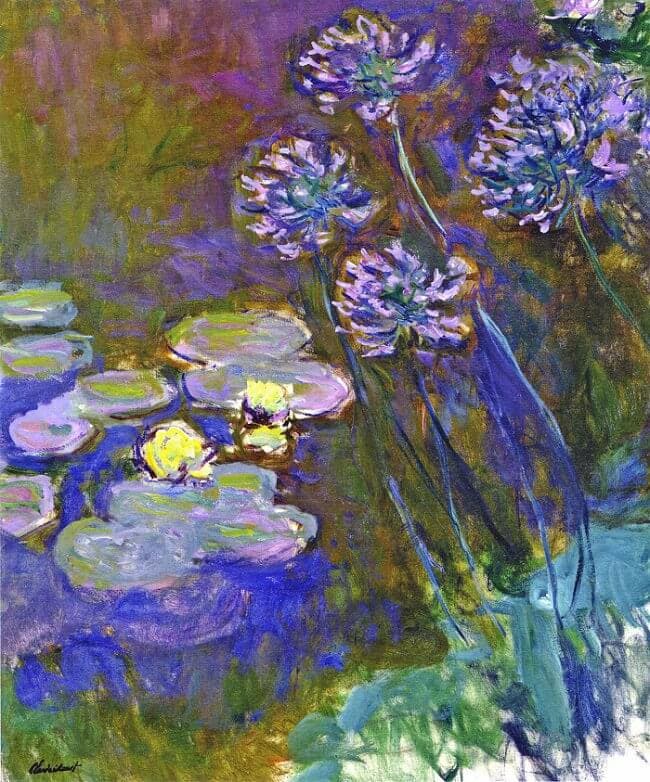
Water Lilies and Agapanthus
Claude Monet · 1914–17

The Scream
Edvard Munch · 1893

Ophelia
John Everett Millais · 1851–52

The Great Wave off Kanagawa
Katsushika Hokusai · c. 1830–32