Image: National Museum of Western Art, Tokyo (Matsukata Collection), via Google Arts & Culture · Public domain · via Wikimedia Commons
Impressionism
Water Lilies (1916, Tokyo)
Claude Monet, 1916
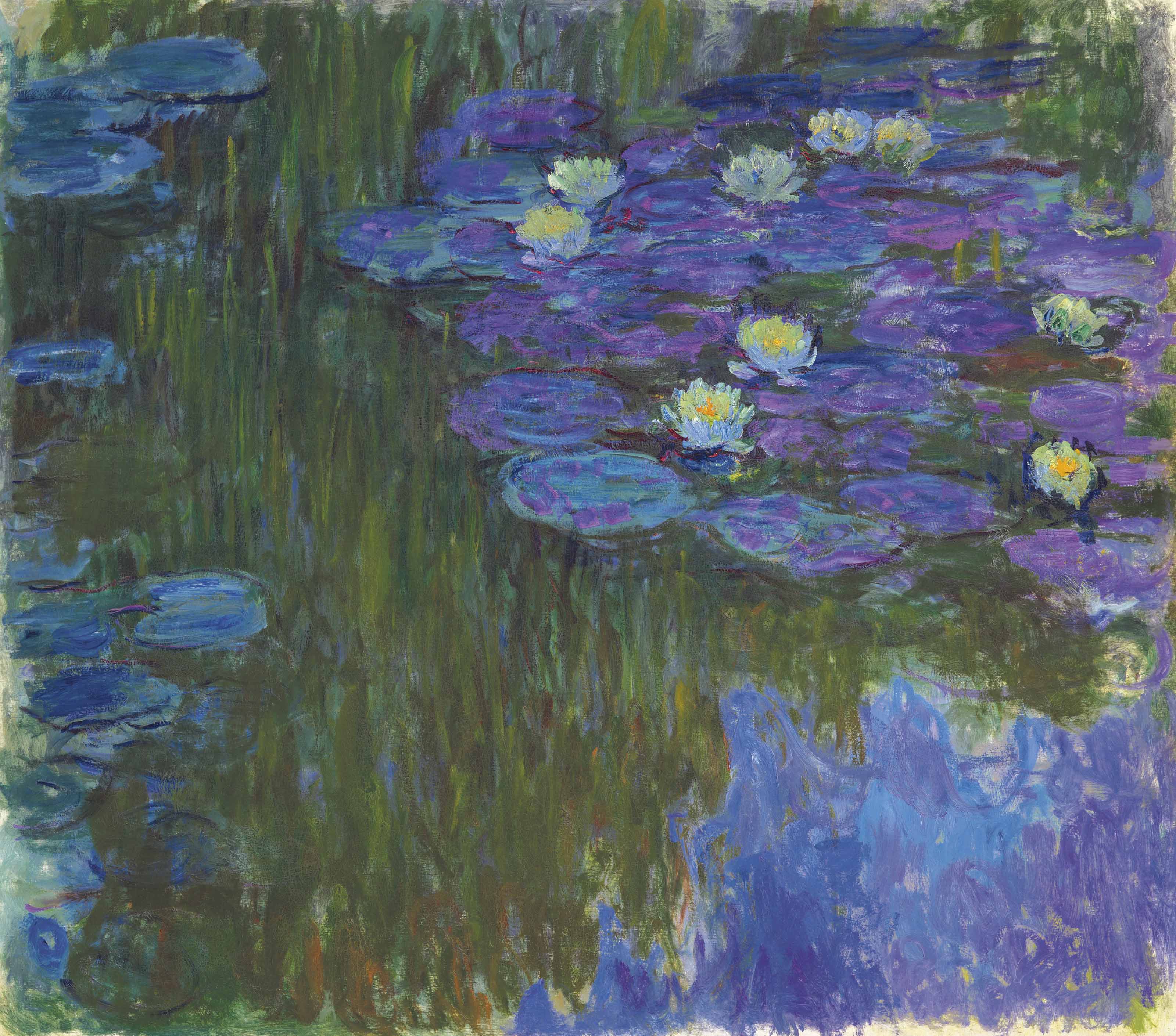
Water Lilies (1916) is a two-meter-square canvas by Claude Monet showing pink, red and yellow lilies floating on the deep blue water of his Giverny pond. It belongs to the Matsukata Collection of the National Museum of Western Art in Tokyo.
- Artist
- Claude Monet
- Date
- 1916
- Medium
- Oil on canvas
- Dimensions
- 200.5 × 201 cm
- Collection
- National Museum of Western Art, Tokyo, Japan
- Movement
- Impressionism
- Catalogue
- Wildenstein 1800
Water Lilies of 1916 is a large, almost exactly square canvas, about two meters on each side, that Claude Monet painted of the lily pond in his garden at Giverny. It is in the National Museum of Western Art in Tokyo, part of the Matsukata Collection that founded the museum, and it is one of the finest of the big wartime water-lily canvases outside France.
What you are looking at
The pond fills the whole canvas, seen from close above with no bank and no sky. The water is a deep, cool blue streaked with violet, and through it run long vertical strokes of green and blue: the reflections of grasses, irises and weeping willows growing at the water's edge, which we never see directly. Those vertical bands give the picture its rhythm and make the water feel deep.
Across this surface Monet sets the lilies in loose diagonal rafts. One group crosses the top edge, another floats in the upper right, and a larger island of pads in the lower half drifts toward the bottom right corner. The pads are painted as flat, rounded ovals in sage green, lilac and pale pink, each one defined by a few curving strokes, and the flowers are small, dense knots of crimson, rose and yellow. Toward the left, two dark red blooms sit almost alone on open water. The signature and date, Claude Monet 1916, are at lower left.
Where and when it was painted
Monet painted this canvas in the second year of the First World War, when he was 75. His son Jean had died in 1914, his stepson and his younger son Michel were at the front, and Monet had just built a large new studio at Giverny so that he could work at the scale of the water-lily decorations he was planning. Canvases of this two-meter size served as studies and trial runs for the panoramas that ended up in the Orangerie. The pond itself, fed from the river Epte and planted with hybrid lilies, is described on our Giverny hub.
How it was painted
The picture was painted quickly over a light ground, in thin and fluid first layers followed by thicker, drier strokes on the lilies. Monet uses three kinds of mark: long vertical drags for reflections, short horizontal touches for the flat pads, and small twisted dabs for the flowers. The difference in direction does the work of perspective. There is no single light source; the blue of the water shifts from turquoise at the edges to near-violet at center, as on a still, overcast afternoon.
The square format matters. A square has no natural up or down, left or right, and Monet uses that neutrality to free the pond from the conventions of landscape. Nothing tells you where the bank is or which way you are facing; the lilies could be turning slowly on the surface as you watch. Seen in the gallery, at two meters across, the canvas fills the field of vision of someone standing close, which is exactly the effect Monet wanted from the larger decorations.
The series and how this version differs
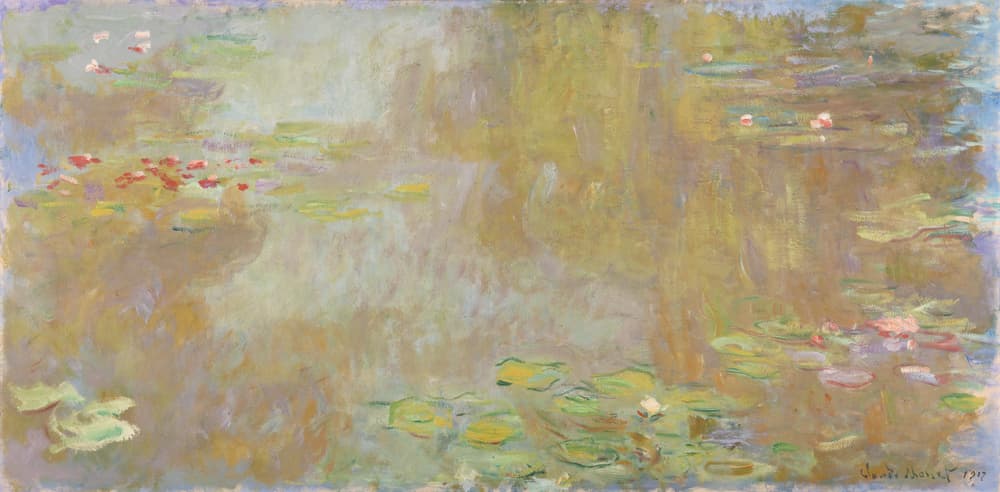
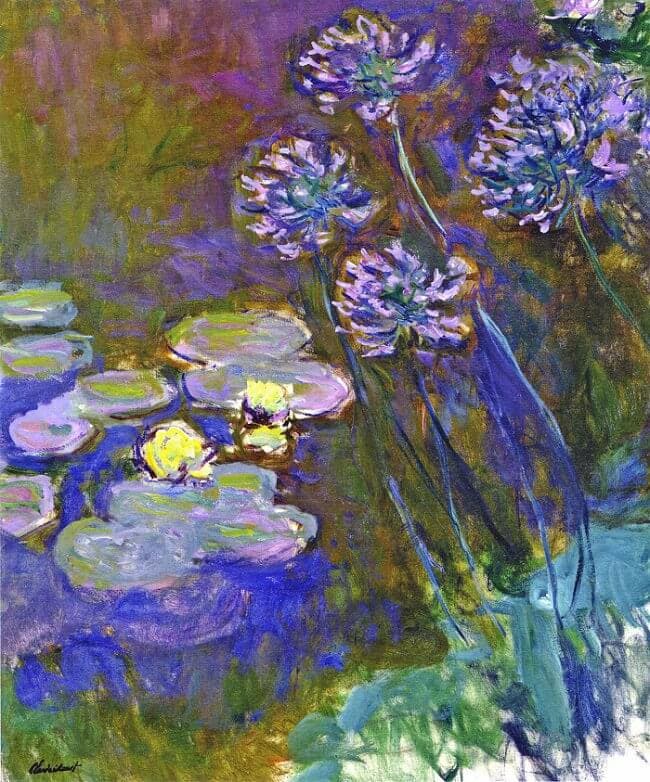
The water lilies were Monet's longest series, about 250 canvases made between 1897 and 1926 and gathered on our Water Lilies hub. Next to the soft golden haze of the 1917 Water Lilies in Giverny at Nantes, the Tokyo picture is cooler, bluer and sharper, with more color in the flowers. It is closer in mood to the Marmottan's Water Lilies and Agapanthus and points ahead to the vast MoMA triptych, where the water expands to wall size.
Ownership and where to see it
The painting belonged to the shipbuilding magnate Kōjirō Matsukata, who visited Monet at Giverny in the early 1920s and bought a large group of his canvases. Much of Matsukata's European collection was held in France during and after the Second World War; it was returned to Japan in 1959, and the National Museum of Western Art, designed by Le Corbusier, was built in Ueno Park to house it. The museum has since shown this canvas as a centerpiece of its permanent collection. For other public collections with Monet's late water lilies, see where to see Monet.
Questions & answers
Where is Monet's Water Lilies (1916)?
It is in the National Museum of Western Art in Ueno Park, Tokyo, as part of the Matsukata Collection with which the museum opened in 1959. The square, two-meter canvas is usually displayed in the permanent-collection galleries alongside the museum's other Monets.
When and where did Monet paint this Water Lilies?
Monet signed and dated it 1916. He painted it at Giverny, his home in Normandy, working from the lily pond he had created in his garden. It was made during the First World War, in the period when he was preparing the large water-lily decorations now in the Musée de l'Orangerie.
What does Monet's 1916 Water Lilies show?
It shows only the surface of the pond, seen from above: rafts of green and lilac lily pads with crimson, pink and yellow flowers on deep blue water. The long vertical green strokes are reflections of plants and trees on the bank, which are outside the picture.
How did the painting get to Japan?
The collector Kōjirō Matsukata bought it in the early 1920s, when he acquired many works from Monet at Giverny. His collection was kept in France during and after the Second World War and returned to Japan in 1959, when the National Museum of Western Art was founded to hold it.
More by the artist
Claude Monet

Bridge over a Pond of Water Lilies
Claude Monet · 1899

Woman with a Parasol – Madame Monet and Her Son
Claude Monet · 1875

Sunset in Venice
Claude Monet · 1908–12

La Grenouillère
Claude Monet · 1869

Beach in Pourville
Claude Monet · 1882

Springtime
Claude Monet · 1872

Boating on the River Epte
Claude Monet · 1890

The Seine at Asnières (Hermitage)
Claude Monet · 1873
Also painted in 1916
The same year
Kindred works
You may also study

Water Lilies (MoMA triptych)
Claude Monet · 1914–26
Water Lilies in Giverny
Claude Monet · 1917
Water Lilies and Agapanthus
Claude Monet · 1914–17
Water Lilies (1919, Metropolitan Museum)
Claude Monet · 1919
Nymphéas en fleur
Claude Monet · c. 1914–17

The Scream
Edvard Munch · 1893

Ophelia
John Everett Millais · 1851–52

The Great Wave off Kanagawa
Katsushika Hokusai · c. 1830–32