Impressionism
Water Lilies: Green Reflections
Claude Monet, 1914–26
Water Lilies: Green Reflections (Reflets verts) is one of Claude Monet's giant water-lily panels of 1914–26, installed in the first room of the Musée de l'Orangerie in Paris. The image here shows its left half.
- Artist
- Claude Monet
- Date
- 1914–26
- Medium
- Oil on canvas (two joined panels)
- Dimensions
- 200 × 850 cm (whole composition)
- Collection
- Musée de l'Orangerie, Paris, France
- Movement
- Impressionism
What you are looking at
The surface of a pond, seen close up, with no bank and no sky. The water is a deep, dense green-blue, streaked with long vertical strokes of darker green and violet: the reflections of trees and reeds standing on the unseen bank. Floating on it are rafts of water lilies. A long band of pads runs across the top, flecked with white and pink flowers; a smaller cluster sits near the center; in the lower left, a group glows with yellow and orange; and in the lower right, pale pads with white and pink blossoms catch the light.
The image here shows only part of a much larger work. The full Green Reflections is about 8.5 meters long, made of two panels each about 4.25 meters wide, and it runs along a curved wall, so a visitor never sees it all from one point.
The Orangerie decoration
Claude Monet had imagined a room of water-lily paintings since the 1890s. After 1914, in his seventies, he began work on the panels in a huge new studio at Giverny. On the day after the armistice of November 1918, he wrote to Georges Clemenceau offering two panels to the French state as a monument to peace; the gift grew into a whole cycle. In 1922 he signed an agreement to give the panels to the state, to be installed in the Orangerie in the Tuileries Garden. He kept working on them until his death in December 1926, and the rooms opened in May 1927.
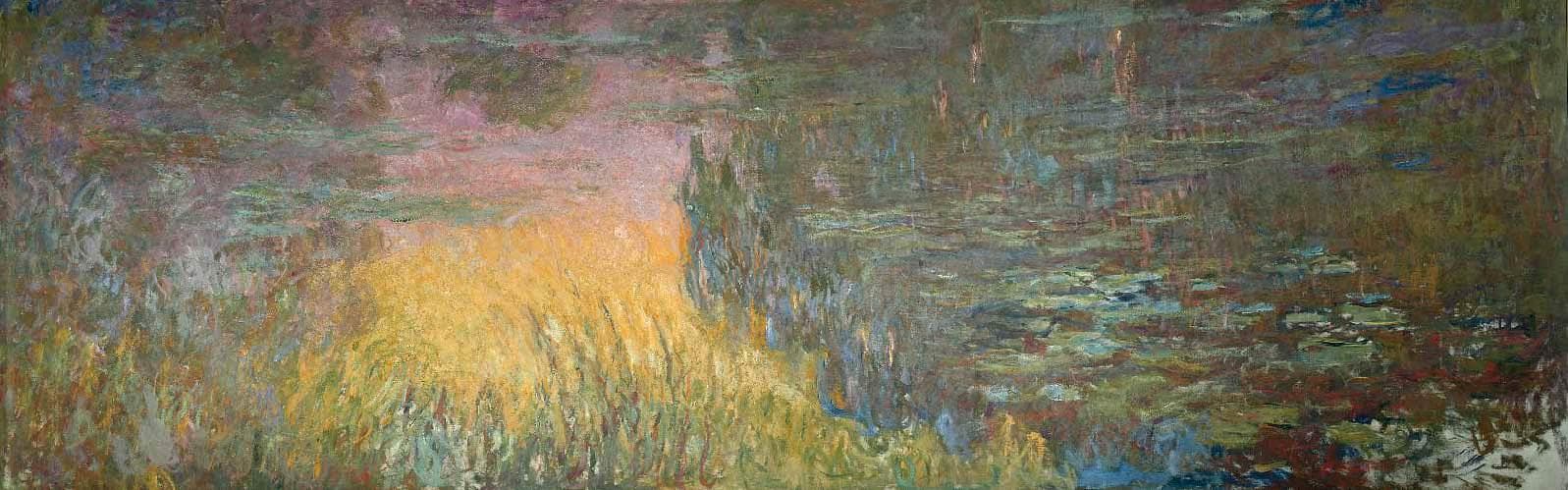
The cycle consists of eight compositions arranged in two oval rooms, the shape Monet chose so that visitors would be surrounded by water. Green Reflections hangs in the first room with Morning, Clouds and Setting Sun, a sequence that moves through the light of a day. The whole project is described on The Water Lilies at the Musée de l'Orangerie.
How it was painted
Look at the vertical streaks. They are what make this composition "green": long strokes of emerald, olive and blue-violet that drop from top to bottom, representing reflected foliage. The lilies are laid horizontally over them, so the surface is a weave of verticals and horizontals, like warp and weft.
The flowers themselves are tiny relative to the canvas, single dabs of pink, white and yellow. Up close the painting is rough and loose, with visible scrubbing, thin passages and thick crusts where Monet reworked an area many times. From a few meters back, it settles into deep water. He intended it to be seen from the middle of the room, under natural light from the skylights.
The panels were painted on canvas in the Giverny studio, not on the walls, and fixed to the curved walls of the Orangerie after his death, in time for the opening of 1927, which is why their edges follow the bend of the rooms. Their surfaces carry the record of years of revision: some passages were scraped back and repainted as Monet's conception, and his eyesight, changed.
The Grandes Décorations and how this panel differs
Within the cycle, Green Reflections is the most enclosed and shadowed composition. There is no sky reflection at all, unlike Clouds, where the whole surface becomes a mirror of the heavens, and no blaze of light, unlike Setting Sun. Its subject can be read as shade: the cool depth of water under overhanging trees. That makes it the calmest of the first room's panels and a hinge between morning and evening.
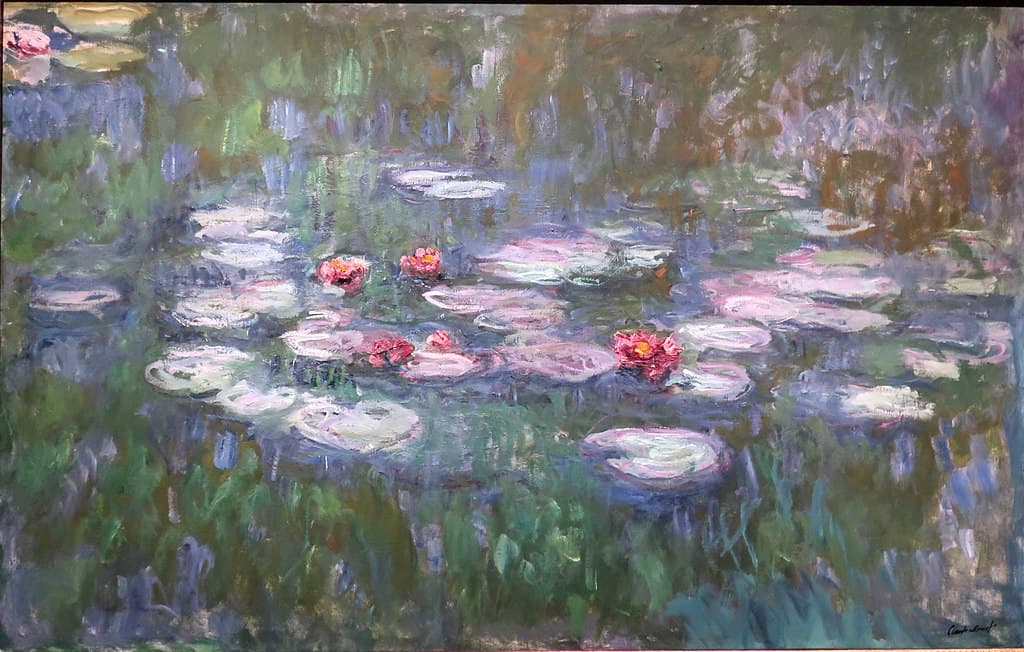
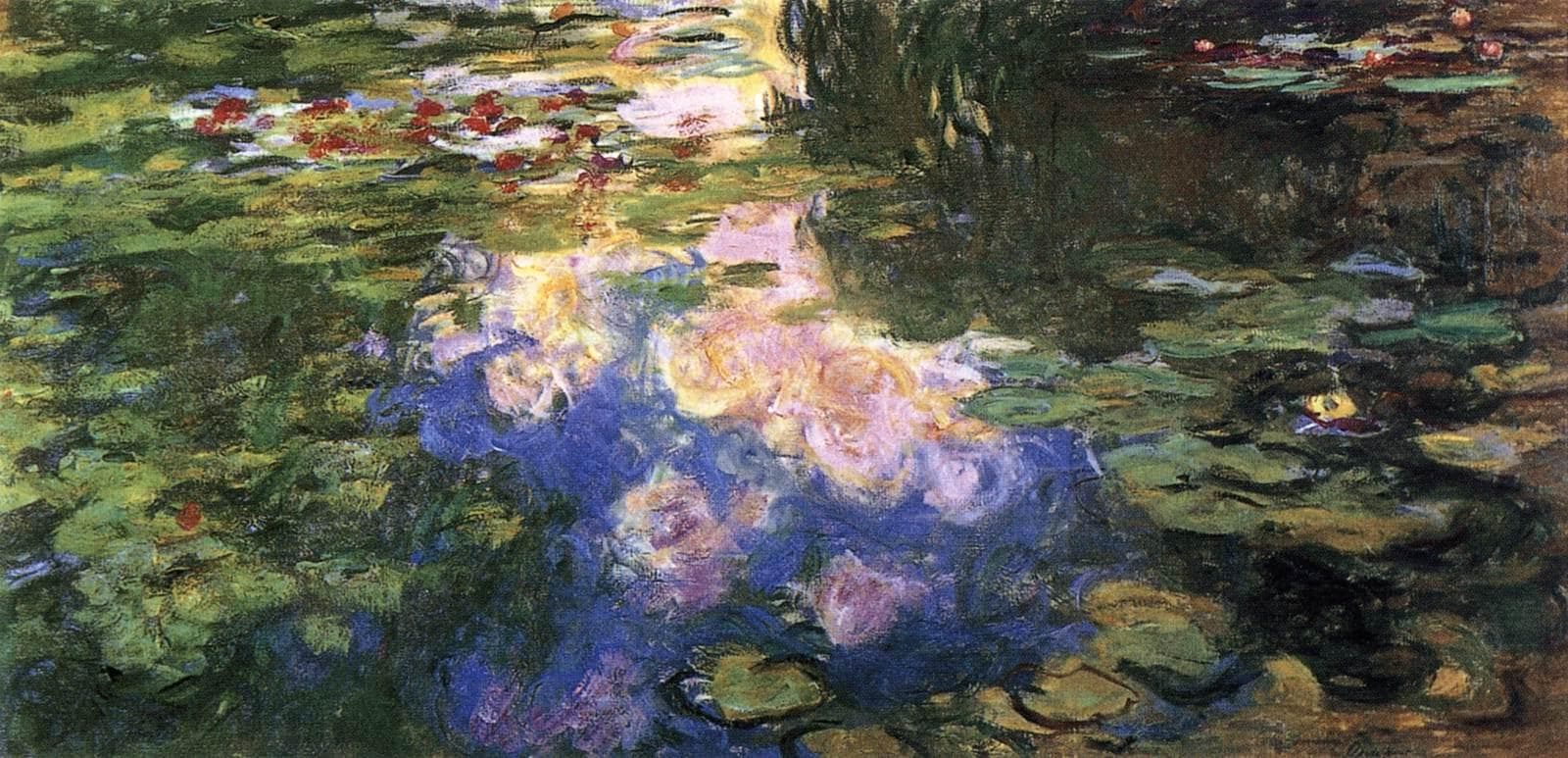
Compare the smaller easel paintings of the same years, such as the wide Water-Lily Pond (1917–19), where Monet tested the same motifs, and the earlier Nymphéas. The full sequence of water-lily pictures is traced in Water Lilies (Nymphéas).
Where to see it
Green Reflections is in Room 1 of the Musée de l'Orangerie, Paris, as Monet intended, a short walk across the Tuileries from the Louvre. The garden and pond it shows can still be visited at Giverny.
Questions & answers
Where can I see Monet's Water Lilies, Green Reflections?
It is in the first oval room of the Musée de l'Orangerie in the Tuileries Garden, Paris, where Monet planned it to hang. The rooms opened in May 1927, a few months after his death, and the panels are lit by natural light from skylights, as he wished.
When was Green Reflections painted?
Monet worked on the Orangerie panels from about 1914 until his death in December 1926, painting them in a large studio at Giverny built for the purpose and revising them repeatedly. They are usually dated 1914–26; Wikidata gives about 1920.
How big is Green Reflections?
The whole composition is about 2 meters high and 8.5 meters long, made of two panels joined side by side and mounted on a curved wall. The image on this page shows only part of it. It is one of eight compositions in the Orangerie cycle.
Why are the Orangerie water lilies important?
They are Monet's final project and his gift to France, offered after the 1918 armistice as a monument to peace. Their scale, loose brushwork and lack of horizon made them a reference point for later abstract painters, especially the American Abstract Expressionists of the 1950s.
More by the artist
Claude Monet

Bridge over a Pond of Water Lilies
Claude Monet · 1899

Woman with a Parasol – Madame Monet and Her Son
Claude Monet · 1875

Sunset in Venice
Claude Monet · 1908–12

La Grenouillère
Claude Monet · 1869

Beach in Pourville
Claude Monet · 1882

Springtime
Claude Monet · 1872

Boating on the River Epte
Claude Monet · 1890

The Seine at Asnières (Hermitage)
Claude Monet · 1873
Also painted in 1920
The same year
Kindred works
You may also study
Water Lilies: Setting Sun
Claude Monet · 1914–26
Nymphéas (Water Lilies)
Claude Monet · c. 1914–1919
Water-Lily Pond (Le Bassin aux nymphéas), 1917–19
Claude Monet · 1917–19
Water Lilies, Evening Effect
Claude Monet · 1897
Weeping Willow
Claude Monet · 1920–22

The Scream
Edvard Munch · 1893

Ophelia
John Everett Millais · 1851–52

The Great Wave off Kanagawa
Katsushika Hokusai · c. 1830–32