Image: Private collection; image via Christie's / Wikimedia Commons · Public domain · via Wikimedia Commons
Impressionism
Nymphéas en fleur
Claude Monet, c. 1914–17
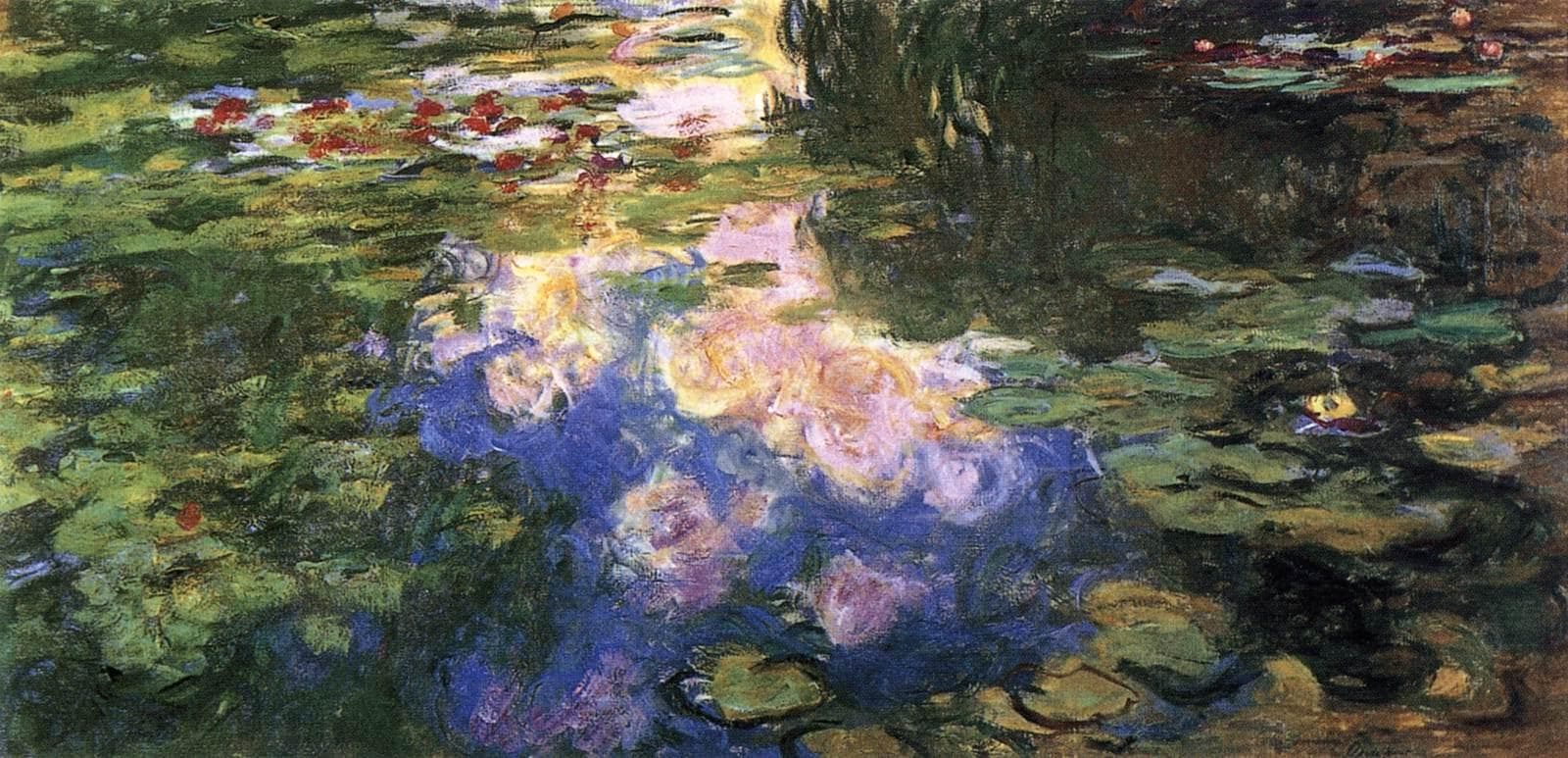
Nymphéas en fleur is a large late Water Lilies canvas painted by Claude Monet around 1914–17 at Giverny. Owned by David and Peggy Rockefeller, it sold at Christie's in 2018 for about $84.7 million and is in a private collection.
- Artist
- Claude Monet
- Date
- c. 1914–17
- Medium
- Oil on canvas
- Dimensions
- c. 160 × 180 cm
- Collection
- Private collection
- Movement
- Impressionism
- Catalogue
- Wildenstein 1790
What you are looking at
There is no bank, no sky and no horizon: only the surface of a pond seen from above. In the upper right, a broad island of lily pads floats across the water, painted in violet, blue and purple, with a few deep-green pads among them. White and pale-yellow water lilies open on the pads, each flower a few thick, round strokes with a yellow heart. Smaller clusters of blue pads drift along the left edge.
The rest of the canvas is reflection. Long vertical strokes of green, olive and brown run down through the water, the mirrored image of willow fronds and plants on a bank we cannot see. In the lower right, a pool of pale blue and lilac opens up: the sky reflected in the pond, with soft, cloud-like forms. The flowers sit on the surface; the willows and sky lie under it. Monet makes us look at both at once.
Where and when it was painted
Monet dug his water-lily pond at Giverny in the 1890s and painted it for the rest of his life. After the death of his wife Alice in 1911 and his son Jean in 1914 he took up the pond again on a new scale, working on large canvases in a purpose-built studio. These pictures led to the vast decorative panels he gave to the French state, now installed in the Musée de l'Orangerie.
Nymphéas en fleur, about 160 by 180 centimeters, belongs to this campaign of about 1914–17. It is one of the many large, independent canvases Monet painted alongside the decorative cycle, and it carries the brushwork and color of that moment: the bold violet of the pads, the dense green of the reflections, the loose, open handling of the sky. It is part of Monet's Water Lilies series, which runs to about 250 canvases.
How it was painted
Monet worked these late pond pictures in layers, often over long periods, building up the surface with thick, dragged strokes. The lily pads are horizontal ovals, the reflections long verticals; the crossing of the two directions is what gives the surface its depth. Violet is the dominant color, a choice that has sometimes been connected with the cataracts that affected his color perception in the 1910s, though Monet had used strong blues and violets in shadowed water long before.
The composition is cropped on every side. The island of pads runs off the right edge, the reflections run off the top and bottom. Nothing tells us how big the pond is, or where we stand. That lack of a fixed viewpoint is what the art critics of the 1950s admired in these late works, and it helped bring them back into favor after decades of neglect.
Provenance and the 2018 sale
After Monet's death in 1926 the large late canvases stayed in the studio with his son Michel. This one passed from Michel Monet to the Paris dealer Katia Granoff and then, through Knoedler & Co., to David and Peggy Rockefeller, who bought it in 1956. It hung in their home for six decades. In May 2018 it was sold at Christie's New York in the sale of the Rockefeller collection, where it fetched about $84.7 million with fees, at the time an auction record for Monet. The record was overtaken in 2019 by a Haystacks canvas. The buyer was not named.
The sale mattered beyond the price. The Rockefellers had been among the American collectors who bought late Monet in the 1950s, when the water-lily canvases were being rediscovered by critics who saw links with Abstract Expressionism. Their purchase came just as the Museum of Modern Art in New York was acquiring its own large water-lily panels, and it reflects the same shift in taste.
Related works
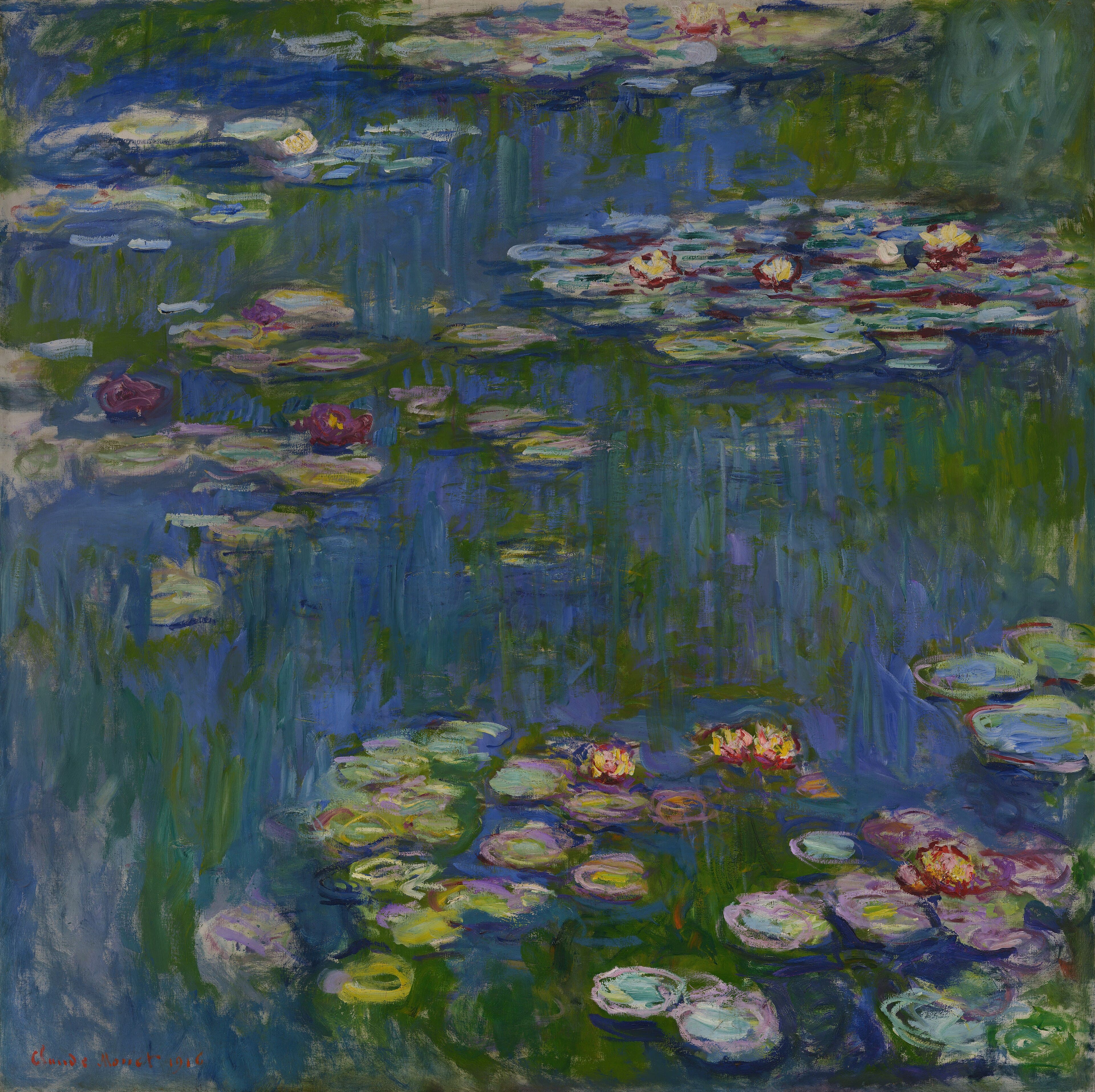
The closest comparisons are the museum water-lily canvases of the same years, such as Water Lilies at the Museum of Modern Art, Water Lilies in Tokyo's National Museum of Western Art and the Orangerie panels.
Where to see it
The painting is in a private collection and is not on public view. For water lilies you can see, the Musée de l'Orangerie in Paris holds the great cycle; see also where to see Monet's paintings.
Questions & answers
Where is Monet's Nymphéas en fleur now?
It is in a private collection. It belonged to David and Peggy Rockefeller from 1956 until it was sold at Christie's New York in May 2018 to an unnamed buyer. It is not on public display.
How much did Nymphéas en fleur sell for?
It sold for about $84.7 million including fees at Christie's New York in May 2018, in the auction of the Rockefeller collection. That was then a record price for Monet, later passed by a Haystacks painting in 2019.
When was Nymphéas en fleur painted?
Around 1914–17, at Giverny, during the years Monet was working on large water-lily canvases that led to the decorative panels in the Musée de l'Orangerie.
Is Nymphéas en fleur part of the Water Lilies series?
Yes. It is one of about 250 paintings of the water-lily pond in Monet's garden at Giverny, which he painted from the late 1890s until his death in 1926.
More by the artist
Claude Monet

Bridge over a Pond of Water Lilies
Claude Monet · 1899

Woman with a Parasol – Madame Monet and Her Son
Claude Monet · 1875

Sunset in Venice
Claude Monet · 1908–12

La Grenouillère
Claude Monet · 1869

Beach in Pourville
Claude Monet · 1882

Springtime
Claude Monet · 1872

Boating on the River Epte
Claude Monet · 1890

The Seine at Asnières (Hermitage)
Claude Monet · 1873
Also painted in 1915
The same year
Kindred works
You may also study

Water Lilies (MoMA triptych)
Claude Monet · 1914–26
Water Lilies (1916, Tokyo)
Claude Monet · 1916
Water Lilies (1919, Metropolitan Museum)
Claude Monet · 1919
Water Lilies: Green Reflections
Claude Monet · 1914–26
Water-Lily Pond (Le Bassin aux nymphéas), 1917–19
Claude Monet · 1917–19

The Scream
Edvard Munch · 1893

Ophelia
John Everett Millais · 1851–52

The Great Wave off Kanagawa
Katsushika Hokusai · c. 1830–32