Impressionism
Water-Lily Pond (Le Bassin aux nymphéas), 1917–19
Claude Monet, 1917–19
This Water Lilies is Le Bassin aux nymphéas of 1917–19 by Claude Monet, a wide canvas of red lilies and blue sky reflected in his Giverny pond. It is privately owned and sold at Sotheby's New York in 2021.
- Artist
- Claude Monet
- Date
- 1917–19
- Medium
- Oil on canvas
- Dimensions
- 100 × 200 cm
- Collection
- Private collection
- Movement
- Impressionism
- Catalogue
- Wildenstein 1897
What you are looking at
There is no bank, no horizon, no sky: only the surface of the pond, seen from above and filling a canvas twice as wide as it is high. Lily pads float in loose rafts of green and yellow-green across the left half and along the bottom. In the upper left, a cluster of red and pink water lilies glows against them. Through the middle of the picture runs a broad pool of open water, and in it the sky appears upside down: a reflection of white and pink cloud in a field of deep blue and violet. At the top right, dark vertical streaks of green and brown are the reflected trunks and hanging branches of a willow on the bank, which we never see directly.
The image is reflected world and floating world at once, and the eye keeps switching between them. A single pale lily at the right edge, painted in yellow and lilac, is easy to miss in the shadow.
Late Monet at Giverny
By 1914 Claude Monet was in his seventies, his eyesight weakening with cataracts, and he had begun the vast water-lily decoration later installed in the Musée de l'Orangerie. Alongside the giant panels he painted many canvases about one by two meters, which served as studies and as independent works. This painting belongs to that group. The Wildenstein catalogue raisonné lists it as W.1897 and dates it 1917–19. The garden that made all this possible is described on our Giverny page.
Many of these canvases stayed in Monet's studio until his death in 1926 and passed to his son Michel. This one came onto the market much later. It sold at Sotheby's New York in May 2021 for about $70.4 million with fees. It should not be confused with Monet's square Water Lilies of 1904 in the MuMa, Le Havre, a different and earlier composition.
How it was painted
The brushwork is broad and fast, very different from the dense dabs of the 1890s. Lily pads are single swipes of the brush, often outlined with a darker green. The cloud reflection is built from thick, curving strokes of pink, white and lavender, scrubbed into wet blue. Look at the upper left, where the red lilies are touched in with small, heavy blobs of crimson and orange; they are the brightest notes in the painting.
The willow reflections, painted as long vertical strokes, cross the horizontal rhythm of the pads at right angles. That grid of vertical and horizontal is what holds the loose surface together. In places the canvas shows through between strokes, and the paint has been dragged so that lower colors flicker up through upper ones.
The scale matters. At two meters wide, the picture is large enough that the viewer's field of vision is filled, yet small enough to hang in a room. Monet painted it in his big new studio at Giverny, built in 1915 for the Orangerie panels, where he could set several such canvases side by side.
The late water lilies and how this one differs
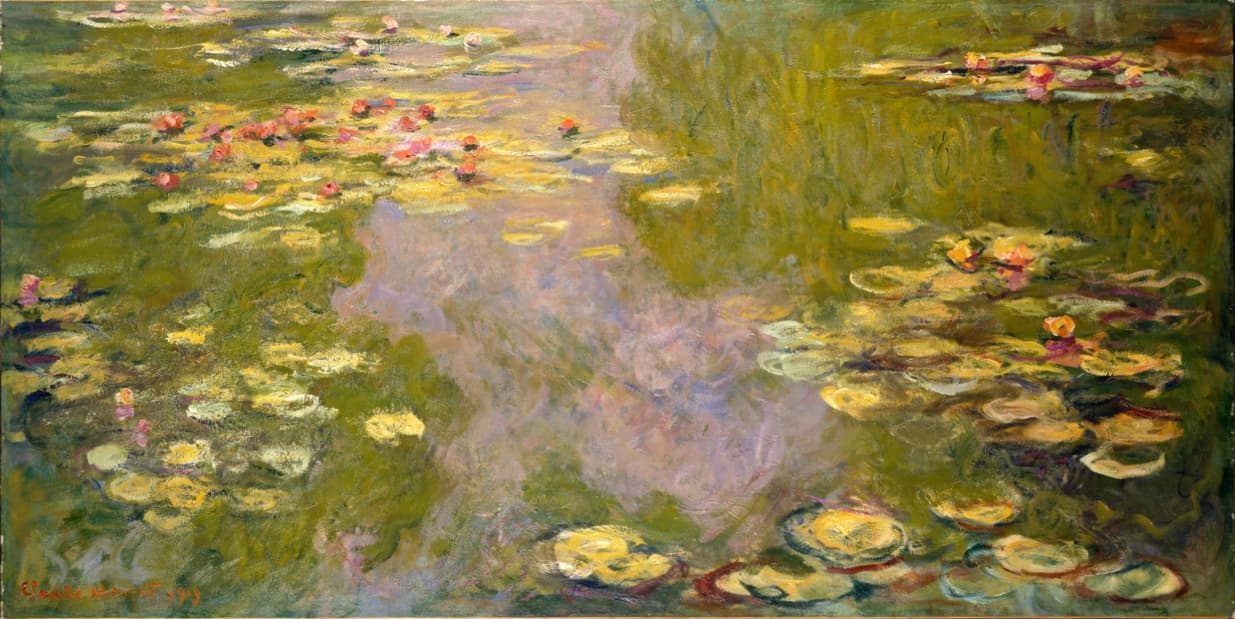
Monet painted some 250 water-lily pictures over three decades; the whole cycle is traced in Water Lilies (Nymphéas). The canvases of 1897–1908 are mostly smaller and often include a strip of bank. After 1914 the bank disappears and the format widens, as here and in Water Lilies of 1919 at the Met. This picture is notable for the strength of its sky reflection, which carves a blue channel through the middle of the composition, and for its warm red lilies, a note the Orangerie panels mostly avoid.
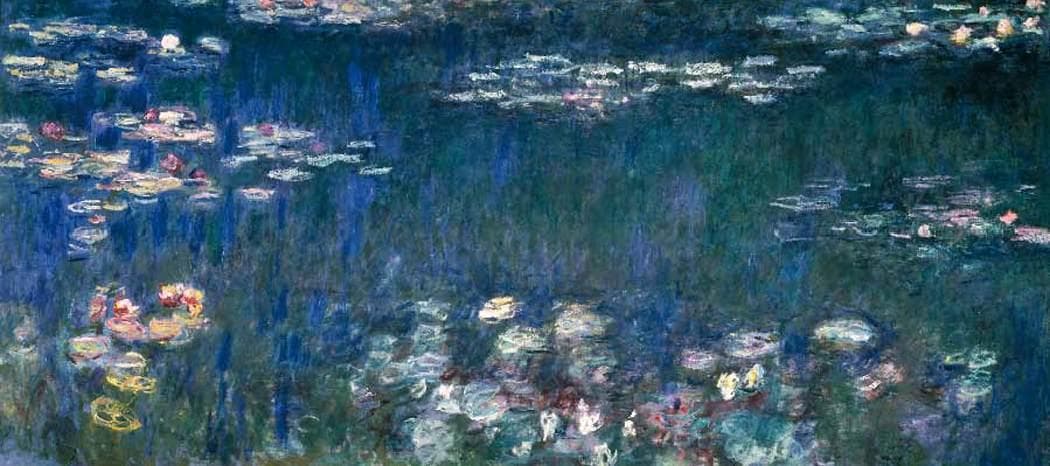
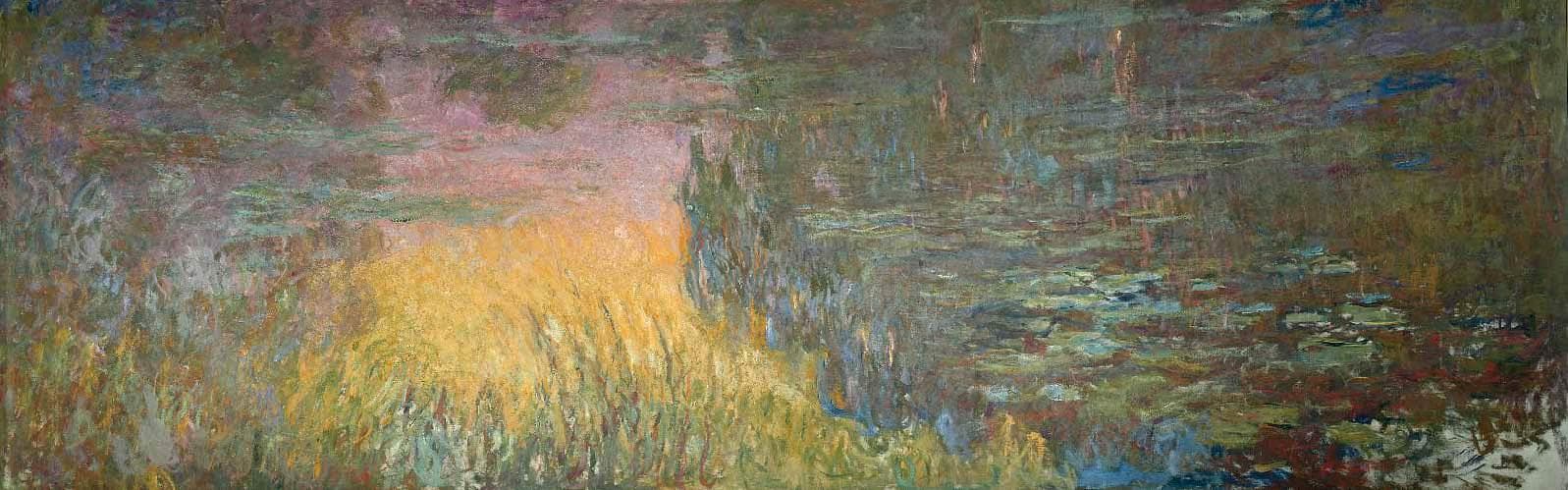
Set it beside the mural-scale Green Reflections and Setting Sun to see how Monet carried the same vocabulary of pad, flower and reflection up to the size of a wall.
Where is it?
The work is privately owned and not on public view. Monet's late water lilies can be seen in Paris at the Orangerie and the Marmottan, and in many museums abroad; see Where to See Monet's Paintings.
Questions & answers
Where is this Monet Water Lilies painting?
This canvas, Le Bassin aux nymphéas (Wildenstein 1897), is in a private collection. It sold at Sotheby's New York in May 2021 for about $70.4 million including fees. It is not the square 1904 Water Lilies in the MuMa, Le Havre, which is a different painting.
When and where was it painted?
It is dated 1917–19 and was painted at Giverny, from Monet's water-lily pond, in the years when he was working on the huge panels later installed in the Orangerie. He painted many canvases about one by two meters at the same time, and this is one of them.
What is reflected in the water?
The open water in the middle mirrors the sky: blue with drifting white and pink clouds. The dark vertical streaks at the upper right are reflections of a willow on the bank. Monet shows no shore or sky directly, only their reflections on the surface of the pond.
How many Water Lilies paintings did Monet make?
Around 250 over about thirty years, from the late 1890s to his death in 1926, including the giant Orangerie panels. They range from small canvases with a strip of bank to wall-sized compositions. This 1917–19 picture belongs to the late, wide-format group made alongside the Orangerie project.
More by the artist
Claude Monet

Bridge over a Pond of Water Lilies
Claude Monet · 1899

Woman with a Parasol – Madame Monet and Her Son
Claude Monet · 1875

Sunset in Venice
Claude Monet · 1908–12

La Grenouillère
Claude Monet · 1869

Beach in Pourville
Claude Monet · 1882

Springtime
Claude Monet · 1872

Boating on the River Epte
Claude Monet · 1890

The Seine at Asnières (Hermitage)
Claude Monet · 1873
Also painted in 1918
The same year
Kindred works
You may also study
Water Lilies (1919, Metropolitan Museum)
Claude Monet · 1919
Water Lilies: Green Reflections
Claude Monet · 1914–26
Water Lilies: Setting Sun
Claude Monet · 1914–26
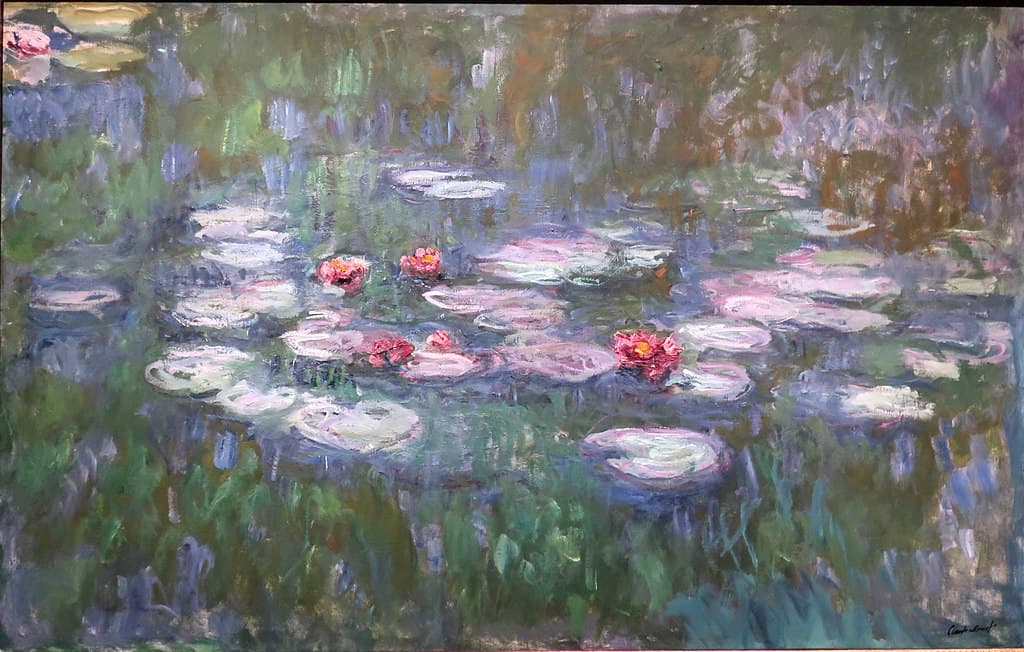
Nymphéas (Water Lilies)
Claude Monet · c. 1914–1919
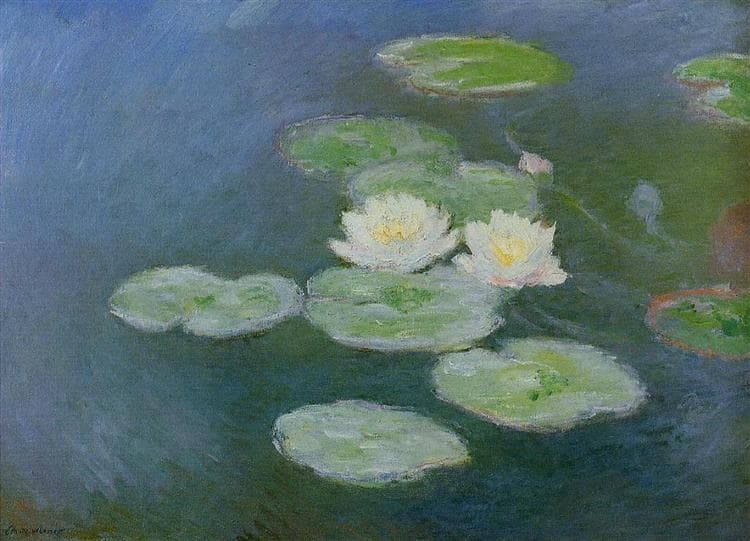
Water Lilies, Evening Effect
Claude Monet · 1897
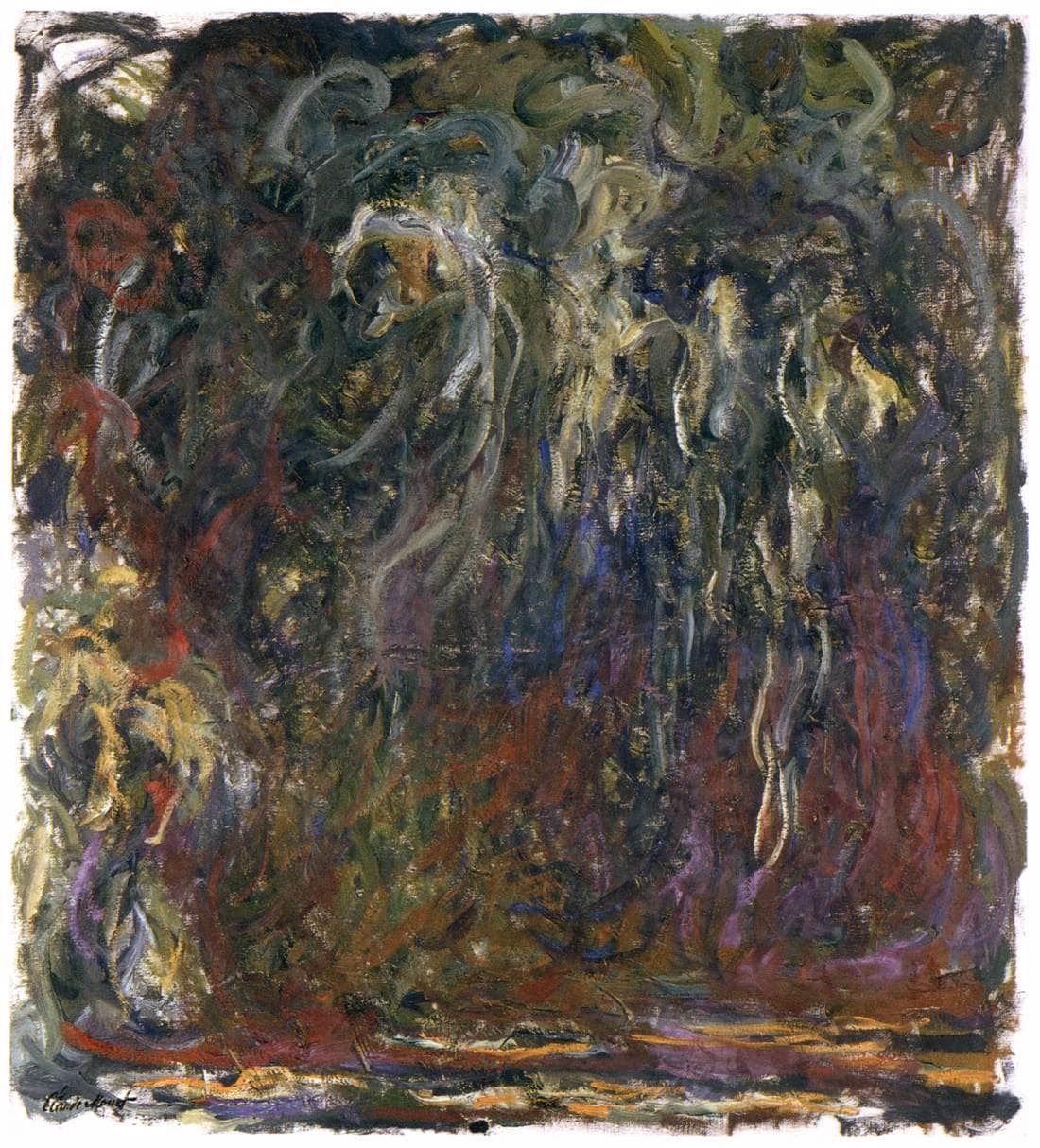
Weeping Willow
Claude Monet · 1920–22

The Scream
Edvard Munch · 1893

Ophelia
John Everett Millais · 1851–52