Image: Private collection (image via Sotheby's, London, 19 June 2007) · Public domain · via Wikimedia Commons
Impressionism
Water Lilies (1904)
Claude Monet, 1904
Water Lilies (Nymphéas) is a 1904 painting by Claude Monet of drifting islands of lilies on the dark, reflective surface of his pond at Giverny. Shown in his 1909 Water Lilies exhibition, it is in a private collection.
- Artist
- Claude Monet
- Date
- 1904
- Medium
- Oil on canvas
- Dimensions
- 81 × 100 cm
- Collection
- Private collection
- Movement
- Impressionism
- Catalogue
- Wildenstein 1662
What you are looking at
The surface of the pond fills the canvas. Across it drift horizontal islands of lily pads, flat ovals of grey-blue and green, studded with blossoms in white, pink, red and a few touches of yellow. The islands are arranged in loose bands that get smaller and closer together toward the top, which makes the pond recede. At the very bottom, closest to us, a last cluster of pink and white flowers sits on pale pads. Between the islands the water is dark and deep green, and in it are the reflections of things we cannot see: the trees and shrubs around the pond, mirrored as soft vertical shapes of green, blue and brown.
There is almost no sky. Monet has pushed the horizon out of the picture, leaving only a small hint of light in the upper reaches, so the space is built entirely from the water and what floats on and in it. The canvas is signed and dated 1904 at lower right.
The detail people miss is how much of the picture is reflection. The dark vertical shapes running down the canvas are not plants in the water; they are the willows and bamboos on the far bank, upside down. The flat pads lie across them like a pattern on glass.
Where and when it was painted
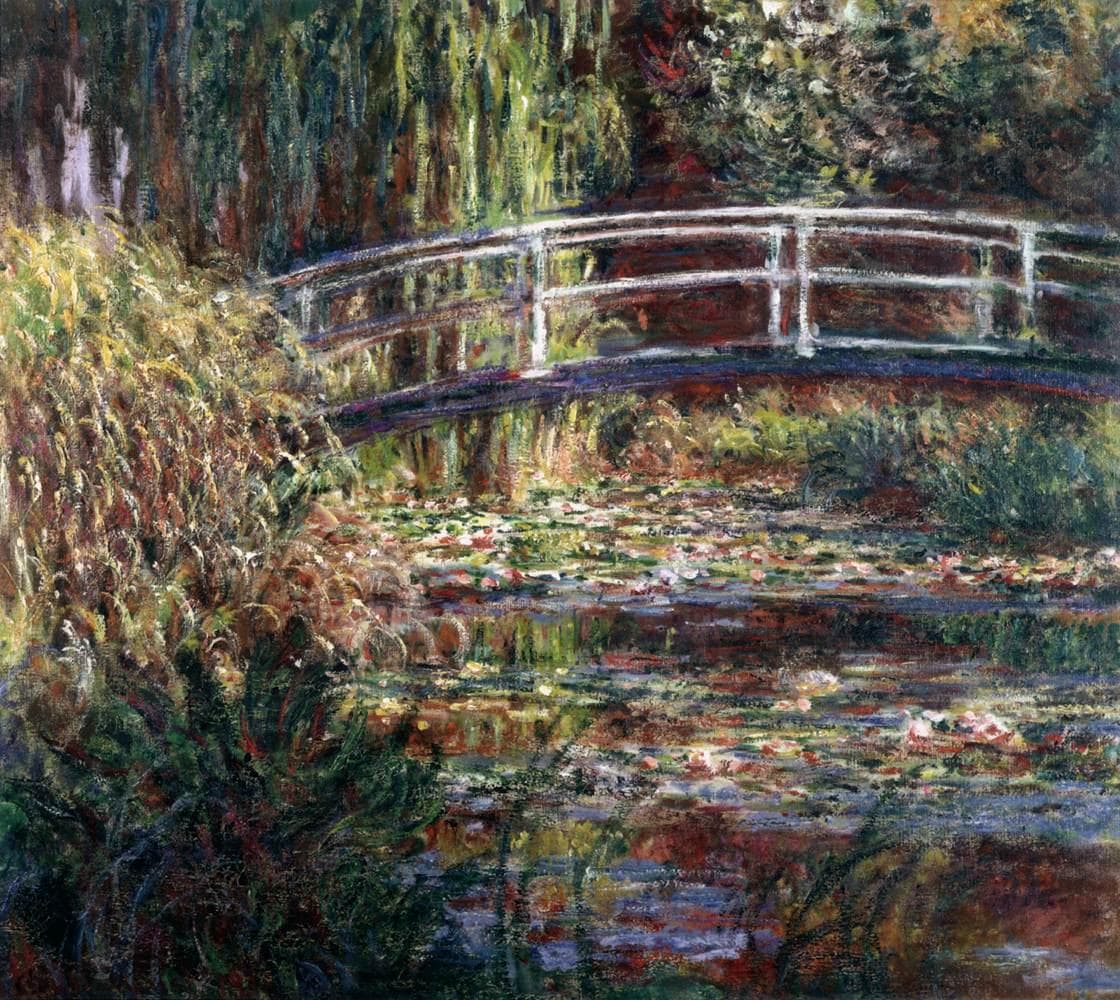
Monet had dug his water-lily pond at Giverny in 1893, and in 1901 he enlarged it and redesigned its banks. From 1903 he began a long campaign of paintings of the pond's surface alone, without the Japanese bridge that had dominated his garden pictures of 1899–1900, such as The Water Lily Pond in Boston or The Water Lily Pond, Harmony in Rose. He worked on these canvases for five years, scraping down and repainting many of them, and postponed their exhibition several times.
In May 1909, 48 of them were finally shown at Durand-Ruel's gallery in Paris under the title Les Nymphéas, séries de paysages d'eau ("water landscapes"). This canvas was number 4 in that exhibition. For the long story of the motif, see Monet's Water Lilies; for the garden, Giverny: Monet's house and garden.
How it was painted
The canvas is 81 by 100 centimeters, a horizontal format; around this time Monet began also to use square canvases for the pond, the logical next step once the horizon had gone. The lily pads are laid down in flat, horizontal strokes, the reflections in long, soft verticals, so the two layers cross each other at right angles. The flowers are small, thick dabs of color placed on top.
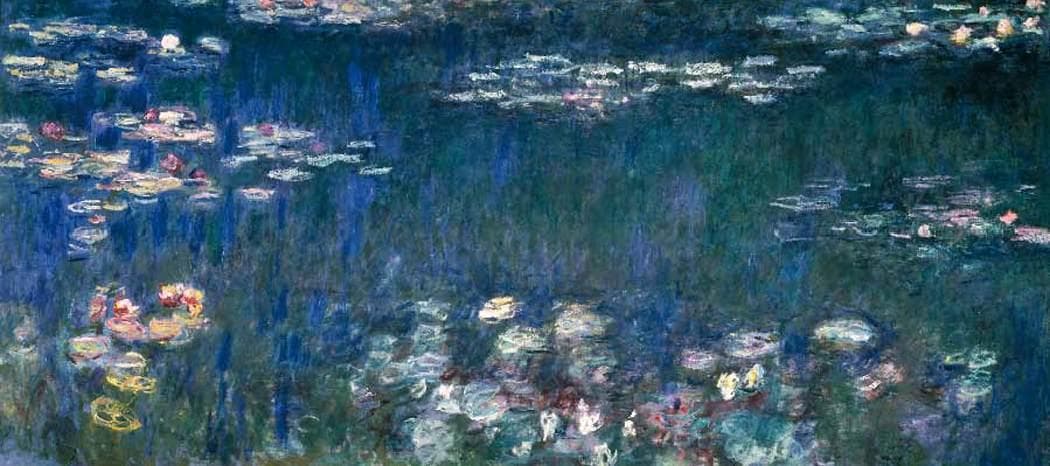
Compare the early close-up of 1897–98, Nymphéas in Los Angeles, where pads and flowers are separate objects on dark water, and the late, wall-sized canvases at the Orangerie, such as Water Lilies: Green Reflections, where the pond becomes an environment. This 1904 picture sits between: the surface has become a world of its own, but it is still a picture of a pond, with depth and distance.
Critics in 1909 struggled to describe what they saw. Several wrote of the canvases as dreams or mirrors rather than landscapes, and the phrase Monet chose for his title, paysages d'eau, water landscapes, reflects the problem: these were landscapes with the land taken out. Their influence on painting after the Second World War, when American abstract painters rediscovered late Monet, has made that ambiguity look prophetic.
Ownership and where to see it
Monet lent the painting to his friend and biographer Gustave Geffroy between 1910 and 1913. It then passed to Monet's son Michel and in the 1920s to a private collection in France. It was sold at Sotheby's in London on 19 June 2007 (lot 7) and remains in private hands. To see Water Lilies of these years in public, go to the Musée Marmottan Monet in Paris or museums in the United States and Europe listed on where to see Monet's paintings. See also the Claude Monet page.
Questions & answers
Where is Monet's 1904 Water Lilies?
This Water Lilies (Nymphéas), Wildenstein 1662, is in a private collection. It was sold at Sotheby's in London on 19 June 2007 after belonging to Gustave Geffroy (on loan), Michel Monet and a French private collection.
When did Monet paint Water Lilies (1904)?
It is signed and dated 1904. It belongs to the series of pond surfaces Monet painted at Giverny from 1903 to 1908, 48 of which he exhibited at Durand-Ruel's gallery in Paris in May 1909; this was number 4.
What does Water Lilies (1904) show?
Horizontal islands of lily pads with white, pink and red blossoms floating on the dark green surface of Monet's pond, with the trees of the far bank reflected in the water and almost no sky.
How many Water Lilies paintings did Monet make?
About 250, from the late 1890s to his death in 1926. They range from small studies to the huge Grandes Décorations installed in the Musée de l'Orangerie in Paris in 1927.
More by the artist
Claude Monet

Bridge over a Pond of Water Lilies
Claude Monet · 1899

Woman with a Parasol – Madame Monet and Her Son
Claude Monet · 1875

Sunset in Venice
Claude Monet · 1908–12

La Grenouillère
Claude Monet · 1869

Beach in Pourville
Claude Monet · 1882

Springtime
Claude Monet · 1872

Boating on the River Epte
Claude Monet · 1890

The Seine at Asnières (Hermitage)
Claude Monet · 1873
Also painted in 1904
The same year
Kindred works
You may also study
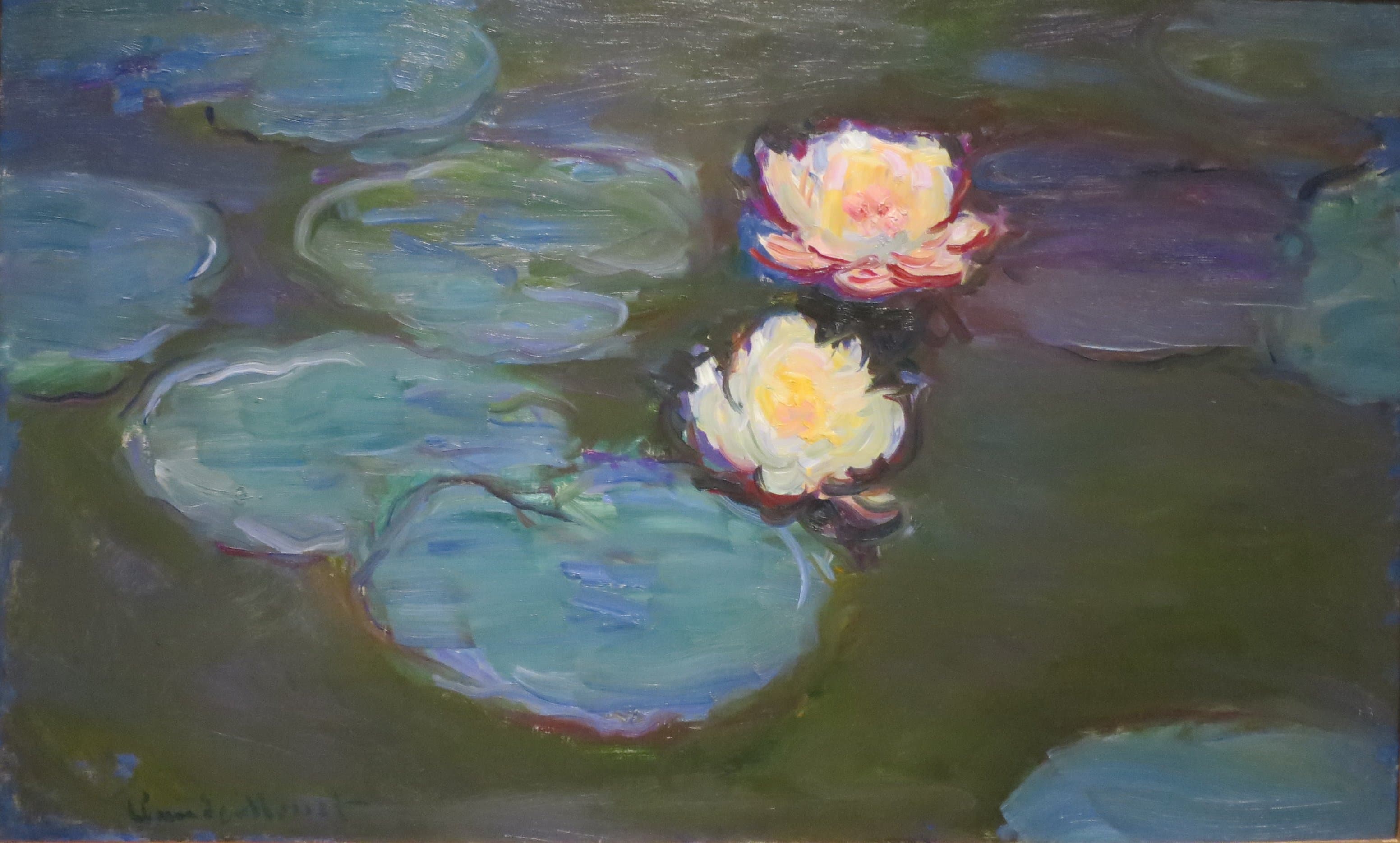
Nymphéas (Water Lilies), c. 1897–98
Claude Monet · c. 1897–98
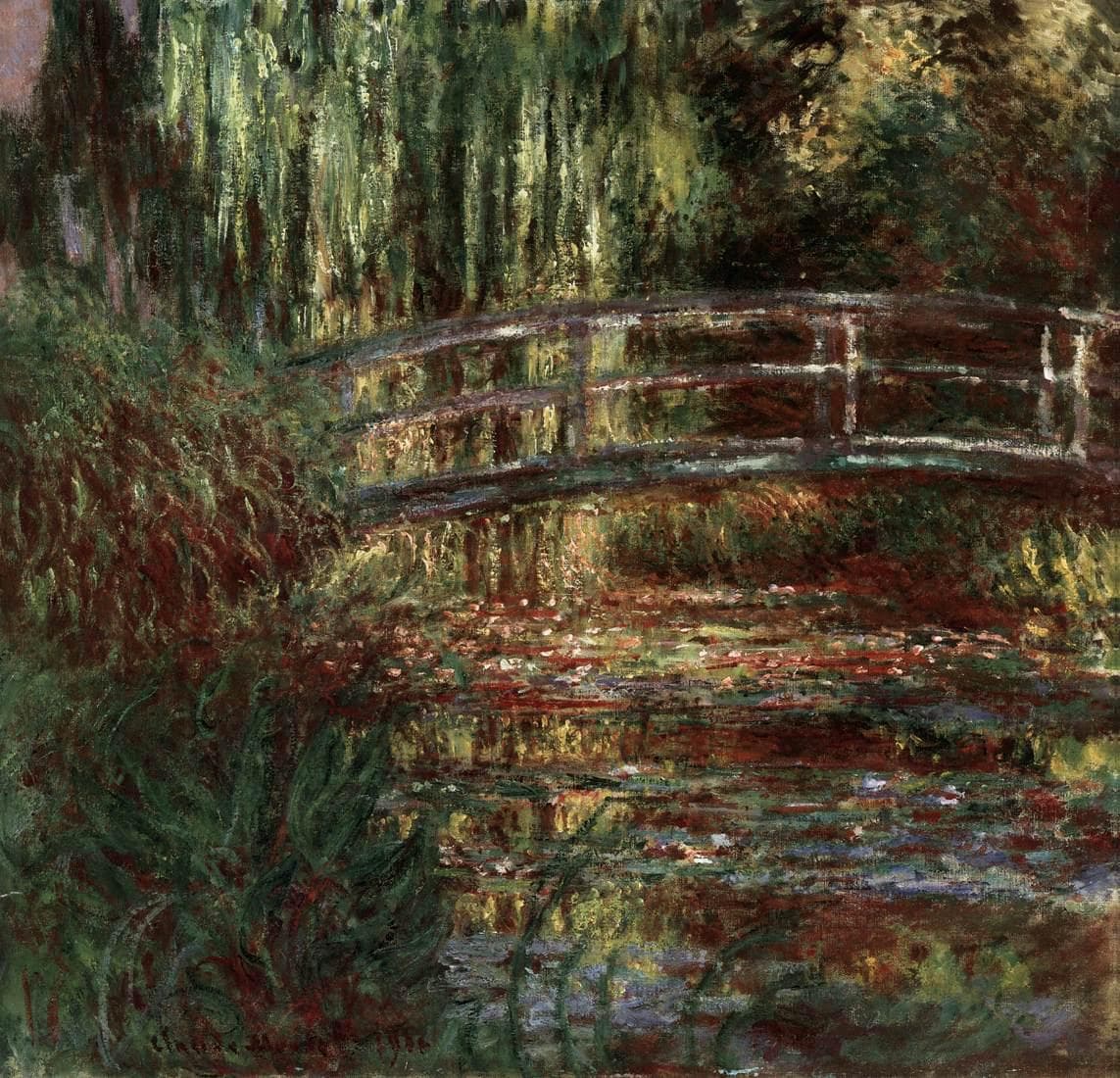
The Water Lily Pond
Claude Monet · 1900
The Water Lily Pond, Harmony in Rose
Claude Monet · 1900
Water Lilies: Green Reflections
Claude Monet · 1914–26

Water Lilies (MoMA triptych)
Claude Monet · 1914–26

The Scream
Edvard Munch · 1893

Ophelia
John Everett Millais · 1851–52

The Great Wave off Kanagawa
Katsushika Hokusai · c. 1830–32