Image: The Metropolitan Museum of Art / Wikimedia Commons (CC0) · CC0 · via Wikimedia Commons
Ukiyo-e
The Great Wave off Kanagawa
Katsushika Hokusai, c. 1830–32
The Great Wave off Kanagawa is a color woodblock print by the Japanese artist Katsushika Hokusai, published c. 1830–32. Because it is a print, there is no single original: impressions survive in many museums, including the Met (shown here).
- Artist
- Katsushika Hokusai
- Date
- c. 1830–32
- Medium
- Polychrome woodblock print; ink and color on paper
- Dimensions
- c. 25 × 37 cm (ōban sheet; impressions vary slightly)
- Collection
- The Metropolitan Museum of Art (impression shown); other impressions worldwide, New York, United States
- Movement
- Ukiyo-e
The Great Wave off Kanagawa (Kanagawa-oki nami ura, literally "Under the Wave off Kanagawa") is a woodblock print by Katsushika Hokusai, published around 1830–32 as the first design in his series Thirty-six Views of Mount Fuji. Each impression is roughly 25 by 37 centimeters, the standard ōban sheet. Large numbers were printed in Hokusai's lifetime, probably thousands, and many survive in public collections, including the Metropolitan Museum of Art in New York, the British Museum, the Art Institute of Chicago, the Museum of Fine Arts in Boston and the Tokyo National Museum. The impression shown here belongs to the Met.
What you're looking at
An enormous wave rears up from the left, its crest curling over into dozens of claw-like fingers of foam that seem about to close on everything beneath. Below it, three long, narrow boats, fast cargo vessels called oshiokuri-bune, carry rowers who bend low and grip their oars, heads down. You can count the men, crouched in rows along each hull.
In the center, far in the distance and tiny beneath the wave, is Mount Fuji, its snow-capped peak framed in the trough. A second, smaller wave in the foreground repeats Fuji's shape exactly, a little white-tipped peak of water, as if the sea were imitating the mountain.
Read the picture the way a Japanese viewer of the time would, right to left, and you follow the boats from the open water toward the wave. Read it the Western way, left to right, and the wave crashes in toward you. Its power works in both directions.
The details most people miss
At the top left is a rectangular cartouche with the series title, Fugaku sanjūrokkei (Thirty-six Views of Mount Fuji), and the subtitle Kanagawa-oki nami ura. Beside it is the signature, Hokusai aratame Iitsu hitsu, "from the brush of Hokusai, changing his name to Iitsu." Hokusai changed his artistic name about thirty times; he was about seventy when he made this print.
Look at the blue. The deep, intense color is largely Prussian blue (bero-ai, "Berlin indigo"), a synthetic pigment invented in Berlin in the early eighteenth century and newly available in Japan in affordable quantities in the late 1820s. Unlike traditional plant-based indigo, it did not fade quickly and gave a range of tones from pale to almost black. The Thirty-six Views series was partly marketed on this fashionable new color.
Finally, compare impressions. Early impressions have crisp lines, a pink-tinged sky at the top and fine gradations in the blue. Later ones, printed from worn blocks, show broken outlines, especially around the cartouche, and flatter color. Specialists date impressions by these signs.
How it was made
Hokusai drew the design; professional carvers cut it into a set of cherry-wood blocks, one for the black key outlines and others for each color; and printers inked and pressed sheets of paper by hand, with a separate impression for each color. The publisher, Nishimura Eijudō, managed and sold the edition. A print like this cost about the same as a double serving of noodles, which explains why so many were made and why it reached such a wide audience.
The design was not new to Hokusai. He had been experimenting with great waves and boats for decades, in prints made around the turn of the nineteenth century, but those waves were softer and less monumental. The Great Wave is the fully developed form.
What does The Great Wave off Kanagawa mean?
The print is a view of Mount Fuji, sacred in Japanese tradition and associated with immortality, seen from the sea off Kanagawa, near modern Yokohama. Its meaning is built on contrasts: the wave's terrifying, temporary energy against the mountain's still permanence; small human figures against the vast forces of nature; motion against stillness.
Many writers also read the picture in terms of Buddhist and Shinto ideas of impermanence. The wave is at its peak and will be gone in a moment; Fuji will remain. The boatmen are neither drowned nor saved; Hokusai suspends them, and us, at the moment of greatest danger.
Hokusai was also thinking of Western art. The low horizon and the use of linear perspective show his study of Dutch prints that reached Japan through the trading post at Nagasaki.
Reception and influence
In Japan, the print was a popular commercial product. In Europe after the 1850s, when Japanese prints arrived in large numbers, it became a sensation and a key image of Japonisme. Claude Monet collected Japanese prints, Hokusai's among them, at his house in Giverny; Vincent van Gogh wrote admiringly of Hokusai's waves in a letter to his brother; Claude Debussy had the image placed on the cover of the first edition of his orchestral work La Mer (1905). Today it is probably the most reproduced work of Asian art in the world, and its wave has become a modern emoji.
Where to see it
Because it is light-sensitive, works on paper are shown only for a few months at a time. No museum displays its impression permanently; the Met, the British Museum and others show theirs in rotation. Check a museum's online collection before visiting. For artists it inspired, see Claude Monet, our collection of famous Monet paintings, Van Gogh's The Starry Night, and our selection of famous paintings.
Questions & answers
Where is the original Great Wave off Kanagawa?
There is no single original. It is a woodblock print, and many impressions were made around 1830–32. Fine ones are in the Metropolitan Museum of Art, the British Museum, the Art Institute of Chicago, the Museum of Fine Arts Boston and the Tokyo National Museum, among others, usually shown only in rotation because of light sensitivity.
What does The Great Wave off Kanagawa mean?
It contrasts the violent, momentary power of a great wave with the stillness of distant Mount Fuji, a sacred symbol of permanence. The tiny boatmen bent beneath the wave make it a meditation on human fragility and impermanence in the face of nature.
Is Mount Fuji in The Great Wave?
Yes. Fuji is the small snow-capped mountain in the center distance, framed by the trough of the wave. The print is the first in Hokusai's series Thirty-six Views of Mount Fuji, and a small wave in the foreground echoes Fuji's shape.
How old was Hokusai when he made The Great Wave?
He was about seventy. Born in 1760, Hokusai published the print around 1830–32, and he signed it 'Hokusai aratame Iitsu hitsu,' using one of the many artistic names he took over his career.
Why is the blue in The Great Wave so striking?
Hokusai's publisher used Prussian blue, a synthetic pigment invented in Europe that became affordable in Japan in the late 1820s. It was more intense and lasting than traditional indigo and allowed deep gradations, making the series fashionable.
Kindred works
You may also study
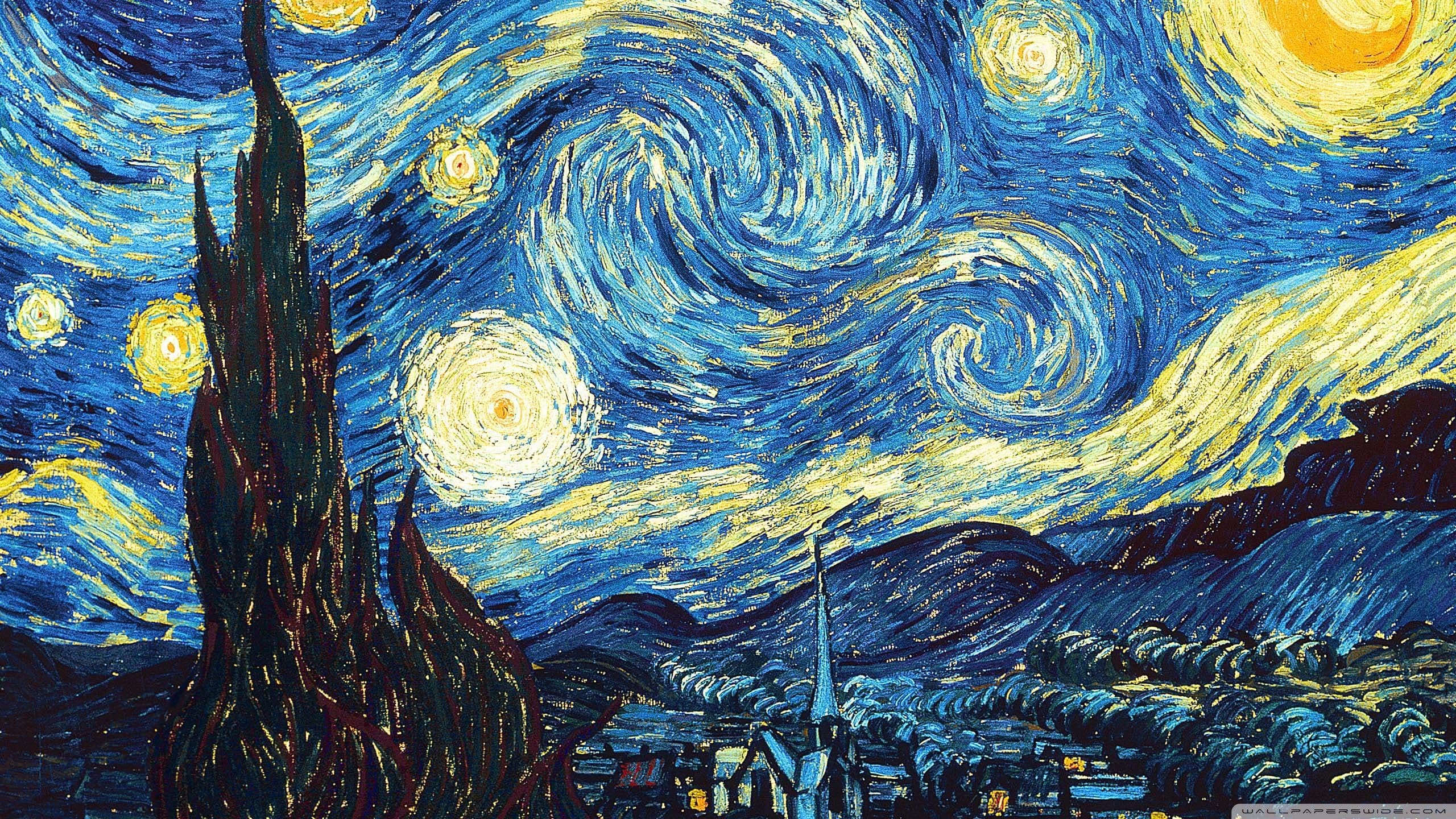
The Starry Night (van Gogh)
Vincent van Gogh · 1889
The Storm on the Sea of Galilee
Rembrandt · 1633

The Scream
Edvard Munch · 1893
Water Lilies, Evening Effect
Claude Monet · 1897
Las Meninas
Diego Velázquez · 1656

Bridge over a Pond of Water Lilies
Claude Monet · 1899

Ophelia
John Everett Millais · 1851–52

Woman with a Parasol – Madame Monet and Her Son
Claude Monet · 1875