Image: Museum of Modern Art, New York; photograph from the Wikipedia Loves Art project (Flickr) · Public domain · via Wikimedia Commons
Impressionism
Water Lilies (MoMA triptych)
Claude Monet, 1914–26
Water Lilies is a three-panel canvas nearly 13 meters long that Claude Monet worked on at Giverny between 1914 and his death in 1926. It shows the surface of his lily pond with clouds reflected in it, and hangs in the Museum of Modern Art, New York.
- Artist
- Claude Monet
- Date
- 1914–26
- Medium
- Oil on canvas, three panels
- Dimensions
- 200 × 1276 cm overall (each panel 200 × 424.8 cm)
- Collection
- Museum of Modern Art, New York, United States
- Movement
- Impressionism
- Catalogue
- Wildenstein 1972-1973-1974
Water Lilies is one of the great late panoramas Claude Monet painted of the pond in his garden at Giverny: three canvases, each two meters high and more than four meters wide, hung edge to edge so the picture runs nearly 13 meters along the wall. The Museum of Modern Art in New York, which dates it 1914–26, bought it in 1959. It is also known as Reflections of Clouds on the Water-Lily Pond, a title that describes exactly what it shows.
What you are looking at
There is no bank, no horizon and no sky in the usual sense. The whole picture is the skin of the water seen from above, and the sky only appears upside down, inside it. Across the center of the three panels runs a broad band of reflected cloud, painted in warm creams, apricots and pale gold. Around it the water deepens into blues and violets, and at the far right a dark mass of green and blue-black suggests the shadow of trees on the bank.
The lilies themselves are almost incidental. Small flat pads, painted in quick horizontal touches of green, float in loose rafts along the lower edge and drift through the reflected clouds, with a few points of pink and white for the flowers. Because the pads lie flat on the surface while the clouds sink into the depth of the reflection, the eye keeps shifting between two distances at once. Standing close, you see only thick, crossing strokes; stepping back, the surface settles into water, light and air.
Where and when it was painted
From 1914, after the death of his wife Alice and of his elder son Jean, Monet built a huge new studio at Giverny so that he could paint water-lily canvases on a mural scale. His eyesight was failing from cataracts, the First World War was being fought less than a hundred miles away, and he worked on these panels for years, repainting and regrouping them. The motif was the pond he had dug at the bottom of his garden, described on our Giverny hub.
The project became the Grandes Décorations, the cycle he gave to France and which was installed after his death in the oval rooms of the Orangerie in Paris (see the Water Lilies at the Orangerie). Many panels stayed in the studio, unsigned, and were sold by his son Michel in the decades after. MoMA's triptych is one of these: closely related to the Orangerie compositions of reflected clouds, but never part of the state gift.
How it was painted
The panels are painted wet over dry in many campaigns, and the surface is heavy, layered and visibly reworked. Monet laid in large zones of color with broad brushes, then broke them up with shorter, curling and dragged strokes. Bare canvas shows in places at the edges. The palette is restrained to blues, violets, greens and warm cloud tones, with almost no hard contrasts, so that the picture reads as a single field of light rather than a set of objects. On how Monet painted we look at this late method in more detail.
The series
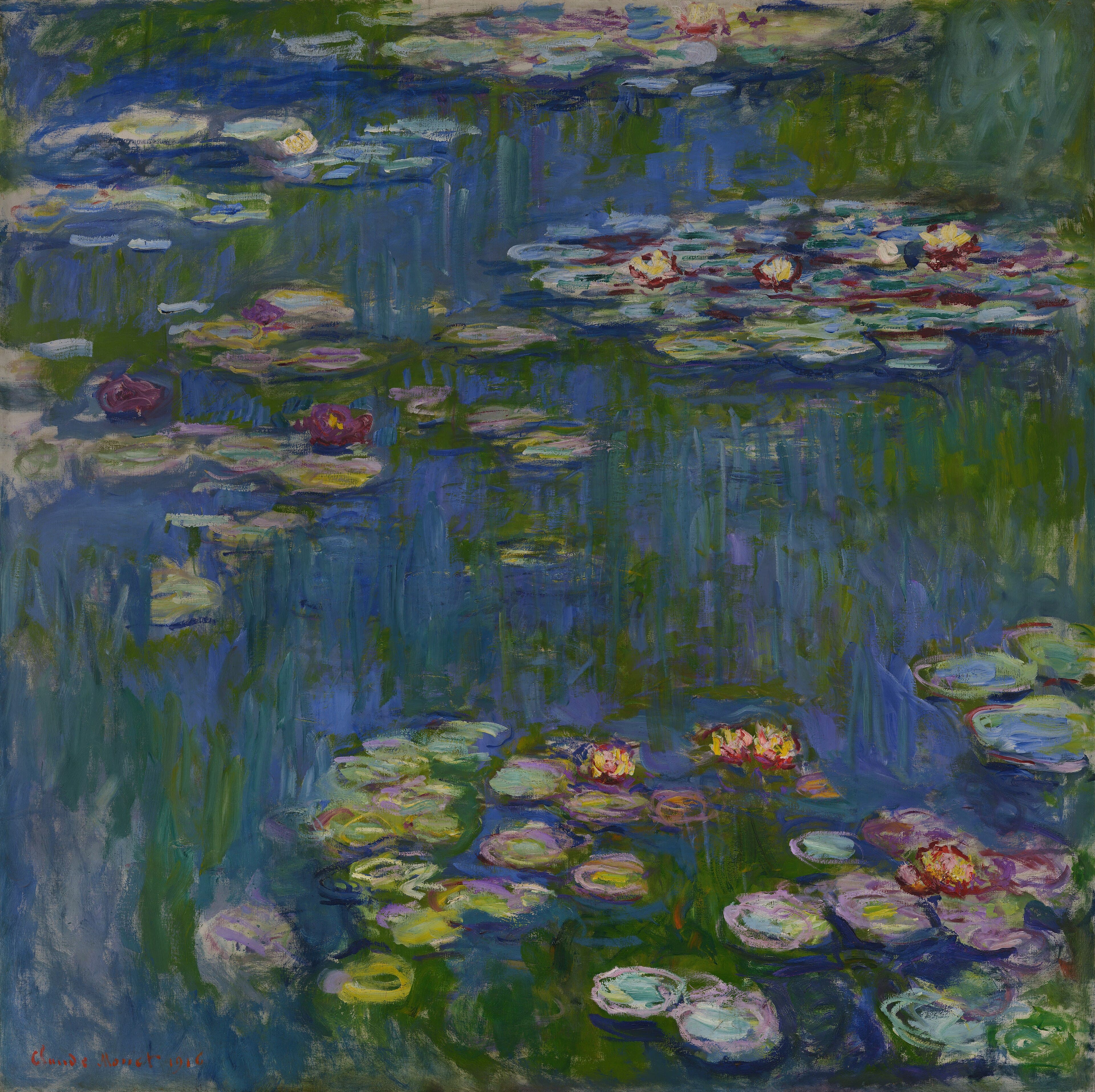
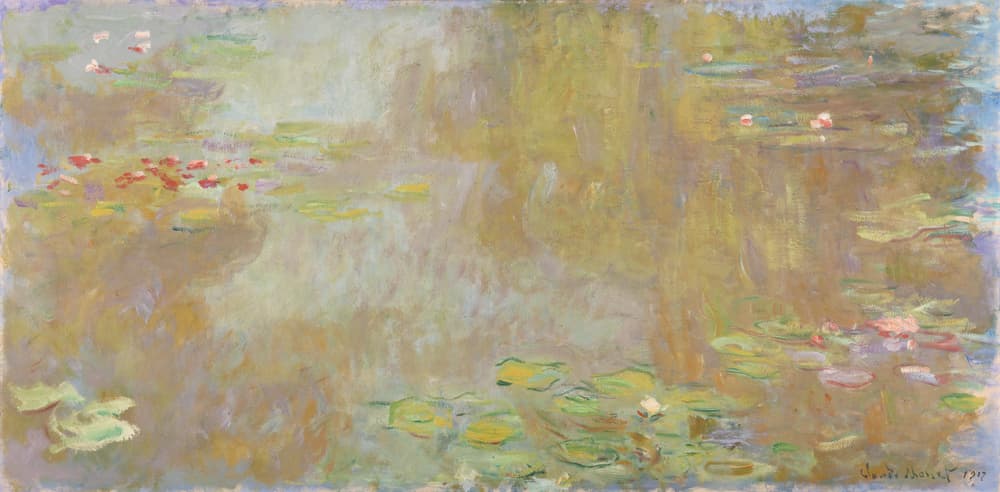
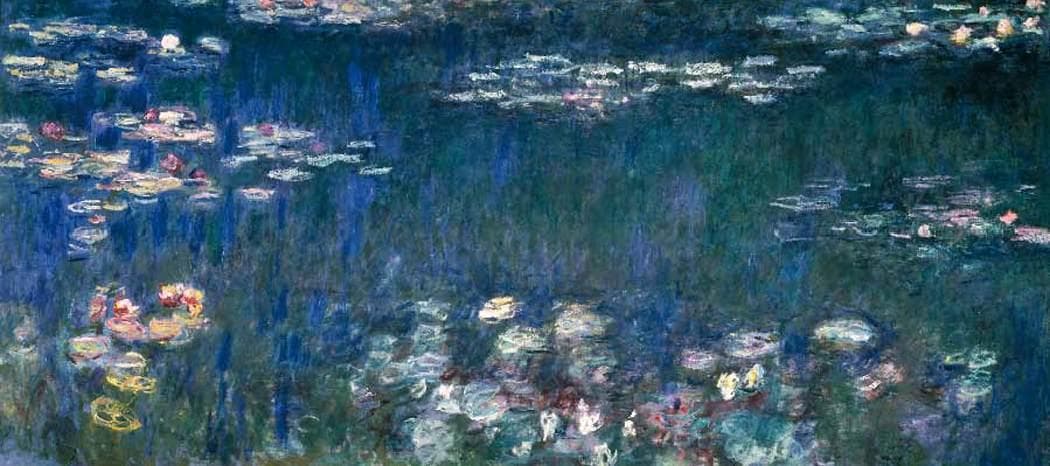
Monet painted the lily pond about 250 times between the late 1890s and 1926, gathered on our Water Lilies hub. Early versions such as Water Lily Pond, Green Harmony still include the bank and the footbridge. The later works lose the frame entirely. Compare this triptych with the near-square Water Lilies of 1916 in Tokyo, the wider Water Lilies in Giverny of 1917 in Nantes, or the Orangerie's Green Reflections. The MoMA picture is the only one in the United States that gives the full, wall-filling effect Monet intended.
Ownership and where to see it
MoMA acquired the triptych in 1959 with the Mrs. Simon Guggenheim Fund, the year after a fire at the museum destroyed an earlier large Water Lilies canvas it had bought. For many visitors it marks the hinge between Impressionism and abstract painting: the Abstract Expressionists in New York were looking hard at late Monet at precisely this time. It is usually on view in the fifth-floor galleries; for other late water lilies on public display, see where to see Monet.
Questions & answers
Where is Monet's Water Lilies triptych in New York?
It is in the Museum of Modern Art (MoMA) in Midtown Manhattan, which bought it in 1959. The three panels together measure about 2 by 12.8 meters and normally hang as one continuous wall in the museum's collection galleries. Check MoMA's website for the current room before visiting.
When and where did Monet paint the MoMA Water Lilies?
MoMA dates the triptych 1914–26. Monet painted it in the large studio he built at Giverny in 1915, working from the lily pond in his own garden. He reworked the panels over many years, during the First World War and while his sight was failing from cataracts.
What does the MoMA Water Lilies show?
It shows only the surface of the pond: floating lily pads and a few flowers, with a band of white and gold clouds reflected in the water. There is no shore or horizon. That is why it is also called Reflections of Clouds on the Water-Lily Pond, and why it is often seen as a forerunner of abstract painting.
Is MoMA's Water Lilies part of the Orangerie series?
It is closely related but separate. Monet gave a set of large panels to the French state, now in the Musée de l'Orangerie in Paris. Other panels from the same project stayed in his studio and were later sold; MoMA's triptych is one of these, so it shares the Orangerie's scale and motif without belonging to the state gift.
More by the artist
Claude Monet

Bridge over a Pond of Water Lilies
Claude Monet · 1899

Woman with a Parasol – Madame Monet and Her Son
Claude Monet · 1875

Sunset in Venice
Claude Monet · 1908–12

La Grenouillère
Claude Monet · 1869

Beach in Pourville
Claude Monet · 1882

Springtime
Claude Monet · 1872

Boating on the River Epte
Claude Monet · 1890

The Seine at Asnières (Hermitage)
Claude Monet · 1873
Also painted in 1914
The same year
Kindred works
You may also study
Water Lilies (1916, Tokyo)
Claude Monet · 1916
Water Lilies in Giverny
Claude Monet · 1917
Water Lilies: Green Reflections
Claude Monet · 1914–26
Water Lilies: Setting Sun
Claude Monet · 1914–26
Water Lilies (1919, Metropolitan Museum)
Claude Monet · 1919

The Scream
Edvard Munch · 1893

Ophelia
John Everett Millais · 1851–52

The Great Wave off Kanagawa
Katsushika Hokusai · c. 1830–32