Image: The Metropolitan Museum of Art, New York · Public domain · via Wikimedia Commons
Impressionism
La Grenouillère
Claude Monet, 1869
La Grenouillère is Claude Monet's 1869 painting of a floating café and bathing place on the Seine near Bougival, painted beside Renoir in the summer Impressionism took shape. It is in the Metropolitan Museum of Art, New York.
- Artist
- Claude Monet
- Date
- 1869
- Medium
- Oil on canvas
- Dimensions
- 74.6 × 99.7 cm
- Collection
- The Metropolitan Museum of Art, New York, United States
- Movement
- Impressionism
- Catalogue
- Wildenstein 134
More at Monet at the Met
The Metropolitan Museum's La Grenouillère is one of the two surviving canvases Claude Monet painted at La Grenouillère, a riverside bathing spot on the Seine, in the late summer of 1869. Working next to Pierre-Auguste Renoir, he set down light on moving water with short, separate strokes. The broken touch these two pictures share has made them a standard starting point for the story of Impressionism.
What you're looking at
The center of the picture is a small round island, nicknamed the Camembert, joined to the shore and to a moored café-barge by narrow plank walkways. A single tree grows out of it, its trunk running up past the top edge. About a dozen figures crowd onto the island: women in dark summer dresses and pale skirts, a man in a top hat stepping along the gangway at right, and a lifebuoy hung on a post. To the left, swimmers bob in the water up to their shoulders, their heads and arms just a few dabs of flesh color. At right the café's striped awning and railing cut into the frame, and a painted sign along its side, half legible, advertises boats for hire.
The real subject is the water. It fills the lower half of the canvas in horizontal slabs of paint: dark blue-green for reflected foliage, cream and sky blue for the open sky, quick white flecks where the light catches the ripples. Close to us the strokes get bigger and further apart, so the river seems to come toward the viewer. Two hire boats float at the edges, cropped by the frame at left and at right, which gives the feeling of a glance rather than a composed view. Above, the far bank is a sunlit band of yellow-green trees under a pale, overcast sky.
Monet and Renoir at Bougival
In 1869 Monet was living with Camille Doncieux and their infant son at Saint-Michel, near Bougival, west of Paris, and he was close to destitute. Renoir, who was staying with his parents nearby, came over to paint with him. On 25 September Monet wrote to Frédéric Bazille that he had a dream of a painting of the baths at La Grenouillère, for which he had done only some bad sketches. Scholars generally take the Met canvas and the National Gallery's Bathers at La Grenouillère to be among those sketches. A larger version, presumably the finished painting he hoped for, was formerly in a Berlin collection and is now lost.
La Grenouillère was easy to reach by train from Paris. It was cheerfully advertised as a Trouville on the Seine, and Napoleon III had recently paid it a visit. Guy de Maupassant later described its crowd with some malice in his story La Femme de Paul. For two young painters wanting to sell scenes of modern leisure, the bathers, rowers and café terrace were an obvious subject.
How it was painted
The brushwork here is broad and constructive, laid on quickly over a light ground and left visible. Monet does not blend: each stroke is a separate decision about color and value, and the ripples are made of the strokes themselves rather than drawn on top of the water. For his Salon pictures of these years he usually aimed at a smoother finish. The speed and roughness are what mark this as a working sketch made on the spot.
Renoir's painting of almost the same view, now in the Nationalmuseum in Stockholm, shows how differently the two men worked side by side. Renoir softens the figures and feathers his touch, while Monet keeps the strokes blocky and gives the water more space. The Met canvas is also more open than the London one: the island sits further back and the river takes up more of the foreground.
From Manet to the Havemeyers
The painting belonged early on to Édouard Manet, who owned it until his death in 1883. It went to the dealer Paul Durand-Ruel and then, in 1897, to the New York collectors Henry and Louisine Havemeyer. Louisine Havemeyer's bequest brought it to the Metropolitan Museum in 1929. It is part of the museum's large Monet holding; see Monet at the Met.
Where to see it
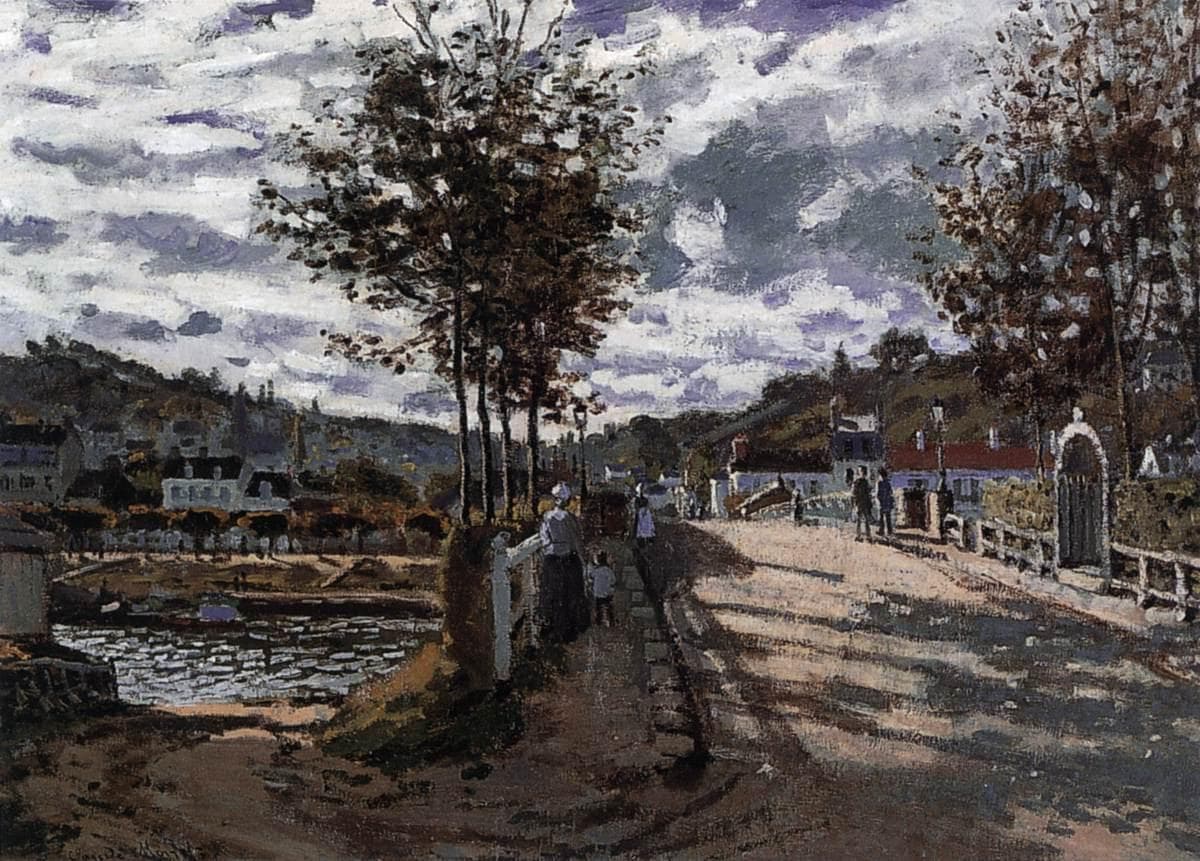
La Grenouillère is in the nineteenth-century European paintings galleries at the Met on Fifth Avenue. It works well alongside the river scenes Monet went on to paint in the 1870s, gathered under Monet at Argenteuil, such as The Bridge at Bougival from the same year and The Basin at Argenteuil. For his work across the world's museums, see where to see Monet.
Questions & answers
Where is Monet's La Grenouillère today?
This version of La Grenouillère is in the Metropolitan Museum of Art in New York, which received it in 1929 through the bequest of Louisine Havemeyer. A second canvas of the same place, Bathers at La Grenouillère, is in the National Gallery, London.
When and where was La Grenouillère painted?
Monet painted it in late summer 1869 at La Grenouillère, a bathing place and floating café on the Seine at Croissy, near Bougival, west of Paris. Renoir worked beside him, painting nearly the same view; his version is in Stockholm.
What does La Grenouillère show?
It shows a small round island with a single tree, crowded with holidaymakers, linked by plank walkways to a café-barge, with swimmers in the water and hire boats in the foreground. Most of the canvas is given to the river, painted in separate strokes of reflected light.
How many versions of La Grenouillère did Monet paint?
Two canvases survive: this one at the Met and Bathers at La Grenouillère in London. Both are probably the sketches Monet mentioned to Bazille in September 1869. A larger version, formerly in Berlin, is lost.
More by the artist
Claude Monet

Bridge over a Pond of Water Lilies
Claude Monet · 1899

Woman with a Parasol – Madame Monet and Her Son
Claude Monet · 1875

Sunset in Venice
Claude Monet · 1908–12

Beach in Pourville
Claude Monet · 1882

Springtime
Claude Monet · 1872

Boating on the River Epte
Claude Monet · 1890

The Seine at Asnières (Hermitage)
Claude Monet · 1873
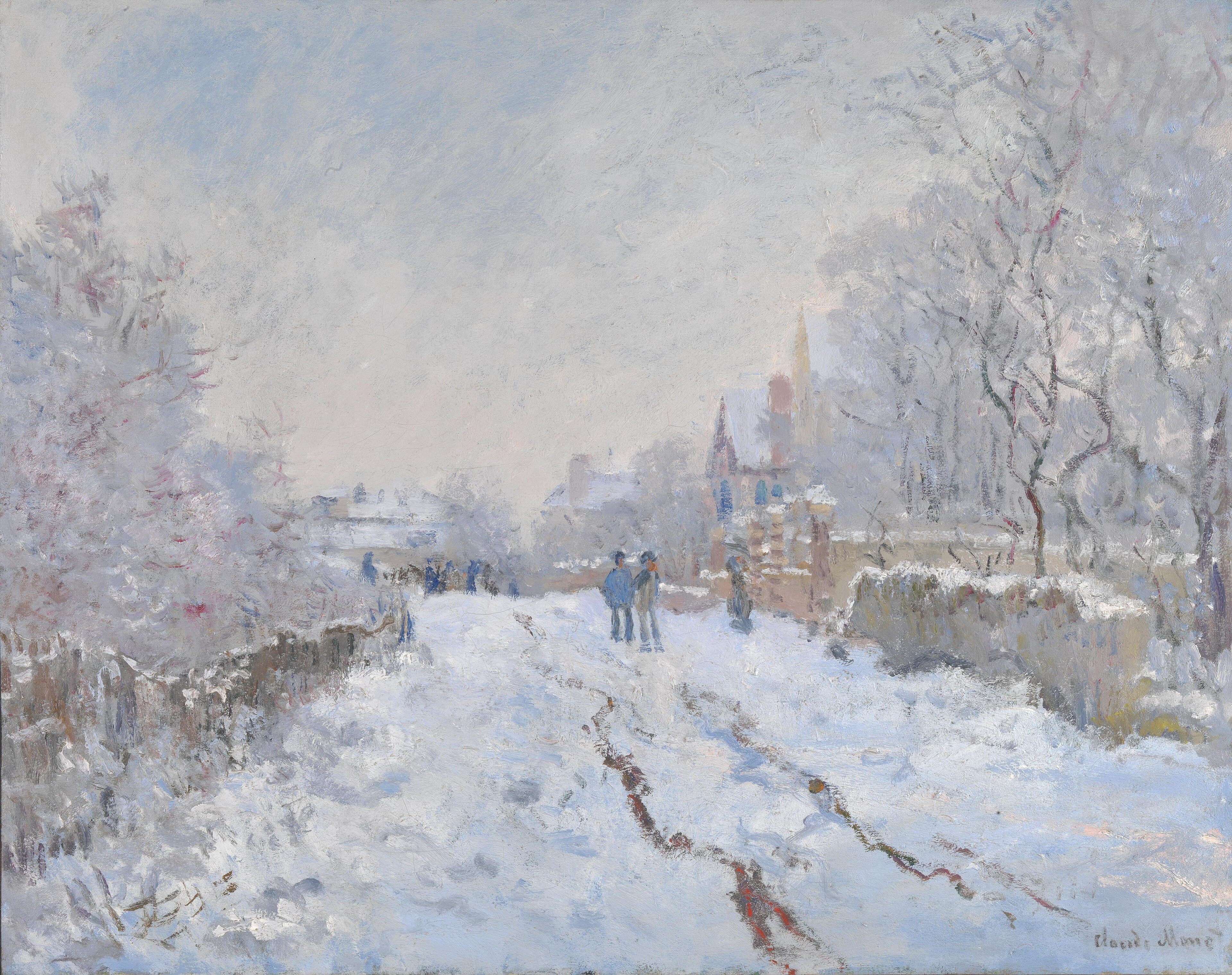
Snow Scene at Argenteuil
Claude Monet · 1875
Also painted in 1869
The same year
Kindred works
You may also study
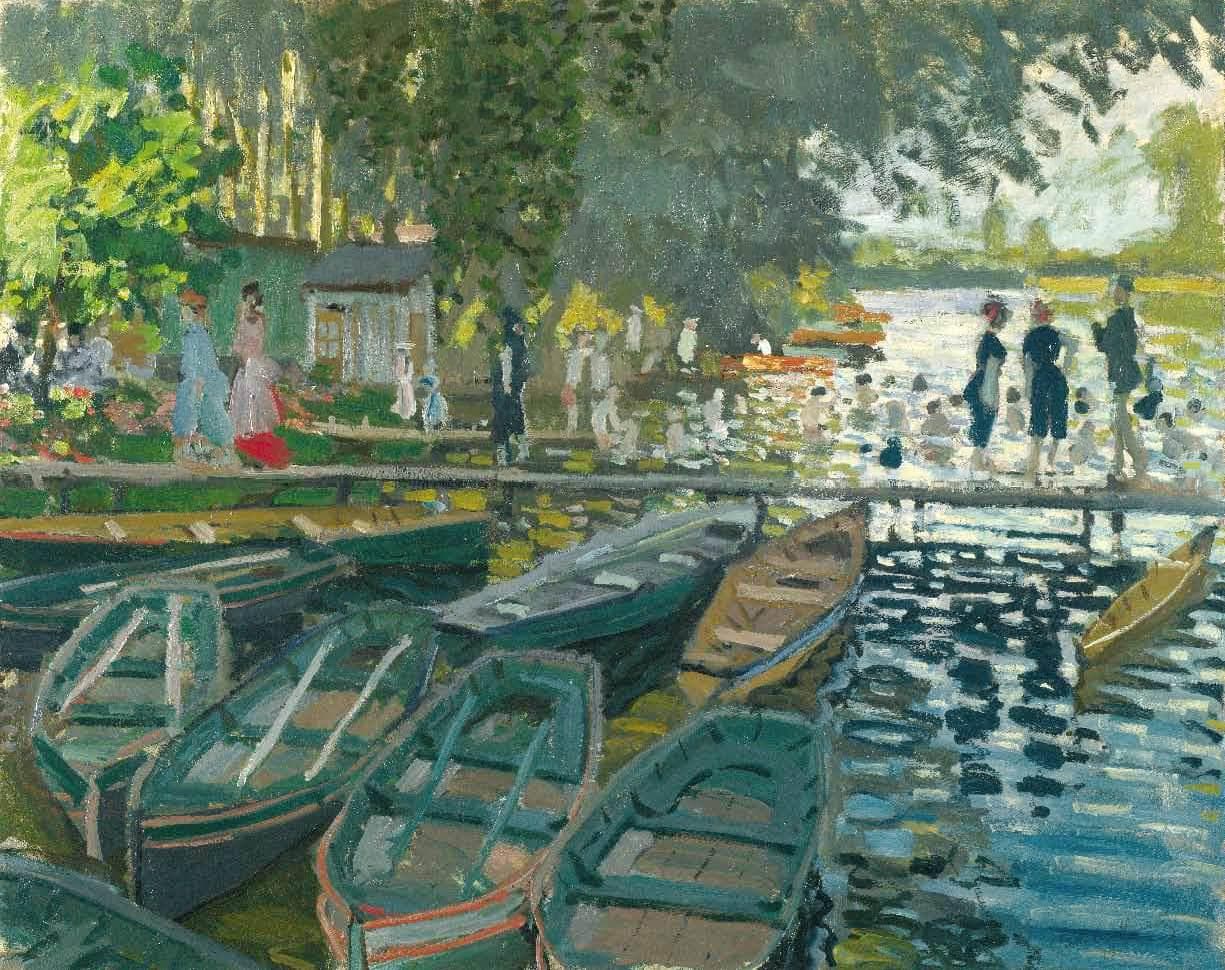
Bathers at La Grenouillère
Claude Monet · 1869
The Bridge at Bougival
Claude Monet · 1869
The Boats
Claude Monet · 1869
The Basin at Argenteuil
Claude Monet · 1872
Regatta at Argenteuil
Claude Monet · c. 1872

The Scream
Edvard Munch · 1893

Ophelia
John Everett Millais · 1851–52

The Great Wave off Kanagawa
Katsushika Hokusai · c. 1830–32