Image: Tate, via Google Arts & Culture · Public domain · via Wikimedia Commons
Pre-Raphaelite
Ophelia
John Everett Millais, 1851–52
The Ophelia painting by John Everett Millais (1851–52) shows Shakespeare's Ophelia floating in a stream moments before she drowns. Modeled by Elizabeth Siddal, it hangs in Tate Britain in London.
- Artist
- John Everett Millais
- Date
- 1851–52
- Medium
- Oil on canvas
- Dimensions
- 76.2 × 111.8 cm
- Collection
- Tate Britain, London, United Kingdom
- Movement
- Pre-Raphaelite
What you are looking at
A young woman lies on her back in a slow English stream, her arms open, her palms turned up, her lips parted as if she is singing. Her dress, heavy with water, is beginning to pull her under. Around her the riverbank is painted leaf by leaf: a willow leaning over the water, nettles, meadowsweet, a dog rose, and in the reeds a robin. Flowers drift from her hand and across the surface.
The longer you look, the stranger the balance becomes. The landscape is painted with almost scientific sharpness, while the figure seems suspended between floating and sinking. Ophelia is not struggling. In Shakespeare's words she is "incapable of her own distress", and Millais makes that the subject: a person absorbed into nature at the moment of death.
The story from Hamlet
In Hamlet (Act 4, Scene 7), Queen Gertrude reports Ophelia's death. Driven mad by grief after Hamlet kills her father Polonius, Ophelia climbs a willow to hang garlands of wildflowers, a branch breaks, and she falls into the brook. For a while her clothes hold her up and she sings old songs, until they grow heavy and drag her down. Shakespeare never shows the drowning on stage, which left painters free to imagine it.
Millais painted the moment of Gertrude's speech almost literally: the willow "aslant a brook", the garlands, the singing, the spreading dress.
How Millais made it
Millais was twenty-two and a founding member of the Pre-Raphaelite Brotherhood, who rejected studio conventions in favor of painting directly from nature in bright, exact detail. He painted the background first, outdoors on the Hogsmill River near Ewell in Surrey, working from about July to November 1851, sometimes eleven hours a day. He complained in letters about flies, wind and the threat of being blown into the water.
The figure was painted that winter in his London studio. His model was Elizabeth Siddal, later the wife of Dante Gabriel Rossetti and a painter and poet herself. She posed in a bath of water kept warm by lamps underneath. According to the story told by Millais's son, the lamps went out, Siddal stayed in the cold water without complaint and fell seriously ill, and her father demanded Millais pay the doctor's bill. Millais worked over a white ground that was still wet, a Pre-Raphaelite technique that makes the colors glow like enamel.
What do the flowers in the Ophelia painting mean?
The flowers are a reading in themselves. Some come from Shakespeare's text and some Millais added for their symbolic value in the Victorian language of flowers:
- Poppies: death and sleep.
- Violets: a chain of them hangs around her neck; in the play Ophelia says the violets "withered all" when her father died. They stand for faithfulness and early death.
- Daisies: innocence.
- Pansies: love in vain.
- Forget-me-nots: remembrance.
- Roses, near her cheek and on the bank: youth and love. Willow, nettle and meadowsweet suggest forsaken love, pain and futility.
Look in the reeds on the left bank for a shape that some viewers read as a skull. It is not certain Millais intended it, but the possibility has become part of the painting's legend.
Reception and legacy
Ophelia was shown at the Royal Academy in 1852. Critics were divided: some found the botanical detail obsessive and the figure unflattering, others saw it as a new kind of truth to nature. Its reputation only grew. It was bought by the Tate's founder Henry Tate and given to the nation in 1894, and it is now one of the most visited and reproduced paintings in Britain.
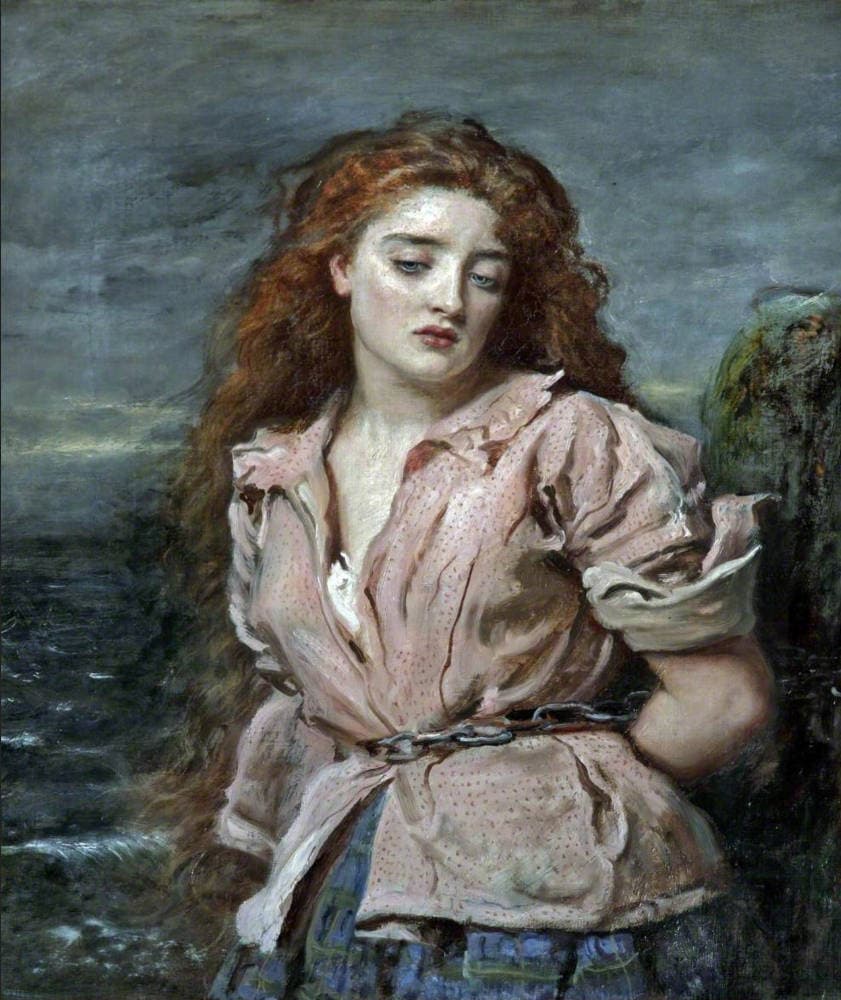
Its image of a drowned or drowning woman among flowers became a long-lived motif, echoed in photography, film and the visual language of dark academia. Compare it with John William Waterhouse's The Lady of Shalott, another doomed heroine on the water, or with Millais's own later The Martyr of Solway.
Details most viewers miss
- The robin. Perched on a branch at the upper left, a robin may allude to Ophelia's song in the play, "For bonny sweet Robin is all my joy".
- The dress. Millais bought an antique embroidered gown, decorated with silver thread, for Siddal to wear in the bath; he recorded paying four pounds for it.
- The water vole. Millais originally painted a water vole swimming near the bank. A friend could not tell what it was, so he painted it out.
- The pose. Ophelia's open arms and upturned palms echo images of saints and martyrs, giving a secular death the look of a religious vision.
Where is Ophelia today?
Ophelia is in the collection of Tate Britain on Millbank in London (accession N01506), usually displayed in the galleries of Victorian art. Entry to the permanent collection is free. The canvas is smaller than many people expect, a little over a meter wide, which makes the density of its detail even more remarkable up close.
Questions & answers
Where is the Ophelia painting by Millais?
It is at Tate Britain in London, which has owned it since Henry Tate presented it to the nation in 1894. It usually hangs in the Victorian galleries, and entry to the collection displays is free.
Who was the model for Millais's Ophelia?
Elizabeth Siddal, an artist and poet who later married Dante Gabriel Rossetti. She posed in a bath of warm water in Millais's London studio. According to family accounts, the lamps heating the water went out and she became seriously ill.
What does the Ophelia painting mean?
It illustrates Gertrude's account of Ophelia's drowning in Hamlet. The flowers carry symbolic meanings: poppies for death, violets for faithfulness and early death, pansies for love in vain, daisies for innocence. The calm figure suggests a death she barely notices.
Where was Ophelia painted?
The landscape was painted outdoors on the Hogsmill River near Ewell in Surrey in the summer and autumn of 1851. Millais then added the figure in his London studio over the following winter, finishing in 1852.
Is there a skull hidden in Ophelia?
Some viewers see a skull-like shape in the foliage on the left bank. Whether Millais intended it is not documented, so treat it as a popular reading rather than an established fact.
More by the artist
John Everett Millais
Kindred works
You may also study
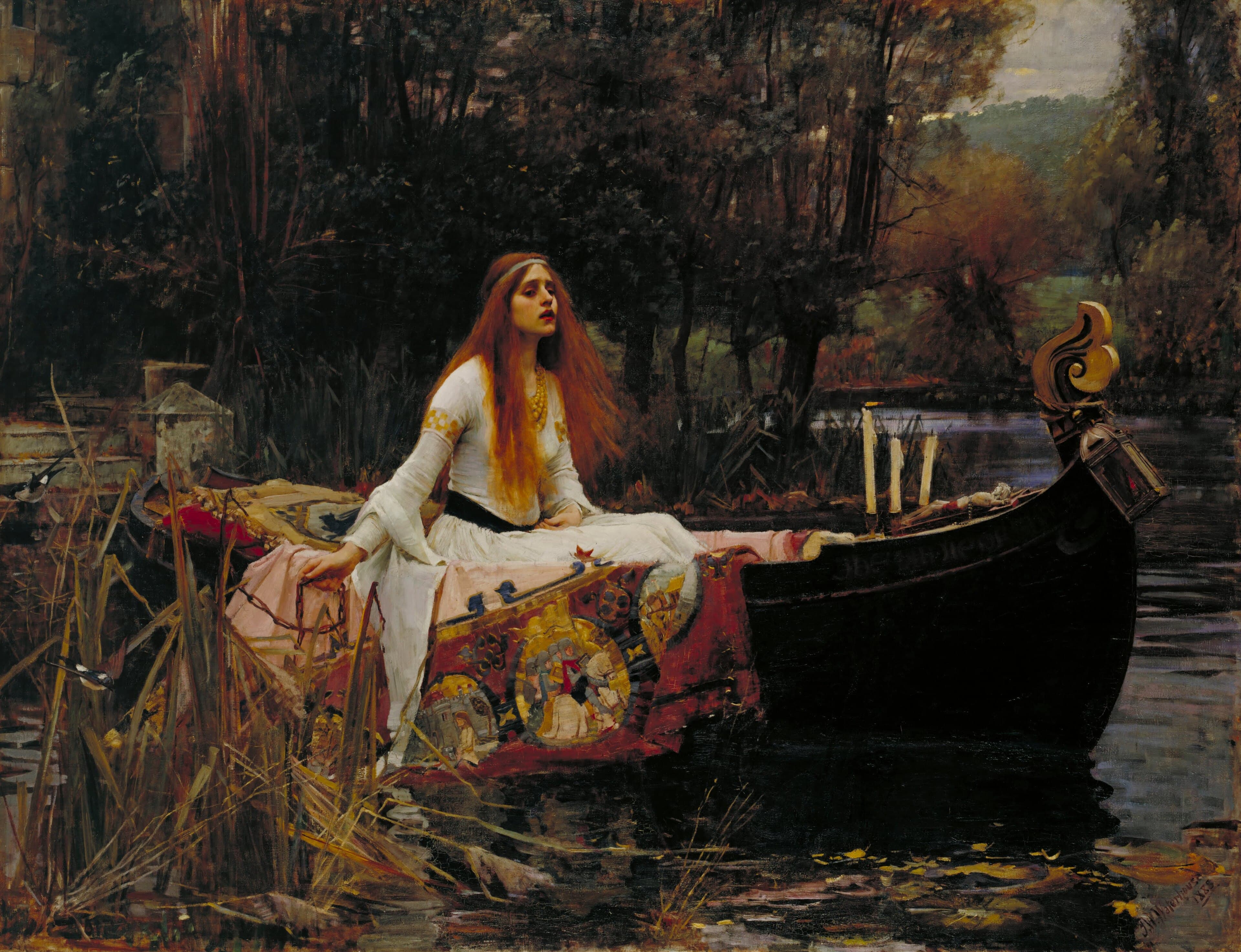
The Lady of Shalott
John William Waterhouse · 1888
Hylas and the Nymphs
John William Waterhouse · 1896
The Soul of the Rose
John William Waterhouse · 1908
Flaming June
Frederic Leighton · 1895

Bridge over a Pond of Water Lilies
Claude Monet · 1899

Venus de Milo
Alexandros of Antioch · c. 150–125 BC

The Scream
Edvard Munch · 1893
The Thinker
Auguste Rodin · Modeled 1880–82; enlarged 1902–03; this cast 1904