Image: Nasjonalmuseet, Oslo (National Museum of Art, Architecture and Design) / Wikimedia Commons · Public domain · via Wikimedia Commons
Symbolism / Expressionism
The Scream
Edvard Munch, 1893
The Scream is Edvard Munch's 1893 painting of a figure clutching its face beneath a blood-red sky, in the National Museum in Oslo. Munch made several versions; the 1893 painting shown here is the best known.
- Artist
- Edvard Munch
- Date
- 1893
- Medium
- Tempera and crayon on cardboard
- Dimensions
- 91 × 73.5 cm
- Collection
- National Museum (Nasjonalmuseet), Oslo, Norway
- Movement
- Symbolism / Expressionism
The Scream (Norwegian Skrik) is the name given to a group of works by the Norwegian artist Edvard Munch, made between 1893 and 1910. The best-known version, shown here, is a painting in tempera and crayon on cardboard of 1893, 91 by 73.5 centimeters, in the National Museum (Nasjonalmuseet) in Oslo. Munch originally titled it Der Schrei der Natur, "The Scream of Nature," and that title matters: the scream is not the figure's own. It comes from the world around it.
What you're looking at
A figure stands on a road with a railing that cuts diagonally across the picture from the lower left. It has a skull-like head, hairless, with hollow eyes and nostrils, and it presses its hands to its face, mouth wide open. Its body sways like a flame, black-blue and boneless, the curves of its outline echoing the curves of the landscape behind it.
Behind the railing, a dark blue fjord curls inward, with a pale shore and a couple of small boats. Above, the sky is laid in long bands of blood red, orange and yellow, swirling in the same rhythm as the water and the figure. Further back along the road, two dark figures in hats walk away, unconcerned. They hear nothing.
The contrast is the point. The ruler-straight lines of the road and railing belong to the ordinary world. Everything else, sky, water and the figure itself, has started to bend.
The details most people miss
In the upper left corner of the red sky, Munch's 1893 painting carries a small inscription in pencil: Kan kun være malet af en gal Mand!, "Can only have been painted by a madman!" For decades it was assumed to be vandalism by an outraged visitor. In 2021 the National Museum announced that handwriting analysis had shown the words to be Munch's own, probably written after the painting was attacked by critics as a sign of mental instability in 1895. The painter had answered his critics on the canvas.
Look also at the surface. The cardboard support shows through in many places, especially in the railing and the road; Munch did not cover it fully. The thin, streaky tempera and crayon give the picture its raw, unfinished energy.
Where does The Scream take place?
The setting is a real place: the road climbing Ekeberg hill, on the southeastern edge of Oslo (then Kristiania), with a view over the city and the Oslofjord. Munch described the moment in a prose poem he wrote several times, beginning in 1892: he was walking with two friends at sunset, the sky turned blood-red, he stopped, exhausted, and leaned on the fence, and "I sensed an infinite scream passing through nature." His friends walked on. He stood trembling with anxiety. Munch later wrote a version of the text on the frame of a pastel and on a lithograph.
Some writers have proposed that the red sky was caused by the ash of the 1883 Krakatoa eruption, which produced vivid sunsets across Europe, or by rare nacreous ("mother-of-pearl") clouds seen in Norway. Neither theory is proven, and art historians generally stress that the sky is an emotional rather than a meteorological record.
What does The Scream mean?
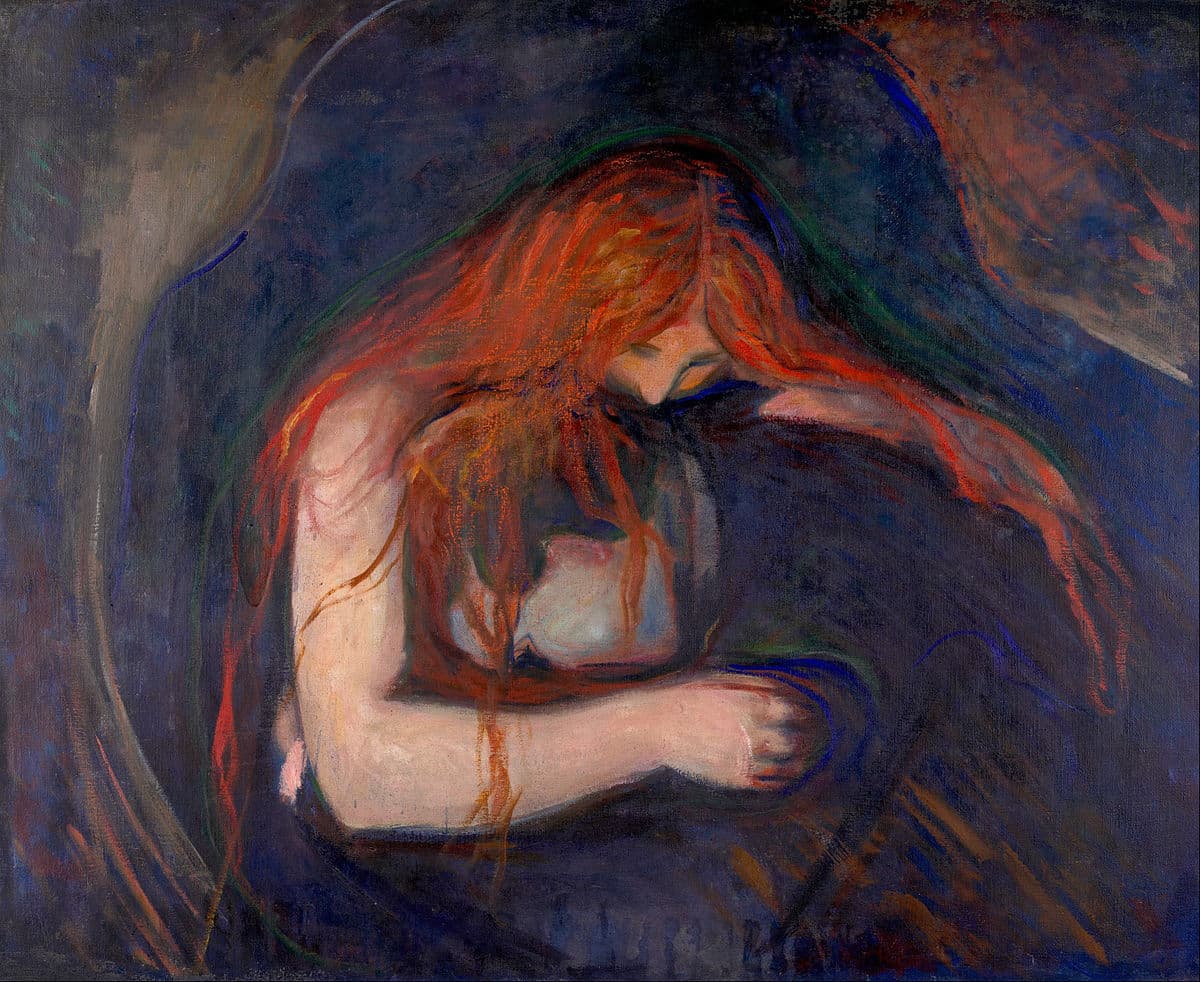
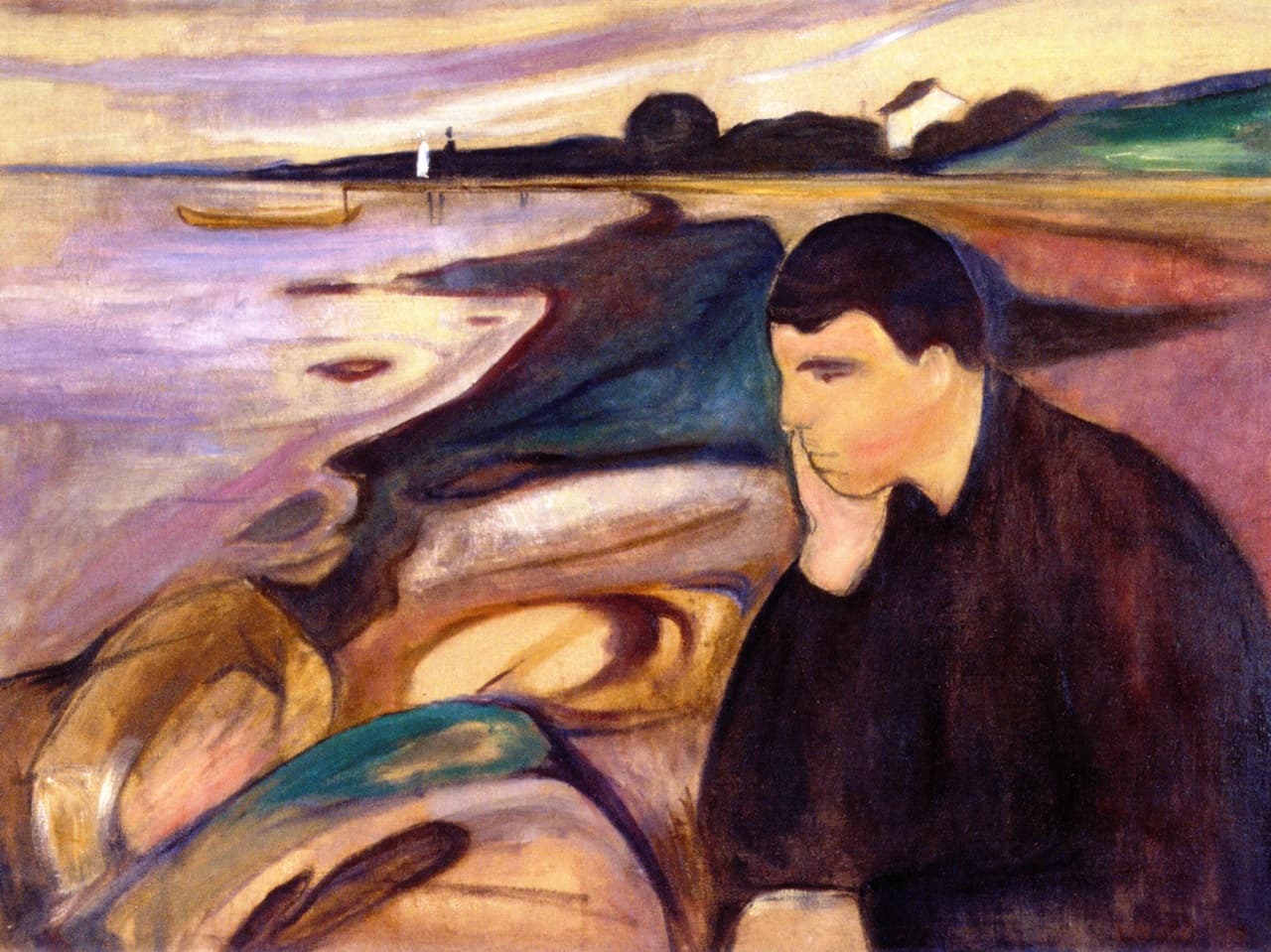
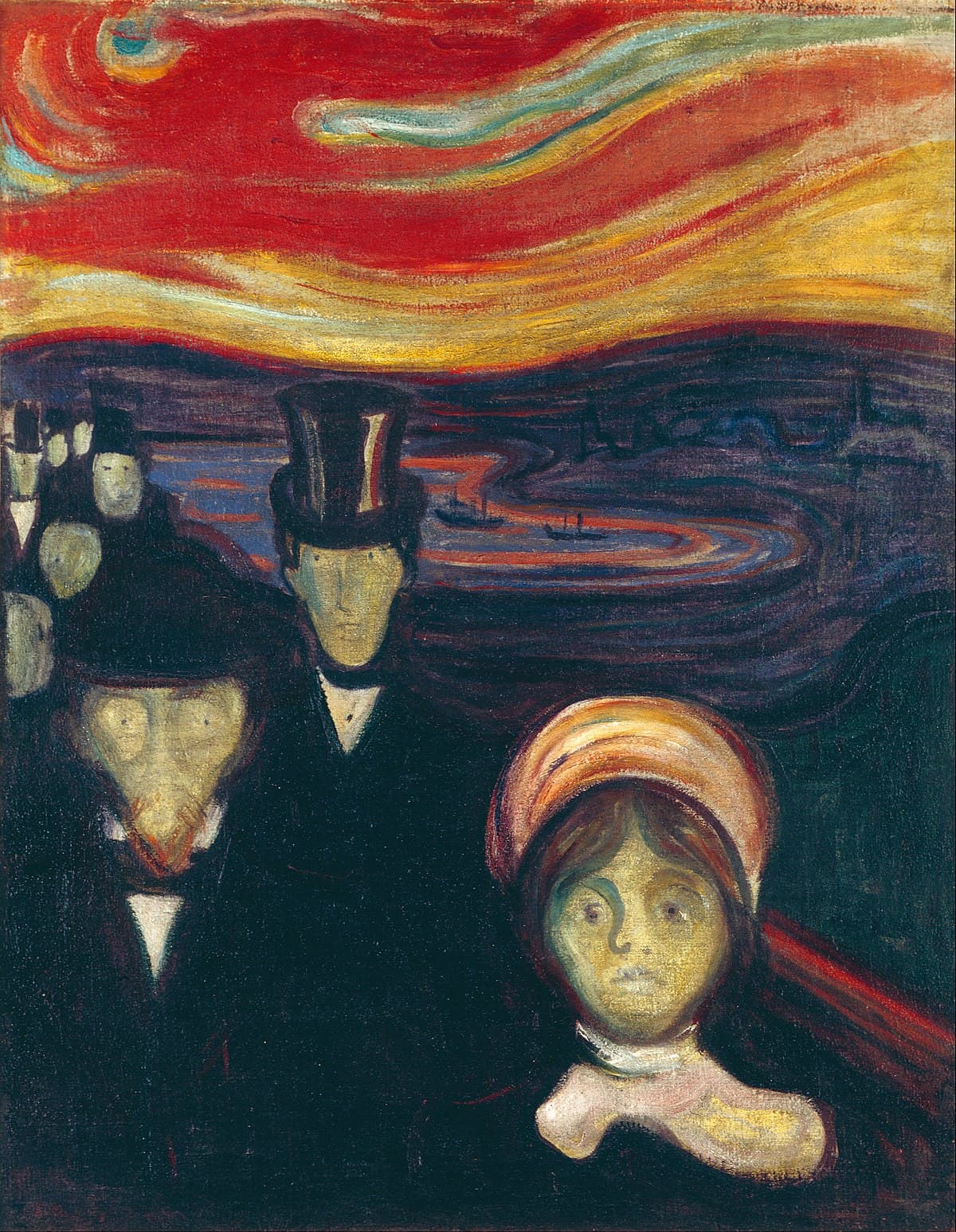
The figure is not screaming; it is covering its ears against a scream it hears from nature. Munch intended the image as a picture of a state of mind, overwhelming anxiety, rather than an event. It belongs to his Frieze of Life, a cycle of paintings on love, anxiety and death that he exhibited together from the 1890s, alongside works such as Anxiety, Melancholy and Vampire.
Munch's life supplied the anxiety. His mother died of tuberculosis when he was five and his favorite sister, Sophie, when he was thirteen; his father was intensely religious; another sister was hospitalized for mental illness. "Illness, insanity and death were the black angels that kept watch over my cradle," he wrote.
The figure's mummy-like face has been linked to a Peruvian mummy Munch could have seen at the Paris Exposition Universelle of 1889, a suggestion made by the art historian Robert Rosenblum. It is plausible but not documented.
How many versions of The Scream are there?
Munch made four color versions and a print:
- A crayon drawing on cardboard, 1893 (Munch Museum, Oslo).
- The painting in tempera and crayon on cardboard, 1893 (National Museum, Oslo), the version shown here.
- A pastel on board, 1895, the only version in private hands; it sold at Sotheby's New York in 2012 for $119.9 million, then a record for any work of art at auction.
- A tempera painting on board, probably 1910 (Munch Museum, Oslo).
- A black-and-white lithograph, 1895, printed in several impressions.
Two versions have been stolen. The National Museum painting was taken in February 1994, on the opening day of the Lillehammer Winter Olympics, and recovered undamaged three months later. The Munch Museum's tempera was stolen at gunpoint in 2004 together with Madonna, and recovered in 2006 with some damage.
Reception and legacy
In the 1890s the painting was considered disturbing and crude. In the twentieth century it became the founding image of Expressionism, the movement that put inner emotion before outward appearance. Since the 1960s it has turned into a universal symbol of modern anxiety, endlessly reproduced, parodied and, in the age of emoji, reduced to a single icon of horror. Few paintings have left the museum so completely and entered everyday life.
Where to see it
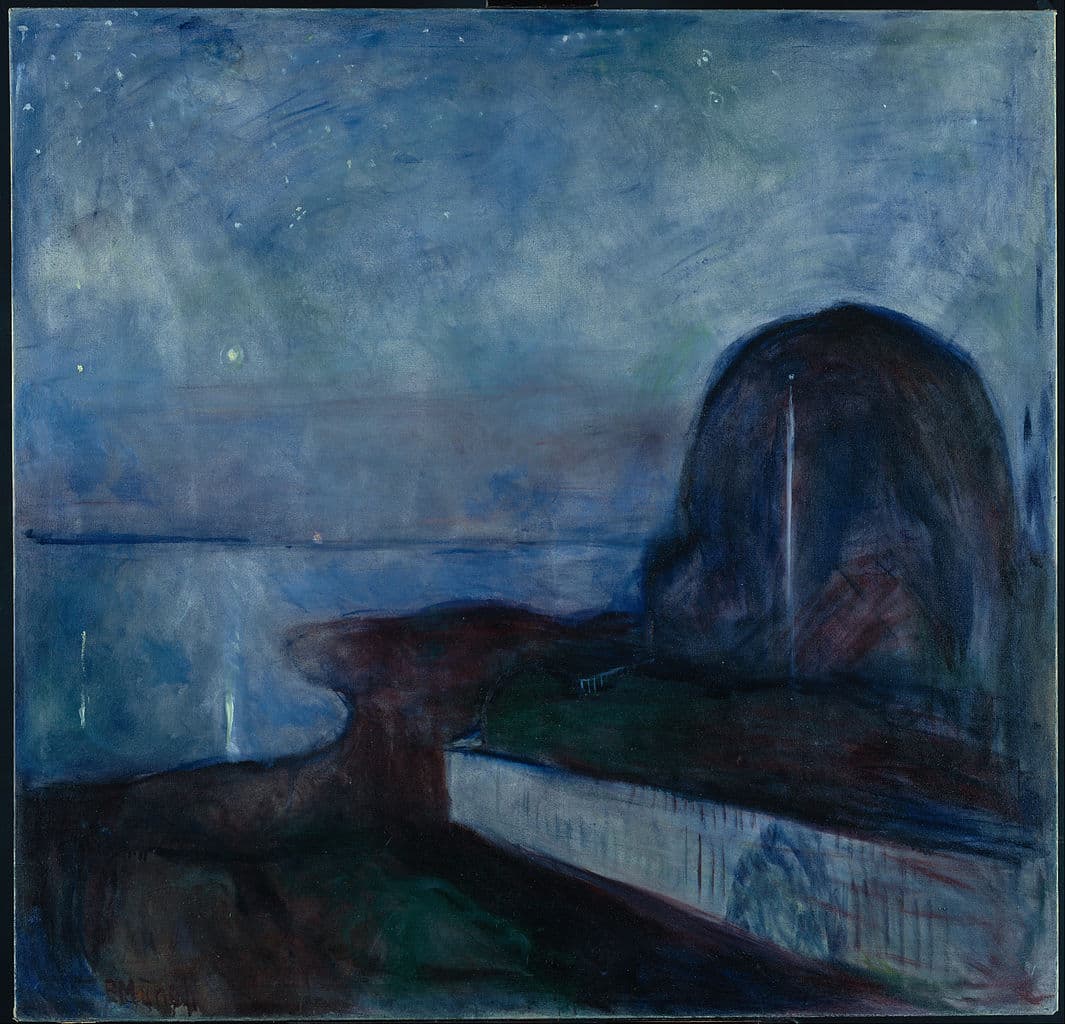
The 1893 painting is in the National Museum in Oslo, which opened in its new building on the harbor in 2022; it is displayed in the Munch room, with Madonna and other works from the Frieze of Life. The drawing and the 1910 version are at the Munch Museum (MUNCH) in Bjørvika, where they are shown in rotation because of their fragility. For more of the artist, see Edvard Munch, his Starry Night, and our collection of Symbolist art.
Questions & answers
Where is The Scream painting?
The best-known version, the 1893 painting in tempera and crayon on cardboard, is in the National Museum (Nasjonalmuseet) in Oslo. Two other color versions, a crayon drawing of 1893 and a tempera of 1910, are in the Munch Museum (MUNCH), also in Oslo. A 1895 pastel is privately owned.
What does The Scream mean?
Munch meant it as a picture of overwhelming anxiety. He described walking at sunset when the sky turned blood-red and he 'sensed an infinite scream passing through nature.' The figure is not screaming itself; it covers its ears against the scream of nature around it.
How many versions of The Scream are there?
Munch made four color versions, a drawing (1893), the painting (1893), a pastel (1895) and a tempera (c. 1910), plus a lithograph (1895) printed in several impressions. Only the 1895 pastel is in private hands; it sold in 2012 for $119.9 million.
Who wrote 'Can only have been painted by a madman' on The Scream?
Munch himself. The faint pencil words in the upper left of the 1893 painting were long thought to be vandalism, but in 2021 the National Museum confirmed through handwriting analysis that they are in Munch's hand, probably added in response to critics.
Where was The Scream painted?
The scene shows the road on Ekeberg hill above Oslo (then Kristiania), looking over the Oslofjord at sunset. Munch painted it in 1893 from his memory of a walk there.
More by the artist
Edvard Munch
Kindred works
You may also study
The Kiss
Gustav Klimt · 1907–08

Bridge over a Pond of Water Lilies
Claude Monet · 1899

Nymphs Dancing to Pan's Flute
Joseph Tomanek

The Thinker
Auguste Rodin · Modeled 1880–82; enlarged 1902–03; this cast 1904

Saturn Devouring His Son
Francisco Goya · c. 1819–1823

Ophelia
John Everett Millais · 1851–52

Woman with a Parasol – Madame Monet and Her Son
Claude Monet · 1875

The Great Wave off Kanagawa
Katsushika Hokusai · c. 1830–32