Impressionism
The Houses of Parliament, London
Claude Monet, 1904
The Houses of Parliament, Stormy Sky (Le Parlement de Londres, ciel orageux) is a 1904 painting by Claude Monet of Westminster beneath a churning yellow-grey sky over a glittering Thames. It is in the Palais des Beaux-Arts, Lille.
- Artist
- Claude Monet
- Date
- 1904
- Medium
- Oil on canvas
- Dimensions
- 81.5 × 92 cm
- Collection
- Palais des Beaux-Arts de Lille, Lille, France
- Movement
- Impressionism
- Catalogue
- Wildenstein 1605
Painted at Monet in London
What you are looking at
The Palace of Westminster rises as a soft blue-grey shape across the right half of the canvas: the Victoria Tower standing tall, a lower tower beside it, and the long line of the building trailing off to the left into mist, where a few paler shapes suggest the far bank. The sky is the dramatic part. It is a churning mass of pale yellow, grey, cream and violet strokes that swirl and curl in long arcs, brightest near the top center where the sun is hidden in cloud.
Below, the Thames catches that light in a wide field of glittering gold, cream and lilac dabs, broken and flickering, while the reflection of the building lies across the water to the right in cooler blue-grey. The signature and date, "Claude Monet 1904," are at lower left.
Known as Le Parlement de Londres, ciel orageux, "stormy sky," the canvas was begun from the motif in London in 1900–01 and completed at Giverny. It measures 81.5 by 92 centimeters, is number 1605 in Wildenstein's catalogue, and belongs to the Palais des Beaux-Arts in Lille.
Where and when
Monet painted in London in the autumn of 1899 and in the late winters of 1900 and 1901, staying at the Savoy Hotel on the Embankment. For the Parliament pictures he crossed the river to St Thomas' Hospital, opposite Westminster, and worked from a terrace there in the late afternoon, when the sun set behind the building and the fog and smoke of the city turned it into a silhouette. See Monet in London.
He brought the unfinished canvases back to Giverny and worked on them for three more years before showing thirty-seven Thames views at Durand-Ruel's gallery in Paris in May 1904. The exhibition was a critical and commercial success, and the pictures were dispersed quickly to collectors and museums.
How it was painted
What sets the Lille canvas apart is its sky. In many versions the sky is calm and the drama is the sun on the water. Here the brushstrokes overhead are long, curving and agitated, laid on thickly in creamy yellows and greys, so the weather itself becomes the subject. Look at the upper left, where the strokes form loops and hooks like wind-blown smoke.
The building is quieter, painted with short vertical strokes of grey-blue that suggest the Gothic pinnacles without describing them; the towers are flat, with no modeling at all. The water is built from short, separate dabs of pale gold, white and lilac, with darker blue between them, so the river shimmers as the light moves across it. The darkest passage is the reflection of the palace at right, a soft column of blue that anchors the composition.
The whole canvas sits in a narrow band of value, everything pale except the building, which is what gives it the luminous, washed look of a stormy afternoon. Even the darkest blue of the towers is lighter than the shadows in the Orsay canvas, as if the storm light had bleached the whole scene.
The series and how this version differs
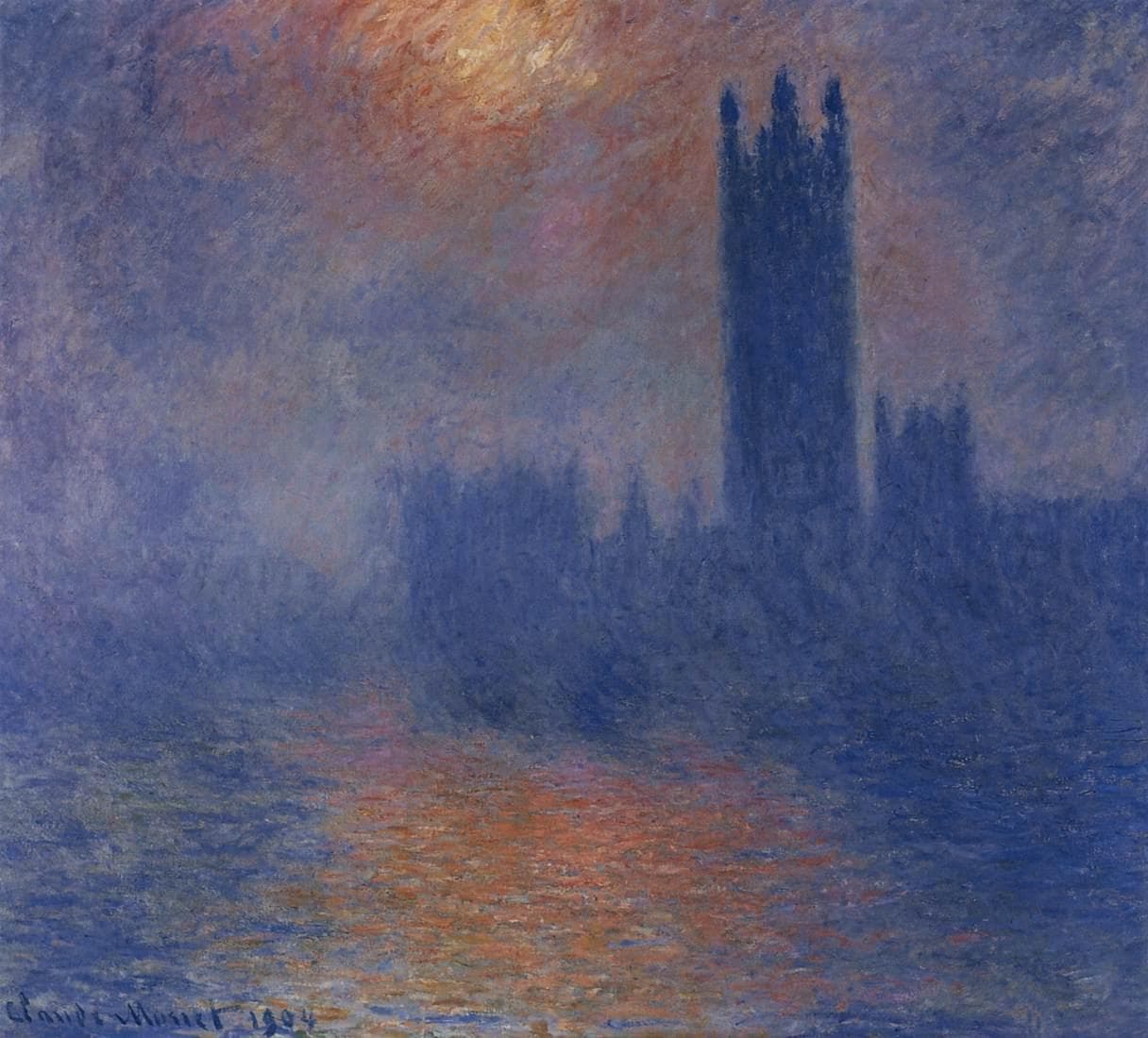
Monet painted the Houses of Parliament about nineteen times from the same spot, varying the hour, the fog and the sun: see the Houses of Parliament series. Compare Sunlight Breaking through the Fog in the Musée d'Orsay, where the palette is deep blue and orange: the same motif, transformed by a change of weather. In Lille the palette is warmer and paler, and the energy moves from the water to the sky.
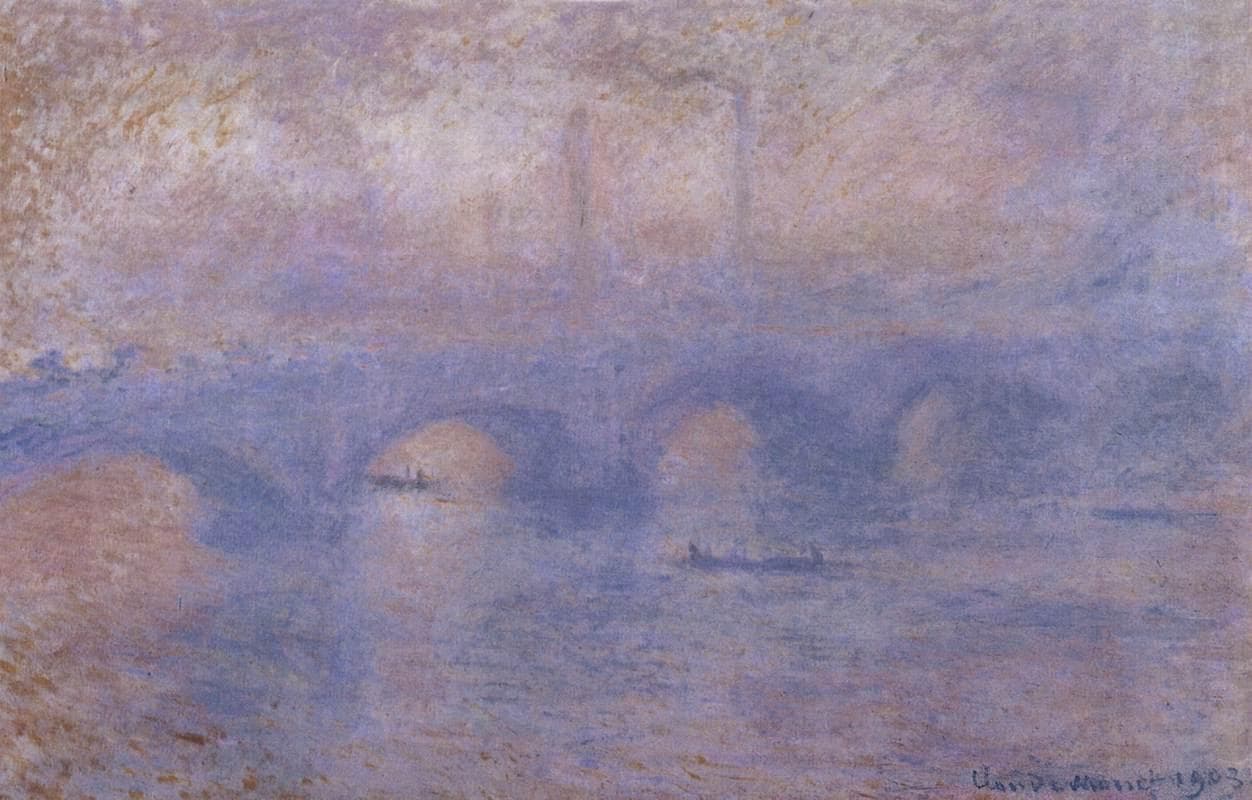
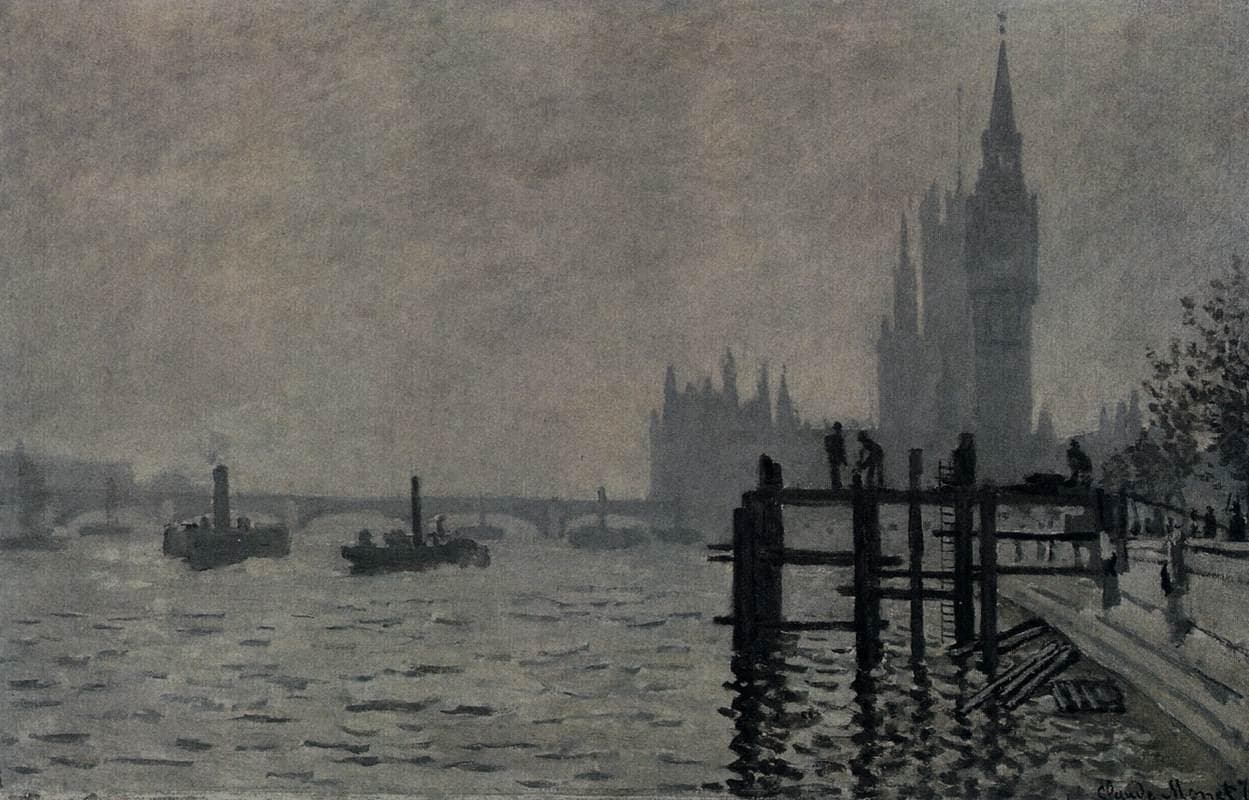
From the Savoy he painted his other London series, Waterloo Bridge and Charing Cross Bridge; see Waterloo Bridge, Effect of Fog in Saint Petersburg. His first view of Parliament, from 1871, is The Thames below Westminster.
Where to see it
The painting is in the Palais des Beaux-Arts de Lille, one of the largest museums in France, with collections from antiquity to the early twentieth century. For other museums, see where to see Monet's paintings, and for the artist, Claude Monet.
Questions & answers
Where is Monet's Houses of Parliament, Stormy Sky?
It is in the Palais des Beaux-Arts in Lille, France. Dated 1904, the canvas measures 81.5 by 92 centimeters and is catalogued by Wildenstein as number 1605, under the title Le Parlement de Londres, ciel orageux.
When and where was it painted?
Monet began it in London in 1900–01, painting from St Thomas' Hospital across the Thames from Westminster in the late afternoon, and finished it at Giverny. It is signed and dated 1904.
What does Houses of Parliament, Stormy Sky show?
The towers and roofline of Westminster as a soft blue-grey silhouette on the right, under a swirling pale yellow and grey sky, with sunlight glittering in gold and lilac strokes on the Thames below.
What is the difference between Monet's Houses of Parliament paintings?
The viewpoint is almost the same in all of them; what changes is the light and weather. The Orsay version is deep blue and orange with sun breaking through fog, while the Lille version is pale and stormy, with an agitated sky.
More by the artist
Claude Monet

Bridge over a Pond of Water Lilies
Claude Monet · 1899

Woman with a Parasol – Madame Monet and Her Son
Claude Monet · 1875

Sunset in Venice
Claude Monet · 1908–12

La Grenouillère
Claude Monet · 1869

Beach in Pourville
Claude Monet · 1882

Springtime
Claude Monet · 1872

Boating on the River Epte
Claude Monet · 1890

The Seine at Asnières (Hermitage)
Claude Monet · 1873
Also painted in 1904
The same year
Kindred works
You may also study
The Houses of Parliament in London
Claude Monet · 1904
Waterloo Bridge, Effect of Fog
Claude Monet · 1903
The Thames below Westminster
Claude Monet · c. 1871

Ophelia
John Everett Millais · 1851–52

The Great Wave off Kanagawa
Katsushika Hokusai · c. 1830–32
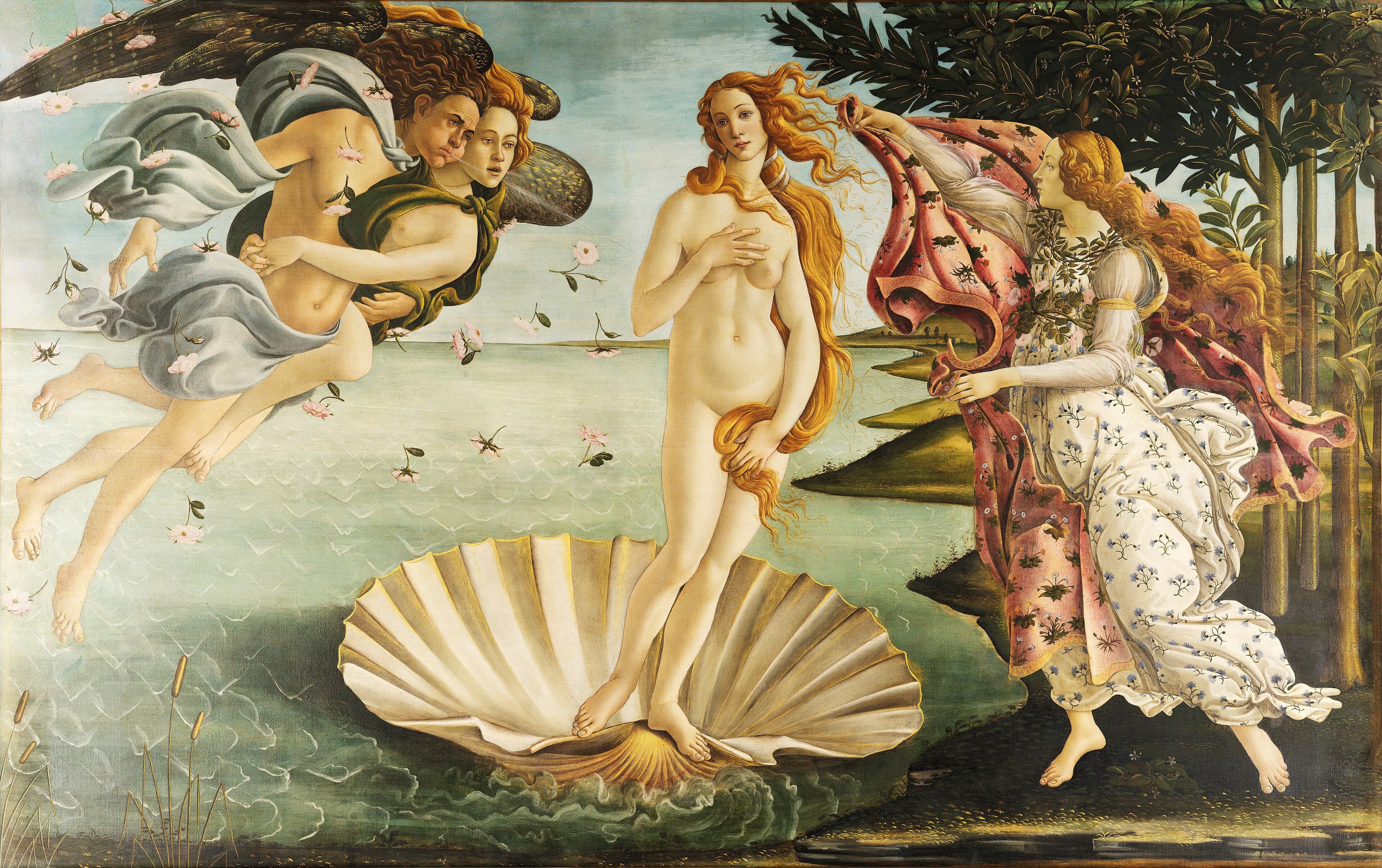
The Birth of Venus
Sandro Botticelli · c. 1484–1486
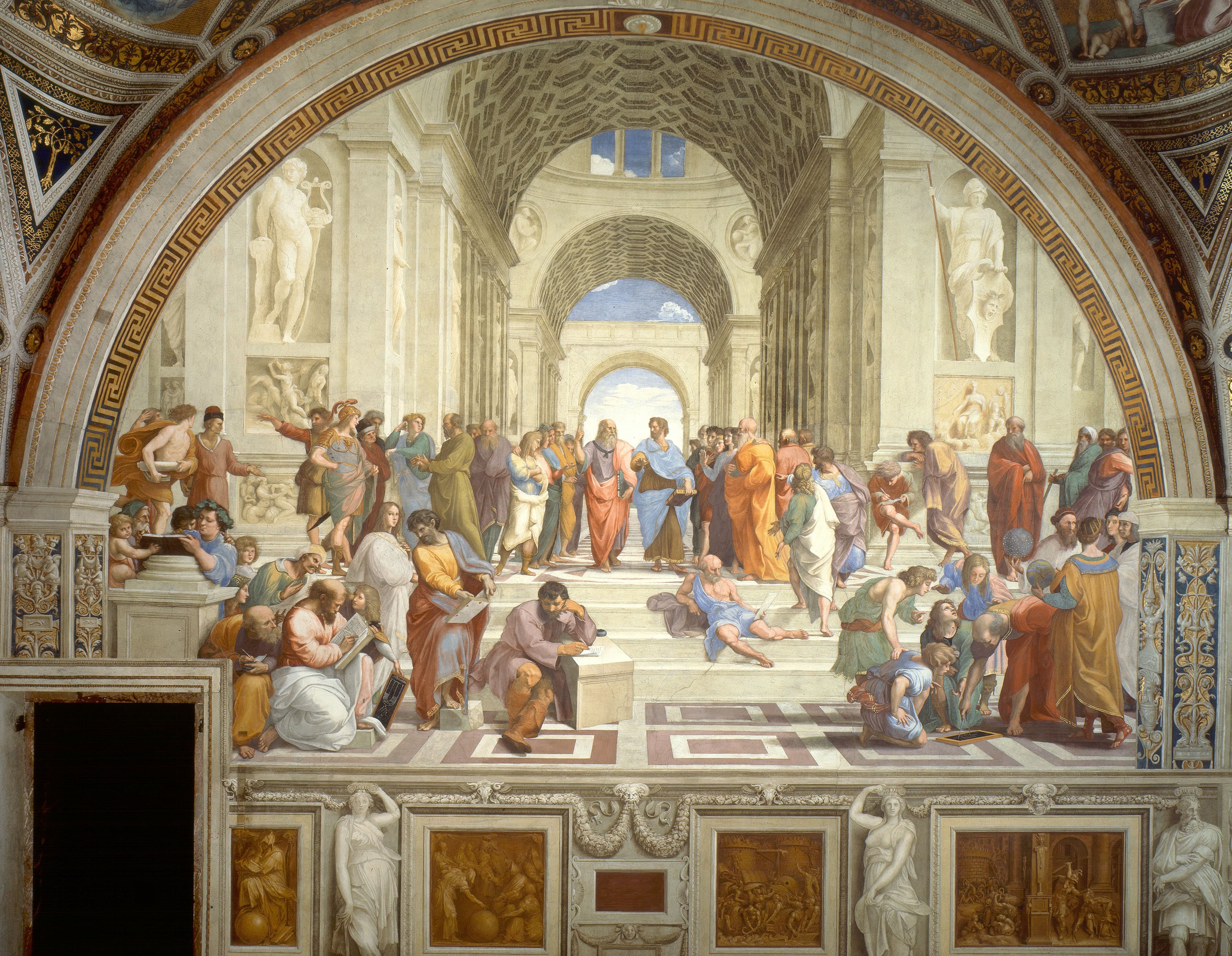
The School of Athens
Raphael · 1509–1511
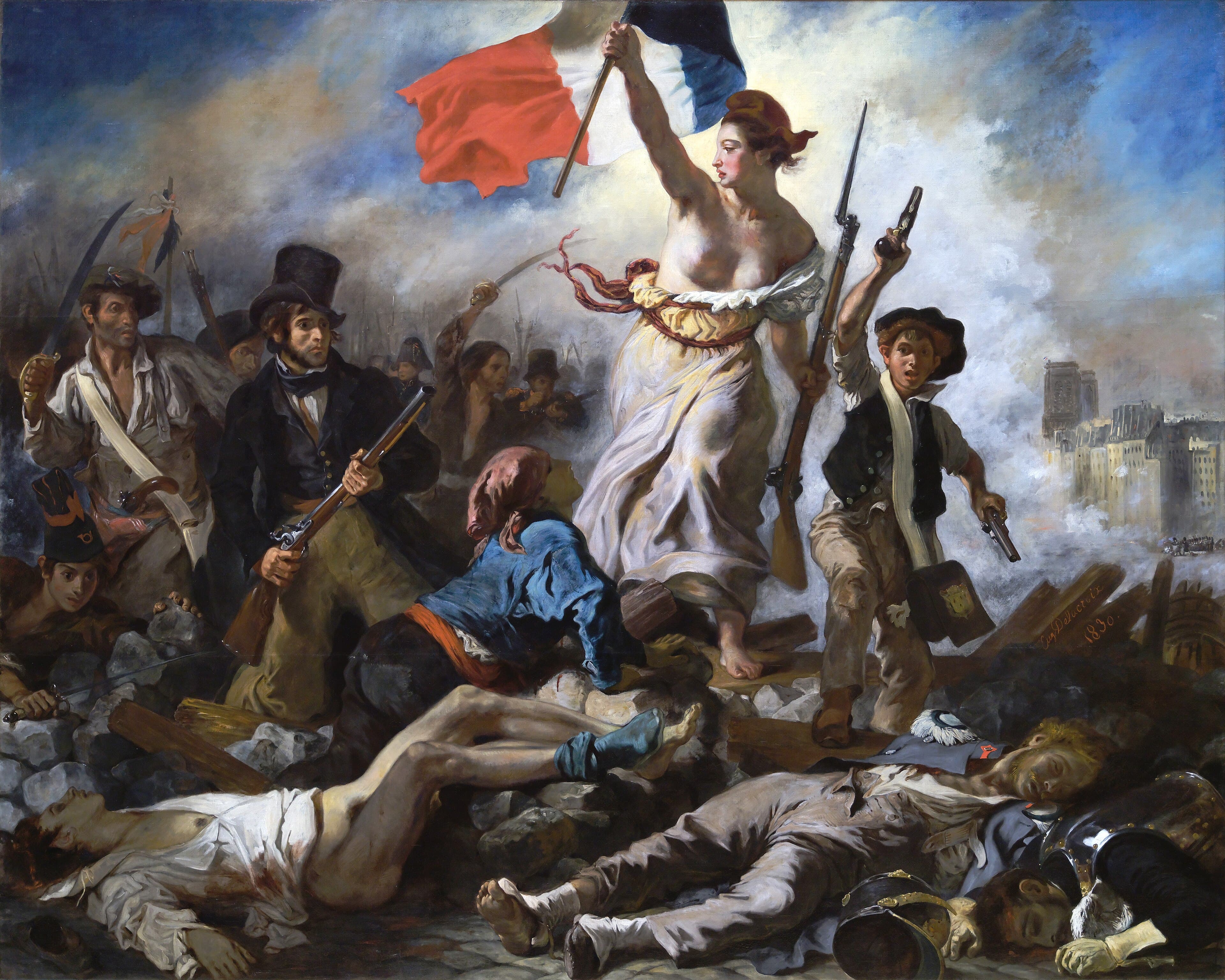
Liberty Leading the People
Eugène Delacroix · 1830