Impressionism
The Water Lily Pond, Harmony in Rose
Claude Monet, 1900
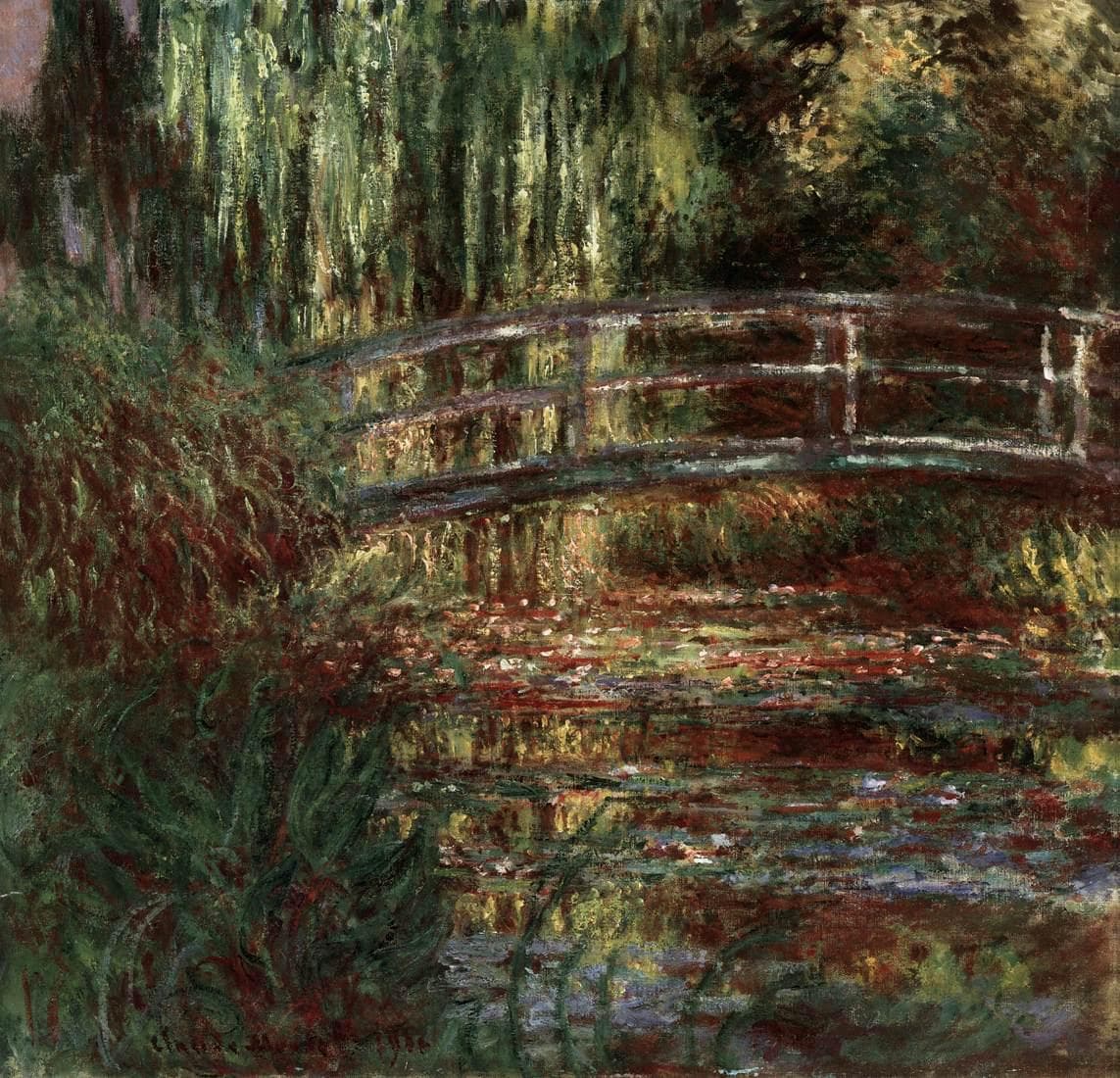
The Water Lily Pond, Harmony in Rose is a 1900 oil painting by Claude Monet of the Japanese footbridge over his lily pond at Giverny, bathed in warm pink and orange light. It is in the Musée d'Orsay, Paris.
- Artist
- Claude Monet
- Date
- 1900
- Medium
- Oil on canvas
- Dimensions
- 89.5 × 100 cm
- Collection
- Musée d'Orsay, Paris, France
- Movement
- Impressionism
- Catalogue
- Wildenstein 1629
More at Monet at the Musée d'Orsay
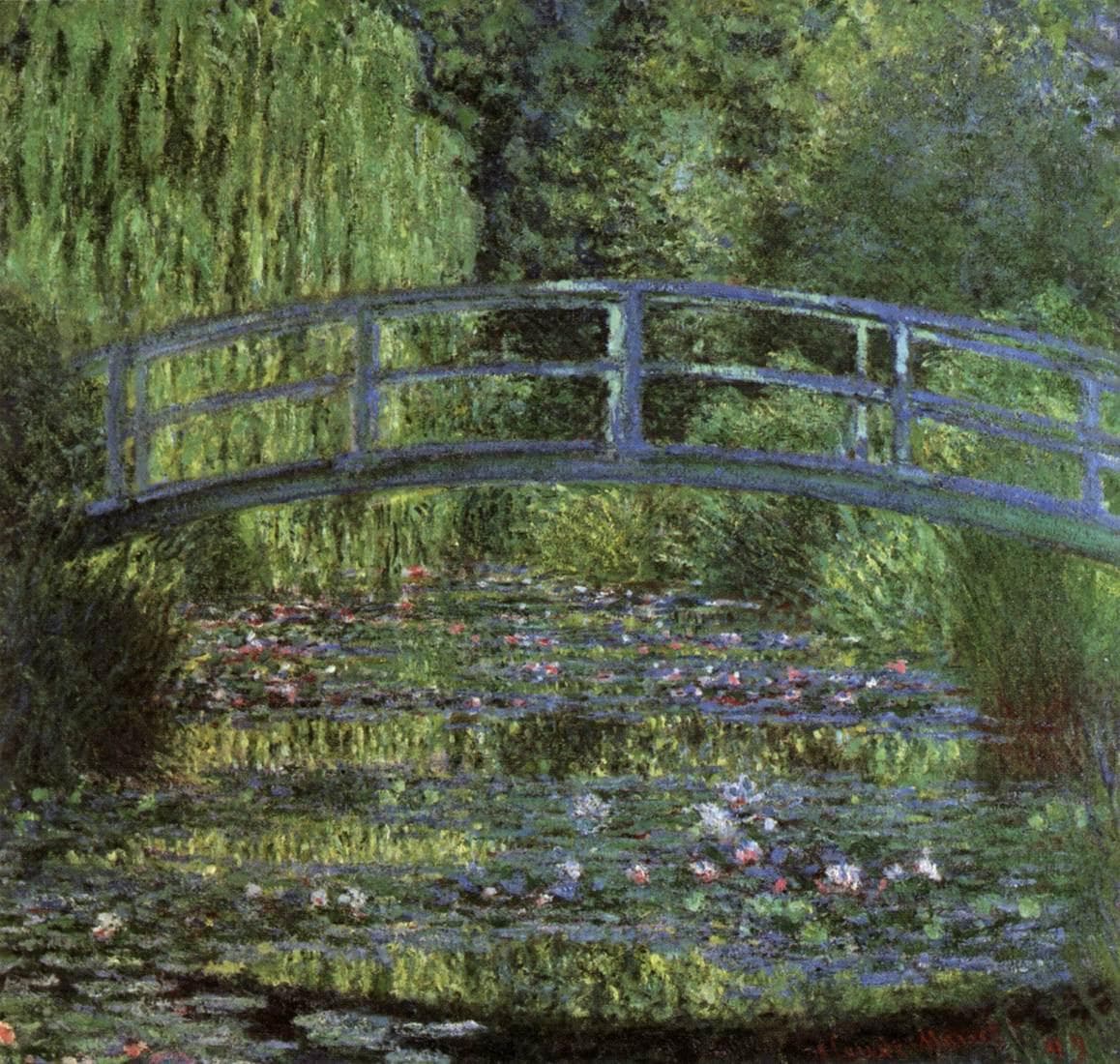
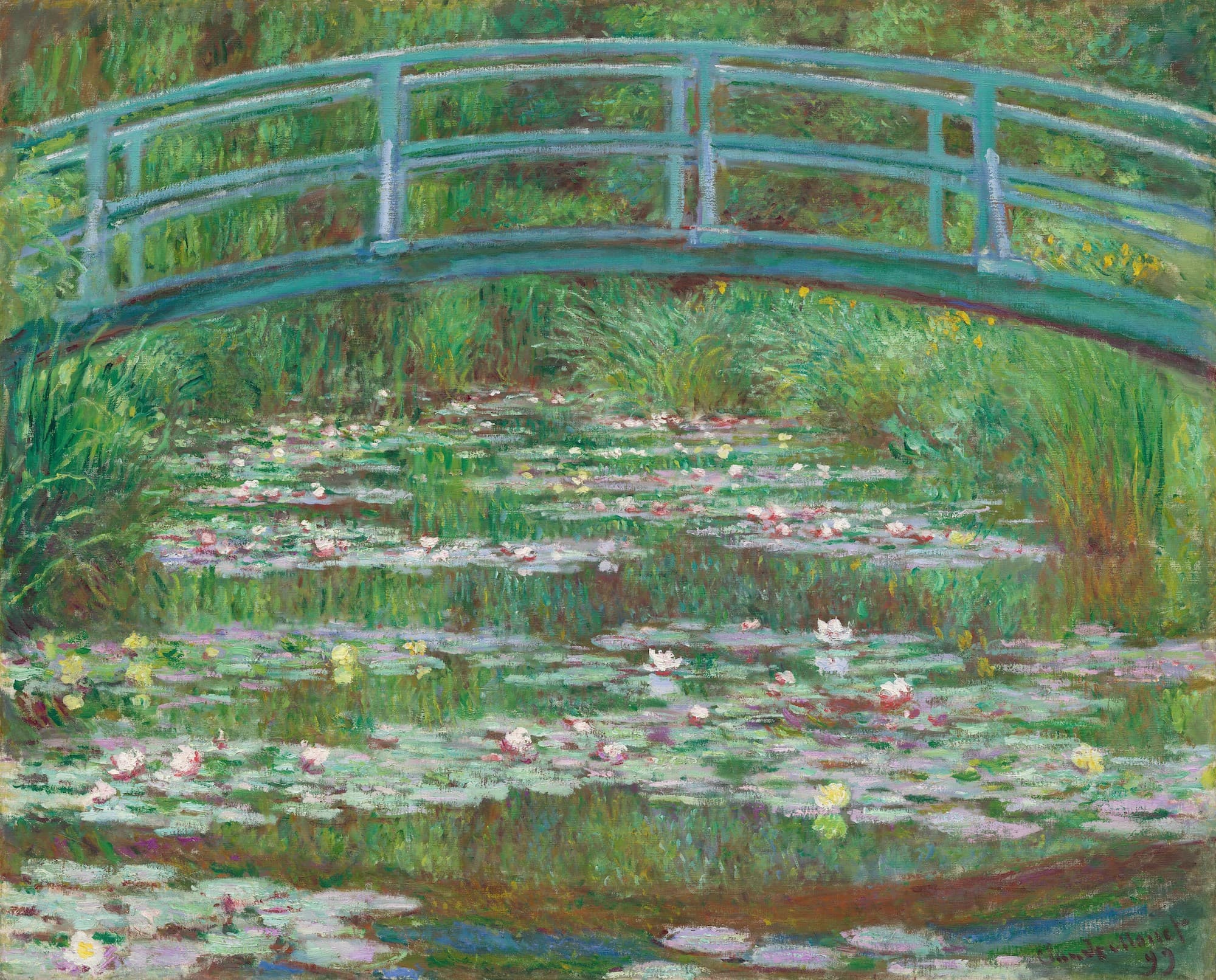
The Water Lily Pond, Harmony in Rose is one of the paintings Claude Monet made of the wooden footbridge over his water garden at Giverny. Dated 1900, the canvas measures 89.5 by 100 centimeters and belongs to the Musée d'Orsay in Paris. It is a late, warm-toned variant of the famous bridge series that includes Bridge over a Pond of Water Lilies (1899) in The Metropolitan Museum of Art, and its title points to what changes between them: the light.
What you are looking at
An arched wooden bridge crosses the canvas from side to side, just above the middle. Below it, the surface of the pond is crowded with lily pads painted as flat, horizontal ellipses, dotted with blossoms of pink, white and yellow. Above and around the bridge, willows and bamboo hang like a curtain, so that there is no sky at all. The whole picture is closed in, a room made of leaves and water.
What makes this version distinct is its color. In the 1899 bridges the dominant note is a cool, fresh green. Here Monet bathes everything in pinks, oranges, rust and coral, laid over the greens so that foliage and water seem lit by low, late-day sun. The bridge itself is no longer the clean green of the earlier canvases; it picks up the same warm rose as its surroundings and almost dissolves into them.
The brushwork is denser and more layered than in the 1899 group. Monet builds the willows from short vertical strokes, crosses them with horizontal touches for the reflections, and loads the paint thickly on the lily flowers so they catch the gallery light. Look closely at the water just under the bridge and you will see reflections of the willow trunks running down into the pond, almost indistinguishable from the stems of the plants.
How it was made
Monet bought the property at Giverny in 1890 and, in 1893, acquired an adjoining plot with a stream where he dug a pond, planted water lilies and built a Japanese-style footbridge. The bridge was modeled loosely on those in the Japanese woodblock prints he collected, and in time it would be covered with wisteria.
In 1899 he painted a group of a dozen views of the bridge, all from nearly the same spot on the bank. In 1900 he returned to the motif, now with stronger, more varied colors and thicker paint. The Orsay painting belongs to this second campaign. Many of these bridge pictures were shown together in a Monet exhibition at the Durand-Ruel gallery in Paris in late 1900.
A series about light
Monet painted series for one reason: to show how a single motif changes with light, season and weather. Haystacks, poplars and the façade of Rouen Cathedral had all been treated this way in the 1890s. The water garden became the longest series of all, occupying him until his death in 1926.
Read in that context, Harmony in Rose is a study of evening. The word "harmony", borrowed from the vocabulary of music and from Whistler's titles, tells us that the painting is meant to be read as a unified chord of color rather than as a description of plants and planks. Compare it with Water Lily Pond, Harmony in Green, also at the Orsay, and the idea becomes obvious: the same bridge, the same pond, transposed into another key.
Meaning and reception
There is no narrative here and no hidden symbolism. Some writers connect the Japanese bridge with Monet's lifelong admiration for Hiroshige and Hokusai, and see the garden itself as a work of art that he designed in order to paint it. The bridge series also marks the transition from the Impressionism of the 1870s to the immersive, edge-less Water Lilies of his last decades, where the bridge disappears entirely and only the surface of the water remains.
How to look at it in the gallery
Stand far back first. From across the room the bridge reads clearly, a dark arc against glowing foliage, and the composition is almost symmetrical. Then walk close. At arm's length the bridge breaks apart into separate strokes of rose, violet and green, and the lily pads become thick, raised dabs of paint with almost no drawing. Monet expected his viewers to move back and forth like this, letting the image form and dissolve. The rough surface also changes as the gallery light shifts during the day, which suits a picture that is itself about changing light.
Where to see it
The painting is in the Musée d'Orsay in Paris, in the Impressionist collection. Other versions of the bridge are in the Met in New York, the National Gallery in London, the Philadelphia Museum of Art and the Princeton University Art Museum, among others. For more of the Giverny paintings, see The Japanese Footbridge and our guide to famous Monet paintings.
Questions & answers
Where is Water Lily Pond, Harmony in Rose?
The painting is in the Musée d'Orsay in Paris. It is one of several views of the Japanese footbridge at Giverny held by the museum, alongside Water Lily Pond, Harmony in Green. Other versions of the bridge are spread across museums in Europe and the United States.
Is Harmony in Rose the same as Bridge over a Pond of Water Lilies?
No, but they belong to the same series. Bridge over a Pond of Water Lilies, painted in 1899 and now in the Met, shows the bridge in cool greens. Harmony in Rose, from 1900, shows a similar view in warm pinks and oranges, under a different light.
What does Harmony in Rose mean in Monet's title?
The word harmony comes from music. Monet uses it to signal that the picture should be read as a single chord of color rather than a record of a place. Rose names the dominant key: warm pinks and corals that suggest late-afternoon or evening light on the garden.
When did Monet paint the Japanese bridge?
Monet built the footbridge over his Giverny pond in the mid-1890s. He painted his first large group of bridge views in 1899, returned to the motif in 1900 with warmer, thicker color, and painted it again, overgrown with wisteria, in the 1910s and 1920s.
More by the artist
Claude Monet

Bridge over a Pond of Water Lilies
Claude Monet · 1899

Woman with a Parasol – Madame Monet and Her Son
Claude Monet · 1875

Sunset in Venice
Claude Monet · 1908–12

La Grenouillère
Claude Monet · 1869

Beach in Pourville
Claude Monet · 1882

Springtime
Claude Monet · 1872

Boating on the River Epte
Claude Monet · 1890

The Seine at Asnières (Hermitage)
Claude Monet · 1873
Also painted in 1900
The same year
Kindred works
You may also study
Water Lily Pond, Green Harmony
Claude Monet · 1899
The Japanese Footbridge
Claude Monet · 1899
The Water Lily Pond
Claude Monet · 1900
Water-Lily Pond (Le Bassin aux nymphéas), 1917–19
Claude Monet · 1917–19

The Scream
Edvard Munch · 1893

Ophelia
John Everett Millais · 1851–52

The Great Wave off Kanagawa
Katsushika Hokusai · c. 1830–32
The Birth of Venus
Sandro Botticelli · c. 1484–1486