Impressionism
The Water Lily Pond
Claude Monet, 1900
The Water Lily Pond is a 1900 painting by Claude Monet of the Japanese footbridge over his lily pond at Giverny, in deep reds, greens and violets. It is in the Museum of Fine Arts, Boston.
- Artist
- Claude Monet
- Date
- 1900
- Medium
- Oil on canvas
- Dimensions
- 90.2 × 92.7 cm
- Collection
- Museum of Fine Arts, Boston, Boston, United States
- Movement
- Impressionism
- Catalogue
- Wildenstein 1630
More at Monet at the MFA Boston
What you are looking at
The arched wooden footbridge crosses the canvas from left to right near the top, almost touching the frame at both ends. Above it hangs a curtain of weeping willow, painted in long vertical strokes of yellow-green. Below, the pond is a dense carpet of lily pads and flowers, laid in with short horizontal touches of red, rust, violet, green and blue, with white and pink blossoms scattered through it. A tangle of tall iris leaves and grasses crowds the lower left corner. The signature and date, "Claude Monet 1900," run along the bottom left.
There is no sky. The bridge, the willow and the water fill everything, and the square canvas gives no direction more weight than another.
The 1899–1900 bridge pictures
Claude Monet settled at Giverny in 1883 and bought the house in 1890. In 1893 he acquired land across the road and dug a water garden, fed from a small branch of the Epte, with a footbridge in the Japanese manner. Its lilies would occupy him for the rest of his life; the garden and house are described on our Giverny page.
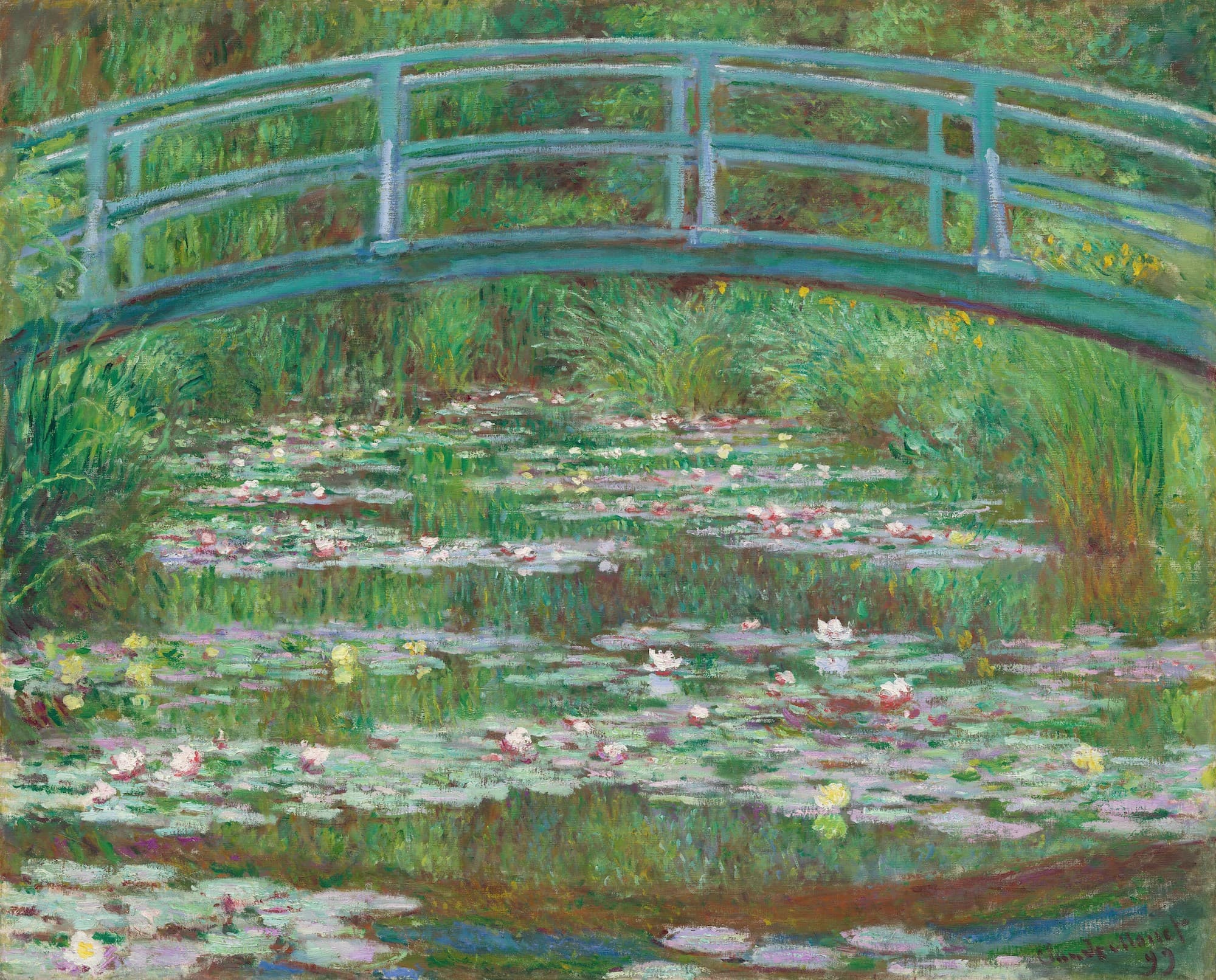
In 1899 he began a group of about a dozen nearly square canvases of the bridge seen from the same spot at the end of the pond. In 1900 he returned to the motif with a smaller group whose colors are hotter and denser, as here. This canvas is catalogued by Wildenstein as W.1630. The whole run of bridge pictures, from 1895 to the 1920s, is traced in The Japanese Footbridge.
How it was painted
The bridge is barely there. Its rails are a few strokes of pale lilac and green, set against the dark willow, and it almost dissolves into the foliage. What carries the picture is the surface of the water, especially the bands of rust and red that run across it. These are partly lily pads and partly reflections of warm light and trees. Monet layers strokes of many colors over each other until the eye mixes them.
Look at the lower right, where the pond opens into a pool of blue and violet: that is reflected sky, the only hint of it in the painting. And look under the bridge, where the willow's reflection makes a band of vertical green streaks in the water, mirroring the curtain above. The bridge is caught between two willows, one real and one reflected.
The square format, close to 90 centimeters a side, was Monet's choice for nearly all the bridge canvases of these two years; it removes any horizon and makes the pond a flat, all-over field. The paint is thick and dry in places, dragged over earlier layers so that underlying colors show through. Compared with the 1899 canvases, the touch is shorter and more agitated, and the foliage at left is heavier, almost a wall.
How this version differs
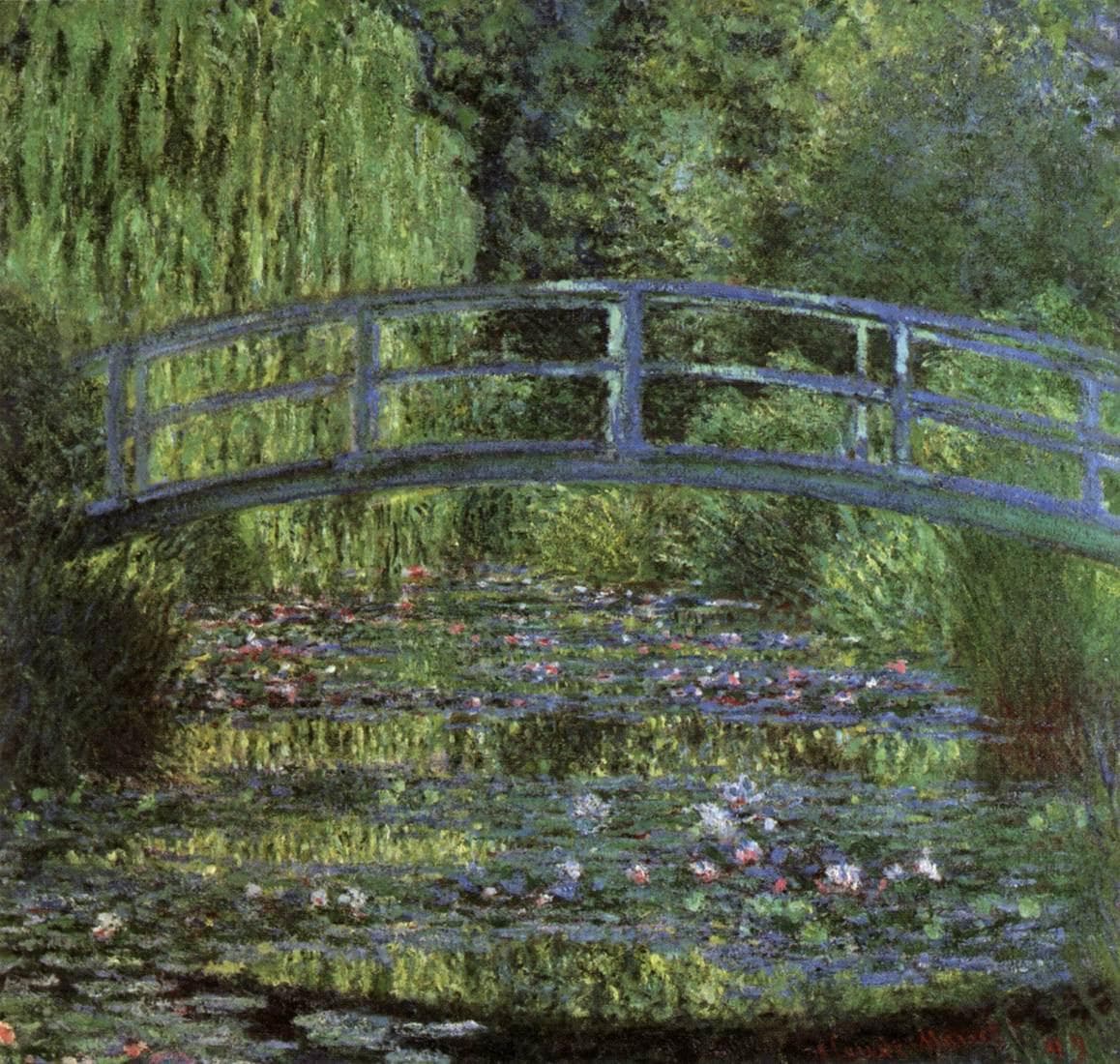
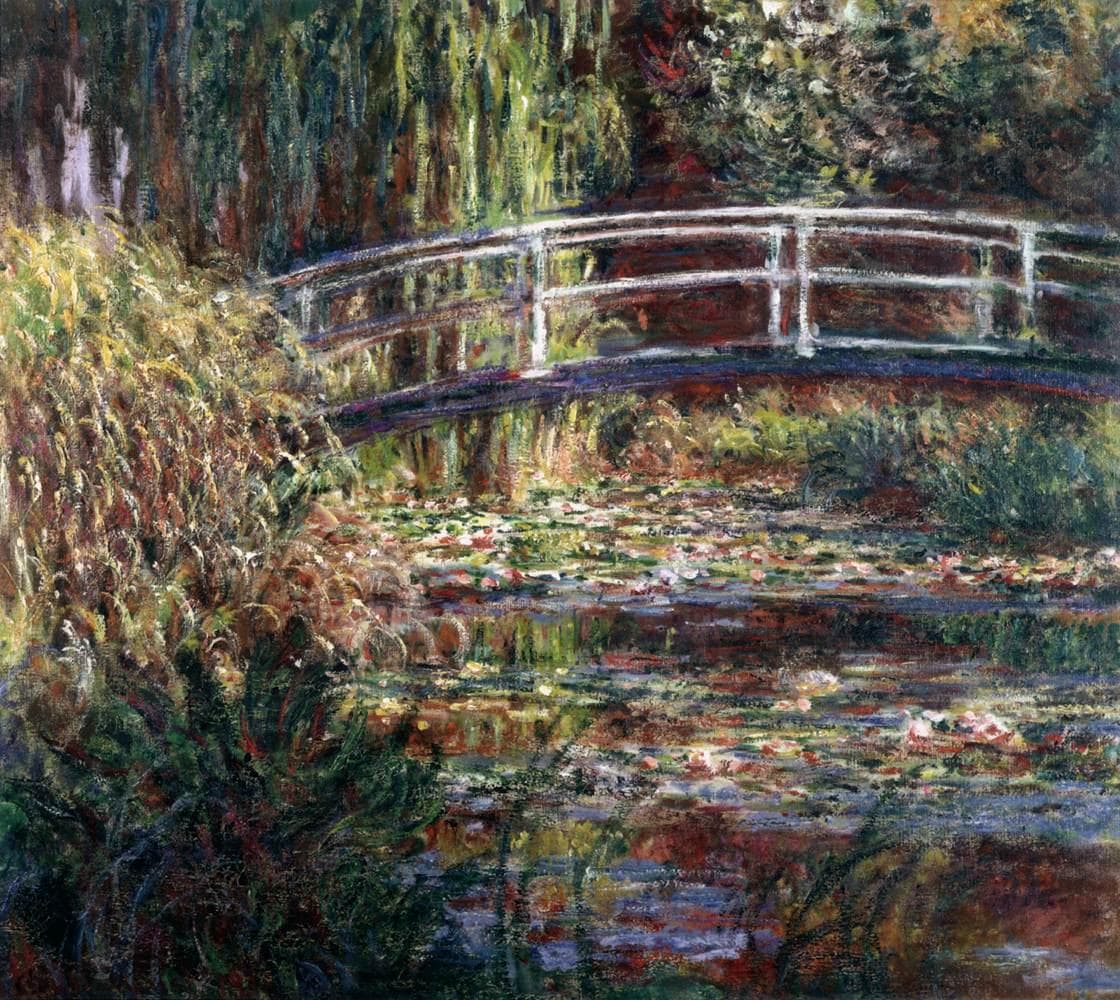
The 1899 group is cool and green; the best known is the Orsay's Water Lily Pond, Green Harmony, and similar canvases are in London, New York and Washington, among them Bridge over a Pond of Water Lilies at the Met. The 1900 pictures shift the key toward red, gold and violet. The Orsay's Water Lily Pond, Harmony in Rose is the closest relative of the Boston painting, and the two are often read as afternoon or evening variants of the morning greens of 1899.
The change matters because it shows Monet moving from a single view repeated to a single view transformed by light, the logic of the series he had just begun with the Haystacks and Poplars. Twenty years later he painted the bridge again, almost buried in color, in pictures like The Japanese Bridge in Minneapolis.
Where to see it
The painting has been in the Museum of Fine Arts, Boston (61.959) since 1961, given in memory of Governor Alvan T. Fuller by the Fuller Foundation. Boston's large Monet holdings are described on Monet at the MFA Boston.
Questions & answers
Where is Monet's The Water Lily Pond (1900)?
This 1900 version, signed and dated at lower left, is in the Museum of Fine Arts, Boston (accession 61.959), which received it in 1961. Monet painted the Japanese footbridge many times in 1899 and 1900, and other versions are in Paris, London, New York, Washington and elsewhere.
When and where was it painted?
In 1900 in Monet's water garden at Giverny, Normandy, which he created from 1893 on land across the road from his house. He painted the footbridge from the same spot at the end of the pond in 1899 and again in 1900. Wildenstein catalogues this canvas as W.1630.
How is the 1900 version different from the 1899 bridge paintings?
The 1899 canvases are cool and green. In 1900 Monet returned to the motif with a hotter palette of rust, red and violet, denser brushwork and more crowded vegetation, so the bridge nearly disappears into the surrounding foliage. Its closest relative is Harmony in Rose in the Musée d'Orsay.
Can you still see the bridge Monet painted?
Yes, in spirit. The garden at Giverny is open to visitors as part of the Fondation Claude Monet, and a green footbridge crosses the pond in the same place. The present bridge is a replacement; Monet's original wooden one was later rebuilt and also gained a wisteria trellis he added himself.
More by the artist
Claude Monet

Bridge over a Pond of Water Lilies
Claude Monet · 1899

Woman with a Parasol – Madame Monet and Her Son
Claude Monet · 1875

Sunset in Venice
Claude Monet · 1908–12

La Grenouillère
Claude Monet · 1869

Beach in Pourville
Claude Monet · 1882

Springtime
Claude Monet · 1872

Boating on the River Epte
Claude Monet · 1890

The Seine at Asnières (Hermitage)
Claude Monet · 1873
Also painted in 1900
The same year
Kindred works
You may also study
Water Lily Pond, Green Harmony
Claude Monet · 1899
The Water Lily Pond, Harmony in Rose
Claude Monet · 1900
The Japanese Footbridge
Claude Monet · 1899
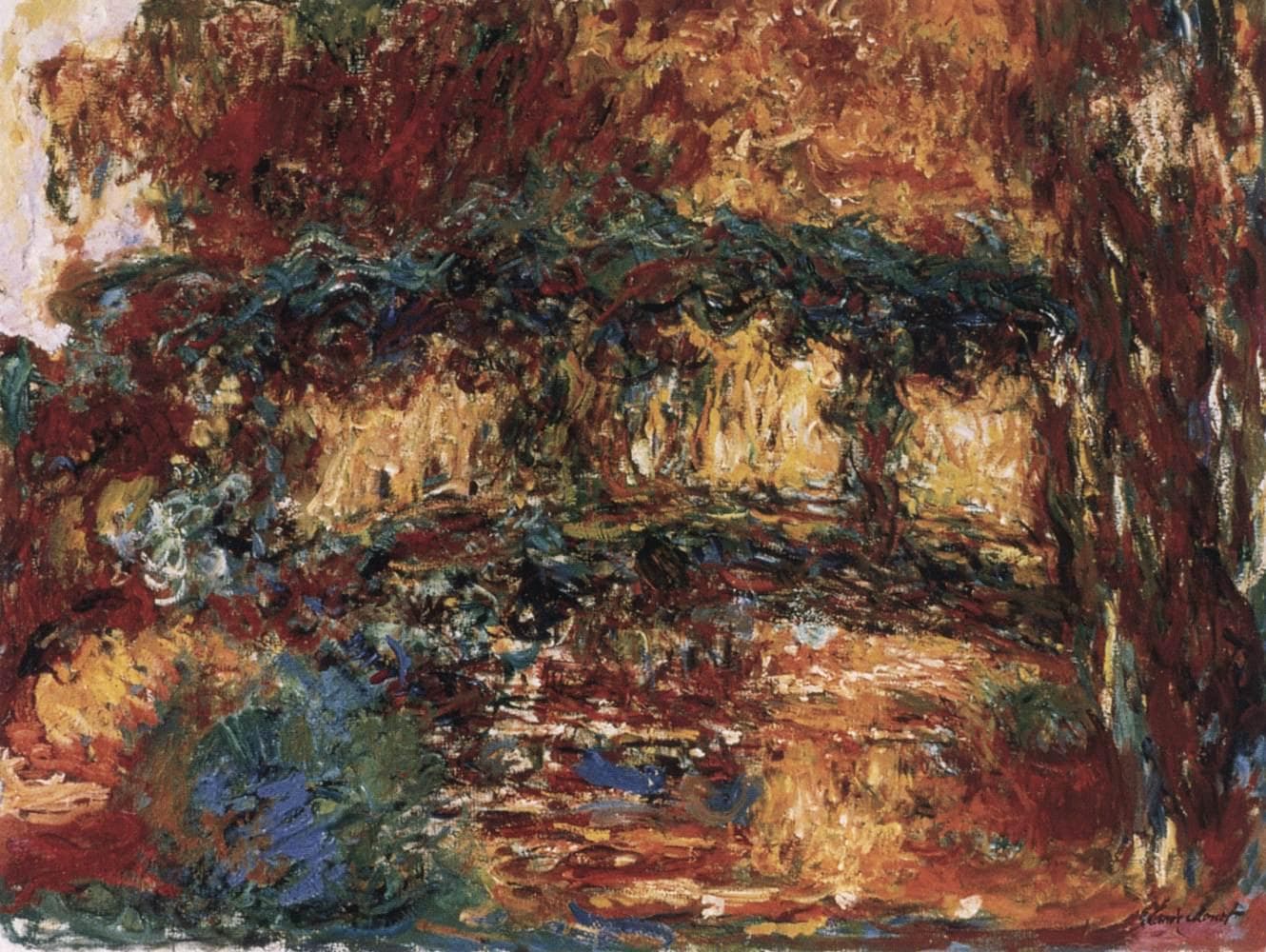
The Japanese Bridge
Claude Monet · c. 1923–25
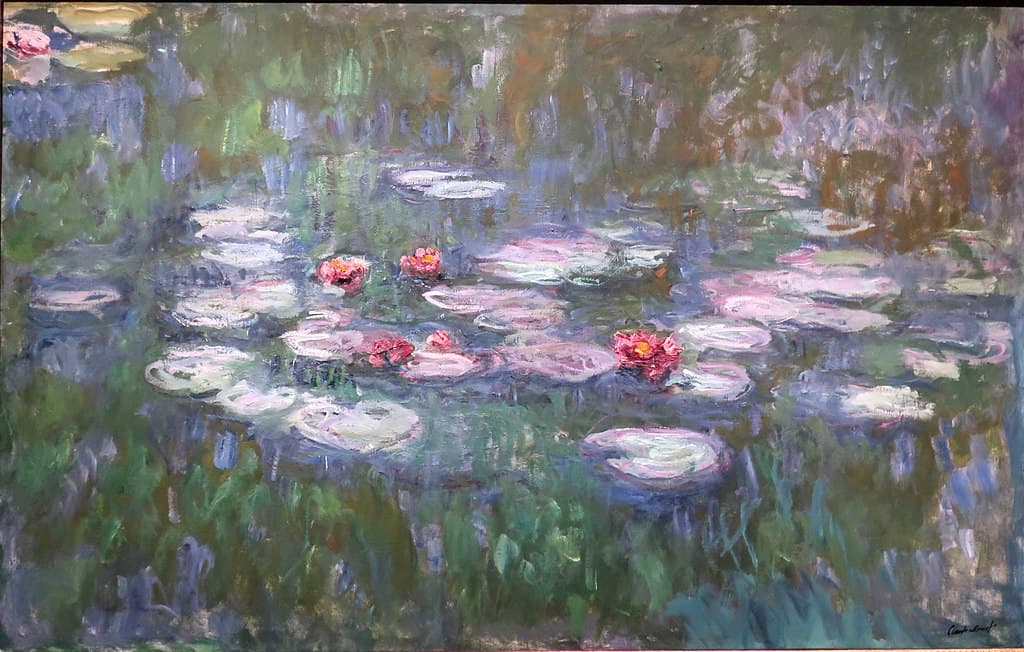
Nymphéas (Water Lilies)
Claude Monet · c. 1914–1919

The Scream
Edvard Munch · 1893

Ophelia
John Everett Millais · 1851–52

The Great Wave off Kanagawa
Katsushika Hokusai · c. 1830–32