Caiaphas Crucified
Gustave Doré, 1861
Caiaphas Crucified is Gustave Doré's 1861 wood engraving for Inferno, Canto XXIII: the high priest who condemned Jesus lies staked naked on the ground among the hypocrites, while Virgil and Dante look down at him.
- Artist
- Gustave Doré
- Date
- 1861
- Medium
- Wood engraving
- Movement
- Romanticism
- Themes
- Religion & Saints, The Macabre, Literature & Poetry, Dark Academia
Caiaphas Crucified is Gustave Doré's wood engraving of the high priest Caiaphas staked to the ground among the hypocrites, from Canto XXIII of Dante's Inferno, published in Paris in 1861. A naked man lies spread-eagled on the floor of the sixth ditch of Malebolge, pinned by three stakes, while Virgil and Dante look down at him and a procession of hooded sinners files past in the distance. It is one of the quietest and strangest of Doré's Inferno illustrations.
What you are looking at
Most of the plate is pale. A tall cliff, cut in long vertical strokes, fills the background, pierced by dark arched openings like the mouths of tombs or cells. Below it a slope runs down from the left, dotted with tiny cloaked figures moving in file. Nearer, in a hollow at left, a cluster of larger hooded figures bends together, some of them turned toward the center of the picture.
The center is almost empty ground, and in it lies the crucified man. He is flat on his back, arms stretched wide, a peg driven through each hand and a third through his crossed feet. His head is tipped back and his hair spreads on the stones. The light falls on him from above so that his body is the brightest thing in the plate.
At the right stand the poets. Virgil, laurel-crowned and barefoot in a pale toga, looks down at the figure with his eyes half closed; Dante, in his dark hooded gown, rests one hand on a boulder and looks down too. A great rounded rock fills the lower left corner. Doré's signature is at lower right, and the engraver's name, "PISAN", is just visible at the bottom edge, half cut away by the border.
The passage: Canto XXIII
The sixth bolgia holds the hypocrites. They walk forever in a slow circle wearing cloaks cut like monks' habits, gilded outside "so that it dazzles; / But inwardly all leaden and so heavy" (XXIII.64–65, Longfellow's translation). Dante speaks with two of them, Catalano and Loderingo, members of the order nicknamed the Jovial Friars, who had been brought in to keep the peace in Florence in 1266. Then he breaks off:
But said no more; for to mine eyes there rushed One crucified with three stakes on the ground. (XXIII.110–111)
Catalano explains: "This transfixed one, whom thou seest, / Counselled the Pharisees that it was meet / To put one man to torture for the people" (XXIII.115–117). He lies "Crosswise and naked ... on the path", so that every hypocrite who passes must tread on him and feel "how much he weighs" (XXIII.118–120). His father-in-law Annas and the rest of the council that condemned Jesus are punished the same way. Then "I saw Virgilius marvel / O'er him who was extended on the cross" (XXIII.124–125), which is exactly the look Doré gives him.
How Doré staged it
Caiaphas's words come from the Gospel of John: "it is expedient for us, that one man should die for the people, and that the whole nation perish not" (John 11:50, King James Version). Dante punishes him by making him the one man who suffers for all of them, forever underfoot.
Doré follows Dante's three stakes precisely, one for each hand and one for the feet, and lays the body out as a cross on the ground. What he changes is the traffic. In the poem the hypocrites must walk over Caiaphas; in the plate they keep their distance, a shuffling line on the far slope, and the figure lies alone in an open space like a specimen. The emptiness makes the scene feel less like a punishment in progress than a sight that stops everyone, Virgil included.
How it was made and published
As with every plate in the book, Doré drew the scene on a boxwood block and a professional engraver cut it, here Héliodore Pisan, whose name appears at the lower edge. Notice how the pale cliff is made almost entirely from vertical lines, and how the ground around Caiaphas is left nearly white, with only short broken strokes for pebbles. The plate was first published in Hachette's 1861 folio L'Enfer de Dante Alighieri, which Doré financed himself; the impression shown is from the Berlin edition of 1870, digitized by the National Library of Poland.
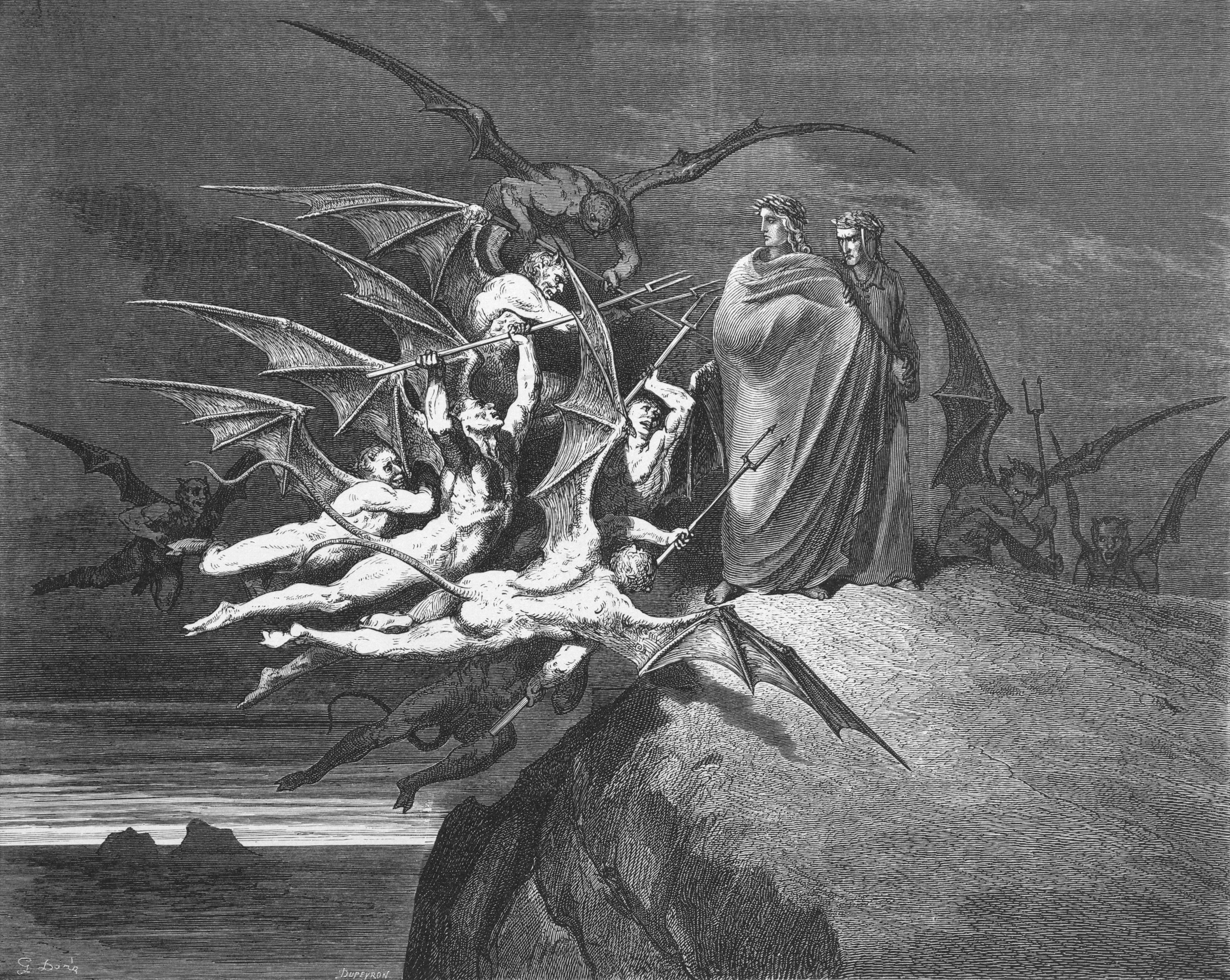
Doré drew two other plates for this canto: the Malebranche demons glaring down from the top of the bank after the poets have slid out of their reach, and the hooded hypocrites crowding around the poets.
What it means
The punishment turns the crucifixion inside out. The priest who argued that one man should die for the people now plays that role himself, and the weight he must bear is the weight of every hypocrite in the ditch. Doré, who five years later would publish his illustrated Bible, gives the body the pose of the crucified Christ without any of Christ's dignity: no cross, no witnesses who mourn, only bare ground.
The plate sits between the farce of the demons and the metamorphoses of The Thieves and the Serpents in the next ditch. For more by Gustave Doré and the darker side of nineteenth-century imagery, see Gothic art.
Questions & answers
What does Doré's Caiaphas plate show?
It shows Caiaphas, the high priest who urged Jesus's death, pinned to the floor of the hypocrites' ditch in Inferno Canto XXIII, with Virgil and Dante looking on and hooded sinners in the distance. Dante's line is "One crucified with three stakes on the ground" (XXIII.111, Longfellow's translation).
Why is Caiaphas crucified in Dante's Inferno?
He told the council that it was better for one man to die for the people (John 11:50). Dante makes him that one man: he lies across the path of the hypocrites, and every one of them in their heavy lead cloaks must walk over him. His father-in-law Annas and the council suffer the same.
When was the Caiaphas engraving made?
Doré designed it for his illustrated Inferno, published in Paris by Hachette in 1861 as L'Enfer de Dante Alighieri, an edition he paid for himself. The engravings were later reprinted in French, German and English editions; the scan here is from the 1870 Berlin edition.
Who engraved Doré's Caiaphas plate?
The engraver's name, "PISAN", is cut at the bottom edge, for Héliodore Pisan, one of Doré's main engravers. Doré drew the design on the woodblock and Pisan cut it, building the pale cliff from vertical lines and leaving the ground around Caiaphas almost white.
Who are the hypocrites in Doré's plate?
They are the hooded figures walking in the background. Dante describes their cloaks as gilded outside but lined with lead, so heavy that they move painfully slowly. Two of them, the Bolognese friars Catalano and Loderingo, explain to Dante who the crucified man is.
More by Gustave Doré
All works →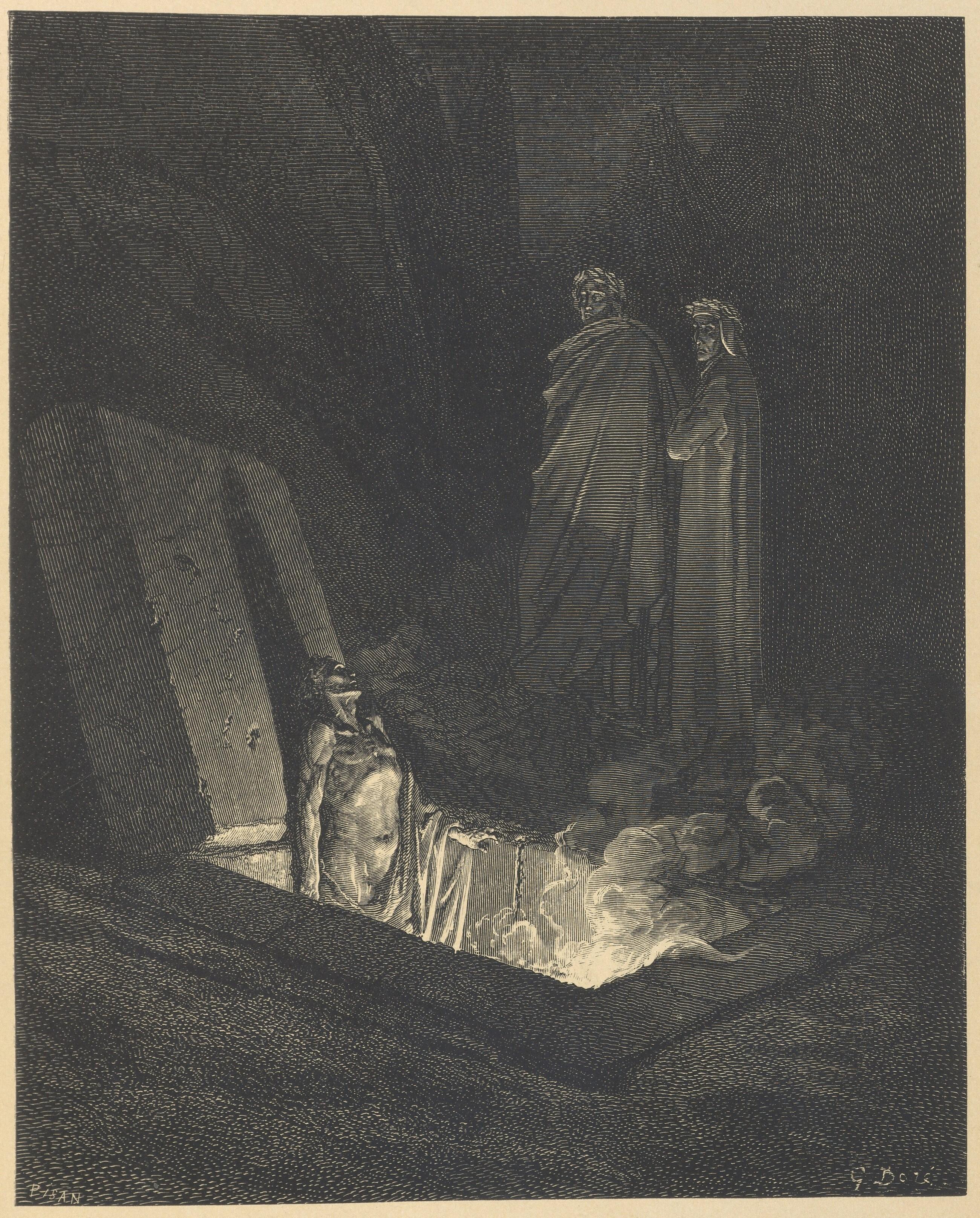
Farinata degli Uberti
Gustave Doré · 1861
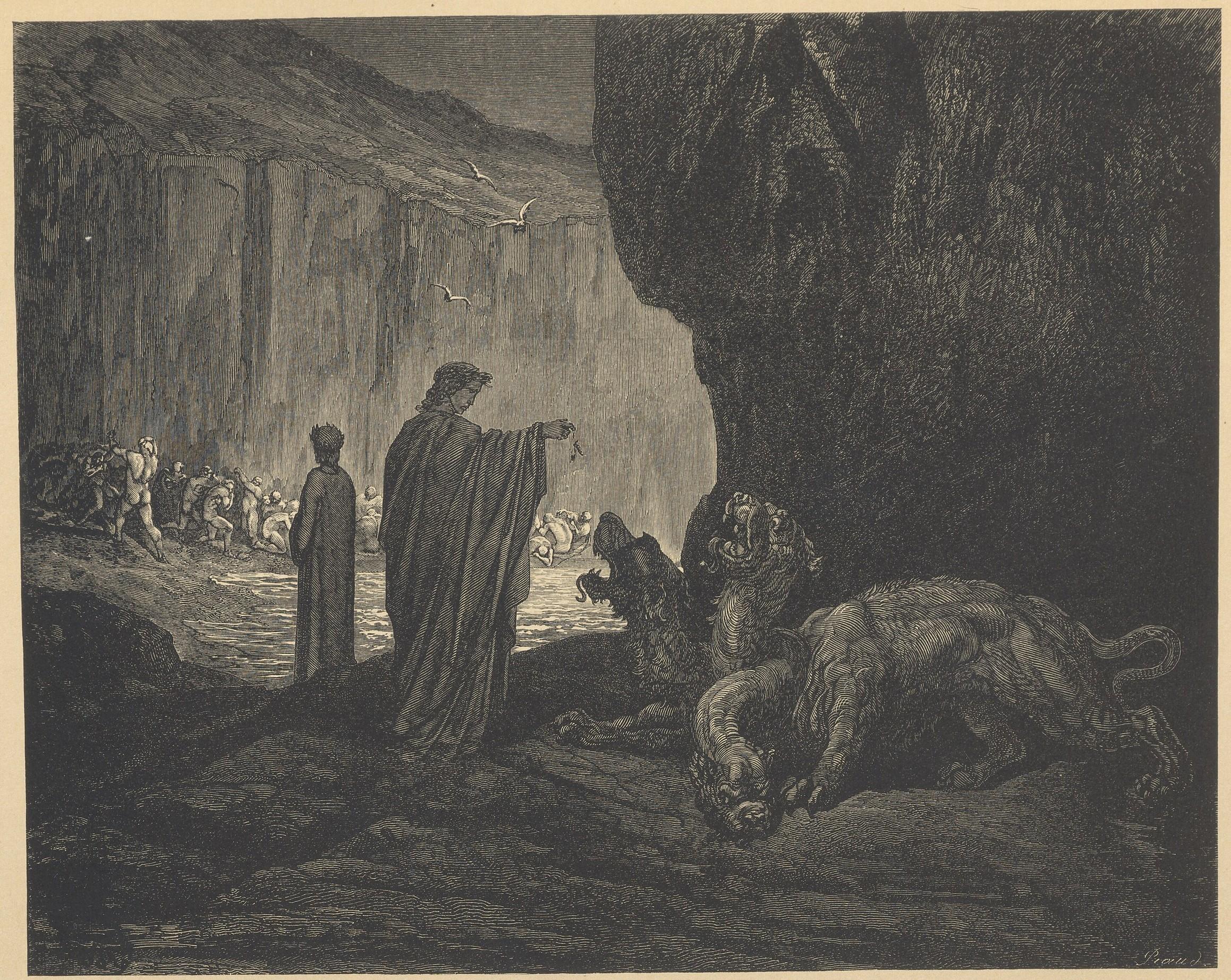
Cerberus
Gustave Doré · 1861
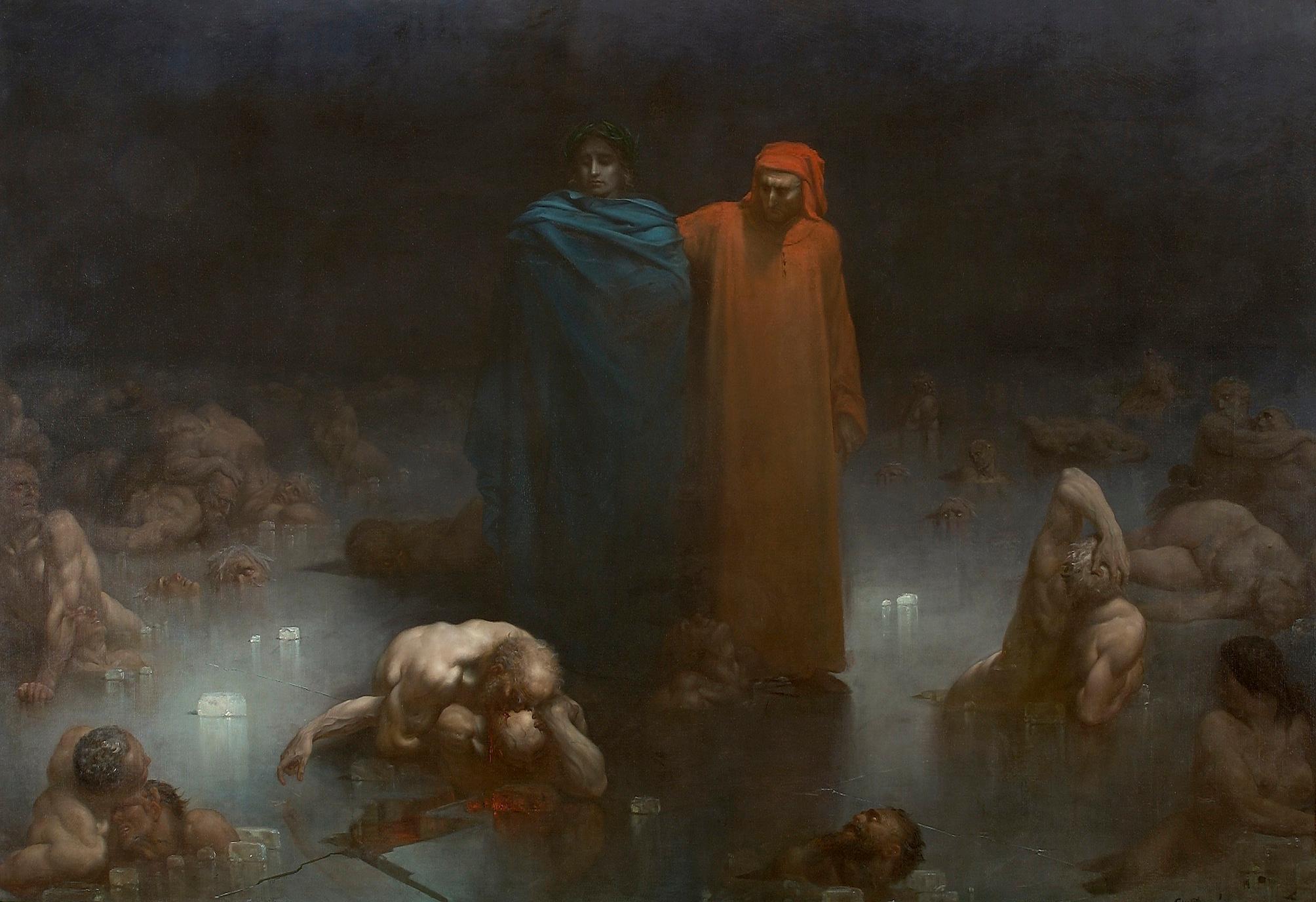
Dante and Virgil in the Ninth Circle of Hell
Gustave Doré · 1861
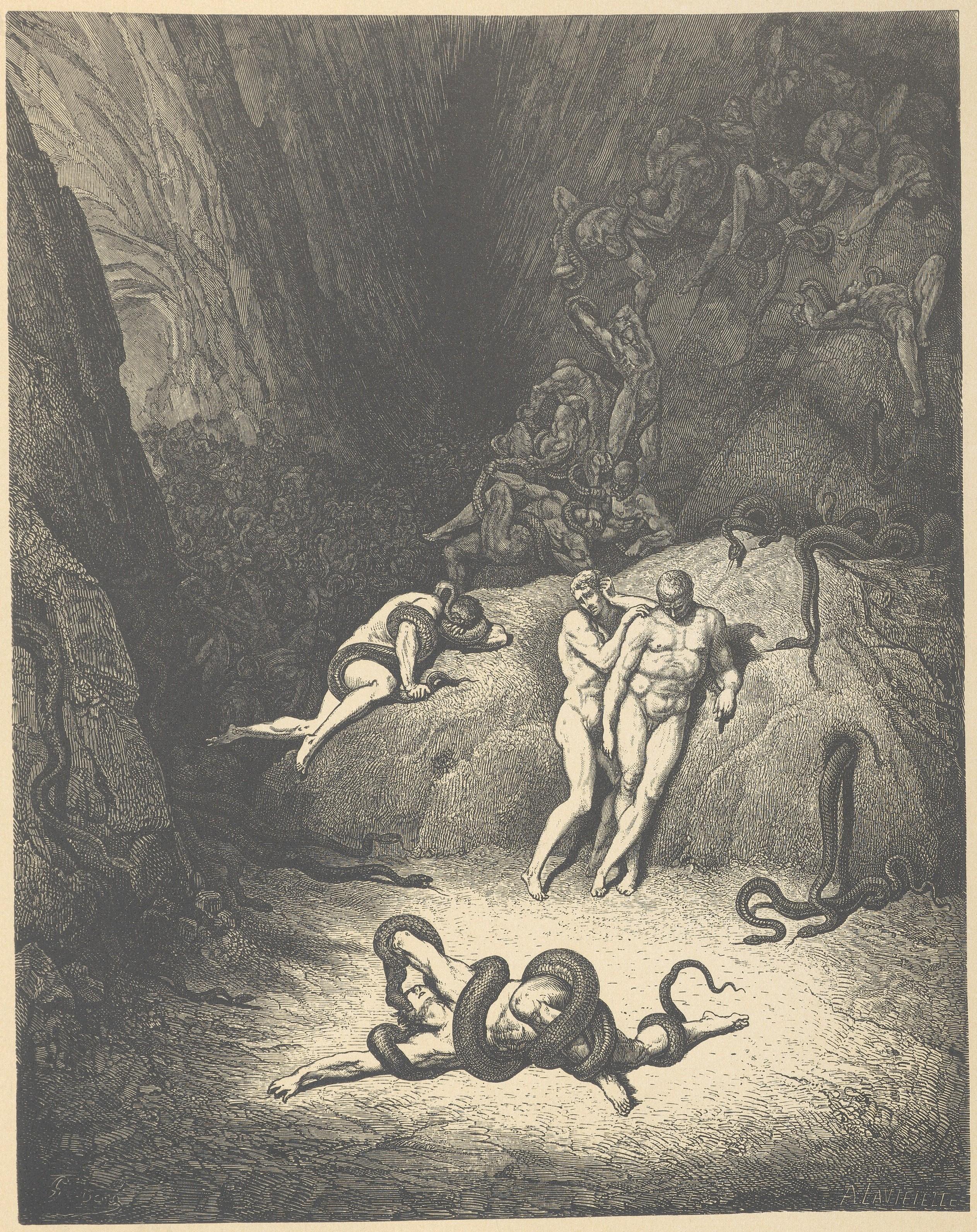
The Thieves and the Serpents
Gustave Doré · 1861
Dante Lost in the Dark Wood
Gustave Doré · 1861
Crossing the Styx (Filippo Argenti)
Gustave Doré · 1861
Bertran de Born Holding His Head
Gustave Doré · 1861
The Giants
Gustave Doré · 1861
Also from 1861
Ulysses and Diomedes
Gustave Doré · 1861
Paolo and Francesca
Gustave Doré · 1861
The Whirlwind of the Lustful
Gustave Doré · 1861
Minos, Judge of the Damned
Gustave Doré · 1861
Charon, Ferryman of the Dead
Gustave Doré · 1861
The Gate of Hell (Abandon All Hope)
Gustave Doré · 1861
The Furies at the Gates of Dis
Gustave Doré · 1861
The Malebranche Demons
Gustave Doré · 1861
Related works
The Malebranche Demons
Gustave Doré · 1861
Ulysses and Diomedes
Gustave Doré · 1861
Witches' Sabbath (The Great He-Goat)
Francisco Goya · c. 1819–1823
Lucifer, King of Hell
Gustave Doré · 1861
The Vision of the Valley of Dry Bones
Gustave Doré · 1866
Satan Cast Out of Heaven
Gustave Doré · 1866
Perched Upon a Bust of Pallas
Gustave Doré · 1884
Satan’s Flight Through Chaos
Gustave Doré · 1866