French · Romanticism
Gustave Doré
b. 6 January 1832, Strasbourg — d. 23 January 1883, Paris
Gustave Doré (1832–1883) was a French illustrator, painter and sculptor whose wood-engraved illustrations for the Bible, Dante's Divine Comedy, Don Quixote and Paradise Lost defined how generations imagined those books.
1 work in the collection
Works by Gustave Doré
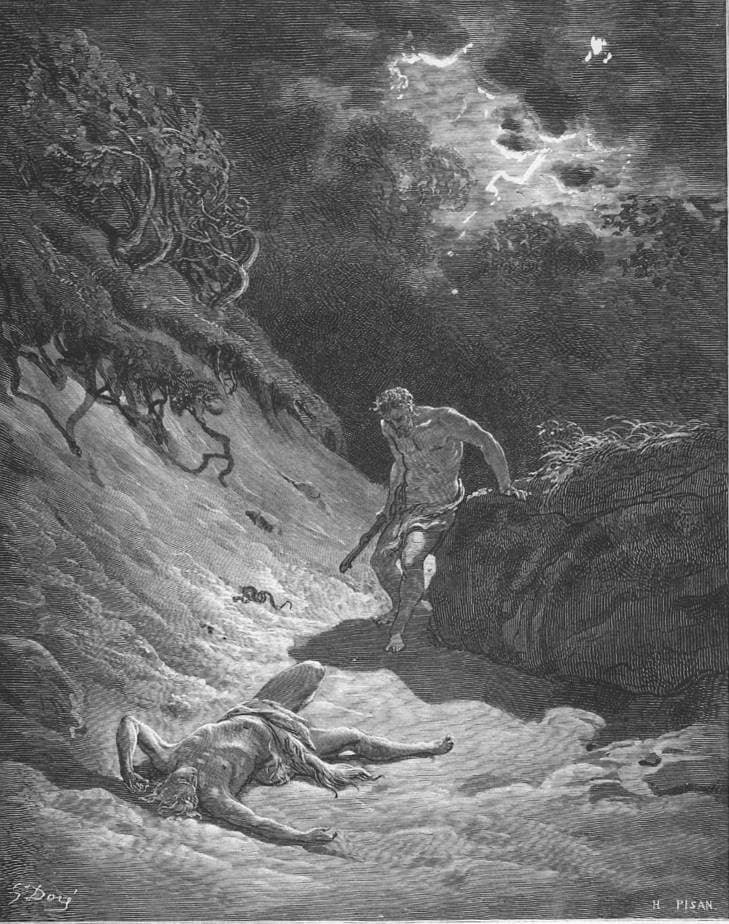
Gustave Doré was the most famous book illustrator of the nineteenth century. His designs, cut into wood blocks by teams of engravers, gave the Bible, Dante, Milton and Cervantes their best-known images. In the gallery he is represented by The Death of Abel, from his illustrated Bible of 1866, in which Cain slips away from his brother's body beneath a lightning-split sky.
Life
Doré was born in Strasbourg on 6 January 1832 and drew obsessively from childhood. At fifteen he was in Paris drawing caricatures for the Journal pour rire, and in his early twenties he was illustrating Rabelais, Balzac and Byron. He was made a Knight of the Legion of Honor in 1861. He never married, lived with his mother, and died of a heart attack in Paris on 23 January 1883, while working on illustrations for Shakespeare.
How the engravings were made
Doré usually designed rather than cut his prints. He drew directly on the wood block, and at the height of his career some forty block-cutters translated his drawings into engraved lines, often signing alongside him. Electrotype copies allowed huge print runs, so the same images appeared at once across Europe and America. He made more than 10,000 illustrations in all.
Key works
- Dante's Inferno (1861), followed by Purgatory and Paradise.
- Don Quixote (1863), whose lanky knight and round Sancho Panza fixed the characters' looks for later readers and filmmakers.
- La Grande Bible de Tours (1866), the Bible illustrations, including The Death of Abel.
- Paradise Lost (1866), with its vast, luminous Satan.
- London: A Pilgrimage (1872), with Blanchard Jerrold, whose scenes of slum life impressed Van Gogh.
- The Rime of the Ancient Mariner (1876) and Poe's The Raven (published 1884).
Doré also painted large religious canvases, shown in his own Doré Gallery in London, and made sculpture.
Legacy
Critics were often cool, but writers loved him; Théophile Gautier praised his power over chimeras and nightmares. His drama of light and darkness runs through later fantasy art and film. See angels and demons in art, fallen angels and Romanticism.
Questions & answers
What is Gustave Doré famous for?
Doré is famous for his wood-engraved illustrations for the Bible (1866), Dante's Divine Comedy (from 1861), Don Quixote (1863), Milton's Paradise Lost (1866) and Coleridge's Rime of the Ancient Mariner (1876).
Did Gustave Doré engrave his own illustrations?
Usually not. Doré drew his designs directly on wood blocks, and professional engravers, at times around forty of them, cut the blocks. Many prints carry both Doré's name and the engraver's.
What is The Death of Abel by Doré?
It is one of Doré's illustrations for his 1866 Bible. Cain walks away from Abel's body, club in hand, under a stormy sky split by lightning, while a small serpent crosses the path.