Bertran de Born Holding His Head
Gustave Doré, 1861
Bertran de Born Holding His Head is Gustave Doré's 1861 wood engraving for Inferno, Canto XXVIII: among the sowers of discord, the troubadour Bertran de Born carries his severed head like a lantern while Dante recoils.
- Artist
- Gustave Doré
- Date
- 1861
- Medium
- Wood engraving
- Movement
- Romanticism
- Themes
- The Macabre, Death & Memento Mori, War & Violence, Literature & Poetry, Dark Academia
Bertran de Born Holding His Head is Gustave Doré's wood engraving for Canto XXVIII of Dante's Inferno, published in Paris in 1861. In the ninth ditch of Malebolge, among the sowers of discord, a headless man strides into view holding his own severed head up by the hair "in fashion of a lantern", while Dante recoils and Virgil looks on. It is the most shocking single figure in Doré's Inferno illustrations.
What you are looking at
The plate is upright and divided into two zones. Above, in a narrow ravine between sheer, dark rock walls, a powerful nude figure stands on a ridge against the grey sky. Where his head should be there is a clean, round cut. His right arm is raised high, and from his fist hangs his own bearded head, held by the hair, its eyes open and its brows drawn together in a glare aimed down at the poets.
Below the ridge, under an overhanging ledge of rock, a mass of mutilated sinners crowds in shadow: some crouch and stare up, some bury their faces in their arms, one lies sprawled at the right with his head turned away. In the foreground, at the poets' feet, a man lies on his back with his chest torn open, one arm thrown up toward them.
At the left stand Virgil and Dante. Virgil, laurel-crowned, turns his head toward the headless figure; Dante, hooded, bows and presses a hand to his forehead as if he cannot look. Doré's signature is at lower left, and the engraver's, "A. PONTENIER SC.", at lower right.
The passage: Canto XXVIII
The ninth bolgia holds those who split families, factions and faiths. A devil with a sword hacks each of them open as they pass, and the wounds heal only to be reopened on the next circuit. Dante opens the canto by saying that no tongue could tell its blood and wounds, then near the end describes the sight he says he would be afraid to report without the reassurance of his conscience:
I truly saw, and still I seem to see it, A trunk without a head walk in like manner As walked the others of the mournful herd. And by the hair it held the head dissevered, Hung from the hand in fashion of a lantern, And that upon us gazed and said: "O me!" (XXVIII.118–123, Longfellow's translation)
The head names itself: "Know that Bertram de Born am I, the same / Who gave to the Young King the evil comfort" (XXVIII.134–135). Bertran de Born, lord of Hautefort and one of the great troubadours, was believed to have encouraged Henry the Young King to rebel against his father, Henry II of England. Dante compares him to Achitophel, who turned Absalom against David. His punishment is spelled out in the last line: "Because I parted persons so united, / Parted do I now bear my brain" from its source in the trunk. "Thus is observed in me the counterpoise" (XXVIII.139–142).
How Doré staged it
Dante's Bertran walks with the herd, and when he reaches the bridge "It lifted high its arm with all the head" (XXVIII.128), so that its words come nearer. Doré turns that gesture into a monument. He sets the figure alone on a ridge, lit against the sky, with the anatomy of a classical statue, and lets the rest of the canto, the split bodies and the cut throats, pile up in the dark below him.
The open-chested man at the poets' feet belongs to the same ditch of torn bodies; Muhammad, whom Dante also places here, has a plate of his own. Notice too that Bertran's head looks at us as much as at Dante. Doré makes the "O me!" a direct address.
How it was made and published
Doré drew the design on a boxwood block for the engraver Auguste Pontenier, whose signature, "A. PONTENIER SC." (sculpsit, "cut it"), is cut into the lower right corner. Pontenier modeled the headless body with fine, curving cross-hatching and left it almost white against the dark ravine. The plate was published in 1861 in Hachette's folio L'Enfer de Dante Alighieri, which Doré paid for himself; the impression shown is from the Berlin edition of 1870, digitized by the National Library of Poland. English editions later captioned it with Henry Francis Cary's version of the same lines, "It bore the sever'd member, lantern-wise".
What it means
Dante's word for the logic of Hell, contrapasso, appears in this canto, in Bertran's last line, rendered by Longfellow as "counterpoise". Punishment mirrors the sin: the man who divided father from son is divided from himself. The head that lights his way like a lantern is the same head that once gave the evil counsel.
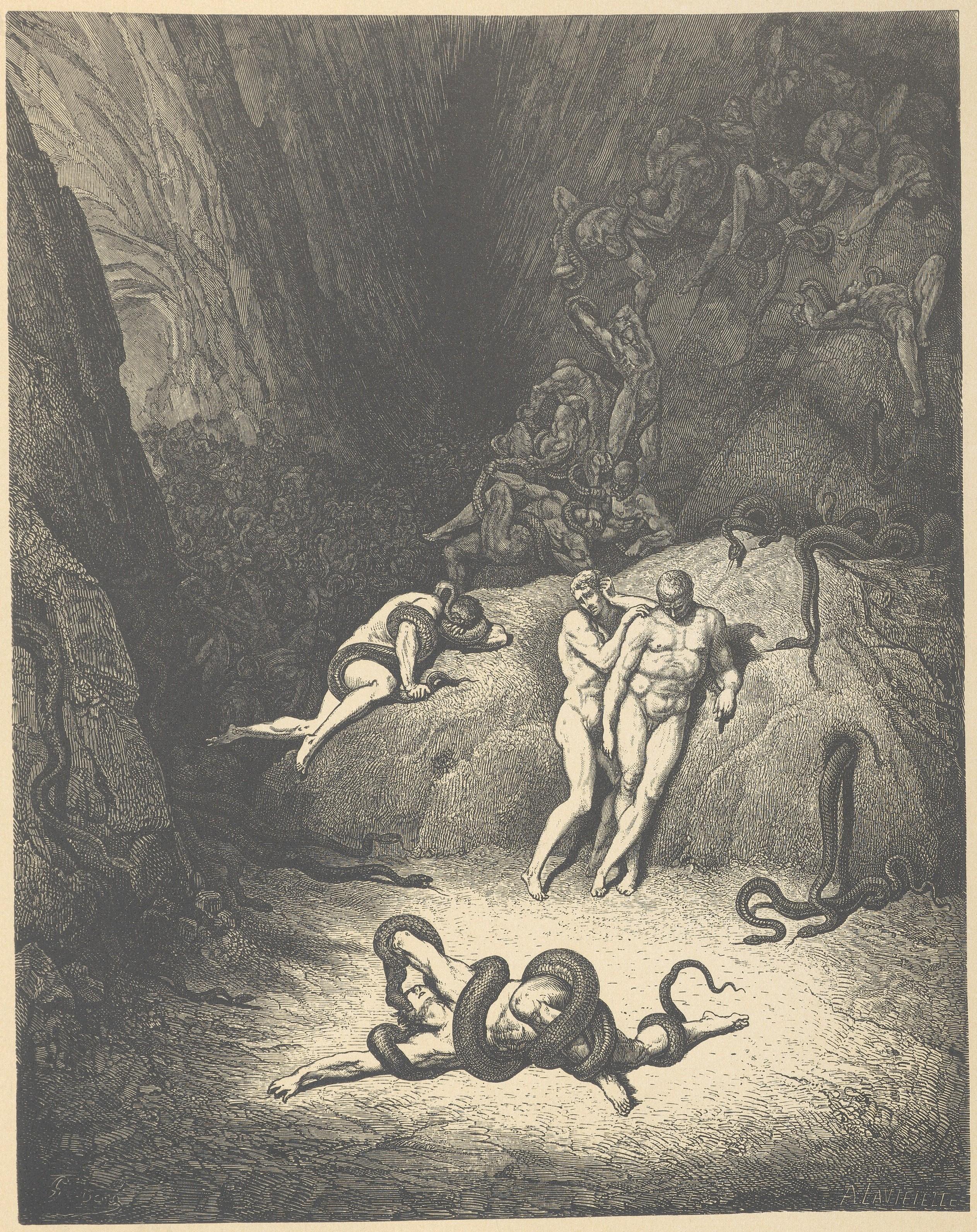
Doré makes the image unforgettable by isolating it. Compare the bodily punishments of The Thieves and the Serpents, the hidden sinners of Ulysses and Diomedes two ditches back, and the frozen traitors of Count Ugolino and His Sons further down. For more by Gustave Doré and the long history of such images, see death in art.
Questions & answers
What does Doré's Bertran de Born plate show?
It shows the troubadour Bertran de Born in the ninth ditch of Malebolge, Inferno Canto XXVIII, holding up his severed head by the hair. Dante writes: "And by the hair it held the head dissevered, / Hung from the hand in fashion of a lantern" (XXVIII.121–122, Longfellow's translation).
Why does Bertran de Born carry his head in Dante's Inferno?
Dante believed Bertran had set Henry the Young King against his father, Henry II of England. Because he divided father and son, he is divided from his own head. He calls it the "counterpoise" (contrapasso in Italian), the principle that punishment mirrors sin.
When was this Doré engraving made?
Doré designed it for his illustrated Inferno, published in Paris by Hachette in 1861 as L'Enfer de Dante Alighieri; Doré financed that first edition himself. The same engravings were reprinted for decades, including the Berlin edition of 1870 from which this scan comes.
Who engraved the Bertran de Born plate?
It is signed "A. PONTENIER SC." at lower right, for Auguste Pontenier; "sc." stands for sculpsit, "cut it". Doré drew the design on the woodblock and Pontenier cut it, modeling the headless body in fine cross-hatching that leaves it almost white.
Who was Bertran de Born?
Bertran de Born (born in the 1140s, died by 1215) was a baron, lord of Hautefort, and a leading troubadour, best known for his fierce political songs. He took part in the revolts of Henry II's sons and late in life became a monk. Dante admired his poetry but damned him as a sower of discord.
More by Gustave Doré
All works →
Charon, Ferryman of the Dead
Gustave Doré · 1861
Geryon
Gustave Doré · 1861
The Malebranche Demons
Gustave Doré · 1861
Count Ugolino and His Sons
Gustave Doré · 1861
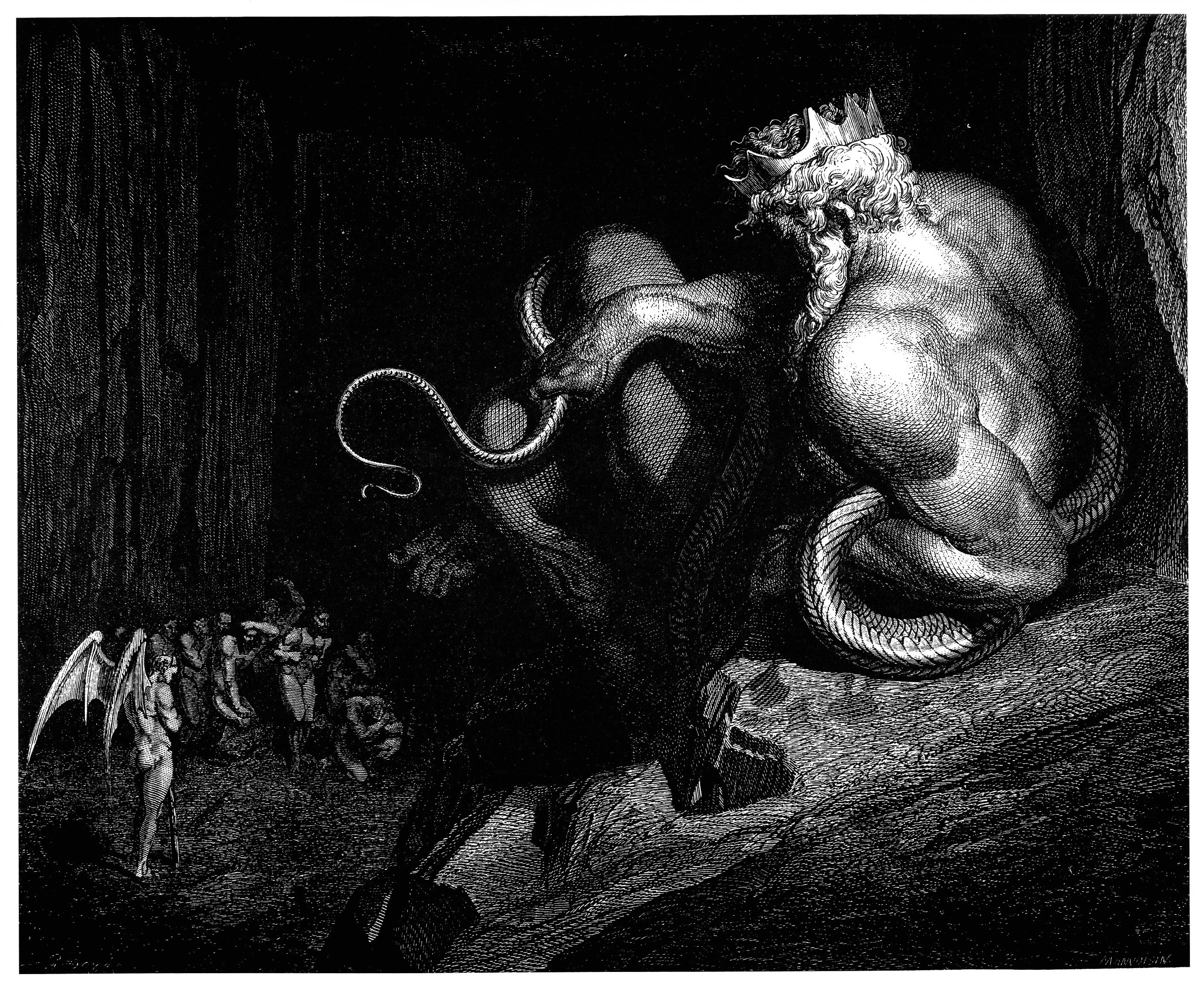
Minos, Judge of the Damned
Gustave Doré · 1861
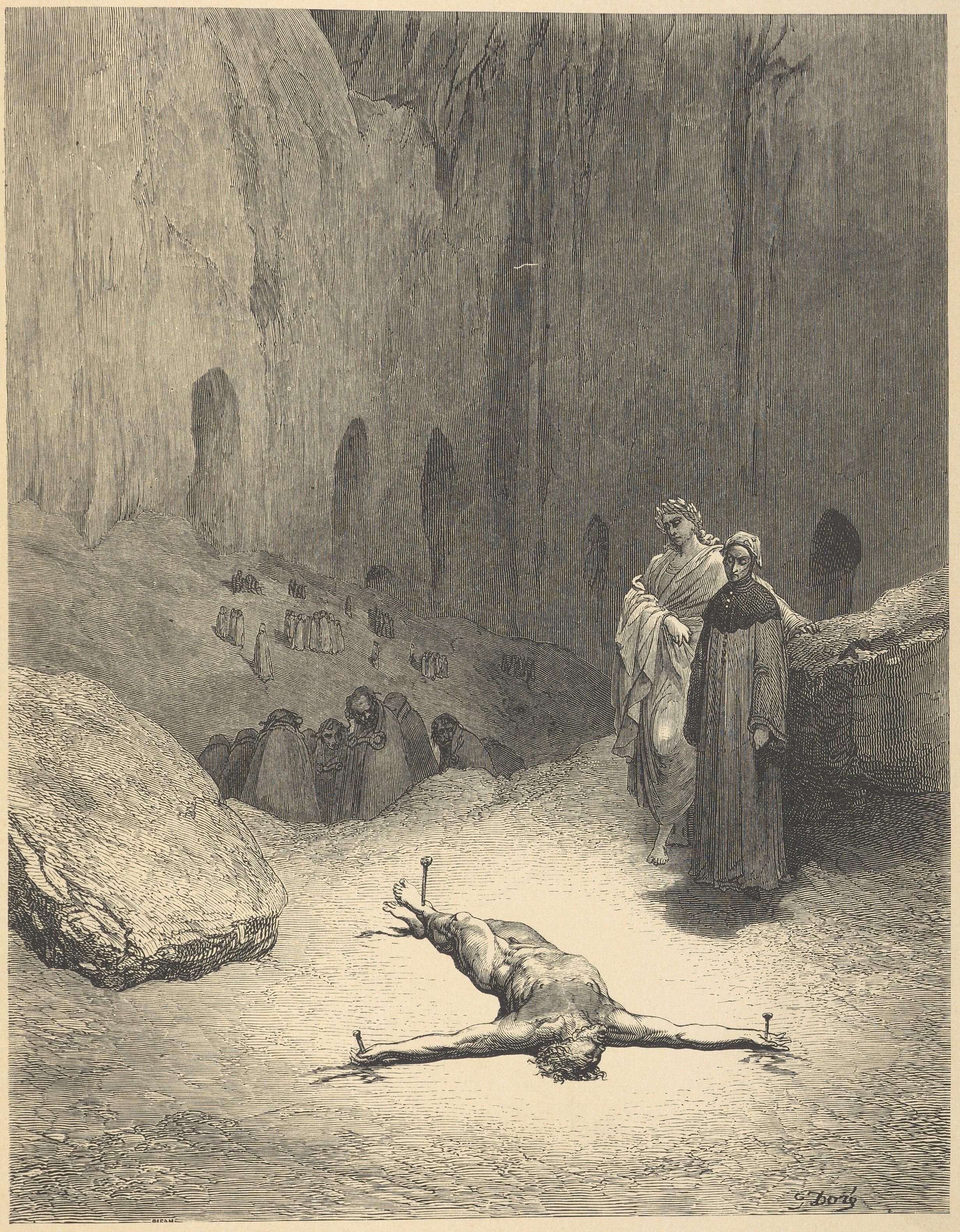
Caiaphas Crucified
Gustave Doré · 1861
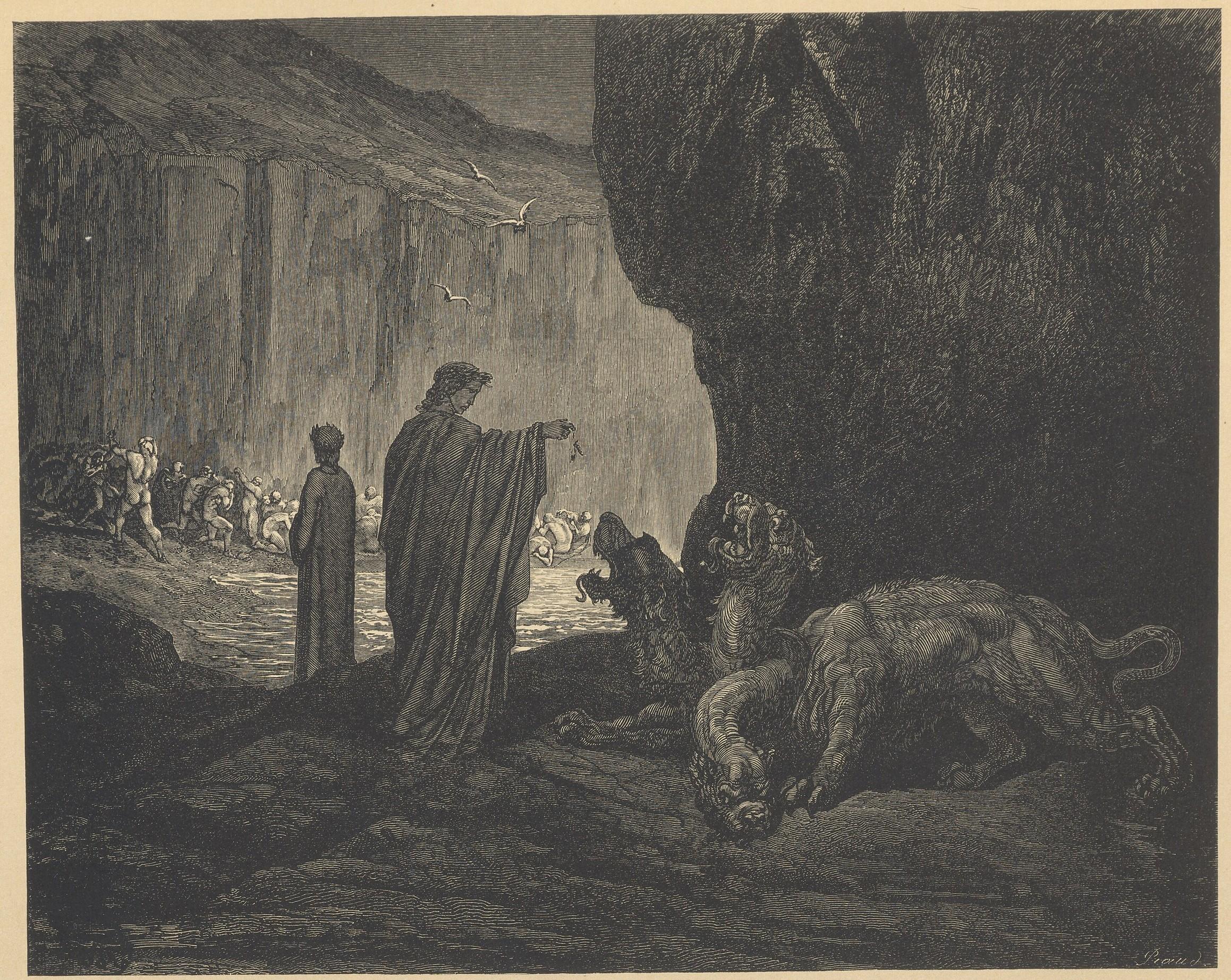
Cerberus
Gustave Doré · 1861
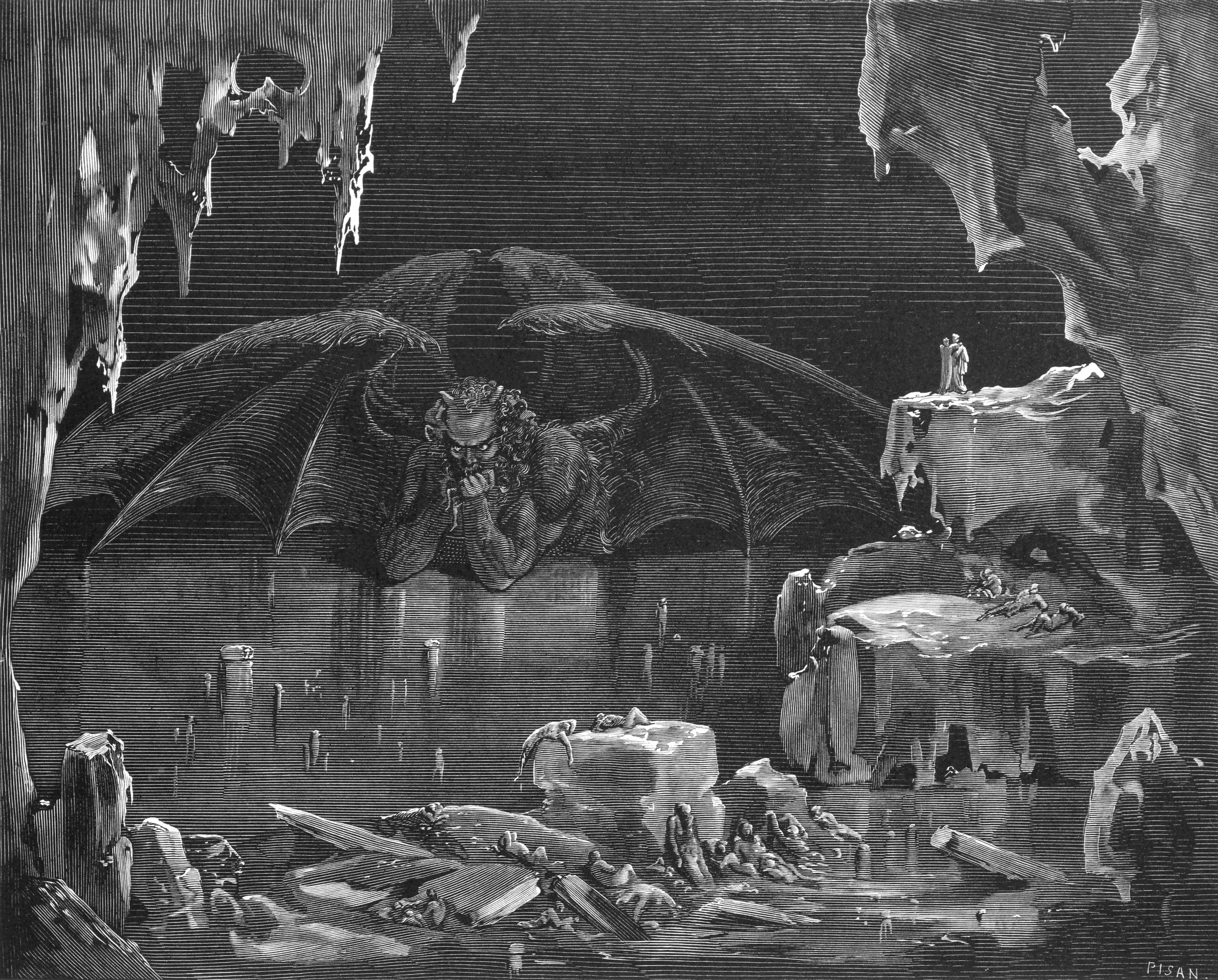
Lucifer, King of Hell
Gustave Doré · 1861
Also from 1861
Dante and Virgil in the Ninth Circle of Hell
Gustave Doré · 1861
Crossing the Styx (Filippo Argenti)
Gustave Doré · 1861
Ulysses and Diomedes
Gustave Doré · 1861
The Thieves and the Serpents
Gustave Doré · 1861
Paolo and Francesca
Gustave Doré · 1861
The Whirlwind of the Lustful
Gustave Doré · 1861
The Gate of Hell (Abandon All Hope)
Gustave Doré · 1861
Dante Lost in the Dark Wood
Gustave Doré · 1861
Related works
Ulysses and Diomedes
Gustave Doré · 1861
The Thieves and the Serpents
Gustave Doré · 1861
The Giants
Gustave Doré · 1861
Death and Life-in-Death
Gustave Doré · 1876
Satan, Sin and Death at the Gates of Hell
Gustave Doré · 1866
Atropos (The Fates)
Francisco Goya · c. 1819–1823
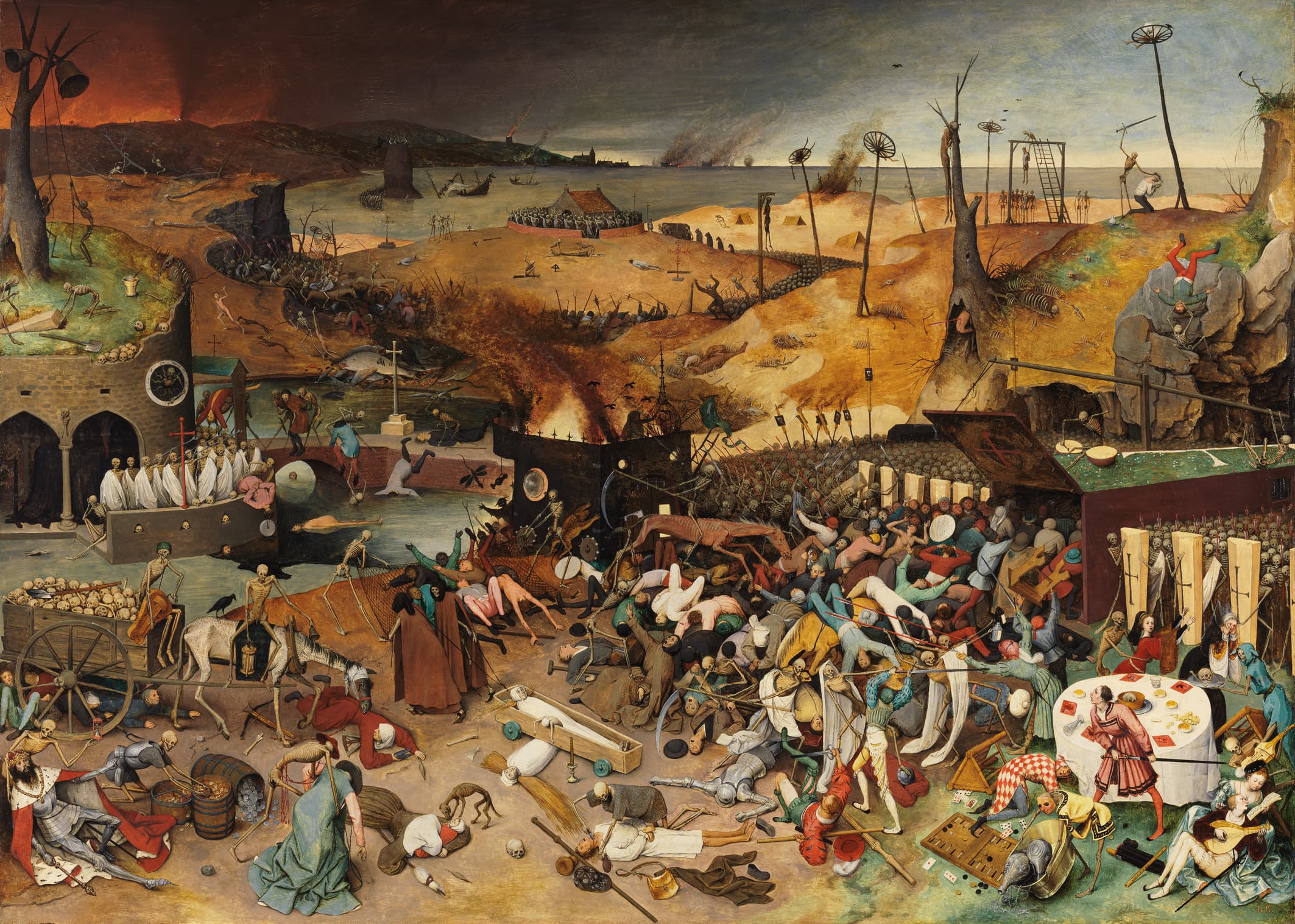
The Triumph of Death
Pieter Bruegel the Elder · c. 1562
The Gate of Hell (Abandon All Hope)
Gustave Doré · 1861