Image: Museum of Modern Art, New York · Public domain · via Wikimedia Commons
Impressionism
The Japanese Footbridge (MoMA)
Claude Monet, c. 1920–22
The Japanese Footbridge is a late painting by Claude Monet, c. 1920–22, of the wooden bridge over his Giverny lily pond, dissolved into swirls of rust, orange and maroon. It is in the Museum of Modern Art, New York.
- Artist
- Claude Monet
- Date
- c. 1920–22
- Medium
- Oil on canvas
- Dimensions
- 89.5 × 116.3 cm
- Collection
- Museum of Modern Art, New York, United States
- Movement
- Impressionism
- Catalogue
- Wildenstein 1932
The Japanese Footbridge is one of the last pictures Claude Monet painted of the arched wooden bridge over the lily pond in his garden at Giverny. The Museum of Modern Art in New York, which bought it in 1956, dates it about 1920–22. In it the bridge that Monet had painted crisply in the 1890s has almost disappeared into a blaze of rust, orange, maroon and dark blue.
What you are looking at
It takes a moment to find the bridge. A low arch crosses the canvas from left to right just above the middle, picked out by a pale yellow line along its rail and a few lighter strokes on the deck. Above it hangs a canopy of dark red and orange, the trained wisteria that Monet grew over a trellis on the bridge, with flecks of violet where blossoms might be. Below, the pond is a turbulent mass of reds and golds: reflections of the bridge and foliage, not the water's own color.
At lower left a thicket of blue-green and gray strokes, loosely coiled, suggests the plants on the bank. Through the gaps under the arch there are small notes of light yellow, like late sun coming through leaves. The paint is everywhere thick and agitated, laid on in looping, scribbled marks that seem to move in several directions at once. The picture feels hot, crowded and close, far from the calm green harmonies of the 1899 bridge paintings.
There is no sky. The top edge cuts through the wisteria, and the bottom edge cuts through the reflections, so the bridge is held in a narrow band between two walls of color. That compression is part of the picture's intensity. You are standing at the end of the path, almost under the foliage, with nowhere for the eye to escape.
Where and when it was painted
From about 1918 Monet returned to the footbridge in a group of more than a dozen canvases, painted in his garden alongside the great water-lily decorations. He was nearly 80, and cataracts had blurred his vision and pushed it toward yellows and reds; he described being unable to distinguish colors accurately. Whether these late bridges record his damaged sight, a deliberate new expressiveness, or both, is still debated. Monet had an operation on his right eye in 1923 and afterward repainted some canvases. The garden setting is described on our Giverny hub.
How it was painted
The canvas is painted from close range, with the bridge pressed against the picture plane so that there is no surrounding view. Monet worked in heavy, dragging strokes, often wet into wet, and let colors mix on the surface. Line, rather than tone, carries the drawing: a single pale stroke for the rail, a curved swipe for the arch. MoMA singles out the palette of maroons, rusts and oranges as unusual in his work.
The series and how this version differs
The footbridge was the first motif Monet painted in series at his water garden, in 1899–1900, when he made about a dozen sunny, ordered views such as Bridge over a Pond of Water Lilies at the Met and The Japanese Footbridge in Washington. The whole group is gathered on our Japanese Footbridge hub. The late versions, including The Japanese Bridge in Minneapolis, abandon that order. Comparing the Washington picture with this one, painted twenty years apart, is one of the clearest ways to see how far Monet traveled toward abstraction.
Ownership and where to see it
After Monet's death the painting passed to his son Michel. It was sold through the dealers M. Knoedler & Co., from whom MoMA bought it in May 1956 with the Grace Rainey Rogers Fund. Like the museum's large Water Lilies triptych, it was acquired when New York painters were rediscovering late Monet as an ancestor of Abstract Expressionism. It is not always on view; for other late Giverny pictures in public collections, see where to see Monet.
Questions & answers
Where is Monet's Japanese Footbridge at MoMA?
It is in the Museum of Modern Art in New York (accession 242.1956), which bought it in 1956. It is not always on view, so check MoMA's online collection before visiting. The museum's large Water Lilies triptych is usually displayed nearby.
When did Monet paint this Japanese Footbridge?
MoMA dates it about 1920–22. Monet painted it in his water garden at Giverny when he was around 80, in a late group of more than a dozen footbridge pictures made while his sight was failing from cataracts.
Why is Monet's late Japanese bridge so red and blurred?
Cataracts dulled Monet's vision and shifted it toward yellows and reds in these years, and that is often given as the reason. Many scholars also see a deliberate turn toward freer, more expressive painting. The truth is probably a mix of both.
How many Japanese Footbridge paintings did Monet make?
About a dozen bright, orderly versions in 1899–1900, and another group of more than a dozen loose, intensely colored ones around 1918–24. This MoMA canvas belongs to the late group; the National Gallery of Art and the Met hold famous early versions.
More by the artist
Claude Monet

Bridge over a Pond of Water Lilies
Claude Monet · 1899

Woman with a Parasol – Madame Monet and Her Son
Claude Monet · 1875

Sunset in Venice
Claude Monet · 1908–12

La Grenouillère
Claude Monet · 1869

Beach in Pourville
Claude Monet · 1882

Springtime
Claude Monet · 1872

Boating on the River Epte
Claude Monet · 1890

The Seine at Asnières (Hermitage)
Claude Monet · 1873
Also painted in 1920
The same year
Kindred works
You may also study
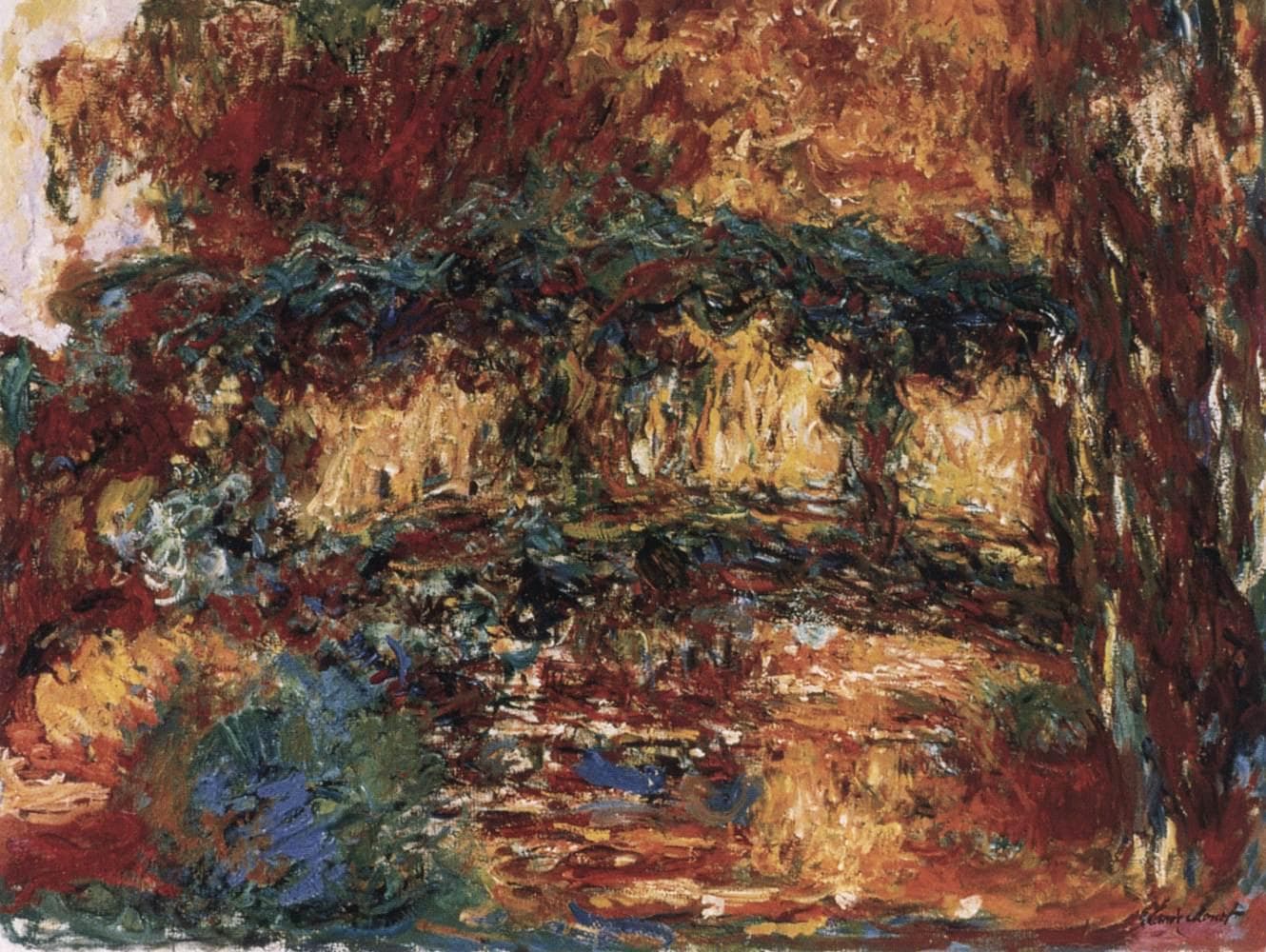
The Japanese Bridge
Claude Monet · c. 1923–25
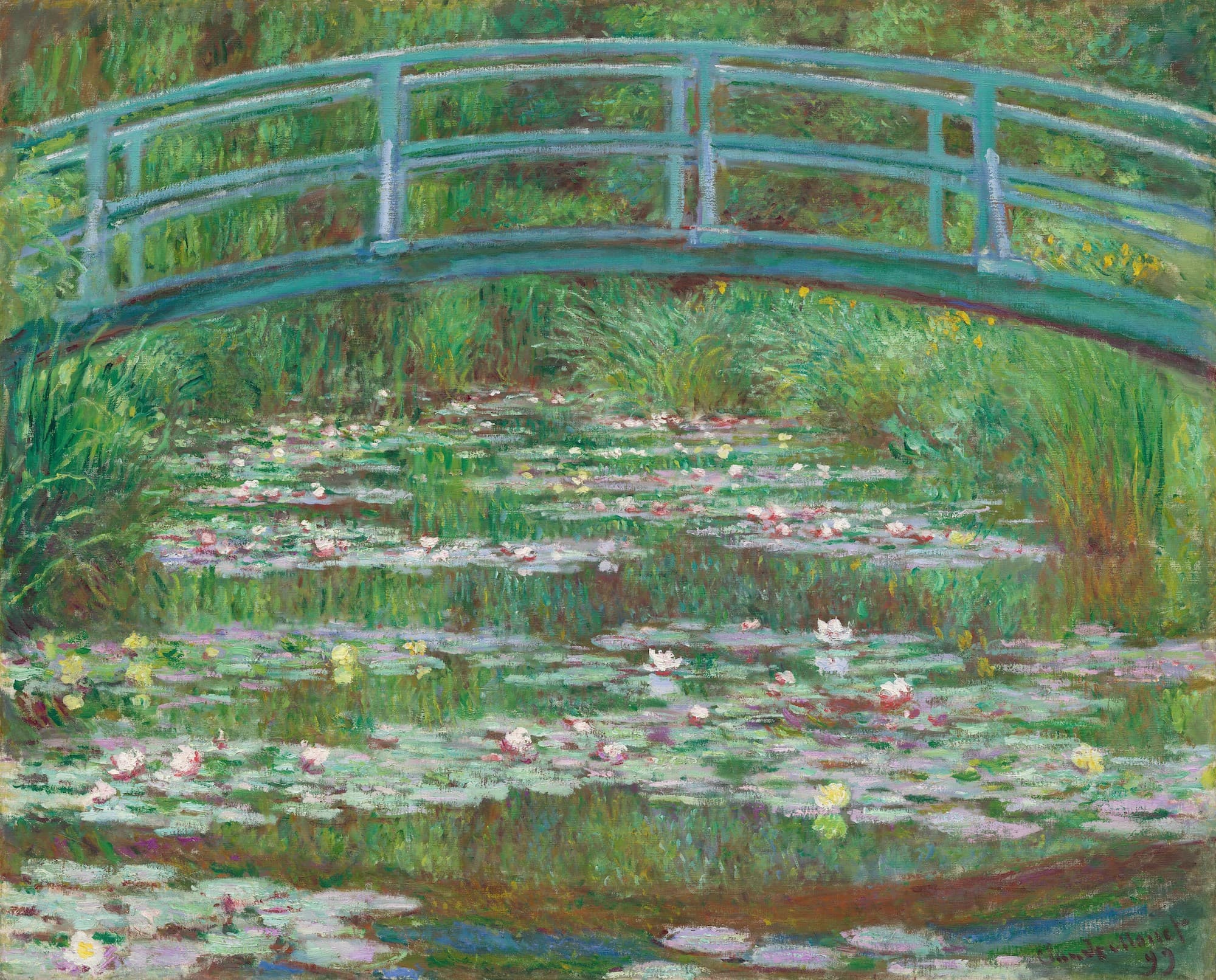
The Japanese Footbridge
Claude Monet · 1899
Weeping Willow
Claude Monet · 1920–22

Water Lilies (MoMA triptych)
Claude Monet · 1914–26

The Scream
Edvard Munch · 1893

Ophelia
John Everett Millais · 1851–52

The Great Wave off Kanagawa
Katsushika Hokusai · c. 1830–32
The Birth of Venus
Sandro Botticelli · c. 1484–1486