Impressionism
Irises by the Pond
Claude Monet, c. 1914–17
Irises by the Pond is a late Claude Monet painting, about two meters tall, of iris leaves and blooms crowding the edge of his water lily pond at Giverny, made around 1914–17. It is in the Virginia Museum of Fine Arts, Richmond.
- Artist
- Claude Monet
- Date
- c. 1914–17
- Medium
- Oil on canvas
- Dimensions
- 199.5 × 150.5 cm
- Collection
- Virginia Museum of Fine Arts, Richmond, United States
- Movement
- Impressionism
- Catalogue
- Wildenstein W 1832
Painted at Giverny: Monet's House and Garden
Irises by the Pond is a large late canvas by Claude Monet showing irises growing at the edge of his water lily pond at Giverny. He painted it around 1914–17, in the years when he was also working on the great water lily decorations. The canvas measures about 199.5 by 150.5 centimeters, is number 1832 in Wildenstein's catalogue, and belongs to the Virginia Museum of Fine Arts in Richmond (accession number 71.8).
What you are looking at
There is no horizon, no sky and no bank in the ordinary sense. Monet stands almost on top of his subject and fills a canvas taller than a person with leaves, flowers and water seen from close range.
Down the right side and across the bottom, the long, blade-shaped leaves of irises spring up and arch over in sweeping strokes of yellow-green, olive and ochre. Some are single strokes more than a hand long, laid with a loaded brush that thins out at the tip just as a leaf does. Among them, the flowers appear as loose clusters of pink, mauve and rose, the largest group at upper right, with a smaller spray drifting toward the center. None is drawn. Each bloom is two or three twisted touches of paint.
At the left, the leaves give way to water. Here the paint turns to blue and violet in long vertical drags, which read as the shadowed surface of the pond or as reflections of the plants on it. Near the top a band of rust-orange and dark green, perhaps overhanging foliage or its reflection, closes off the space, and a single patch of brighter blue opens in it like a window onto reflected sky.
Reproductions of this picture vary a good deal. Older color plates, like the one shown here, push it toward hot violet and orange; the museum's own photograph is greener and cooler, with lilac flowers. In both, the structure is the same: a diagonal surge of leaves from lower right toward upper left, set against a cool field of water.
Where and when was it painted?
The irises grew along the banks of the water garden that Monet had created across the road from his house at Giverny, described on our Giverny page. He had planted irises of several kinds, both in the flower garden in front of the house and around the pond, where their spiky leaves set off the flat pads of the water lilies.
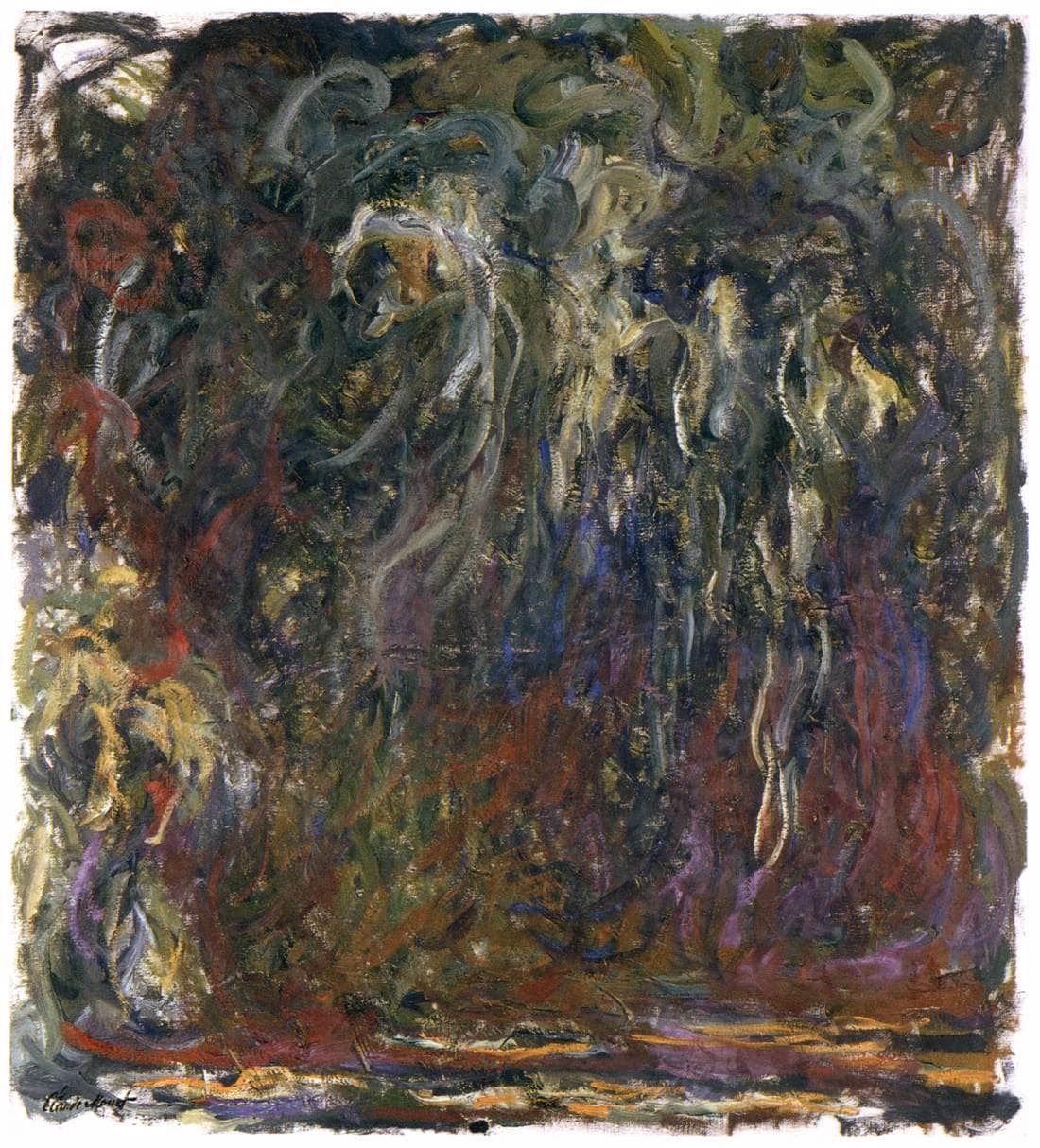
From about 1914, after a period of grief and failing eyesight, Monet threw himself into a vast project: a cycle of mural-sized water lily paintings. In 1915 he built a huge new studio to house them. Alongside the Water Lilies themselves he painted dozens of large canvases of the pond's edges, with irises, agapanthus, wisteria and weeping willows, each a single plant enlarged to wall scale. This painting belongs to that campaign.
How was it painted?
The brushwork is fast, thick and physical. Monet used large brushes and worked with long, decisive movements, often wet into wet, so the strokes drag through one another and leave ridges of paint. Up close the image nearly disappears into marks of color; from across a room the plants reassemble.
His eyesight is part of the story. Monet had been diagnosed with cataracts in 1912, and over the following decade his color grew stronger and less naturalistic, with heavy blues and violets set against hot yellows, oranges and reds. Our page on how Monet painted traces that change. Whether this canvas is a study, a fragment of a larger plan or a finished work in its own right is not certain; like most of the late pond paintings, it was never exhibited in his lifetime.
How does it relate to Monet's other irises?
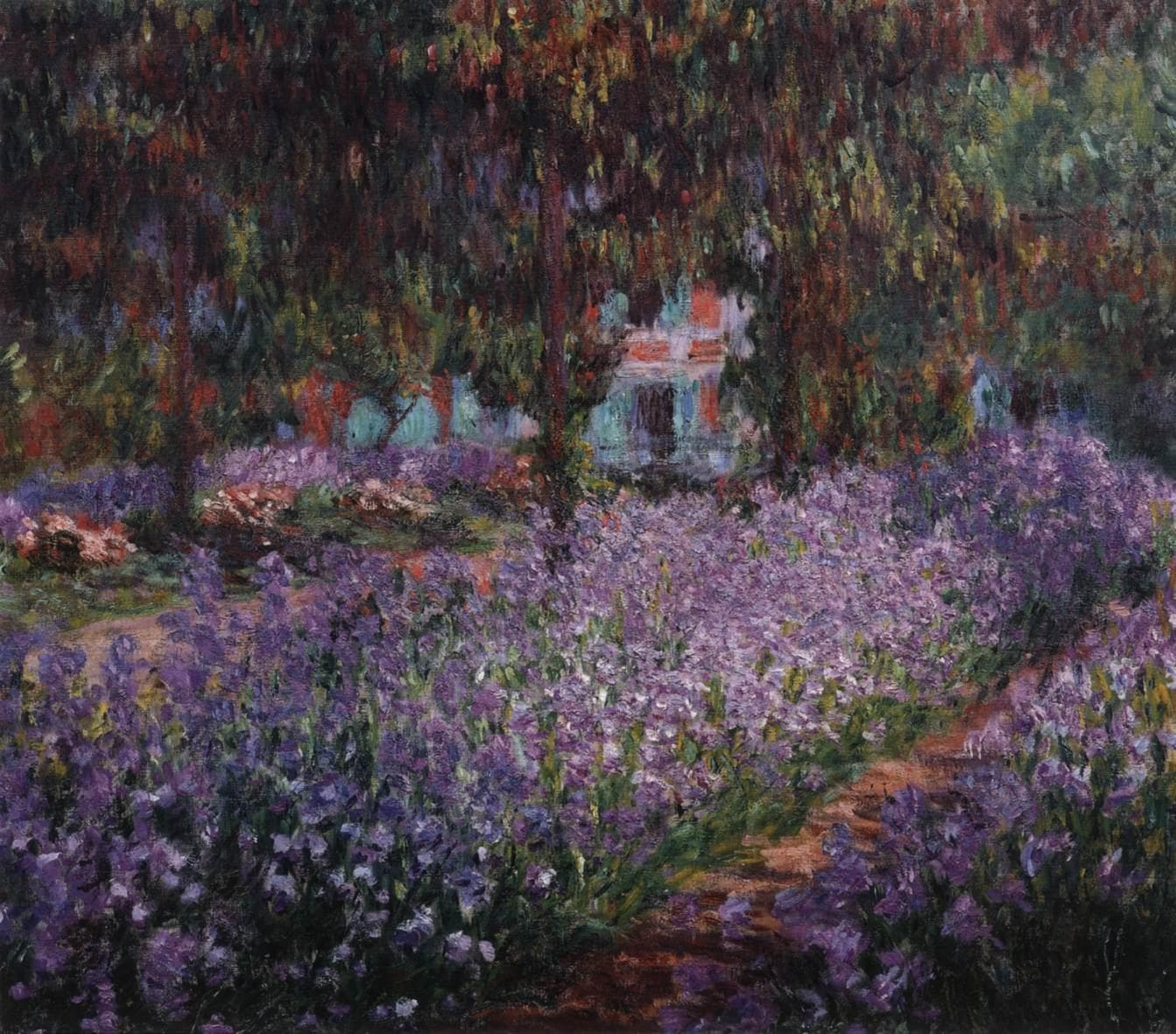
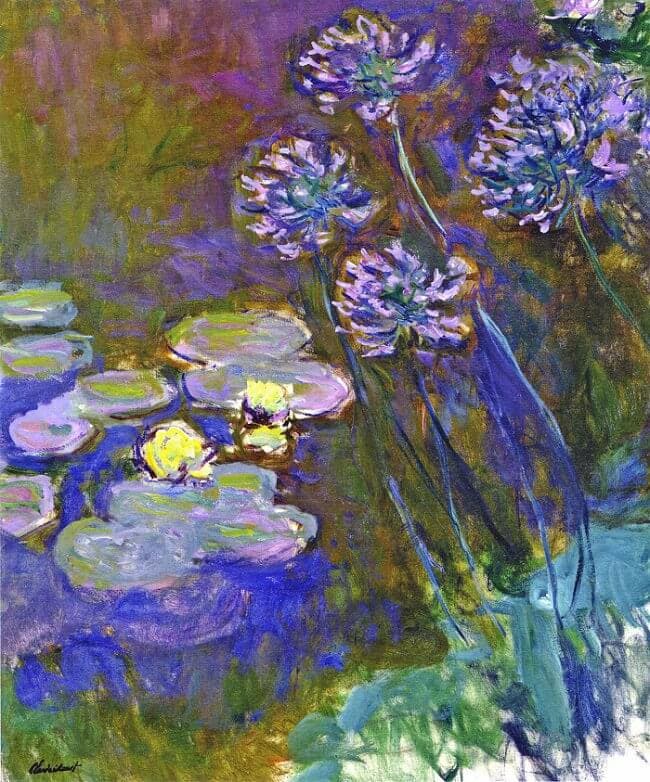
Irises run through Monet's work at Giverny. The early Field of Yellow Irises at Giverny of 1887 shows them as a band of color in an open landscape, and The Artist's Garden at Giverny of 1900, in the Musée d'Orsay, floods the flower garden with violet blooms. In the late canvases the scale changes completely, and the viewer is pushed into the plants. The closest relatives of this picture are the other iris canvases of about 1914–17, of similar size, including one in the National Gallery in London, and the late Agapanthus.
These pictures stayed in the Giverny studio after Monet's death in 1926. When they began to reach museums in the 1950s, critics saw in their scale and freedom a link to the large abstract canvases of American painters of that decade.
Where can you see it?
Irises by the Pond is in the Virginia Museum of Fine Arts in Richmond, Virginia. For other collections with late Giverny paintings, see our guide to where to see Monet's paintings.
Questions & answers
Where is Monet's Irises by the Pond?
It is in the Virginia Museum of Fine Arts in Richmond, Virginia, accession number 71.8. The canvas is about 199.5 by 150.5 centimeters, taller than most visitors, and shows irises growing at the edge of Monet's water lily pond at Giverny. Similar large late iris canvases are in other museums, including the National Gallery in London.
When did Monet paint Irises by the Pond?
He painted it at Giverny around 1914–17, while working on his monumental water lily decorations, many of them now in the Musée de l'Orangerie in Paris. In 1915 he built a vast new studio for that project, and he painted large canvases of the pond's irises, agapanthus and willows alongside the water lilies. It was not exhibited in his lifetime.
What does Irises by the Pond show?
It shows a close-up of iris plants on the bank of the water garden: long yellow-green leaves arching across the lower right, pink and mauve blooms in loose clusters, and the blue and violet surface of the pond at left. There is no horizon or sky. Monet enlarges a small corner of his garden to wall scale.
Did Monet paint other versions of his late Irises?
Yes. Around 1914–17 Monet painted a group of large iris canvases at the edge of his pond, close in size and handling to this one, alongside related pictures of agapanthus, wisteria and weeping willows. One of the best known is in the National Gallery in London. Earlier, smaller iris paintings of 1887 and 1900 show the flowers within a recognizable garden view.
More by the artist
Claude Monet

Bridge over a Pond of Water Lilies
Claude Monet · 1899

Woman with a Parasol – Madame Monet and Her Son
Claude Monet · 1875

Sunset in Venice
Claude Monet · 1908–12

La Grenouillère
Claude Monet · 1869

Beach in Pourville
Claude Monet · 1882

Springtime
Claude Monet · 1872

Boating on the River Epte
Claude Monet · 1890

The Seine at Asnières (Hermitage)
Claude Monet · 1873
Also painted in 1915
The same year
Kindred works
You may also study
Irises in Monet's Garden at Giverny
Claude Monet · 1900

Field of Yellow Irises at Giverny
Claude Monet · 1887
Water Lilies and Agapanthus
Claude Monet · 1914–17
Weeping Willow
Claude Monet · 1920–22
Water Lilies (1919, Metropolitan Museum)
Claude Monet · 1919
Irises (Vase with Irises Against a Yellow Background)
Vincent van Gogh · 1890

The Scream
Edvard Munch · 1893

Ophelia
John Everett Millais · 1851–52