Image: Sotheby's, New York, 12 November 2018, lot 37 · Public domain · via Wikimedia Commons
Charing Cross Bridge (private collection, c. 1900)
Claude Monet, c. 1899–1901
Charing Cross Bridge (c. 1899–1901) is a sea-green and coral view of the Thames by Claude Monet, the bridge barely visible as the sun sets its reflections ablaze on the water. It is in a private collection and was sold at Sotheby's New York in 2018.
- Artist
- Claude Monet
- Date
- c. 1899–1901
- Medium
- Oil on canvas
- Dimensions
- 65 × 81 cm
- Collection
- Private collection
- Movement
- Impressionism
- Catalogue
- Wildenstein 1550
- The City
- Water & Sea
This Charing Cross Bridge is one of the most dissolved canvases Claude Monet painted of the London railway bridge. Begun around 1900 at the Savoy Hotel, it shows a thick green-gray fog in which the bridge is little more than a pale horizontal, while streaks of coral and orange light spread across the river below. It is in a private collection; its image on Wikimedia Commons comes from a sale at Sotheby's New York on 12 November 2018.
What you are looking at
The canvas is about 65 by 81 cm, and its whole surface is a soft, fog-green field. The bridge runs across the upper third as a slightly paler band. Its piers appear only as two lit blocks beneath the deck: on the left a rectangle of orange and pink, on the right a cluster of vertical green and red strokes, as if the sun were shining through the gaps between the piers.
The river takes up most of the picture, and here Monet concentrated his color. Long horizontal streaks of coral, salmon and orange are laid over green and blue, broken into short dashes that ripple downward toward the viewer. In the lower left a group of rounded, pale blue-gray shapes, perhaps puffs of smoke from a tug or reflections of steam, floats on the water. There are no Parliament towers, no boats with figures, no foliage. The picture is almost entirely about colored light in fog.
Where and when it was painted
Monet painted from the Savoy Hotel during his three London campaigns, in autumn 1899 and in early 1900 and 1901. The view upriver showed the Hungerford railway bridge, known as Charing Cross Bridge; downriver was Waterloo Bridge. He went to London precisely for its fogs, which he described as giving the city its "breadth", and his letters to Alice record days when the sun turned the fog red, orange or green. Our Monet in London hub follows the campaigns.
Wikidata dates the canvas to about 1900, with a range of 1899–1901.
How it was painted
The handling is loose and layered. Monet seems to have laid down an overall green-gray, then brushed horizontal strokes of warm color into it while the paint was still soft, so that the coral streaks blend at their edges. The bridge is reserved rather than drawn, a strip left slightly lighter than the fog around it. This is one of the least finished-looking canvases in the series, and it may have remained in a working state, though it is fully developed in color.
Sunset in the fog
The warm reflections under a green fog suggest late afternoon or sunset, when the low winter sun stood west over the river beyond the bridge and lit it from behind. Compare the Art Institute of Chicago canvas, which Durand-Ruel recorded as soleil couchant (sunset), where the sun is a yellow glow at upper right, or the green-gold Murauchi Art Museum version. Here the effect is pushed further: the bridge and skyline have gone, and only the light on the water remains.
How this version differs
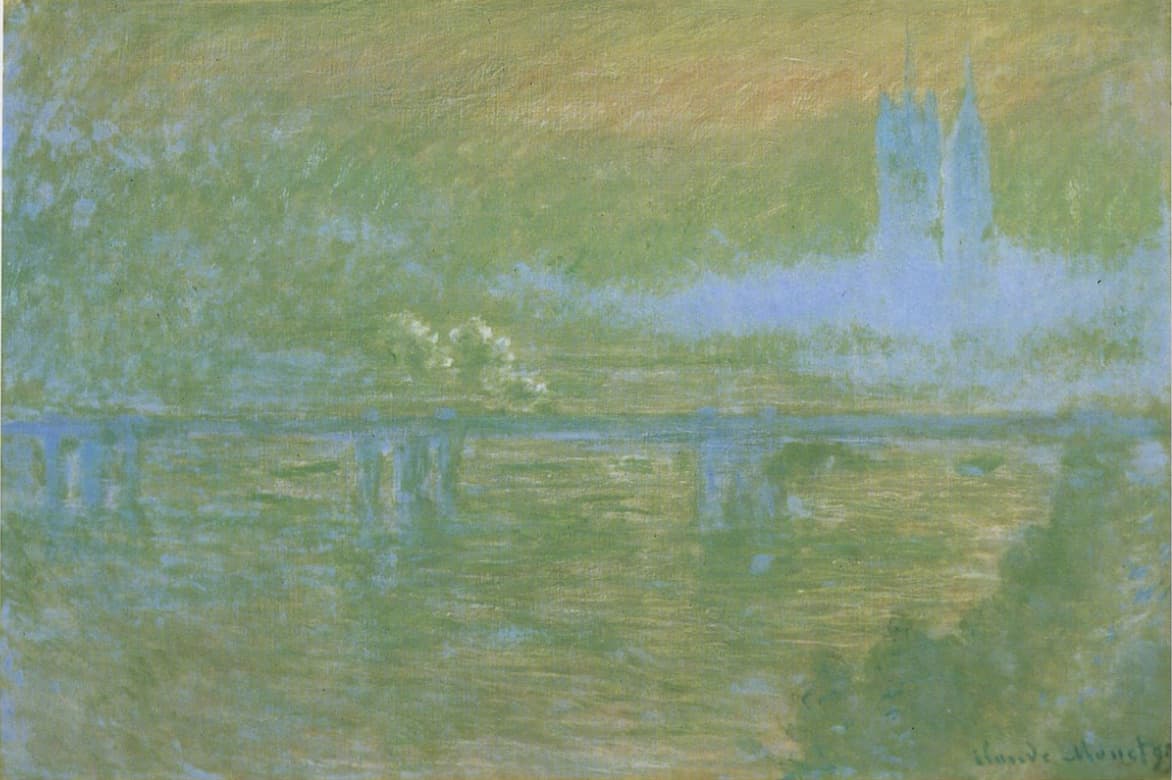
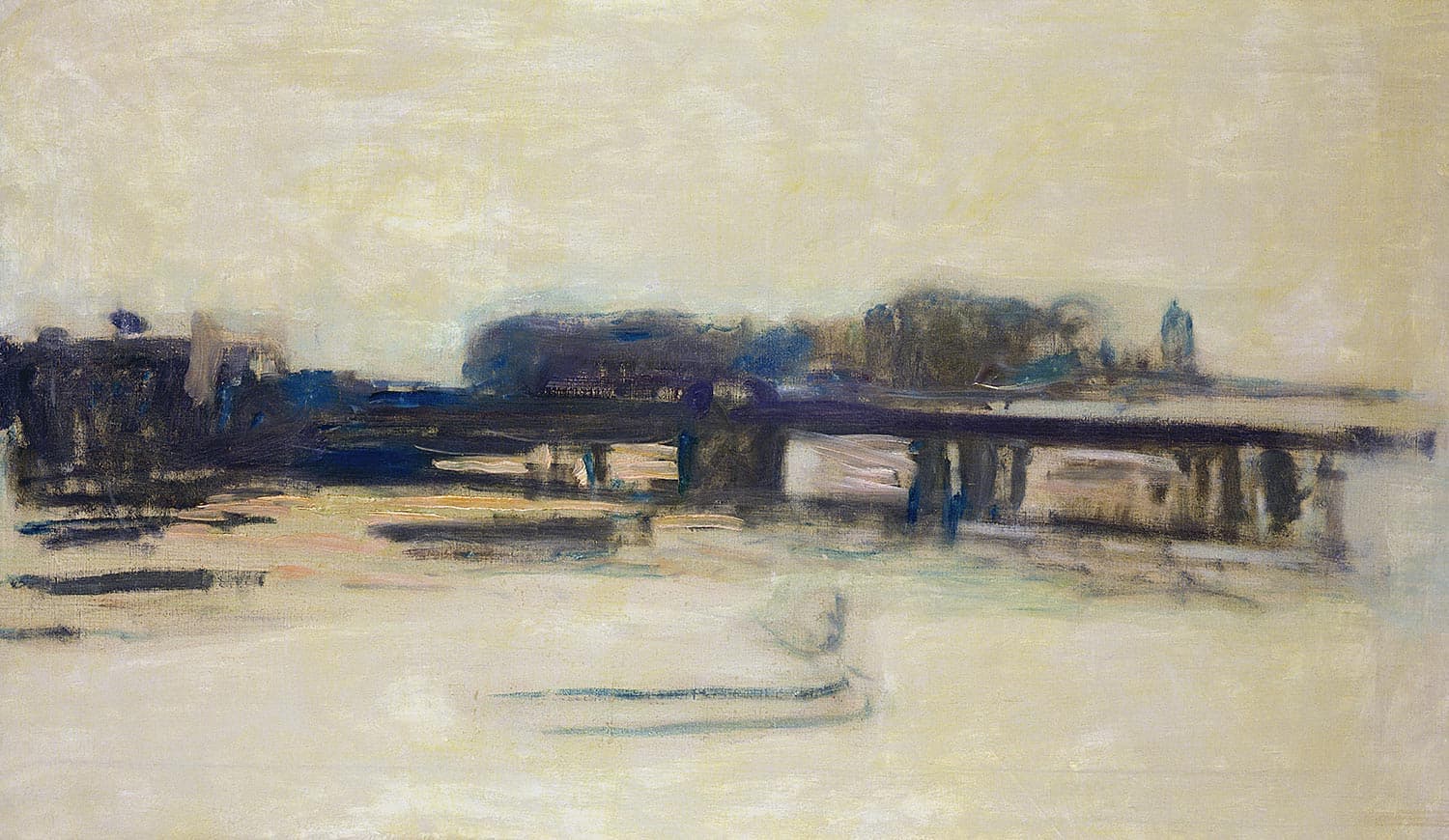
Most Charing Cross canvases keep the towers of Westminster as an anchor at upper right. This one leaves them out entirely, which gives it an abstract quality closer to Monet's late water lilies than to the topographical pictures of the series. It pairs naturally with the dark, unfinished Marmottan study as evidence of how differently Monet could start the same motif. See all versions on our Charing Cross Bridge series page.
Reading an unsigned surface
No signature is visible in the reproduction, which fits a canvas Monet may have kept in a working state rather than sending to his dealer. Many such pictures surfaced only after his death, and their dating relies on comparison with the signed works. Here the color, close to the late-day canvases, and the format, the standard 65 by 81 cm used for many 1899–1900 pictures, both support the date of about 1900.
Where to see it
The painting is in a private collection and is not on public view. Its appearance at Sotheby's New York in November 2018 is the most recent public record. For Charing Cross canvases you can visit, see the museum versions listed in our series page, or where to see Monet's paintings.
Questions & answers
Where is this Charing Cross Bridge by Monet?
It is in a private collection and not on public view. The image on Wikimedia Commons comes from its sale at Sotheby's New York on 12 November 2018. Other versions of the motif can be seen in museums in Chicago, Boston, Paris and elsewhere.
When was it painted?
Around 1900, during Monet's London campaigns of 1899–1901, when he painted the Thames from his room at the Savoy Hotel.
What does the painting show?
Charing Cross railway bridge almost dissolved in a green-gray fog, with coral and orange light reflected in long streaks on the river. Unusually, the towers of Westminster are not shown.
What makes this version unusual?
Its near-abstraction. The bridge is only a pale band, there are no Parliament towers or figures, and the picture is given over almost entirely to colored light on the water, anticipating the freedom of Monet's late work.
More by the artist
Claude Monet
The Water Lily Pond
Claude Monet · 1900
Charing Cross Bridge (Overcast Day)
Claude Monet · 1900
Charing Cross Bridge, Reflections on the Thames
Claude Monet · c. 1900
Charing Cross Bridge
Claude Monet · 1899
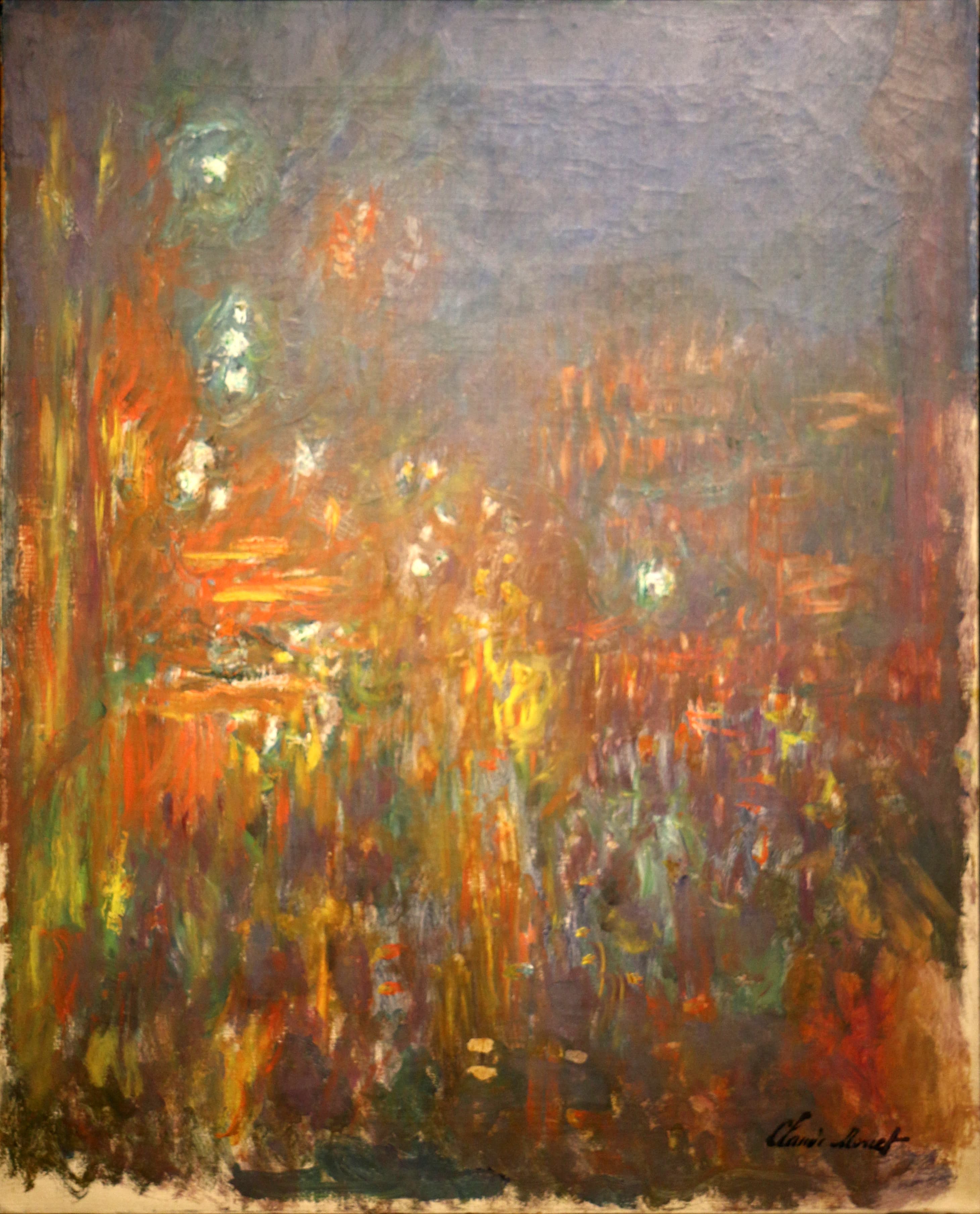
Leicester Square, by Night
Claude Monet · 1901
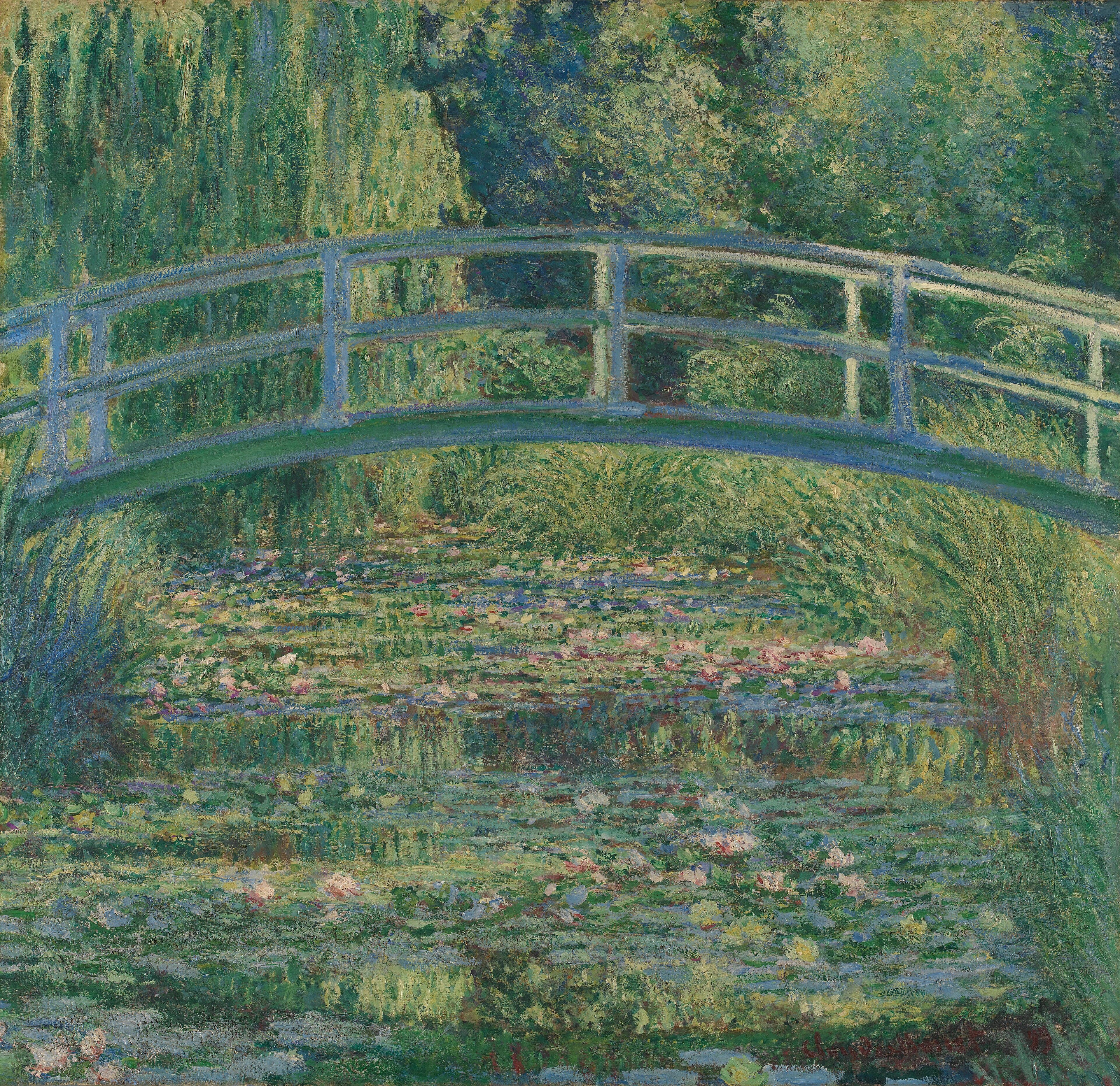
The Water-Lily Pond (National Gallery, London)
Claude Monet · 1899
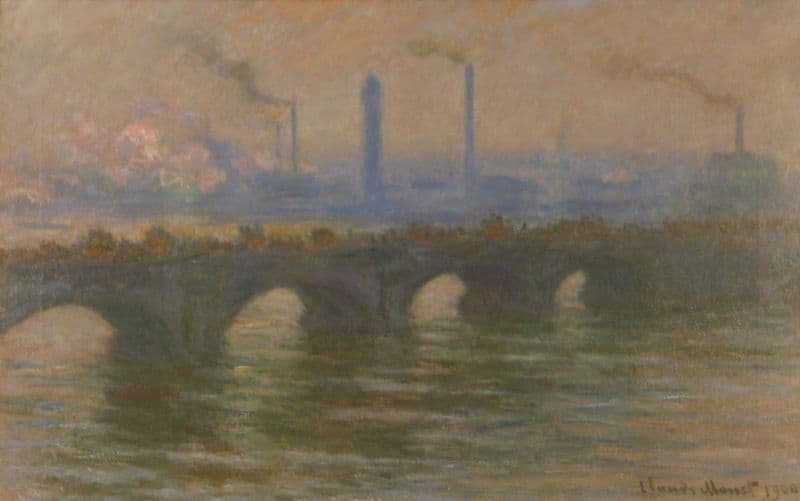
Waterloo Bridge, Overcast Weather
Claude Monet · 1900

Bridge over a Pond of Water Lilies
Claude Monet · 1899
Also painted in 1900
The same year
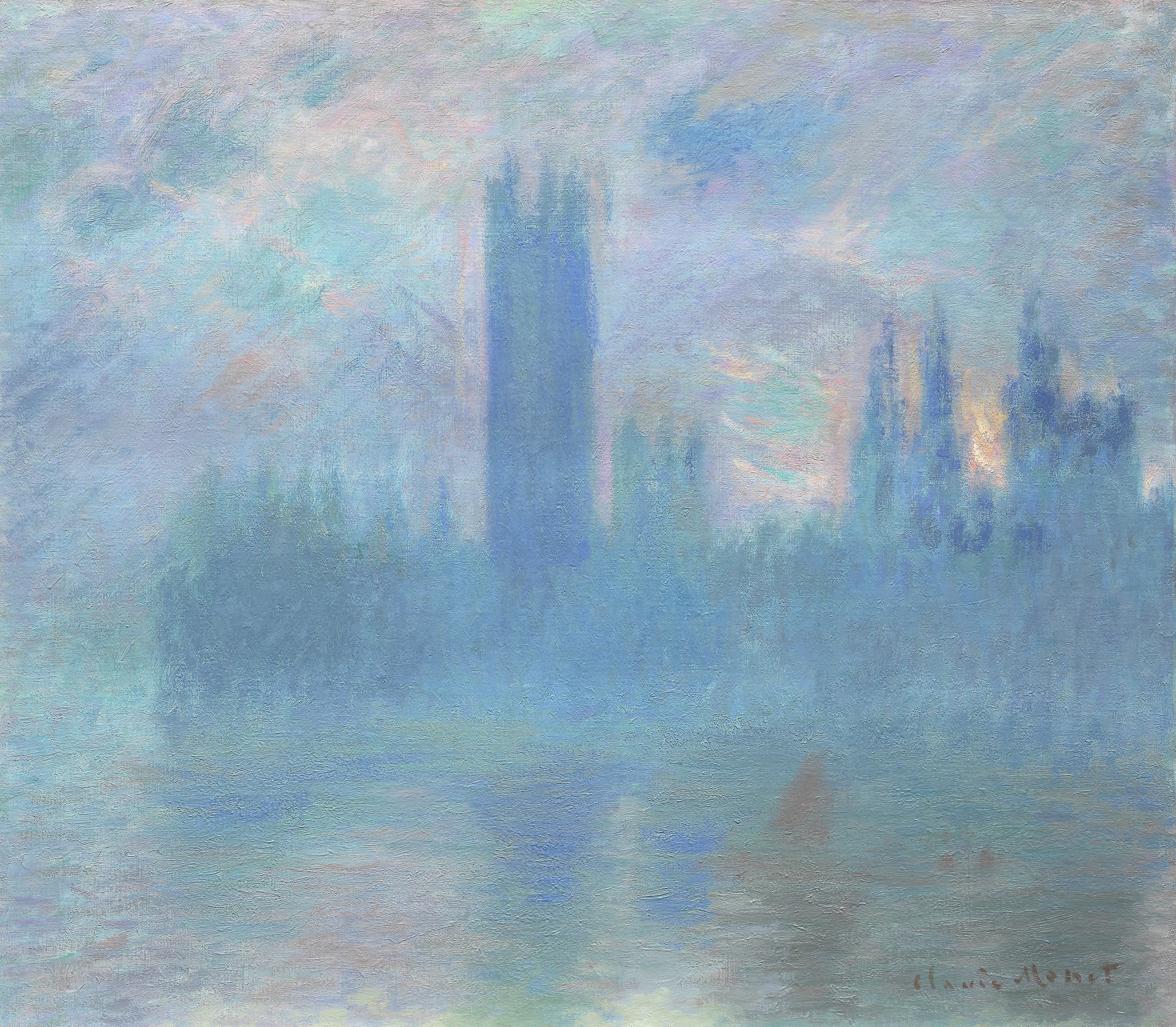
Houses of Parliament, London
Claude Monet · 1900–01
Houses of Parliament, Symphony in Rose
Claude Monet · 1900
The Japanese Bridge or The Lily Pond
Claude Monet · 1900
Waterloo Bridge, London, Sun Effect
Claude Monet · 1899–1901
Waterloo Bridge (Santa Barbara Museum of Art)
Claude Monet · 1900
Waterloo Bridge, Gray Weather
Claude Monet · 1900
Waterloo Bridge, Effect of Sun in the Mist
Claude Monet · c. 1900–03
Waterloo Bridge (Kerry Stokes Collection)
Claude Monet · 1899–1901
Kindred works
You may also study
Charing Cross Bridge, London
Claude Monet · 1901
Charing Cross Bridge
Claude Monet · c. 1899
Charing Cross Bridge, London (Marmottan study)
Claude Monet · c. 1899–1901
Charing Cross Bridge, Smoke in the Fog, Impression
Claude Monet · 1902
Waterloo Bridge, Effect of Fog
Claude Monet · 1903
Houses of Parliament, Sunset
Claude Monet · 1903
Waterloo Bridge, Sunlight Effect
Claude Monet · 1903
Palazzo Contarini
Claude Monet · 1908