Series
Monet's Waterloo Bridge: 41 Views of the Thames in Fog
From a room at the Savoy Hotel, Monet painted the same granite bridge again and again as London's smoke turned it blue, mauve and gold.
Monet's Waterloo Bridge is a series of 41 paintings of the old Waterloo Bridge over the Thames in London, painted from his room at the Savoy Hotel during winter stays in 1899, 1900 and 1901 and finished in his studio at Giverny, with dates running from 1900 to 1904. It is the largest of his three London series, alongside the Houses of Parliament and Charing Cross Bridge.
The canvases are now widely scattered. Examples are in the State Hermitage Museum in Saint Petersburg (Waterloo Bridge, Effect of Fog), the National Gallery of Art in Washington (two), the National Gallery of Canada in Ottawa, the Hugh Lane Gallery in Dublin, the National Museum of Western Art in Tokyo, the Denver Art Museum, the Santa Barbara Museum of Art, the Ordrupgaard collection near Copenhagen, the Memorial Art Gallery in Rochester and the McMaster Museum of Art in Hamilton, Ontario.
The complete set
All 29 known canvases
From the catalogue raisonné. Works with a full close reading are marked ✦.
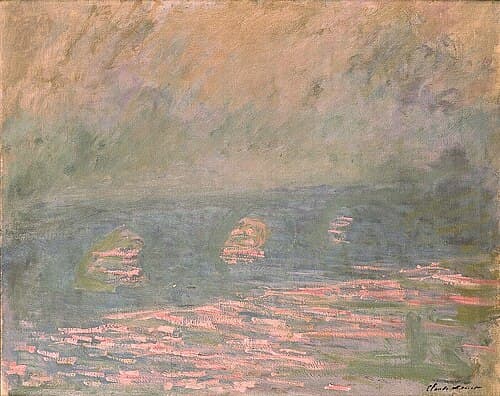
Waterloo Bridge
1899 · Matsushita Museum of Art
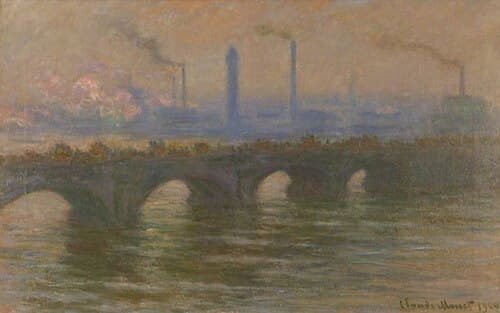
Waterloo Bridge, overcast weather
1900 · Hugh Lane Gallery
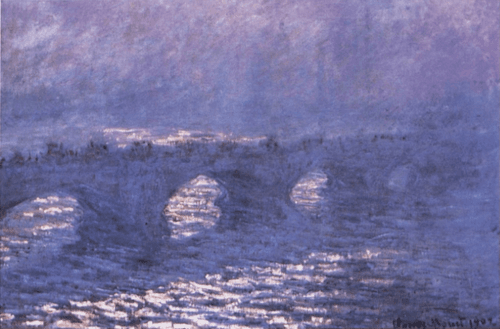
Le pont de Waterloo, effet de soleil dans la brume
1900 · Contemporary Art Museum of Caracas
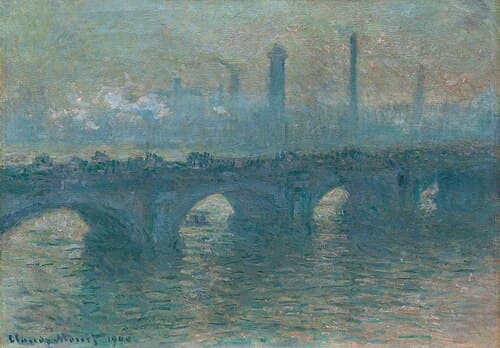
Waterloo Bridge, Gray Weather
1900 · Art Institute of Chicago
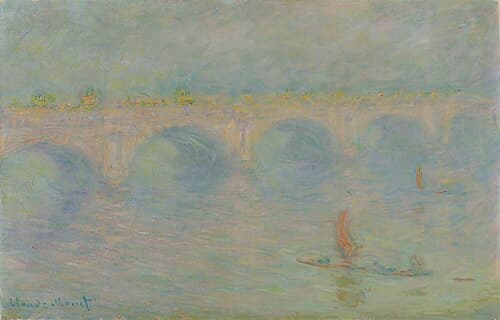
Waterloo Bridge, London, Sun Effect
1900 · Foundation E.G. Bührle Collection
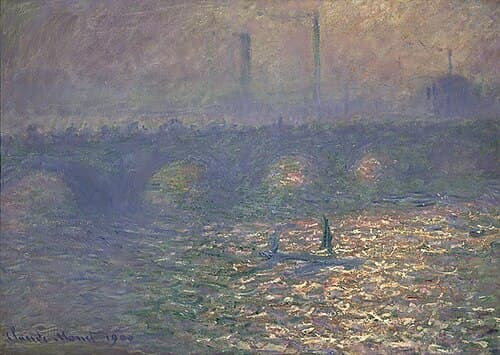
Waterloo Bridge
1900 · Santa Barbara Museum of Art
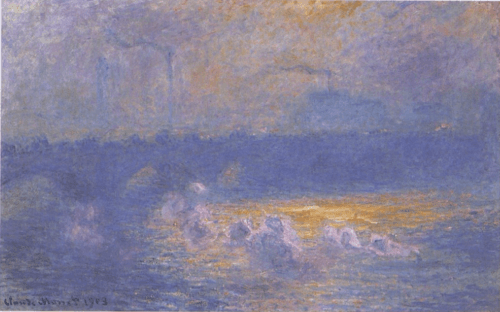
Waterloo bridge in the sun with smoke
1900 · Baltimore Museum of Art
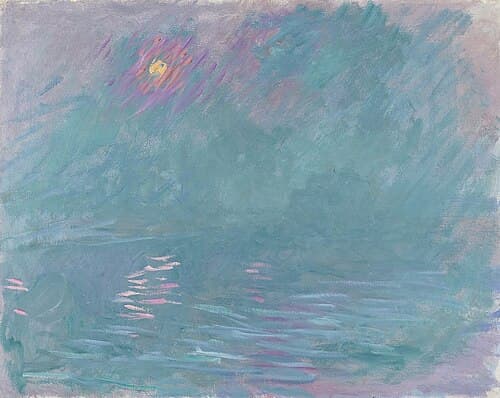
Waterloo Bridge
1900 · Kerry Stokes Collection
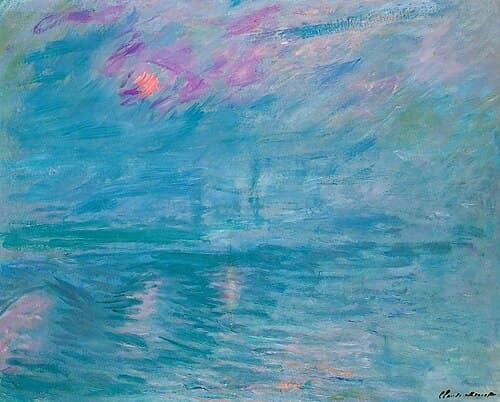
Waterloo Bridge
1901 · Davis Museum and Cultural Center
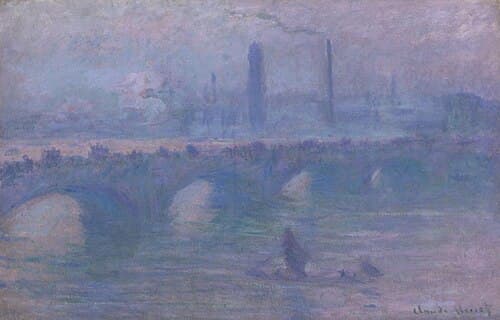
Waterloo Bridge, Morning Fog
1901 · Philadelphia Museum of Art
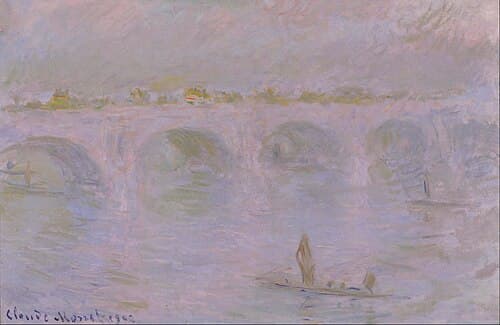
Waterloo Bridge in London
1902 · National Museum of Western Art
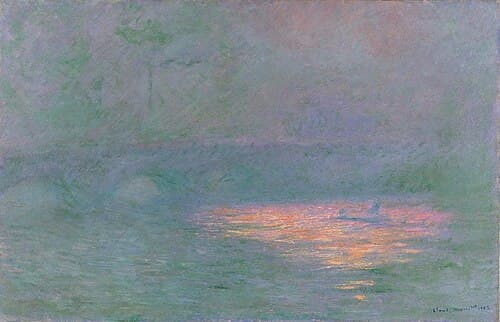
Le Pont de Waterloo
1902 · Kunsthaus Zürich
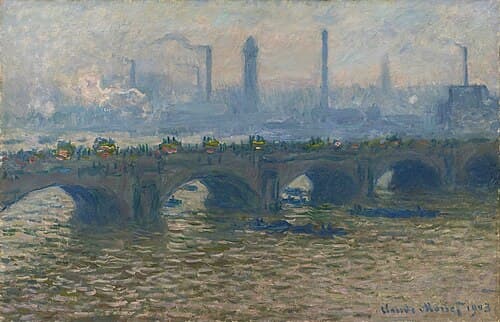
Waterloo Bridge, Gray Day
1903 · Museum Ordrupgaard
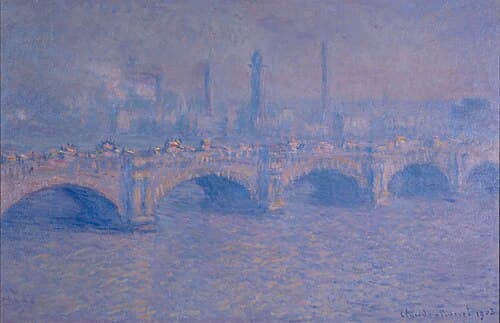
Waterloo Bridge, Sunlight Effect
1903 · McMaster Museum of Art
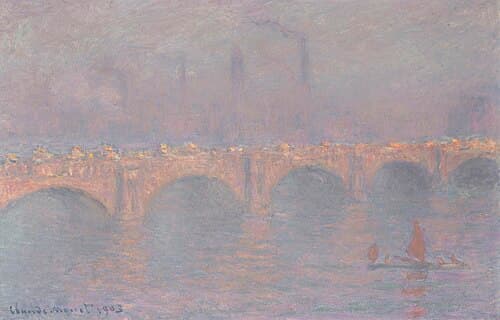
Waterloo Bridge, Hazy Sun
1903 · Paul G. Allen Collection
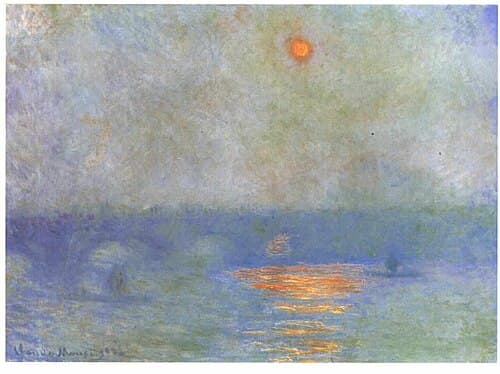
Waterloo Bridge: the Sun in a Fog
1903 · National Gallery of Canada
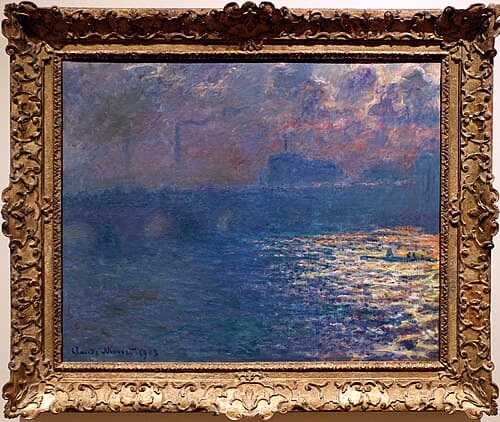
Waterloo Bridge, Sunlight Effect
1903 · Milwaukee Art Museum
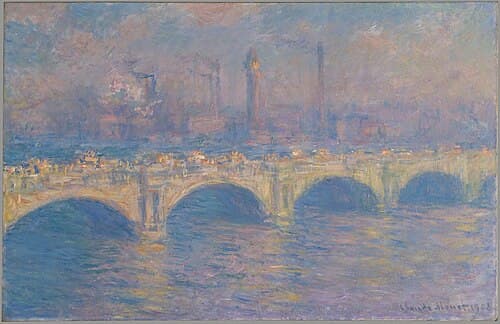
Waterloo Bridge, London
1903 · Carnegie Museum of Art
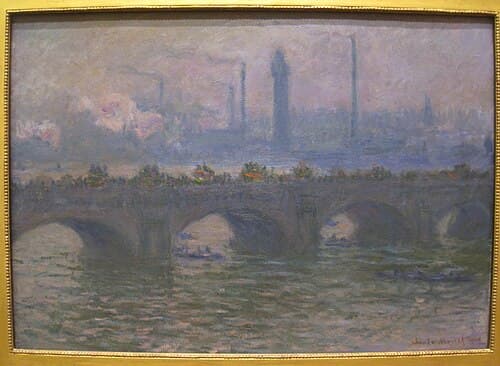
Waterloo Bridge
1903 · Worcester Art Museum
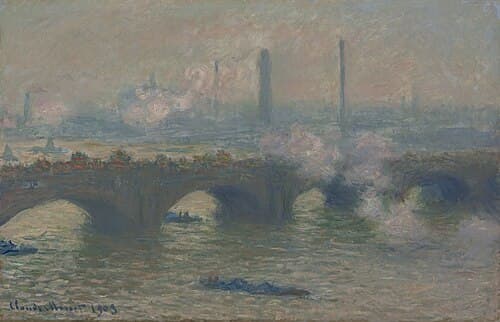
Waterloo Bridge, Gray Day
1903 · National Gallery of Art
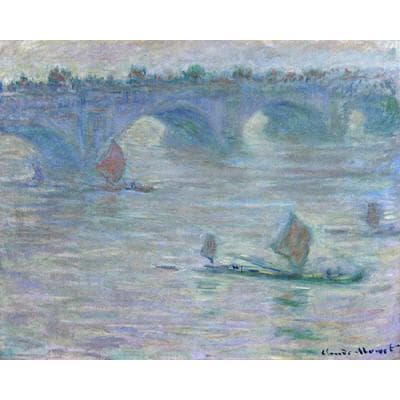
Le pont de Waterloo
1903 · Lowe Art Museum
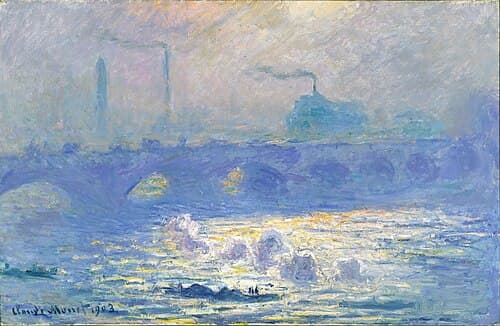
Waterloo Bridge, Sunlight Effect
1903 · Denver Art Museum
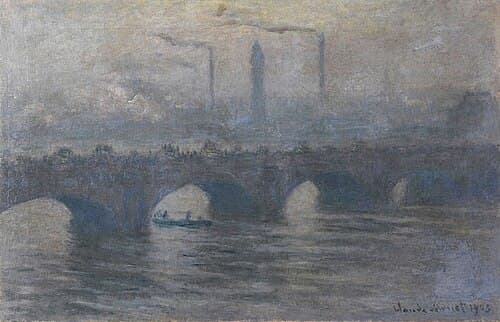
Waterloo Bridge
1903 · Kunstmuseum Bern
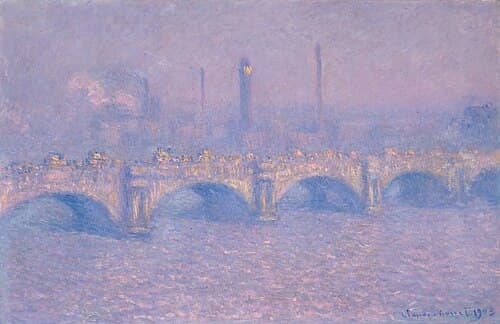
Waterloo Bridge, Veiled Sun
1903 · Memorial Art Gallery
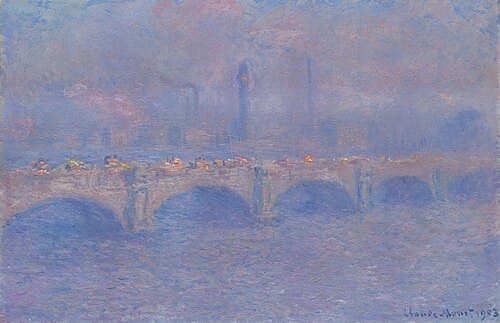
Waterloo Bridge, Sunlight Effect
1903 · Art Institute of Chicago
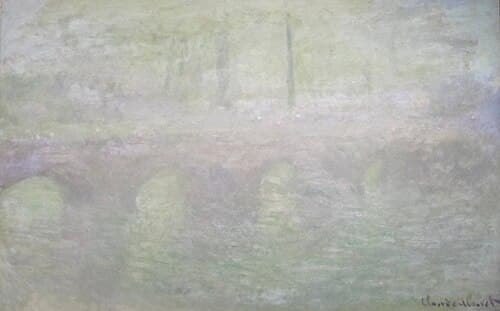
Waterloo Bridge, London, at Dusk
1904 · National Gallery of Art
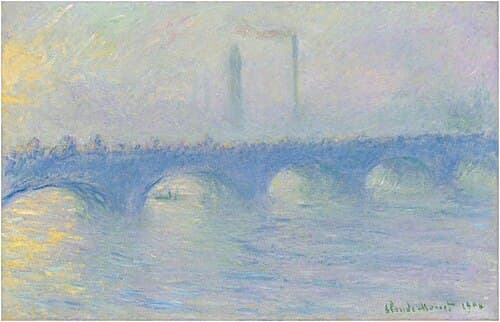
Waterloo Bridge, effet de brume
1904
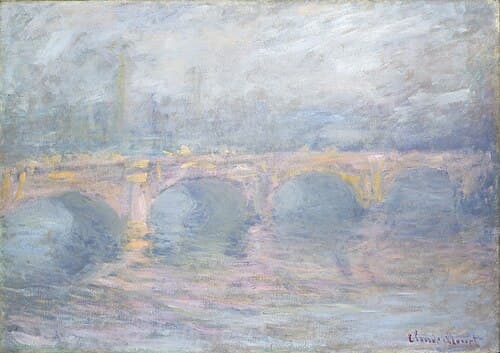
Waterloo Bridge, London, at Sunset
1904 · National Gallery of Art
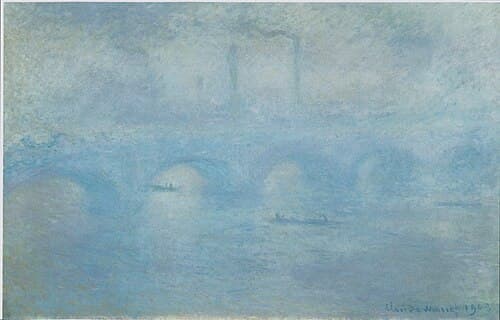
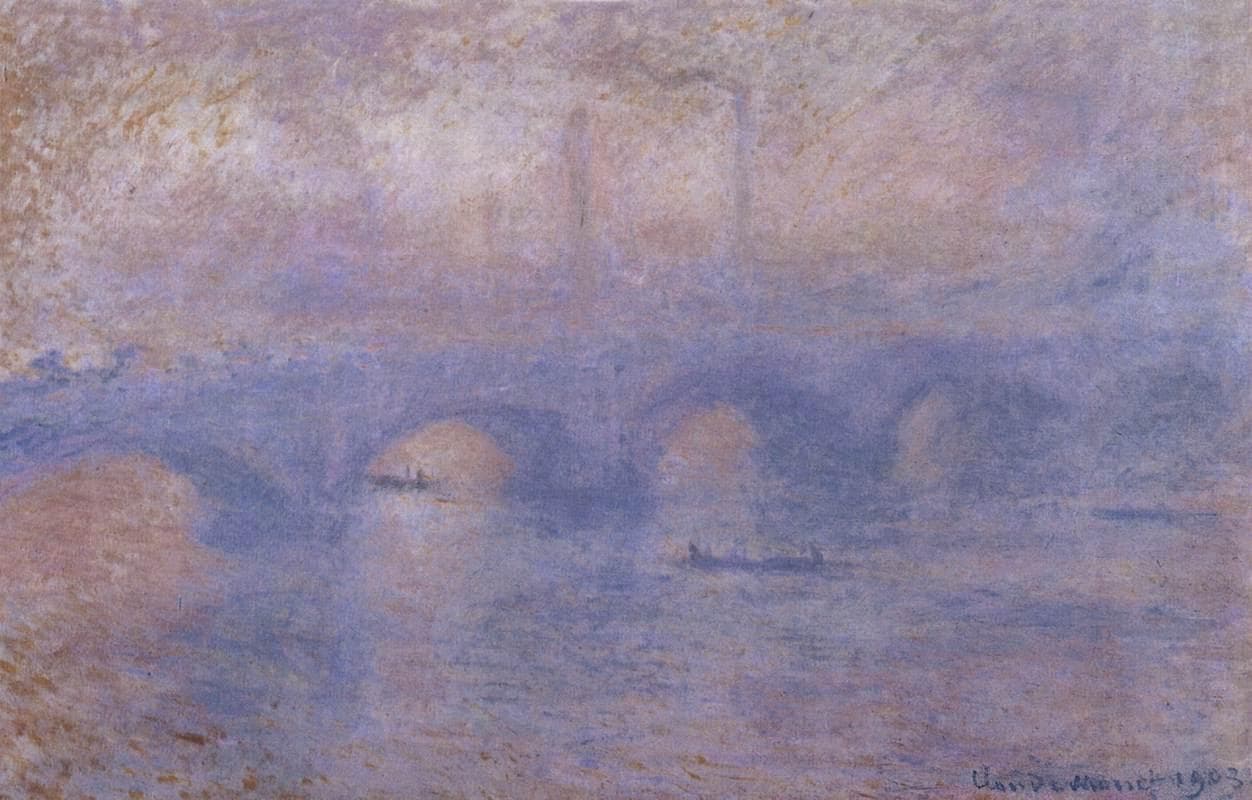
✦Waterloo Bridge. Effect of Fog
Hermitage Museum
What the Waterloo Bridge paintings show
The bridge Monet painted no longer exists. Designed by John Rennie and opened in 1817, the old Waterloo Bridge was a long, low granite bridge of nine arches, much admired in its day. It was demolished in the 1930s and replaced by the present concrete bridge, completed in the 1940s.
In Monet's pictures it runs across the canvas as a dark band of arches, seen downstream from the Savoy Hotel on the north bank. Beyond it the south bank, then crowded with wharves and factories, is reduced to a pale line of buildings and the vertical strokes of chimneys sending up smoke. Traffic crosses the top of the bridge as a flicker of small marks: carts, omnibuses, pedestrians. Below, the river catches whatever light the sky allows. Barges and tugs sometimes appear as dark notes on the water.
There is no detail to speak of. In many canvases the bridge is a silhouette only a little darker than the fog, and the far bank is barely there. The subject is the atmosphere: the London "pea-souper," thick with coal smoke, which Monet loved and which colored the light in ways he never saw in France.
Why Monet painted Waterloo Bridge
Monet first knew London in 1870–71 as a refugee from the Franco-Prussian War. He came back in the autumn of 1899, partly to see his son Michel, and took rooms at the Savoy, a new luxury hotel on the Embankment. From his window and balcony he could look east, downstream, to Waterloo Bridge, and west, upstream, to Charing Cross railway bridge and the Houses of Parliament beyond. He returned in February 1900 and again in 1901.
For Monet, London's fog was what made the city paintable. He wrote to his wife Alice about mornings when the fog was so thick he could see nothing, and others when the sun broke through for minutes and he scrambled for the right canvas. His letters swing between delight at a good day and despair when the light changed before he could catch it.
How the versions differ
- Fog and veiled sun: the bridge and bank dissolve into pink and lilac, as in the Hermitage's Effect of Fog. The sun may appear as a pale disk.
- Gray days: cool blue-grays and greens, the arches more legible, the river dull silver.
- Sunlight through fog: a band of light falls across the water and the bridge glows at its edges.
- Twilight: the sky and river turn orange, red and violet, and the bridge becomes a dark cut-out against them.
- Cloudy weather: brownish grays and broken skies.
The titles the museums use read like a weather diary: Gray Day, Sun Through Fog, Veiled Sun, Cloudy Weather, Twilight, Sun. The composition stays fixed; the time and atmosphere change.
A closer look: Effect of Fog
In the Hermitage canvas of 1903 the bridge is not drawn at all. Its arches are suggested by a row of slightly darker violet loops across the middle of the picture, and the parapet by a single soft line. Above it, the sky is a rose-colored veil; below, the river repeats the rose in broken horizontal strokes, with a few small boats as darker accents on the water. The chimneys of the south bank are ghostly verticals in the distance. Stand back and the picture resolves into a bridge in fog; step close and it is a field of interwoven pinks and blues with almost no contrast at all.
How Monet worked
Monet arrived in London with a supply of canvases and soon ran short; at one point he had dozens of pictures in progress in his hotel room, each kept for a particular effect. He worked in sessions as short as a few minutes, switching canvases when the light shifted. Many he took back to Giverny unfinished.
There, from 1901 until 1904, he reworked them as a group, sometimes without the motif in front of him. The paint is built up in many thin and thick layers, dragged and dabbed so that colors show through one another. This is what gives the fog its density: up close it is not gray at all but a mesh of pinks, blues, yellows and greens.
Exhibition and sale
In May 1904 Durand-Ruel exhibited 37 of the London canvases at his Paris gallery, including several Waterloo Bridges. The show was a success, and many of the pictures were sold to collectors in the United States and elsewhere, which is why the series is now spread across three continents.
One version had a dramatic later history. In October 2012 a Waterloo Bridge, London of 1901 was stolen, with a Charing Cross Bridge and other works, from the Kunsthal in Rotterdam, where it was on loan from a private foundation. The mother of one of the thieves later claimed to have burned the stolen paintings, and the Monets have not been recovered.
Waterloo Bridge in Monet's work
The series belongs to the line of works that runs from the Haystacks and Rouen Cathedral to the Water Lilies: one viewpoint, many canvases, the subject being light and air rather than the thing. London added something new, an urban, industrial atmosphere, and it pushed Monet further toward pictures in which forms all but disappear. It also connected him with the English painters he admired, above all Turner, and with Whistler, whose Thames Nocturnes had shown the river as a few tones in the dark.
Where to see Monet's Waterloo Bridge paintings
Versions are in the State Hermitage Museum, Saint Petersburg; the National Gallery of Art, Washington (Gray Day and Twilight); the National Gallery of Canada, Ottawa; the Hugh Lane Gallery, Dublin; the National Museum of Western Art, Tokyo; the Denver Art Museum; the Santa Barbara Museum of Art; the Ordrupgaard, Charlottenlund; the Memorial Art Gallery, Rochester; the McMaster Museum of Art, Hamilton; and private collections.
For the other London series, see Charing Cross Bridge and Houses of Parliament, and for his time in the city, Monet in London. For more museums, see Where to See Monet's Paintings; for the painter, Claude Monet.
Questions & answers
How many Waterloo Bridge paintings did Monet make?
Monet painted 41 views of Waterloo Bridge in London, his largest London series. He worked on them from the Savoy Hotel during stays in 1899, 1900 and 1901 and finished them at Giverny; they are dated between 1900 and 1904.
Where did Monet paint Waterloo Bridge from?
From his room and balcony at the Savoy Hotel on the Victoria Embankment, looking east, downstream, along the Thames. From the same hotel he painted Charing Cross Bridge, looking the other way.
Where are Monet's Waterloo Bridge paintings?
Examples are in the Hermitage in Saint Petersburg, the National Gallery of Art in Washington, the National Gallery of Canada, the Hugh Lane Gallery in Dublin, the National Museum of Western Art in Tokyo, the Denver Art Museum, the Santa Barbara Museum of Art and other museums and private collections.
Is the Waterloo Bridge Monet painted still there?
No. Monet painted John Rennie's granite bridge of 1817. It was demolished in the 1930s and replaced by the current Waterloo Bridge, completed in the 1940s. The Savoy Hotel, where Monet stayed, still stands.
Was a Monet Waterloo Bridge stolen?
Yes. In October 2012 Waterloo Bridge, London (1901) was stolen from the Kunsthal in Rotterdam along with a Charing Cross Bridge and other paintings. The mother of one thief claimed she had burned them; the Monets have never been recovered.