Series
Monet's Charing Cross Bridge: The Railway Bridge in London Fog
An iron railway bridge, trains and steam, and the towers of Westminster behind: Monet's second London series, painted from the Savoy Hotel.
Monet's Charing Cross Bridge is a series of 34 paintings (some sources count 37) of the Hungerford railway bridge, known as Charing Cross Bridge, over the Thames in London, painted from his room at the Savoy Hotel during winter stays in 1899, 1900 and 1901 and finished at Giverny by 1904. Looking upstream, Monet painted the low iron bridge with trains and steam crossing it, and the Houses of Parliament as a faint silhouette beyond.
It is one of his three London series, with Waterloo Bridge and the Houses of Parliament. Versions are now in the Art Institute of Chicago, the Museum of Fine Arts, Boston, the Baltimore Museum of Art, the Saint Louis Art Museum, the Indianapolis Museum of Art, the Art Gallery of Ontario in Toronto, the Thyssen-Bornemisza Museum in Madrid, the Musée des Beaux-Arts de Lyon, the National Museum of Western Art in Tokyo and private collections.
The complete set
All 18 known canvases
From the catalogue raisonné. Works with a full close reading are marked ✦.
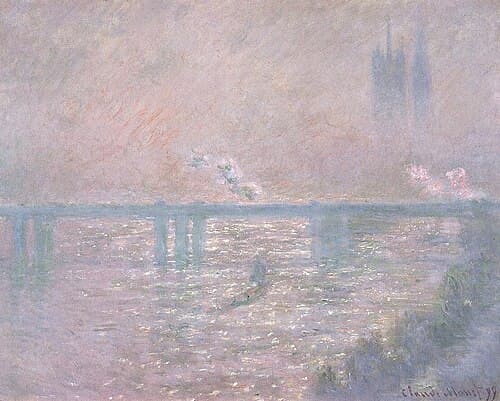
Charing Cross Bridge
1899 · Menard Art Museum
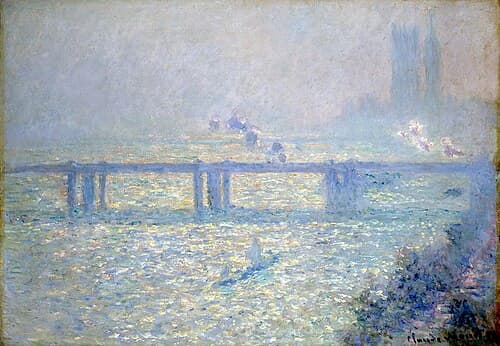
Le pont de Charing Cross
1899 · Shelburne Museum
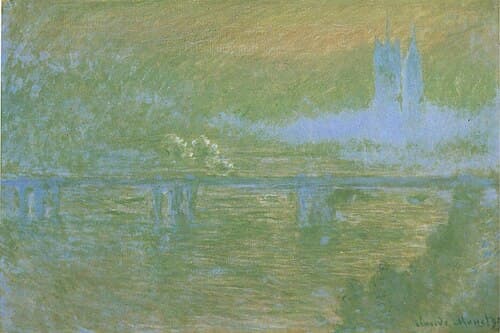
Charing Cross Bridge
1899 · Murauchi Art Museum
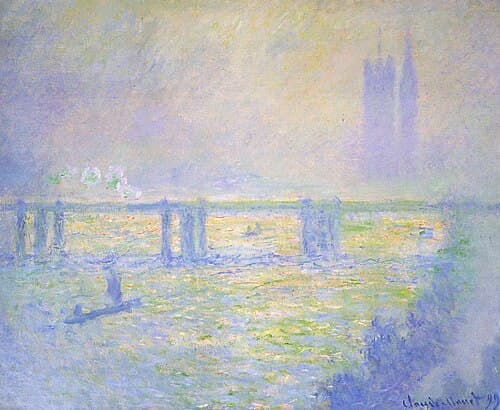
Charing Cross Bridge
1899 · Santa Barbara Museum of Art
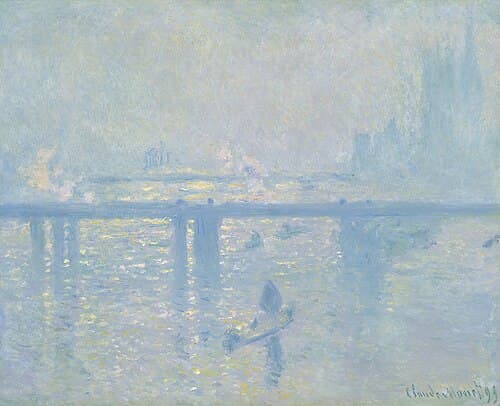
Charing Cross Bridge
1899 · Thyssen-Bornemisza Museum
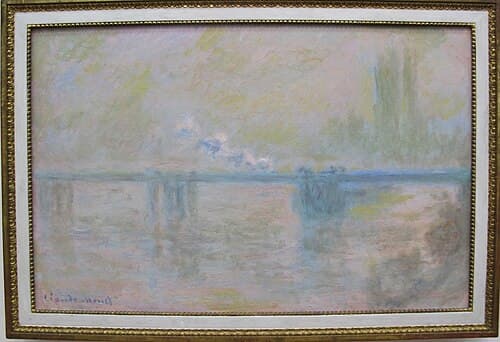
Charing Cross Bridge (overcast day), 1900
1900 · Museum of Fine Arts Boston
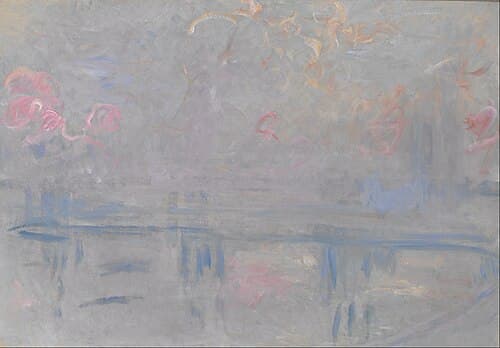
Charing Cross Bridge
1900 · Musée d'Art d'Indianapolis
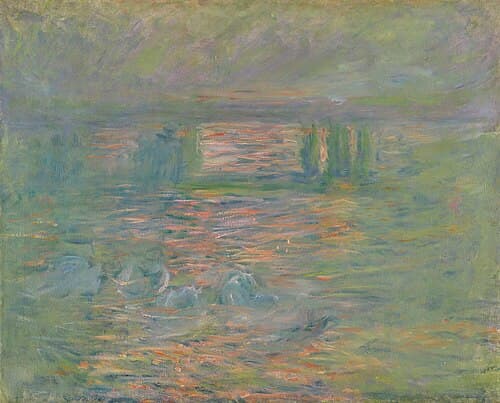
Charing Cross Bridge
1900
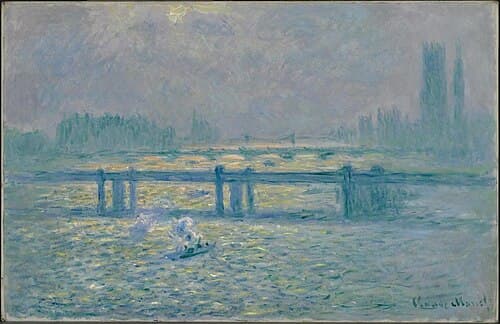
Charing Cross Bridge, reflets sur la Tamise
1900 · Baltimore Museum of Art
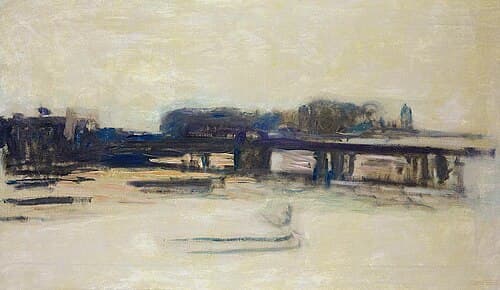
Charing Cross Bridge
1900 · Musée Marmottan Monet
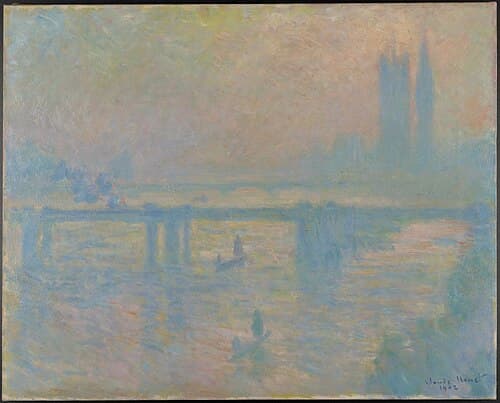
Charing Cross Bridge
1900 · Amgueddfa Cymru – Museum Wales
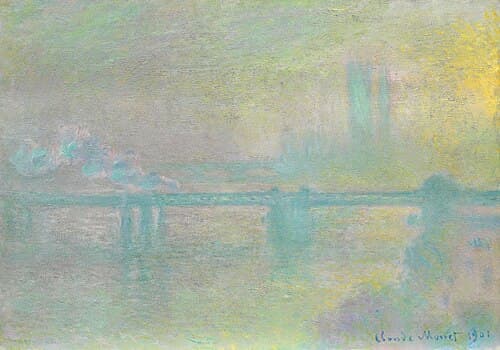
Charing Cross Bridge, London
1901 · Art Institute of Chicago
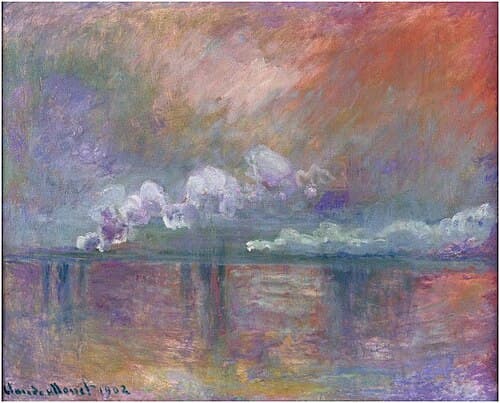
Charing Cross bridge, fumées dans le brouillard, impression
1902 · Musée Marmottan Monet
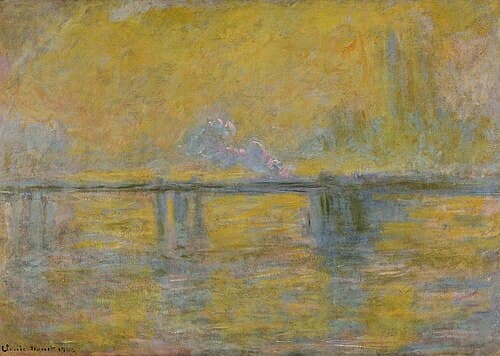
Pont de Londres (Charing Cross Bridge, London)
1902 · National Trust
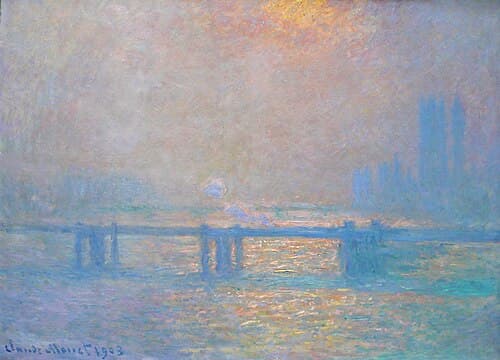
Charing Cross Bridge, The Thames
1903 · Museum of Fine Arts of Lyon
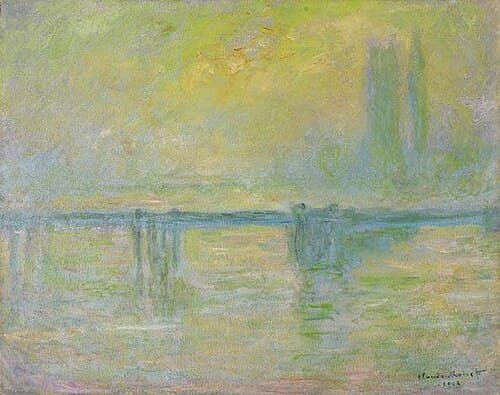
Charing Cross Bridge, Fog
1903 · Art Gallery of Ontario
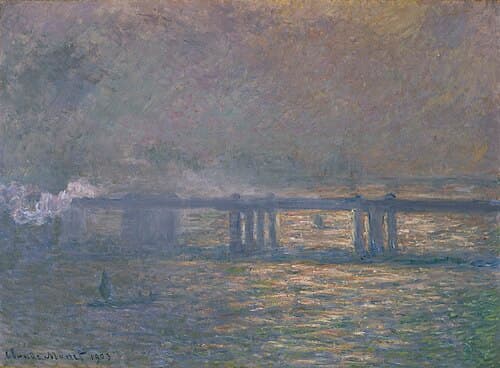
Charing Cross Bridge
1903 · Saint Louis Art Museum
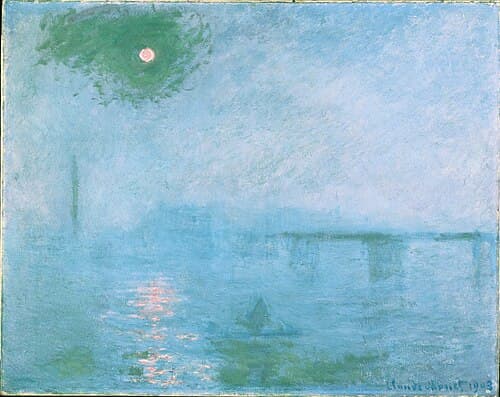
Charing Cross Bridge: Fog on the Thames
1903 · Fogg Museum
What the Charing Cross Bridge paintings show
Charing Cross Bridge, properly the Hungerford Bridge, carried the railway from the south bank into Charing Cross station. Built in the 1860s on the piers of an earlier suspension bridge, it was a plain lattice of iron girders on brick and iron supports, and Londoners did not think it handsome. Monet saw it from his window at the Savoy, a short way downstream, so that it ran across his view of the river at a slight angle.
In the paintings the bridge is a long horizontal band low across the canvas, sometimes sharp and dark, often barely there. Above it, white or pink puffs of steam mark a passing train. Beyond it, on the skyline, the Houses of Parliament and the tower of Big Ben rise as a blue ghost. The river below takes up half the picture and holds the reflections of the sun, the steam and the sky.
The contrast with the Waterloo Bridge canvases, painted from the same hotel looking the other way, is instructive. Waterloo was a heavy stone bridge with traffic on it; Charing Cross is a thin iron line with trains, and its pictures are emptier and more airy.
Why Monet painted it
Monet had painted modern railways all his life, from the Gare Saint-Lazare in 1877 to the railway bridge at Argenteuil. At Charing Cross the trains' steam merged with London's coal-smoke fog, and that mixture was exactly what fascinated him. He arrived in London in the autumn of 1899, partly to visit his son Michel, and stayed at the Savoy Hotel, which had opened ten years earlier on the Embankment. From his room on an upper floor he could turn from one bridge to the other as the light moved, and from February 1900 he also crossed the river to paint Parliament from St Thomas' Hospital, usually in the late afternoon.
How the versions differ
- Fog: the bridge is a faint gray-blue band, the towers of Westminster almost invisible. Everything is a single tone of violet or gray.
- Sun through fog: a pale disk hangs over Westminster and lays a track of gold or pink across the water.
- Smoke and steam: trains crossing the bridge leave plumes that dissolve into the sky; in some canvases the steam is the brightest thing in the picture.
- Clear or overcast days: the girders become more legible, the colors cooler.
Monet often painted the same effect on several canvases and then pushed each toward a different harmony in the studio. The result is that two Charing Cross Bridges of the same year can look entirely different, one all lavender, another blue and gold.
How they were made
As with all the London pictures, Monet began the canvases on the spot and finished them at Giverny. He brought many canvases with him and had to send for more; at times he was working on dozens in rotation, changing whenever the fog thickened or lifted. Back in France, from 1901 to 1904, he reworked them without the motif in front of him, adjusting color across the whole group so that they would hang well together.
The paint is softer and thinner in many of the Charing Cross pictures than in the Parliament series: broad scumbles of sky, a few firm strokes for the bridge, then dabs of brighter color for the sun, steam and reflections.
How to look at a Charing Cross Bridge
In the gallery, start from a distance. The pictures are built to be read at a few meters, where the bridge settles into a firm horizontal and the towers of Westminster appear from the haze. Then move close. The bridge turns out to be a few strokes of dark blue or purple, often unbroken for the whole width of the canvas, and the trains are not drawn at all: a white or rose-colored smear above the girders is all that tells you one is crossing.
Look at where the brightest color sits. Often it is not in the sky but on the water, where Monet laid thick dabs of yellow or orange for the sun's reflection, sometimes the most heavily painted passage in the picture. Finally, compare the edges. The bridge rarely ends inside the frame; it runs off both sides, which makes it a line across the river rather than an object in it.
Exhibition and sale
In May 1904 Durand-Ruel exhibited 37 of the London paintings at his gallery in Paris, including a group of Charing Cross Bridges. They sold well, many to American collectors, which explains why the series is particularly well represented in museums in the United States.
One version was lost in 2012, when Charing Cross Bridge, London (1901) was stolen from the Kunsthal in Rotterdam together with a Waterloo Bridge and works by other artists. It has not been recovered.
Charing Cross Bridge and the London series
Monet painted almost 100 views of the Thames between 1899 and 1904. The Charing Cross pictures connect the other two series: Waterloo Bridge downstream, Parliament upstream, and in many Charing Cross canvases Parliament appears on the horizon. They show Monet's interest in modern subjects, which persisted long after his Impressionist years, and his conviction that the city's polluted air could be as beautiful as a Norman sky. He admired Turner, who had painted steam and speed on the Great Western Railway, and Whistler, whose Nocturnes had already turned the Thames into a few tones of blue.
Where to see Monet's Charing Cross Bridge paintings
Versions are in the Art Institute of Chicago; the Museum of Fine Arts, Boston; the Baltimore Museum of Art; the Saint Louis Art Museum; the Indianapolis Museum of Art (Newfields); the Art Gallery of Ontario, Toronto; the Thyssen-Bornemisza Museum, Madrid; the Musée des Beaux-Arts de Lyon; the National Museum of Western Art, Tokyo; and private collections.
For Monet's London years, see Monet in London; for other cities and museums, Where to See Monet's Paintings; and for the painter, Claude Monet.
Questions & answers
How many Charing Cross Bridge paintings did Monet make?
Monet painted 34 views of Charing Cross Bridge, though some sources count 37. He began them at the Savoy Hotel in London during stays in 1899, 1900 and 1901 and finished them at Giverny by 1904.
Where did Monet paint Charing Cross Bridge from?
From his room at the Savoy Hotel on the Victoria Embankment, looking upstream along the Thames. The Houses of Parliament appear in the distance beyond the bridge in many versions.
Where are Monet's Charing Cross Bridge paintings now?
Examples are in the Art Institute of Chicago, the Museum of Fine Arts, Boston, the Baltimore Museum of Art, the Saint Louis Art Museum, the Indianapolis Museum of Art, the Art Gallery of Ontario, the Thyssen-Bornemisza Museum in Madrid, the Musée des Beaux-Arts de Lyon and the National Museum of Western Art in Tokyo.
What is Charing Cross Bridge?
It is the Hungerford railway bridge, which carries trains over the Thames into Charing Cross station. The iron bridge Monet painted dates from the 1860s; it has since been flanked by two pedestrian footbridges, the Golden Jubilee Bridges, opened in 2002.
How is Charing Cross Bridge different from Waterloo Bridge in Monet's work?
Both were painted from the Savoy Hotel. Waterloo Bridge, downstream, is a heavy stone bridge with traffic; Charing Cross Bridge, upstream, is a thin iron railway bridge with trains and steam, with the Houses of Parliament on the horizon. The Charing Cross pictures are usually emptier and more atmospheric.