Impressionism
The Bridge in Monet's Garden
Claude Monet, c. 1895–96
The Bridge in Monet's Garden (Brücke in Monets Garten) is an early Claude Monet view of the Japanese footbridge over his Giverny water lily pond, c. 1895–96, with yellow irises in front and the bridge reflected whole in pink water.
- Artist
- Claude Monet
- Date
- c. 1895–96
- Medium
- Oil on canvas
- Movement
- Impressionism
The Bridge in Monet's Garden, catalogued in German as Brücke in Monets Garten, is one of Claude Monet's first paintings of the wooden footbridge he built over his water lily pond at Giverny. This nearly square version, with yellow irises crowding the left foreground and the bridge reflected whole in the water, belongs to the mid-1890s, before the famous series of 1899. It is in a private collection. A closely matching canvas is catalogued by Daniel Wildenstein as number 1419a, Le Pont dans le jardin de Monet, dated 1895–96 and measuring about 89 by 92 centimeters, but that identification still needs confirming.
What you are looking at
The footbridge spans the picture from left to right in a low arch, its railings painted pale cream and yellow-green, with small blue touches marking the bolts. Unlike the later versions, where wisteria hangs over it and lilies crowd the water, the bridge here is open to the light and the pond is almost clear. Under it the water carries a nearly complete reflection of the arch, so the two curves together form a long lens shape across the middle of the canvas.
The foreground is crowded with color: clumps of yellow flag irises with sword-shaped blue-green leaves at lower left, more irises along the far bank under the bridge, and a pinkish sandy path entering at the left edge. The water itself is pink, violet and lilac, the reflection of sky and blossom rather than a surface of lily pads. Behind the bridge, trees and shrubs dissolve into a haze of green, mauve and gold, and at the far left a tall pink trunk rises out of the frame. Monet signed the canvas at lower left.
How it was painted
The picture is high-keyed and soft. Monet paints the foliage with short, broken touches of pastel color laid side by side, and the water with longer horizontal strokes that carry the colors of the bank down into the reflection. The bridge is the only firm drawing in the picture, and even it is made of loose strokes that wobble slightly, as if seen through warm air. The square format, unusual for Monet in these years, makes the composition feel centered and still: the arch and its reflection sit almost exactly in the middle.
The bridge and the water garden
Monet bought land across the road from his house at Giverny in 1893 and dug a pond fed by a diversion of the little river Epte. The arched wooden bridge, inspired by the Japanese prints he collected, was in place by 1895, and he first painted it that year. The Philadelphia Museum of Art owns a closely related landscape-format view of 1895 (Wildenstein 1419), with the same path, irises and reflected arch in warmer reds and oranges.
In 1899 he made a famous group of about a dozen views of the bridge, among them Bridge over a Pond of Water Lilies in New York and The Water Lily Pond, Harmony in Green in Paris, followed in 1900 by versions with irises in the foreground like Harmony in Rose. This canvas is the seed of that series: the motif is already there, but the water is still empty. Our hub on the Japanese footbridge follows the motif from 1895 to 1924.
Later bridges
Monet returned to the motif in the last decade of his life, when cataracts clouded his vision. In those late canvases, such as The Japanese Bridge in Minneapolis, the structure almost vanishes in hot reds and browns. This version, by contrast, is airy and pastel, a record of a garden that was still young. The garden itself, replanted after 1977, can be visited at Giverny.
Where to see it
The painting is in a private collection. Pictures from the bridge series can be seen in many museums, including the National Gallery in London, the Metropolitan Museum, the Musée d'Orsay and the National Gallery of Art in Washington, whose Japanese Footbridge of 1899 is one of the best known. See where to see Monet's paintings and the main Claude Monet page.
Questions & answers
Where is The Bridge in Monet's Garden?
This square early version, with yellow irises in the foreground, is in a private collection. A closely related 1895 view of the bridge is in the Philadelphia Museum of Art, and many later bridge paintings are in public museums, including the Metropolitan Museum, the National Gallery in London and the Musée d'Orsay.
When was The Bridge in Monet's Garden painted?
It belongs to the mid-1890s, probably 1895–96, when Monet first painted the wooden footbridge he had built over his new water lily pond at Giverny. That is a few years before his famous group of about a dozen bridge views made in 1899.
What does The Bridge in Monet's Garden show?
The pale arched footbridge spans the pond, reflected almost whole in pink and violet water. Yellow flag irises crowd the foreground and the far bank, a sandy path enters at the left, and the trees behind dissolve into soft greens, mauves and golds. There are almost no lily pads yet.
How many paintings of the Japanese bridge did Monet make?
Dozens. The main groups are the first views of about 1895, a series of about a dozen in 1899, versions with irises in 1900, and a late series from about 1918 to 1924, painted when his eyesight was failing, in which the bridge almost disappears into thick color.
More by the artist
Claude Monet

Bridge over a Pond of Water Lilies
Claude Monet · 1899

Woman with a Parasol – Madame Monet and Her Son
Claude Monet · 1875

Sunset in Venice
Claude Monet · 1908–12

La Grenouillère
Claude Monet · 1869

Beach in Pourville
Claude Monet · 1882

Springtime
Claude Monet · 1872

Boating on the River Epte
Claude Monet · 1890

The Seine at Asnières (Hermitage)
Claude Monet · 1873
Kindred works
You may also study
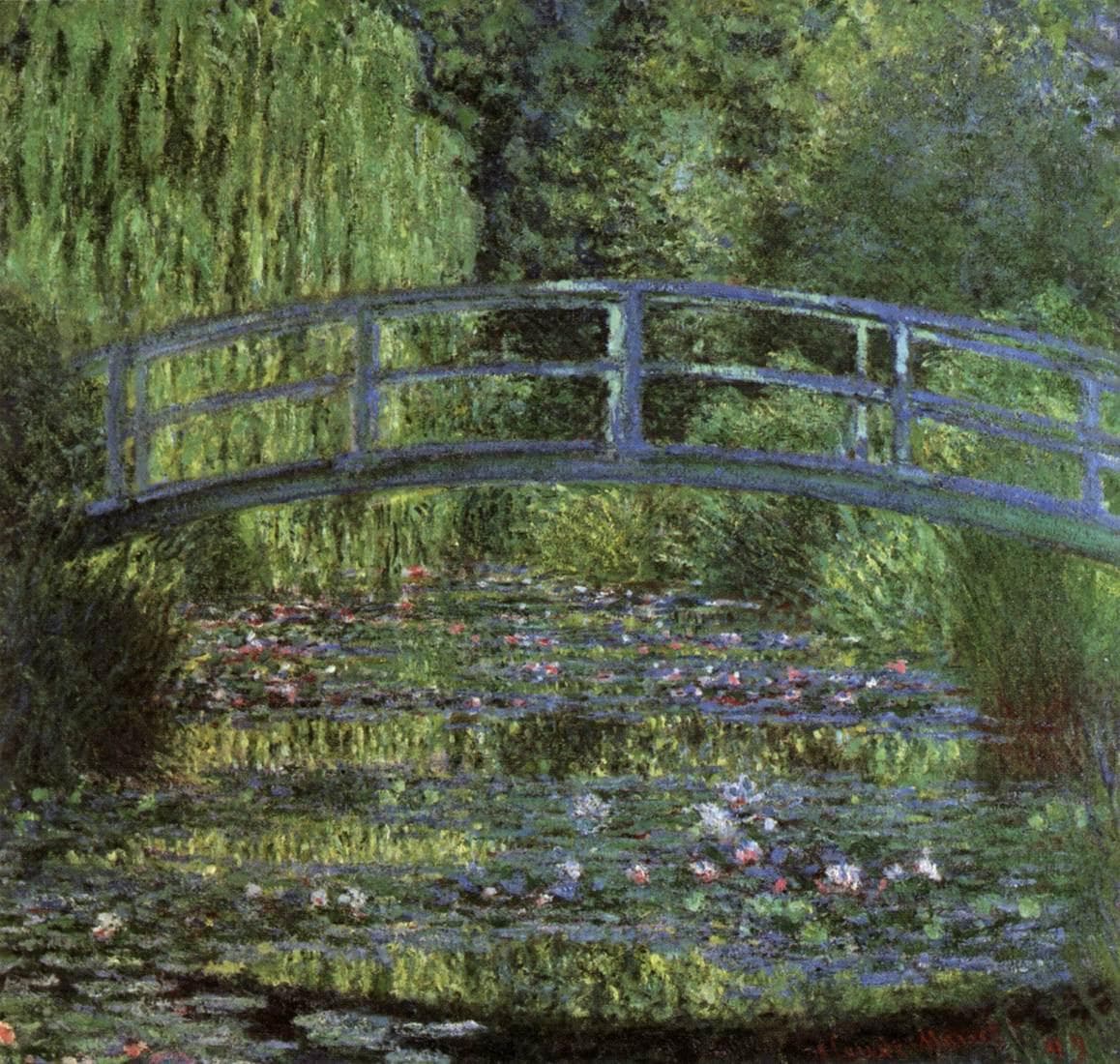
Water Lily Pond, Green Harmony
Claude Monet · 1899
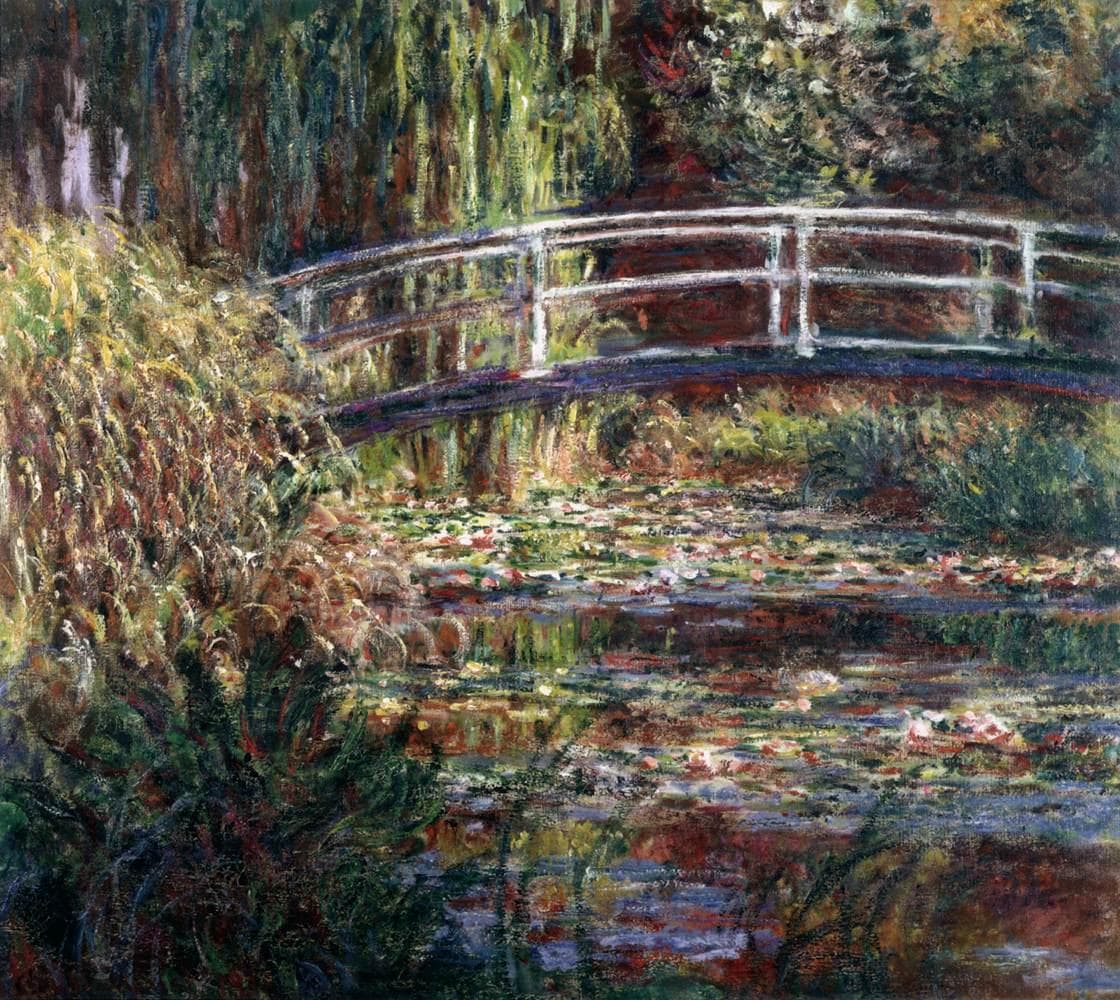
The Water Lily Pond, Harmony in Rose
Claude Monet · 1900
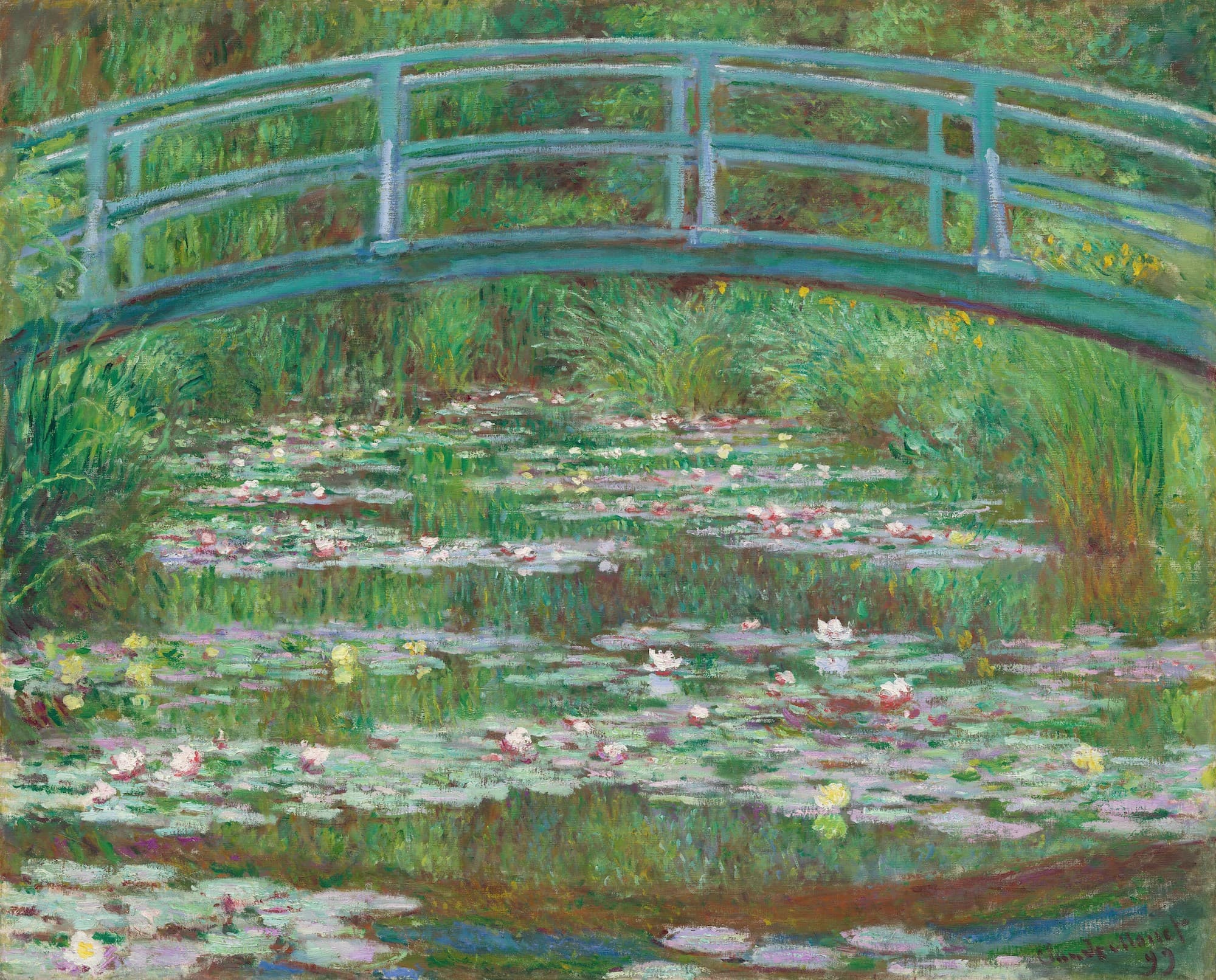
The Japanese Footbridge
Claude Monet · 1899
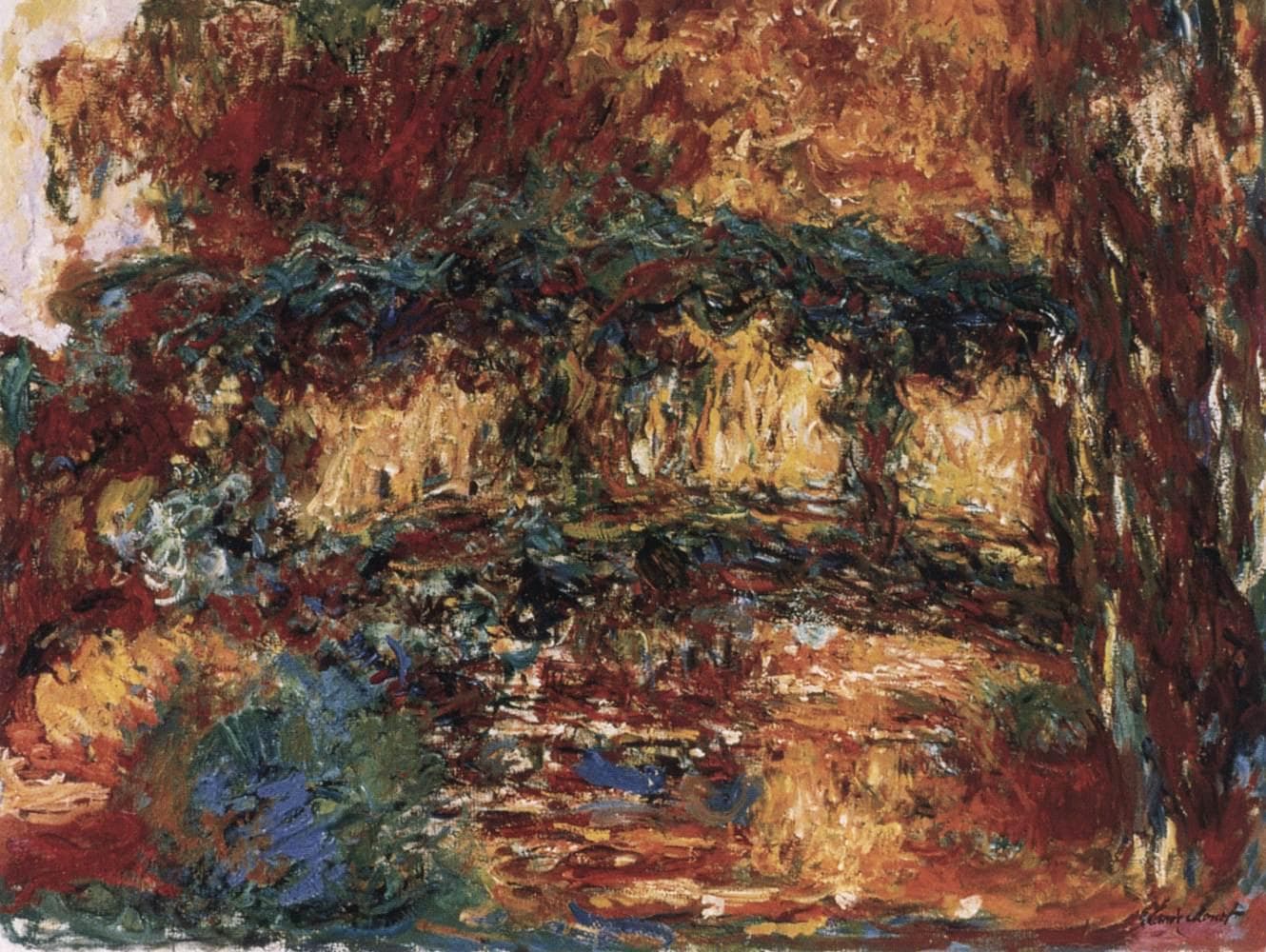
The Japanese Bridge
Claude Monet · c. 1923–25
Irises in Monet's Garden at Giverny
Claude Monet · 1900

The Scream
Edvard Munch · 1893

Ophelia
John Everett Millais · 1851–52

The Great Wave off Kanagawa
Katsushika Hokusai · c. 1830–32