Image: The National Gallery, London · CC BY-SA 4.0 · via Wikimedia Commons
Impressionism
The Museum at Le Havre
Claude Monet, 1873
The Museum at Le Havre is an 1873 painting by Claude Monet of the city's museum of fine arts seen across the inner harbor, its facade half hidden behind the sails of moored fishing boats. It belongs to the National Gallery, London.
- Artist
- Claude Monet
- Date
- 1873
- Medium
- Oil on canvas
- Dimensions
- 75 × 100 cm
- Collection
- National Gallery, London, United Kingdom
- Movement
- Impressionism
- Catalogue
- Wildenstein 261
Painted at Étretat and the Normandy Coast
What you are looking at
A grand stone building with tall arched windows, a balustrade and a clock in its pediment stands on the far side of a stretch of harbor water. In front of it, packed along the quay, are fishing boats with their sails raised to dry or lowered in loose folds, a forest of greyish-white canvas that hides most of the facade. On the left, older houses with steep roofs and chimneys crowd in behind more sails. In the middle distance a small rowing boat with a few passengers crosses the harbor, and a second, smaller one sits further right.
The weather is overcast. The sky is a moving mass of grey and white cloud, and the water below repeats it in short, broken horizontal strokes of grey-green, blue and cream. The palette is cool and muted, mostly greyish blues and browns, with a few touches of warmer orange in the boats along the quay.
The detail most people miss is what Monet leaves out. There is no quay in the foreground, no wall, no ground under the painter's feet. We seem to be looking at the city from the water itself.
Where and when it was painted
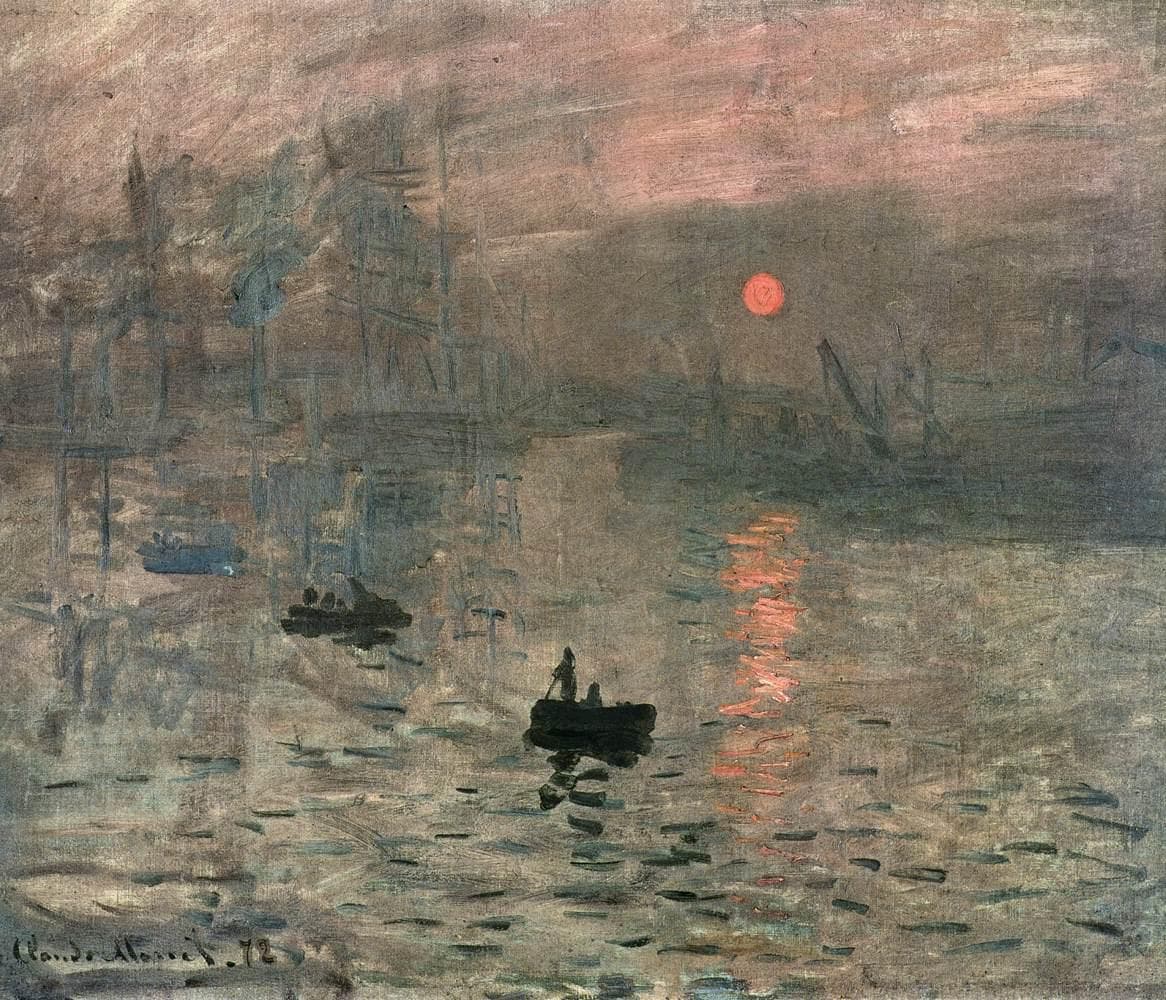
Monet grew up in Le Havre, at the mouth of the Seine, and kept returning while he lived at Argenteuil in the 1870s. In those years Le Havre was France's main transatlantic port, a city of docks, warehouses and steamers. In 1873 and 1874 Monet painted its harbors rather than the beaches of Sainte-Adresse he had painted in the 1860s, and the most famous result is Impression, Sunrise, the view across the port that gave Impressionism its name.
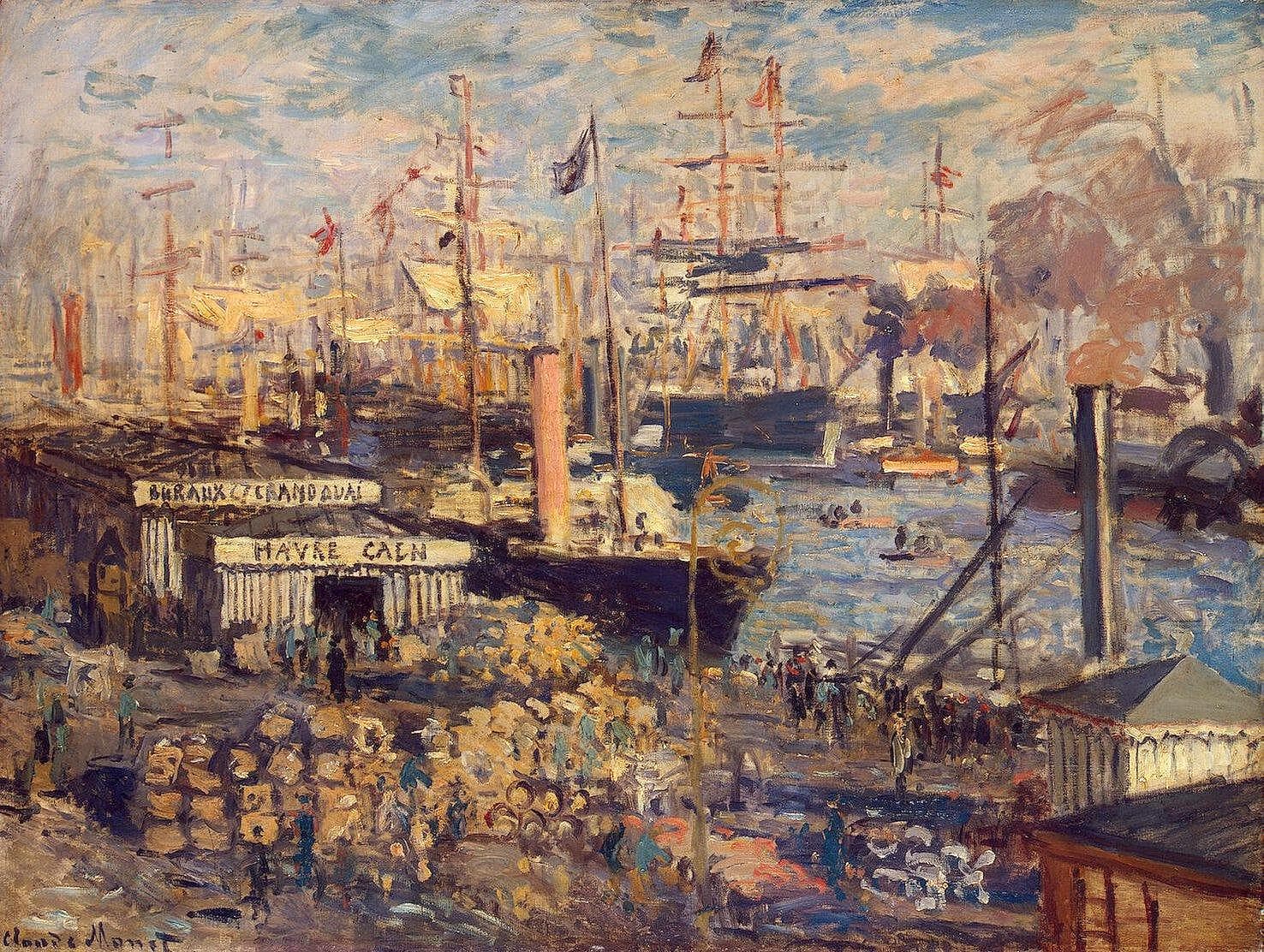
For this picture he stood on the wall of the inner harbor facing the Grand Quai, as he did for Impression, Sunrise, but turned the other way, toward the city's museum of fine arts and public library. The building had opened in 1845. It had a personal meaning for Monet: its curator, the local painter Jacques-François Ochard, had given him drawing lessons as a boy. The museum was destroyed in the Second World War, so the painting now records a vanished building.
How it was painted
At 75 by 100 centimeters the canvas is large for Monet in the early 1870s, but it keeps the speed of his smaller sketches. The sails are brushed in quickly with long vertical strokes, and the reflections in the foreground are a lattice of separate dabs that make the water ripple. The architecture is solid enough to read, but Monet treats it as one more surface for the grey light to fall on.
He planned the composition. Four sketches in a sketchbook now in the Musée Marmottan Monet show him trying different arrangements of the sails in front of the building while keeping almost the same viewpoint. Contemporary photographs of the museum taken from the same spot show the same rows of sails, so the crowding is observed, not invented. He signed and dated the canvas 1873 at lower right.
Le Havre in Monet's work
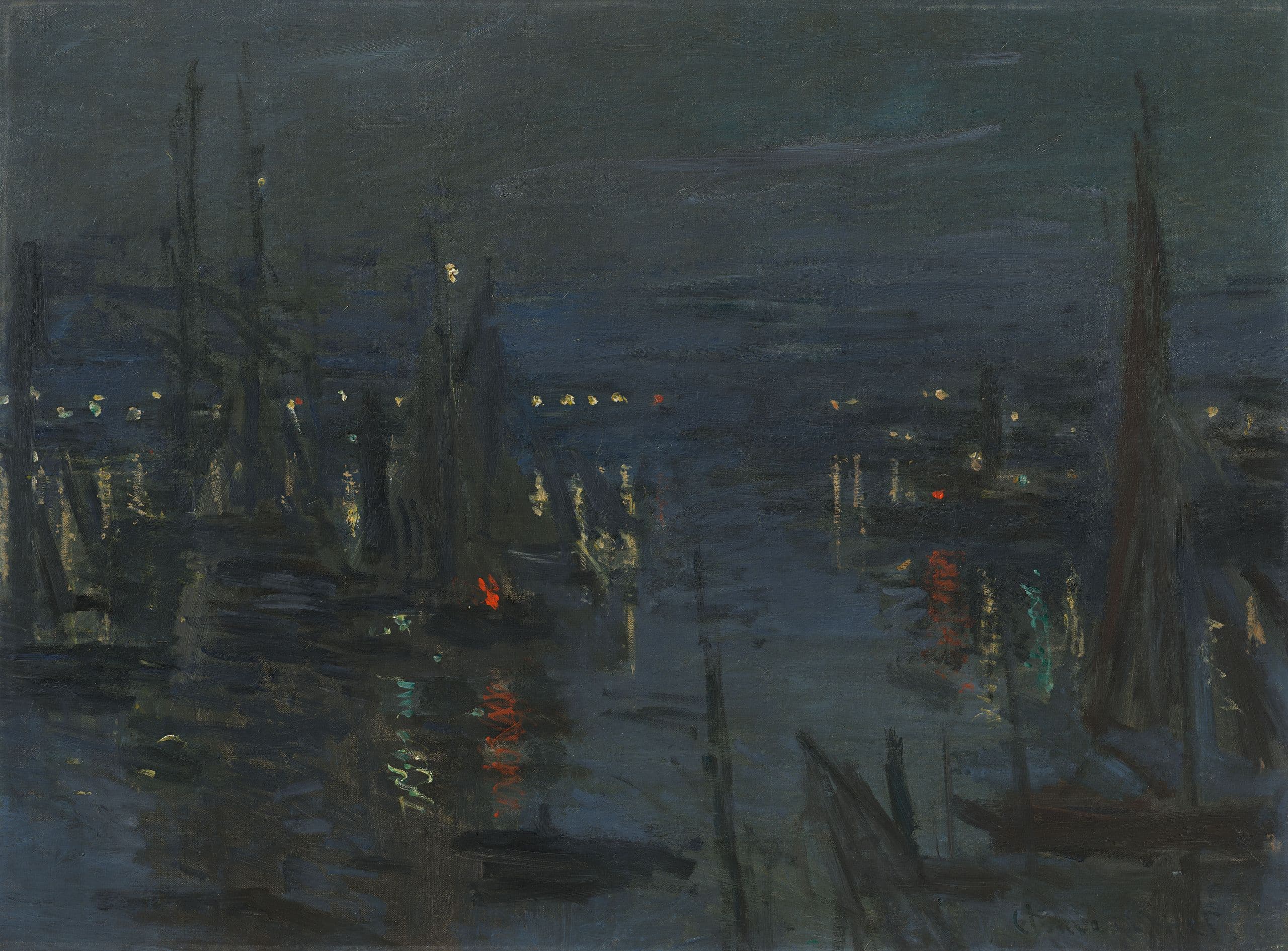
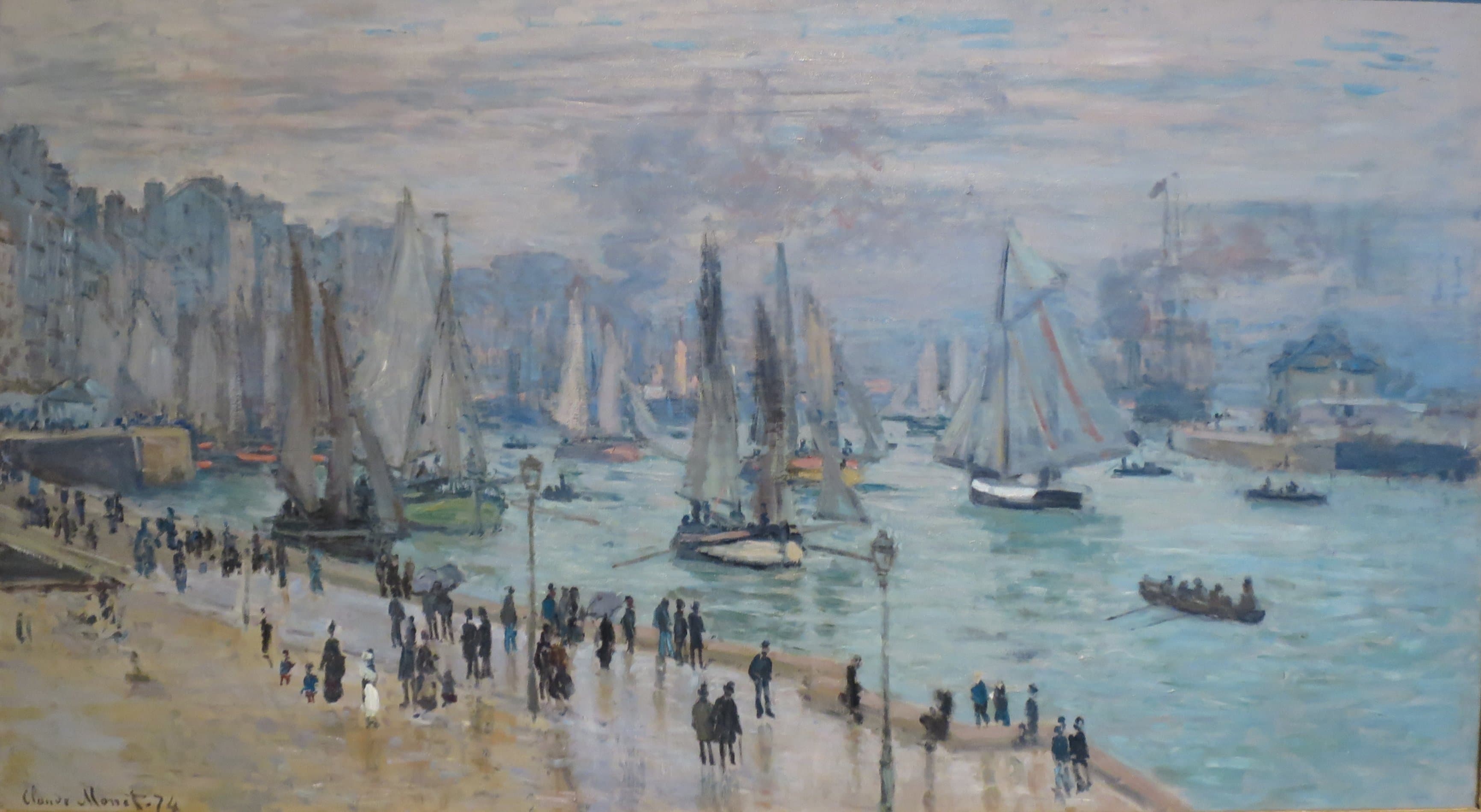
The picture belongs to a group of port views from 1872–74 that includes The Port of Le Havre, Night Effect, Fishing Boats Leaving the Harbor, Le Havre and Embankment in Le Havre. Next to Impression, Sunrise it looks almost documentary: a daylight view of a public building, with the bustle of the working port in front of it. For Monet's coast as a whole, see Étretat and the Normandy coast.
Ownership and where to see it
The Italian painter Giuseppe de Nittis, a friend of the Impressionists, bought the picture from Monet in Paris in 1876. It later passed through the dealer Durand-Ruel in 1912 and the London firm of Arthur Tooth & Sons, from whom Kenneth Levy bought it in 1936. Helena and Kenneth Levy bequeathed it to the National Gallery in 1990 (NG6527). It was shown in the gallery's Monet & Architecture exhibition in 2018 and lent to Monet in Le Havre at the MuMa in 2026. It is not always on display; see where to see Monet's paintings and the Claude Monet page.
Questions & answers
Where is Monet's The Museum at Le Havre?
It belongs to the National Gallery in London (NG6527), bequeathed by Helena and Kenneth Levy in 1990. It measures 75 by 100 centimeters. The painting is not always on display, so check the gallery's website before visiting.
When and where did Monet paint The Museum at Le Havre?
He painted it in 1873 in Le Havre, the port where he grew up, standing on the wall of the inner harbor facing the Grand Quai. It is signed and dated 1873. That year he also painted Impression, Sunrise from the same harbor.
What building does The Museum at Le Havre show?
It shows Le Havre's museum of fine arts and public library, opened in 1845, seen across the harbor behind the sails of fishing boats. Its curator had taught Monet drawing as a boy. The building was destroyed during the Second World War.
How is it related to Impression, Sunrise?
Both were painted from the inner harbor of Le Havre facing the Grand Quai, but in opposite directions. Impression, Sunrise looks out over the port at dawn; The Museum at Le Havre turns back toward the city in grey daylight.
More by the artist
Claude Monet

Bridge over a Pond of Water Lilies
Claude Monet · 1899

Woman with a Parasol – Madame Monet and Her Son
Claude Monet · 1875

Sunset in Venice
Claude Monet · 1908–12

La Grenouillère
Claude Monet · 1869

Beach in Pourville
Claude Monet · 1882

Springtime
Claude Monet · 1872

Boating on the River Epte
Claude Monet · 1890

The Seine at Asnières (Hermitage)
Claude Monet · 1873
Also painted in 1873
The same year
Lilac in the Sun
Claude Monet · 1873
Lilacs, Gray Weather
Claude Monet · 1872–73
The Seine at Asnières
Claude Monet · 1873
Autumn Effect at Argenteuil
Claude Monet · 1873
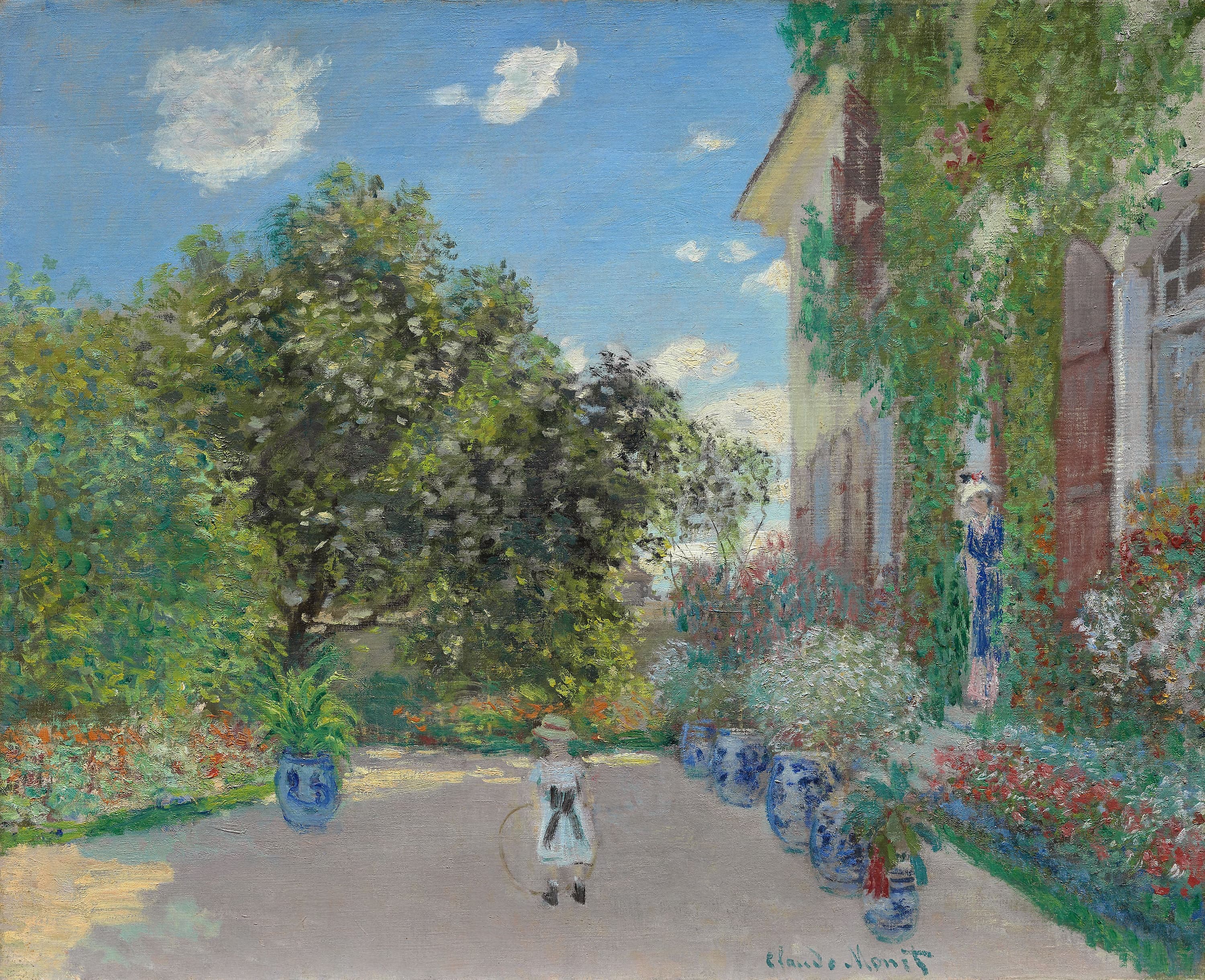
The Artist's House at Argenteuil
Claude Monet · 1873
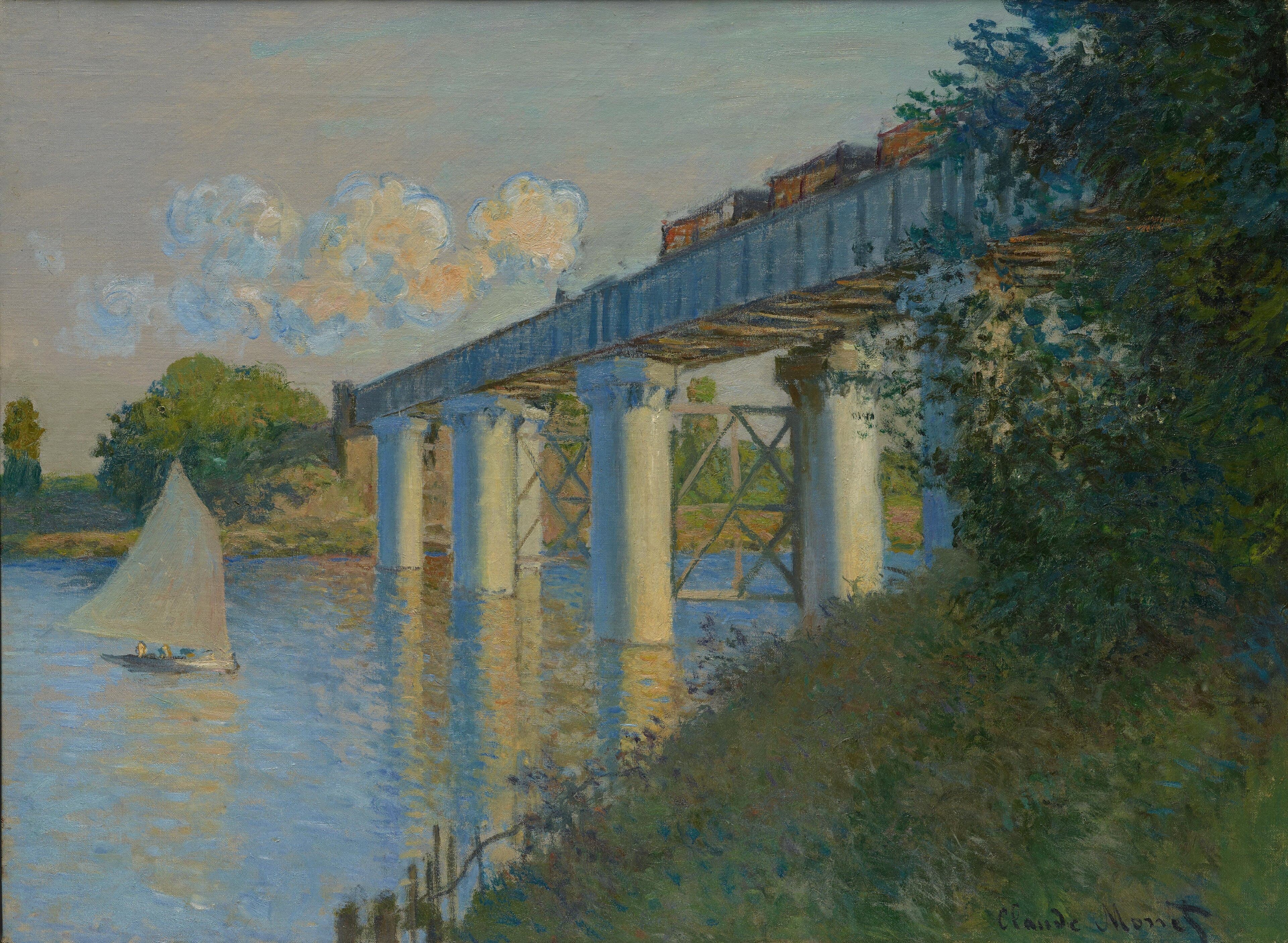
Railroad Bridge, Argenteuil
Claude Monet · 1873
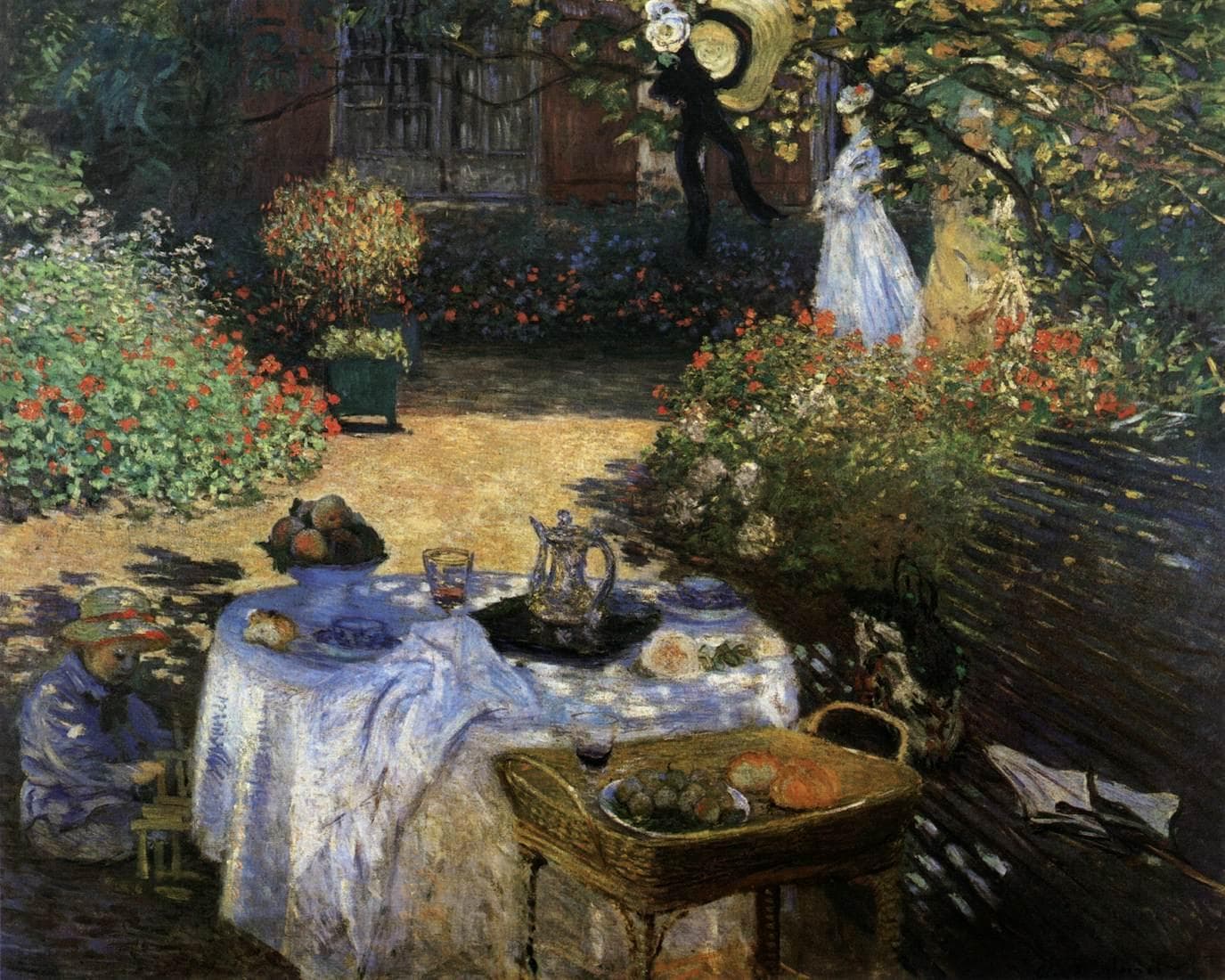
The Luncheon (Monet's Garden at Argenteuil)
Claude Monet · c. 1873
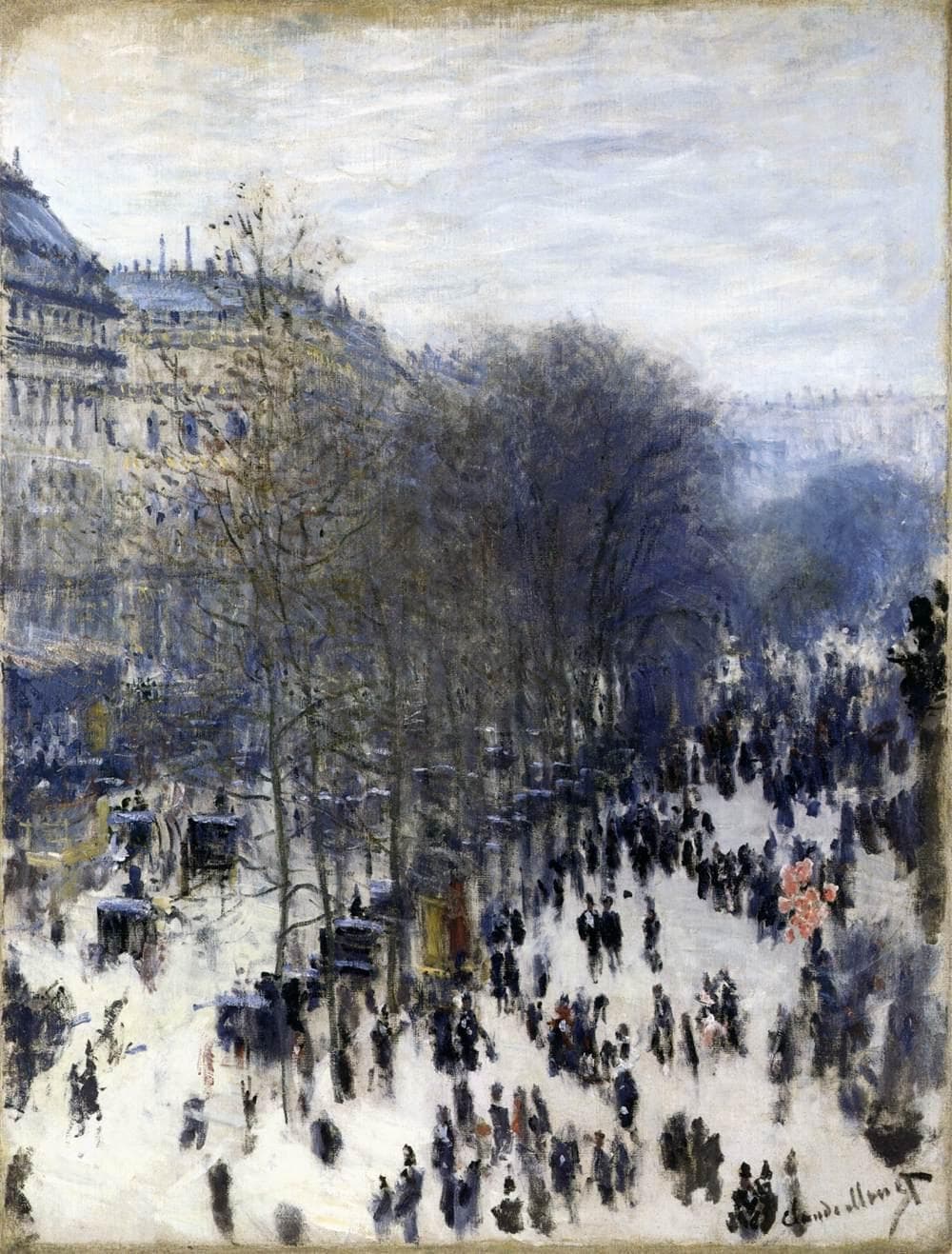
Boulevard des Capucines
Claude Monet · 1873–74
Kindred works
You may also study
Impression, Sunrise
Claude Monet · 1872
The Port of Le Havre, Night Effect
Claude Monet · 1872
Fishing Boats Leaving the Harbor, Le Havre
Claude Monet · 1874
The Grand Quai at Le Havre
Claude Monet · 1874
View at Rouelles, Le Havre
Claude Monet · 1858

Ophelia
John Everett Millais · 1851–52

The Great Wave off Kanagawa
Katsushika Hokusai · c. 1830–32
The Birth of Venus
Sandro Botticelli · c. 1484–1486