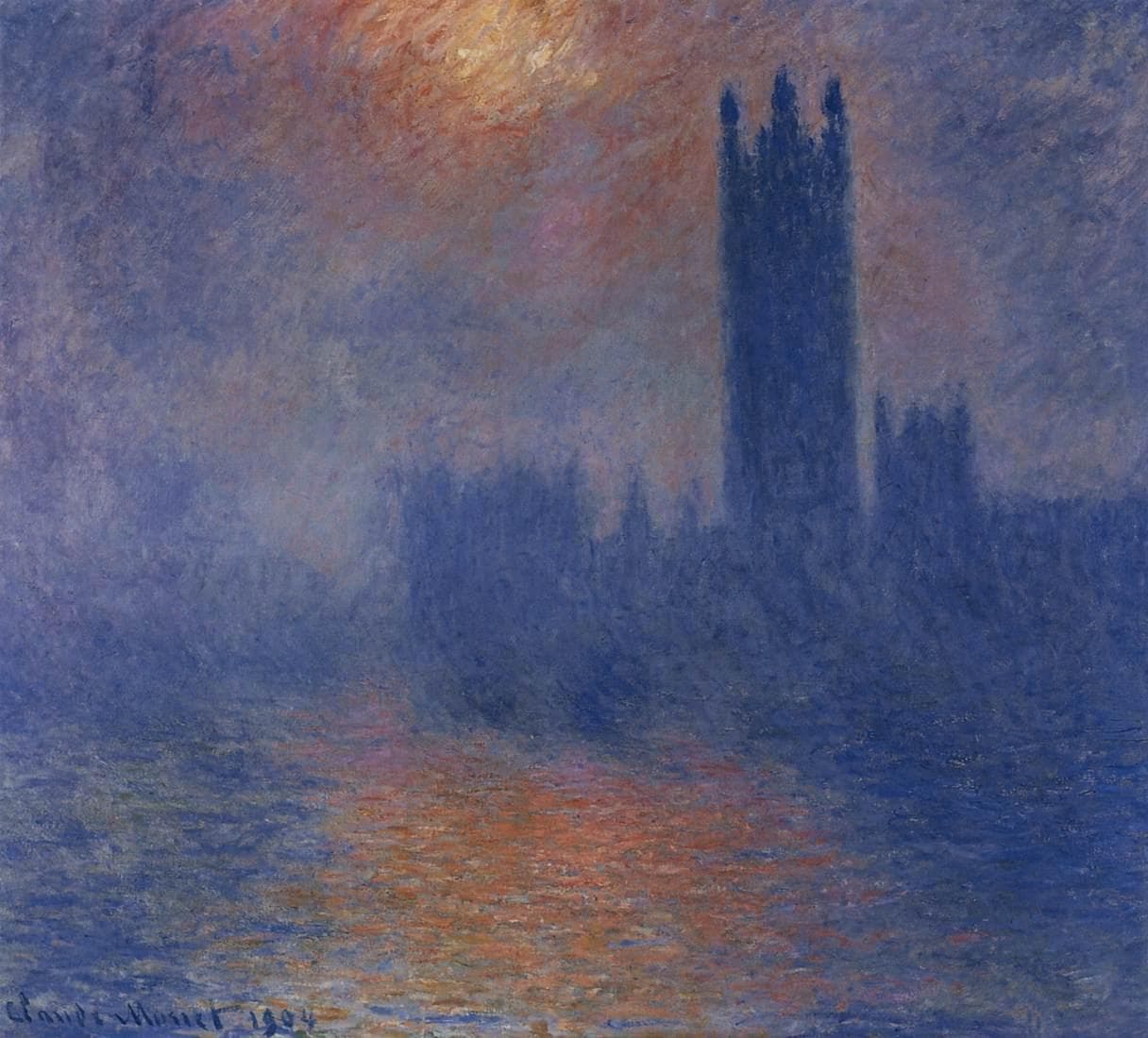
Series
Monet's Houses of Parliament: The London Series, 1900–1905
Nineteen views of Westminster across the Thames, a dark Gothic silhouette dissolving in fog, smoke and the setting sun.
Monet's Houses of Parliament are a series of 19 known paintings of the Palace of Westminster in London, seen across the Thames from St Thomas' Hospital on the south bank. Monet began them in February 1900, during the second of three winter stays in London (1899, 1900 and 1901), and finished them over the next few years in his studio at Giverny; most are dated 1903 or 1904, one 1905.
They form one of three London series, with Waterloo Bridge and Charing Cross Bridge, nearly 100 Thames canvases in all. Today the Parliament pictures are in museums including the Musée d'Orsay, the Palais des Beaux-Arts in Lille, the Art Institute of Chicago, the Metropolitan Museum, the Brooklyn Museum, the National Gallery of Art in Washington, the High Museum in Atlanta, the Kunsthaus Zürich, the Pushkin Museum and the Musée Marmottan Monet.
The complete set
All 17 known canvases
From the catalogue raisonné. Works with a full close reading are marked ✦.
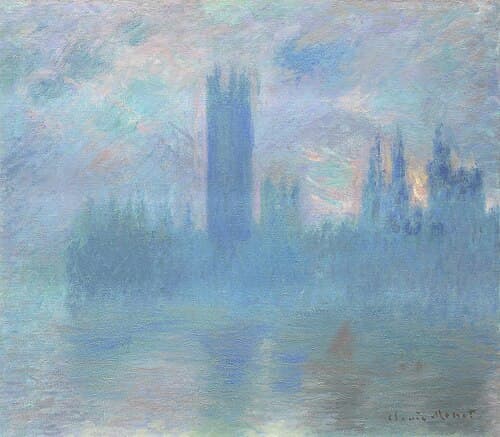
Houses of Parliament, London
1900 · Art Institute of Chicago
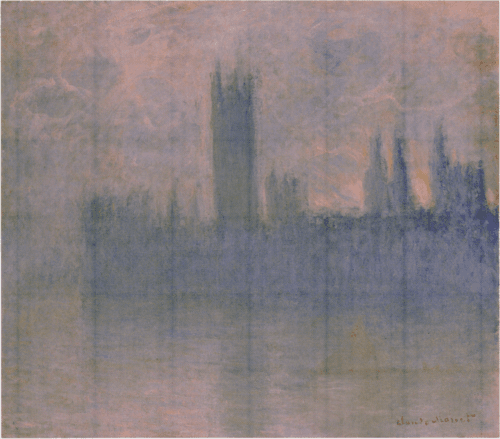
Houses of Parliament, Symphony in Rose
1900 · Pola Museum of Art
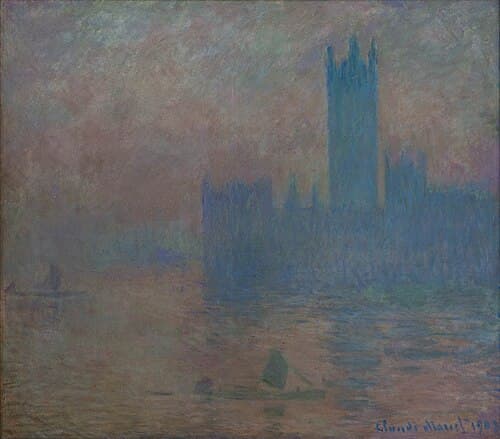
Le Parlement de Londres, effet de brouillard
1903 · MuMa Museum of modern art André Malraux
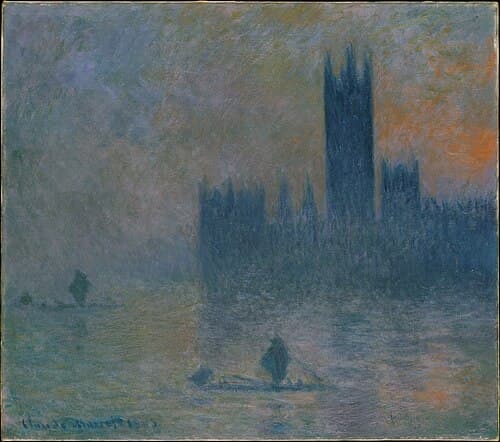
The Houses of Parliament (Effect of Fog)
1903 · Metropolitan Museum of Art
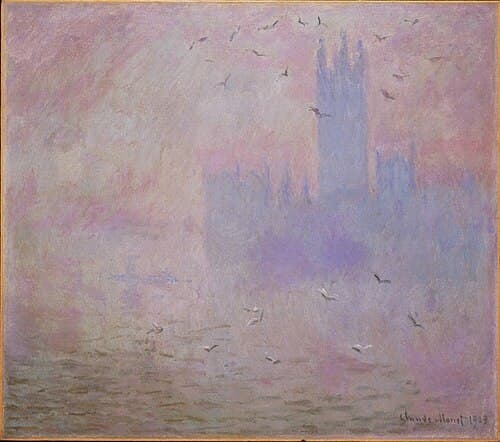
The Houses of Parliament, Seagulls
1903 · Princeton Art Museum
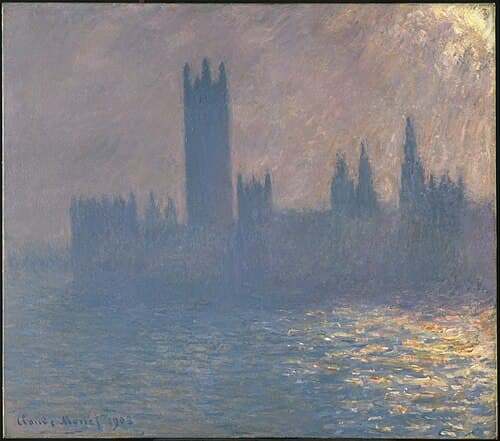
Houses of Parliament, Sunlight Effect (Le Parlement, effet de soleil)
1903 · Brooklyn Museum
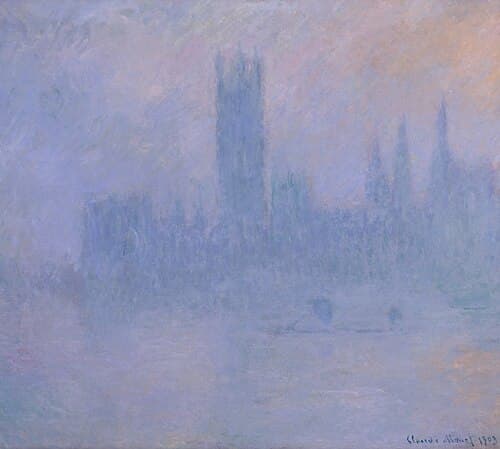
Le Parlement, symphonie en bleu
1903 · High Museum of Art
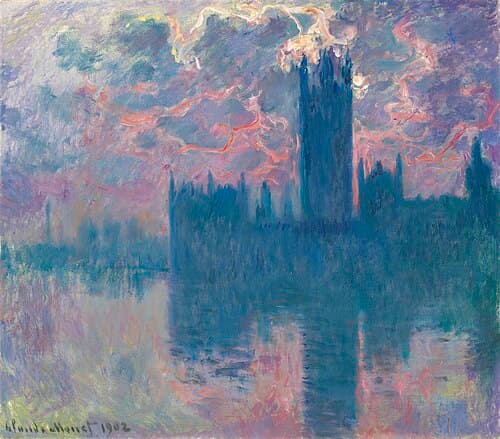
Houses of Parliament, Sunset
1903
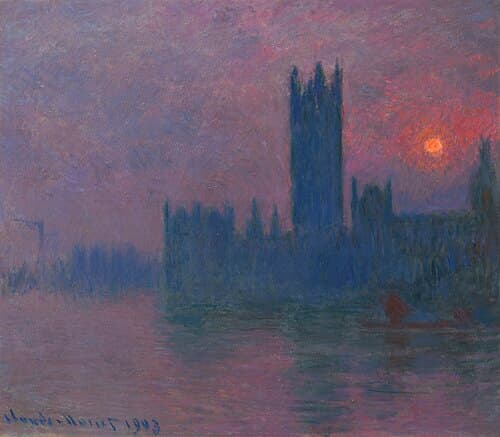
Houses of Parliament, Sunset
1903 · Impressionism: The Hasso Plattner Collection
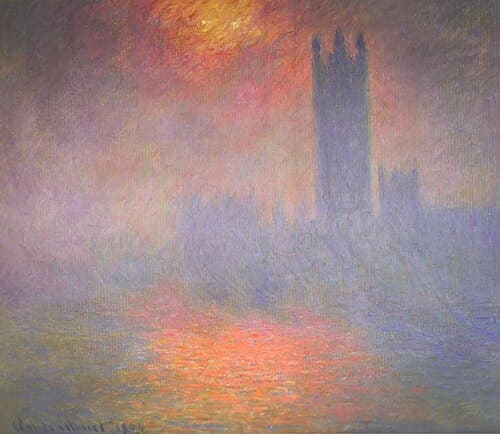
✦London, the Houses of Parliament, Sunlight Opening in Fog
1904 · Musée d'Orsay
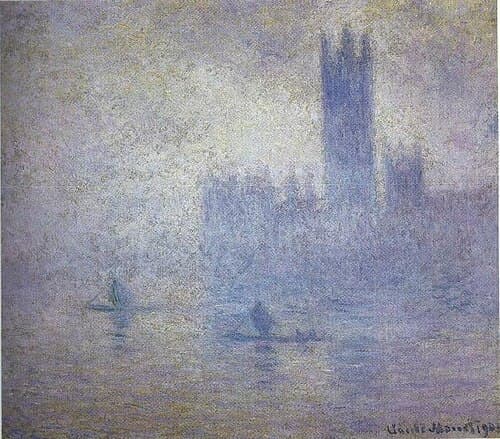
Houses of Parliament, Effect of Fog
1904 · Museum of Fine Arts, St. Petersburg, Florida, USA
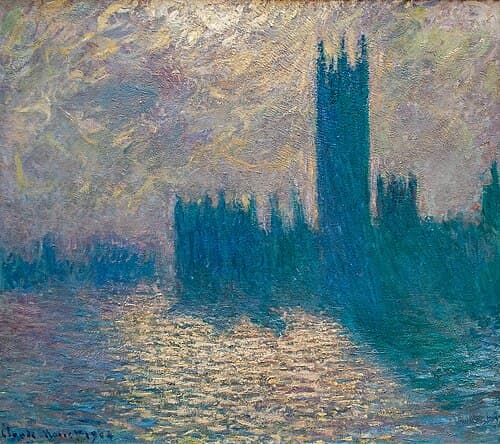
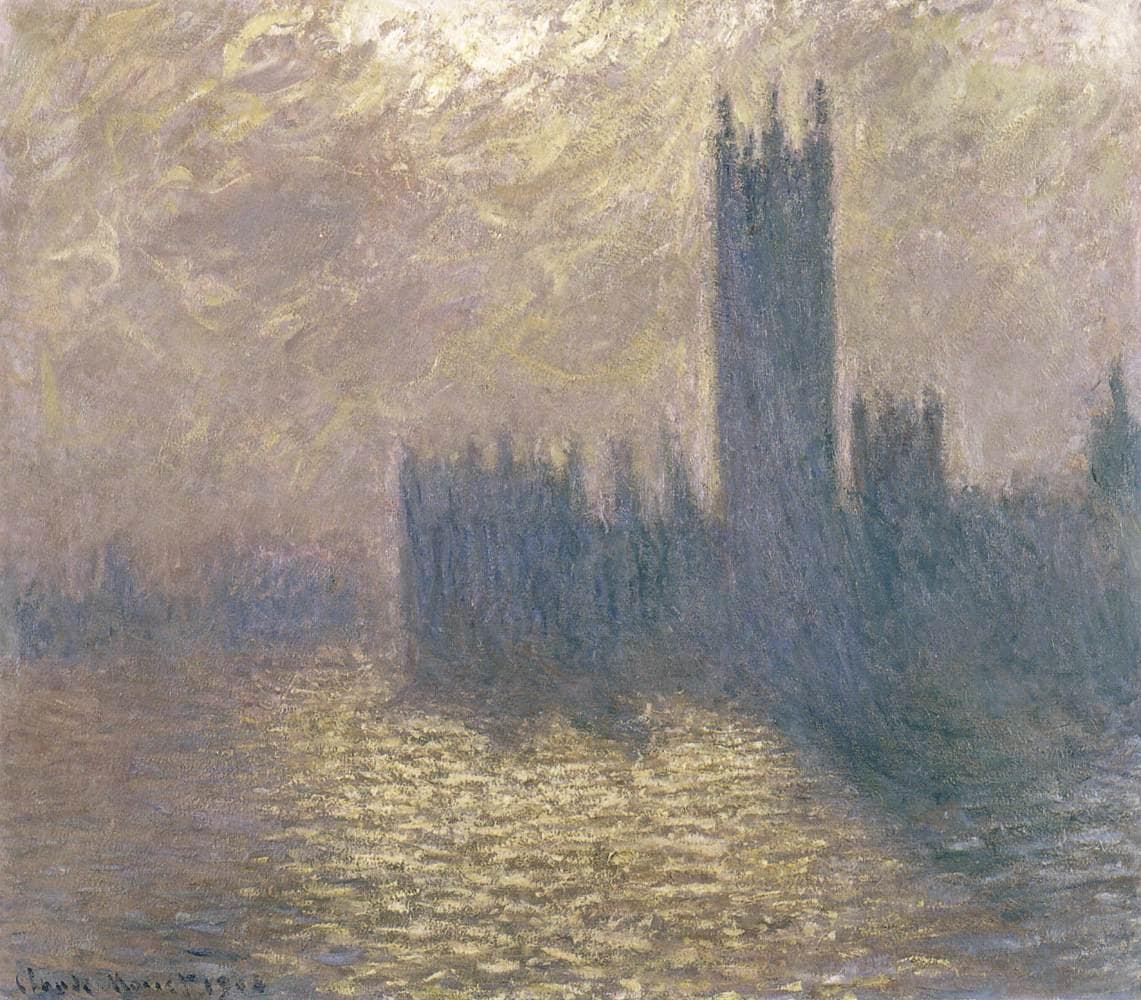
✦Houses of Parliament, stormy sky
1904 · Palais des Beaux-Arts de Lille
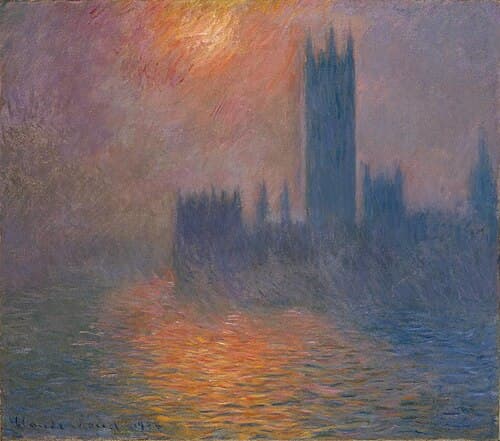
Houses of Parliament, sunset
1904 · Kunsthaus Zürich
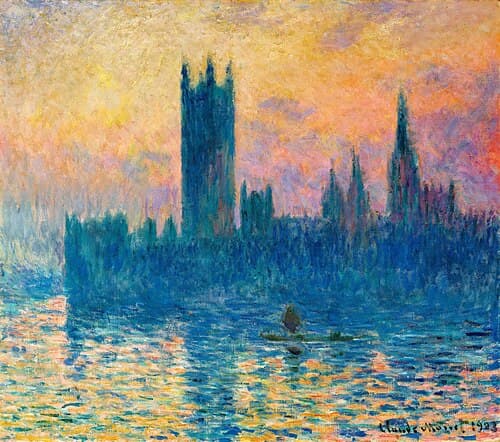
The Houses of Parliament, Sunset
1904 · National Gallery of Art
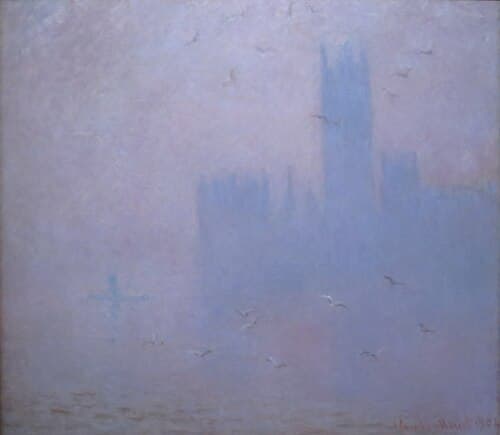
Seagulls, the River Thames and the Houses of Parliament
1904 · Pushkin Museum of Fine Arts
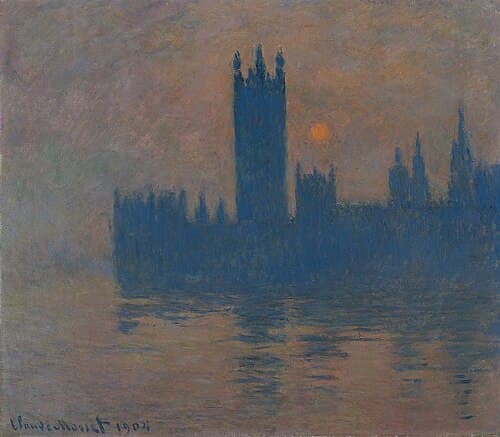
Le Parlement, coucher de soleil
1904 · Kaiser Wilhelm Museum
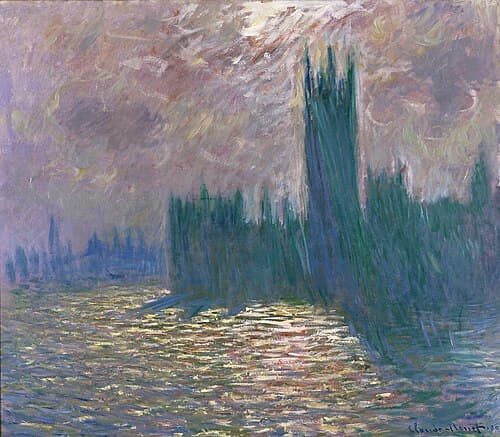
London. Parliament. Reflections on the Thames
1905 · Musée Marmottan Monet
What the paintings show
Every canvas shows the same thing: the long river front of the Houses of Parliament, with the Victoria Tower at one end and the clock tower of Big Ben at the other, seen straight on from across the Thames. The building is never described in detail.
Its Gothic Revival pinnacles, designed by Charles Barry and A. W. N. Pugin after the old palace burned in 1834, are reduced to a jagged silhouette, dark blue, violet or green against the sky.
The real subject is what lies between Monet and the building: fog, smoke, and the sun trying to get through them. In some canvases the sun is a red or orange disk low in the sky, its reflection a broken track of color across the water. In others, the sky is purple and gold and the river glitters.
In a few, a boat or a gull is the only sign of life. The canvases are almost all the same size, about 81 by 92 centimeters, which made them easy to work on in rotation and to hang as a set.
Why Monet painted London
Monet had first painted the Thames in 1870–71, when he fled to London during the Franco-Prussian War. It was there that he met the dealer Paul Durand-Ruel, and there he painted The Thames below Westminster, with the new Parliament building half-veiled in spring mist behind a jetty.
He also saw the paintings of J. M. W. Turner, whose London skies and dissolving light he admired, though he later downplayed the debt.
He came back almost thirty years later, in the autumn of 1899, partly to visit his son Michel, who was studying English there. He stayed at the Savoy Hotel, from whose windows he painted Waterloo and Charing Cross bridges. For Parliament, he needed a different viewpoint and obtained permission to work at St Thomas' Hospital, directly across the river. He began the first canvas, according to his own record, at about a quarter to four on the afternoon of 13 February 1900.
"Without the fog," he said, "London would not be a beautiful city." The coal smoke that made the city's air thick and colored was, for him, its glory.
How the versions differ
Monet painted Parliament mostly in the late afternoon and at sunset, when the sun was behind the building and it stood in silhouette. The differences come from weather and the time of the sun's fall.
- Sun breaking through fog: the building is a ghostly blue, and a pale sun burns a hole in the mist, as in the Orsay's Sun Breaking Through the Fog.
- Stormy sky: a turbulent sky of gray, blue and gold over a brighter river, as in Lille's The Houses of Parliament, London (Stormy Sky).
- Sunset: the whole picture turns orange, red and violet, the building a dark cut-out.
- Gulls and fog: a few canvases add a flight of seagulls or a lone boat, giving scale to the empty water.
Because he used the same viewpoint and canvas size every time, the changes of color are startling when the pictures are seen together: the same tower can be green, mauve, rust or nearly black.
How they were made
Monet worked fast on site, with as many as dozens of canvases stacked in his room, each tied to an effect, and he wrote to his wife Alice of despair when the fog lifted or the sun failed to appear. He returned to London in 1901, then stopped going and finished the series at Giverny from 1901 to 1904, reworking every canvas, sometimes, it seems, with the help of photographs and certainly from memory. When it became known that the pictures had been finished in the studio, some observers objected that "impressions" ought to be painted from life. Monet wrote to Durand-Ruel in 1905 that whether his London views were painted from nature or not was nobody's business, and that only the result mattered.
The paint is layered and dense, with dragged and scumbled strokes that build the haze out of countless separate touches of color. Up close, the "gray" fog is made of pinks, blues and yellows.
What do the Parliament paintings mean?
Monet framed the series as a matter of light, but the subject carried weight. The Palace of Westminster was the seat of the British government and one of the most famous buildings of the age, and the smoke that made Monet's fog came from the factories, steamers and coal fires of the largest city in the world. Some historians see the series as an image of modern industrial London, its monument half-erased by its own pollution. Others place it in a line of painters of the Thames, from Turner, who painted the old Parliament burning in 1834, to Whistler, whose Nocturnes reduced the river to a few tones. Monet's pictures sit between those poles: grand architecture, dissolving.
Exhibition and sale
In May 1904 Durand-Ruel exhibited 37 of the London paintings in Paris under the title Vues de la Tamise à Londres. The show was a success, and the pictures sold well, especially to American collectors, which is why so many Parliament canvases are now in American museums.
Where to see Monet's Houses of Parliament
The 19 known canvases include versions at the Musée d'Orsay, Paris; the Palais des Beaux-Arts, Lille; the Art Institute of Chicago; the Metropolitan Museum and the Brooklyn Museum, New York; the National Gallery of Art, Washington; the High Museum of Art, Atlanta; the Princeton University Art Museum; the Museum of Fine Arts, St. Petersburg, Florida; the Kunsthaus Zürich; the Kunstmuseen Krefeld; the Pushkin Museum, Moscow; the Musée Marmottan Monet; and private collections, among them the Hasso Plattner Collection.
None is in a public collection in London. To see Monet's London in London, look for his earlier Thames below Westminster at the National Gallery. For the full story of Monet's London years see Monet in London, for more museums Where to See Monet's Paintings, and for the artist Claude Monet. The London fog pictures sit between the Mornings on the Seine and the Water Lilies in his series work.
Questions & answers
How many Houses of Parliament paintings did Monet make?
Nineteen paintings of the Houses of Parliament by Monet are known. He began them in February 1900 from St Thomas' Hospital in London and finished them at Giverny, mostly dating them 1903–04. They are part of a larger group of nearly 100 Thames views.
Where did Monet paint the Houses of Parliament from?
From a window or terrace of St Thomas' Hospital, on the south bank of the Thames, directly opposite the Palace of Westminster. He painted Waterloo and Charing Cross bridges from his room at the Savoy Hotel on the north bank.
Where are Monet's Houses of Parliament paintings now?
They are in the Musée d'Orsay, the Palais des Beaux-Arts in Lille, the Art Institute of Chicago, the Met, the Brooklyn Museum, the National Gallery of Art in Washington, the High Museum, the Kunsthaus Zürich, the Pushkin Museum, the Musée Marmottan and other collections. None is in a London museum.
Why are Monet's Houses of Parliament so foggy?
Fog was the subject. London's air at the time was thick with coal smoke, which colored the light and blurred buildings. Monet said that without fog London would not be beautiful, and he painted the building as a silhouette in it, mostly at sunset.
Did Monet finish the London paintings in London?
No. He started them during stays in 1899, 1900 and 1901 but reworked and finished them in his studio at Giverny until 1904, partly from memory and perhaps from photographs. He showed 37 Thames views at Durand-Ruel's gallery in Paris in May 1904.