Image: Wikimedia Commons (source: WikiArt) · Public domain · via Wikimedia Commons
Weeping Willow and the Water-Lily Pond
Claude Monet, c. 1916–19
Weeping Willow and the Water-Lily Pond is a late Claude Monet canvas of about 1916–19: the massive trunk of a willow on the left, its fronds falling over blue water with lily pads and pink flowers. Its current owner is not recorded in open sources.
- Artist
- Claude Monet
- Date
- c. 1916–19
- Medium
- Oil on canvas
- Movement
- Impressionism
- Nature & Landscape
- Water & Sea
Weeping Willow and the Water-Lily Pond is a late painting by Claude Monet, made at Giverny around 1916–19, in which the trunk of a weeping willow on the bank of his lily pond fills the left side of the canvas. Wikidata dates it to about 1916–17; the image circulating on Wikimedia Commons is labeled 1919. Its present collection and exact dimensions are not recorded in the open sources we could check, so the facts on this page are kept to what the picture itself shows.
What you're looking at
The composition is built on a hard vertical. A wide, rough trunk rises from the bottom edge almost to the top on the left, painted in streaks of ultramarine, violet, rose and green rather than brown. Monet treats the bark as a field of colored light, and the trunk seems to shimmer as much as the water beside it.
To the right lies the pond. The water is a strong, clear blue, crossed by the long green threads of willow fronds hanging down from above and by their reflections running down into the depths. A few flat green lily pads float in the middle and at the left edge, and a cluster of pink-lilac blossoms opens in the upper right. Along the bottom, a bank of grass and low plants is painted in quick strokes of green, yellow and orange, the only warm color in the picture.
The point of view is unusual for the pond pictures. Instead of looking straight down at the water, Monet stands back on the bank, so we see the tree, the ground and the pond together. The willow acts like a stage curtain, holding one side of the picture closed while the water opens out beyond it.
Where and when it was painted
Weeping willows were planted around the water garden that Monet created at Giverny from 1893, and in the years of the First World War they became one of his main subjects. Their trunks and drooping branches appear in a group of canvases now in Paris, Columbus, Fort Worth and elsewhere, and their reflections run through the panels of the Orangerie. Writers have often read the weeping willow as a figure of mourning in these years, when Monet had lost his wife and son and France was at war, though he never described the motif in those terms himself.
How it was painted
Even at small reproduction size the handling is visibly loose and fast. The trunk is built from long vertical drags of unmixed color laid side by side; the water from broad, flatter strokes of blue with greens laid wet into it; the grass along the bottom from short, broken touches. There is little attempt to model volume. The picture holds together through color contrasts, the cool blue-violet of trunk and water against the hot orange and green of the bank.
How this version differs
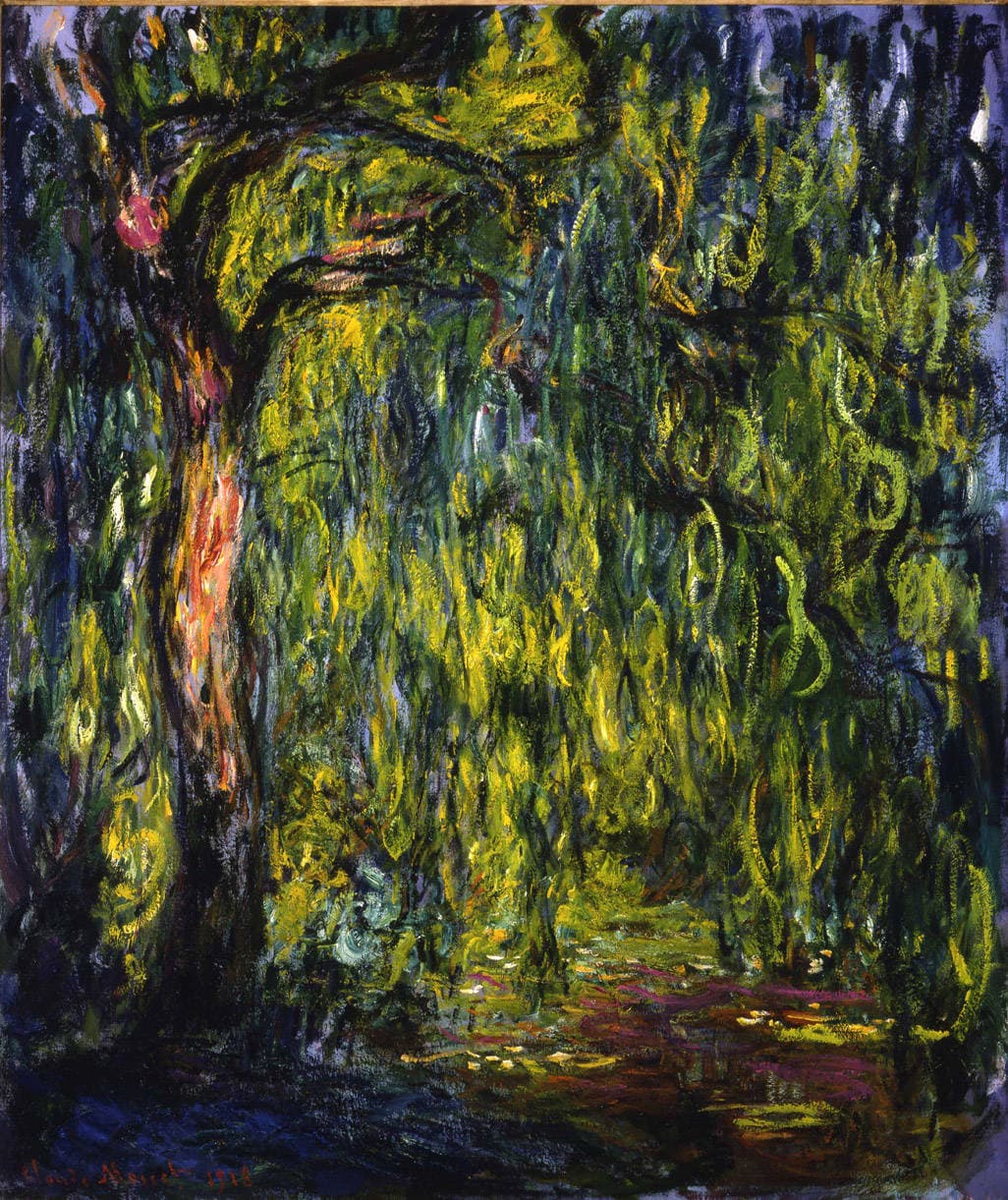
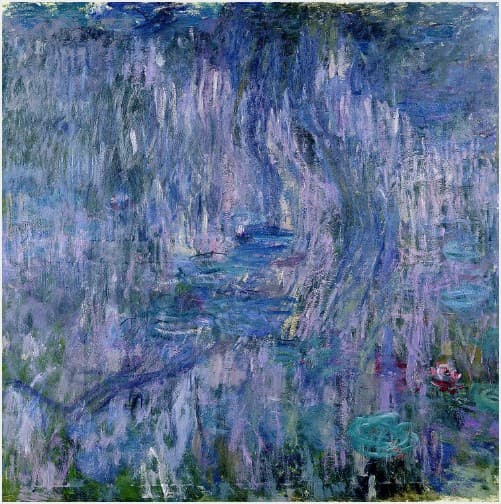
Most willow pictures in the Water Lilies series show the tree only as a reflection. Here it is solid and present, closer to the standing trunks of Weeping Willow (1918) in Columbus and Weeping Willow at the Kimbell, but with the lily pond added on the right. That combination links the willow canvases to pond studies such as Water-Lilies, Reflection of a Weeping Willow.
Willows at Giverny
Monet planted several weeping willows around the pond, and by the 1910s they had grown large enough to overhang the water. He painted at least ten canvases in which a willow trunk is the main subject, mostly in 1918–19, and the tree also appears, reflected, in many of the large water-lily panels. In the Orangerie, one of the eight great compositions is known as The Two Willows. A visitor to the garden today sees replanted willows in roughly the same positions, which makes it possible to stand where Monet stood and see how much of the arrangement in a picture like this one comes straight from the site.
Where to see it
We have not been able to confirm a public collection for this canvas, and it may be in private hands. For the many late Giverny works that are on public view, see where to see Monet's paintings and Giverny: Monet's House and Garden; for the artist, see Claude Monet.
Questions & answers
Where is Monet's Weeping Willow and the Water-Lily Pond?
Its present owner is not recorded in open sources such as Wikidata, and it may be in a private collection. Other willow pictures from the same years are in the Musée d'Orsay, the Columbus Museum of Art and the Kimbell Art Museum.
When was it painted?
It was painted at Giverny around 1916–19. Wikidata gives about 1916–17, while the image on Wikimedia Commons is labeled 1919; both fall within the years Monet repeatedly painted the willows around his pond.
What does the painting show?
A thick weeping-willow trunk, painted in blue, violet and rose, fills the left side. On the right, willow fronds hang over blue water with green lily pads and pink flowers, above a strip of grassy bank.
Why did Monet paint weeping willows?
Willows grew around his water garden, and during the First World War he painted them often, both as trunks and as reflections. Many writers read them as images of mourning in those years, but Monet left no statement saying so.
More by the artist
Claude Monet
Self-Portrait (1917)
Claude Monet · 1917
Water Lilies (Nymphéas), 1915 (Gunma)
Claude Monet · 1915
Water Lilies in Giverny
Claude Monet · 1917
Nymphéas (Water Lilies)
Claude Monet · c. 1914–1919
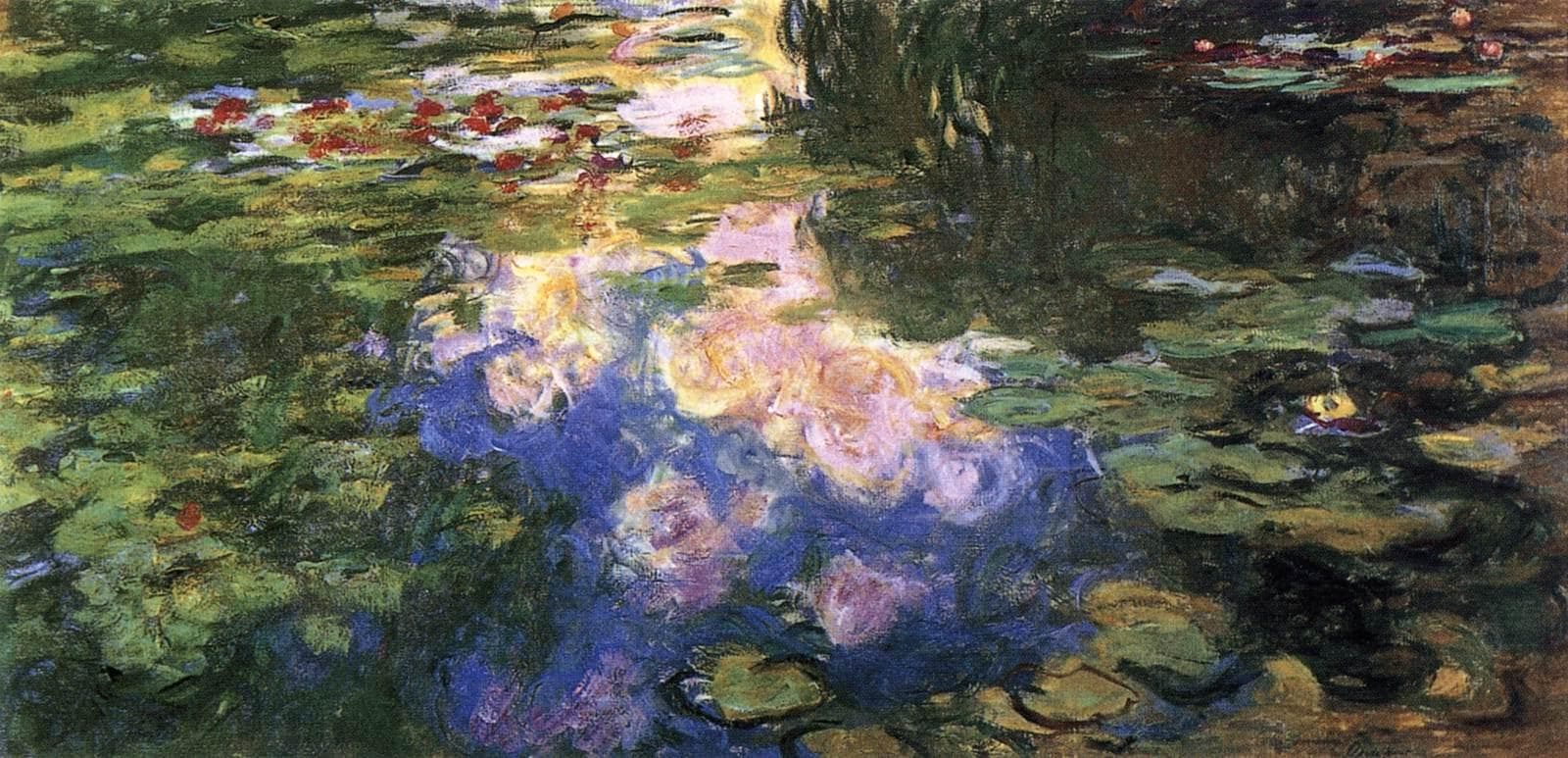
Water-Lily Pond (Le Bassin aux nymphéas), 1917–19
Claude Monet · 1917–19
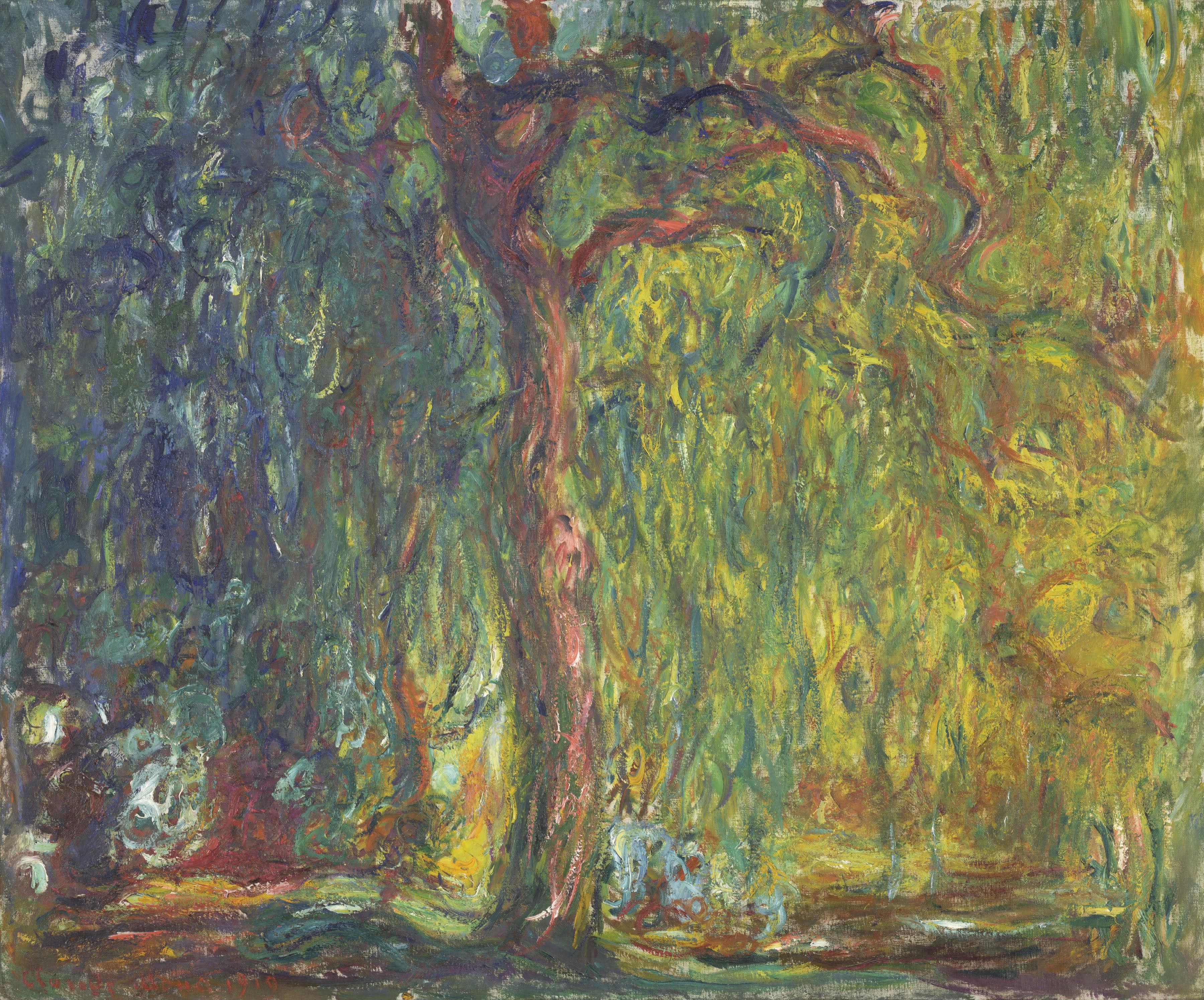
Weeping Willow
Claude Monet · 1918–19
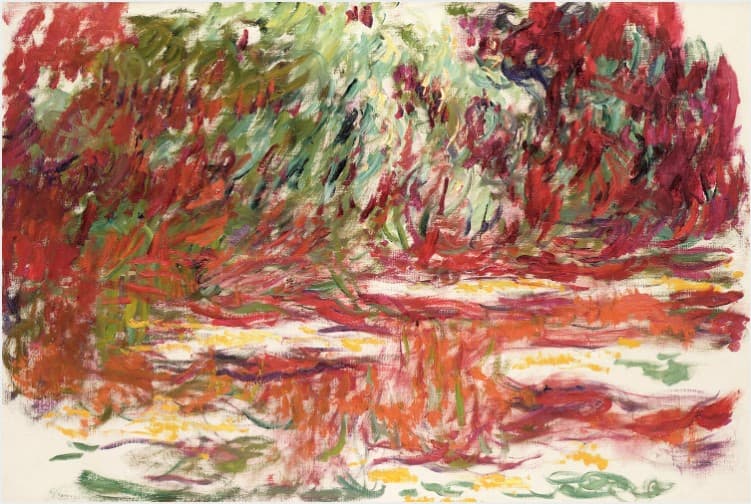
Water-Lily Pond (Bassin aux nymphéas, 1918–19)
Claude Monet · 1918–19
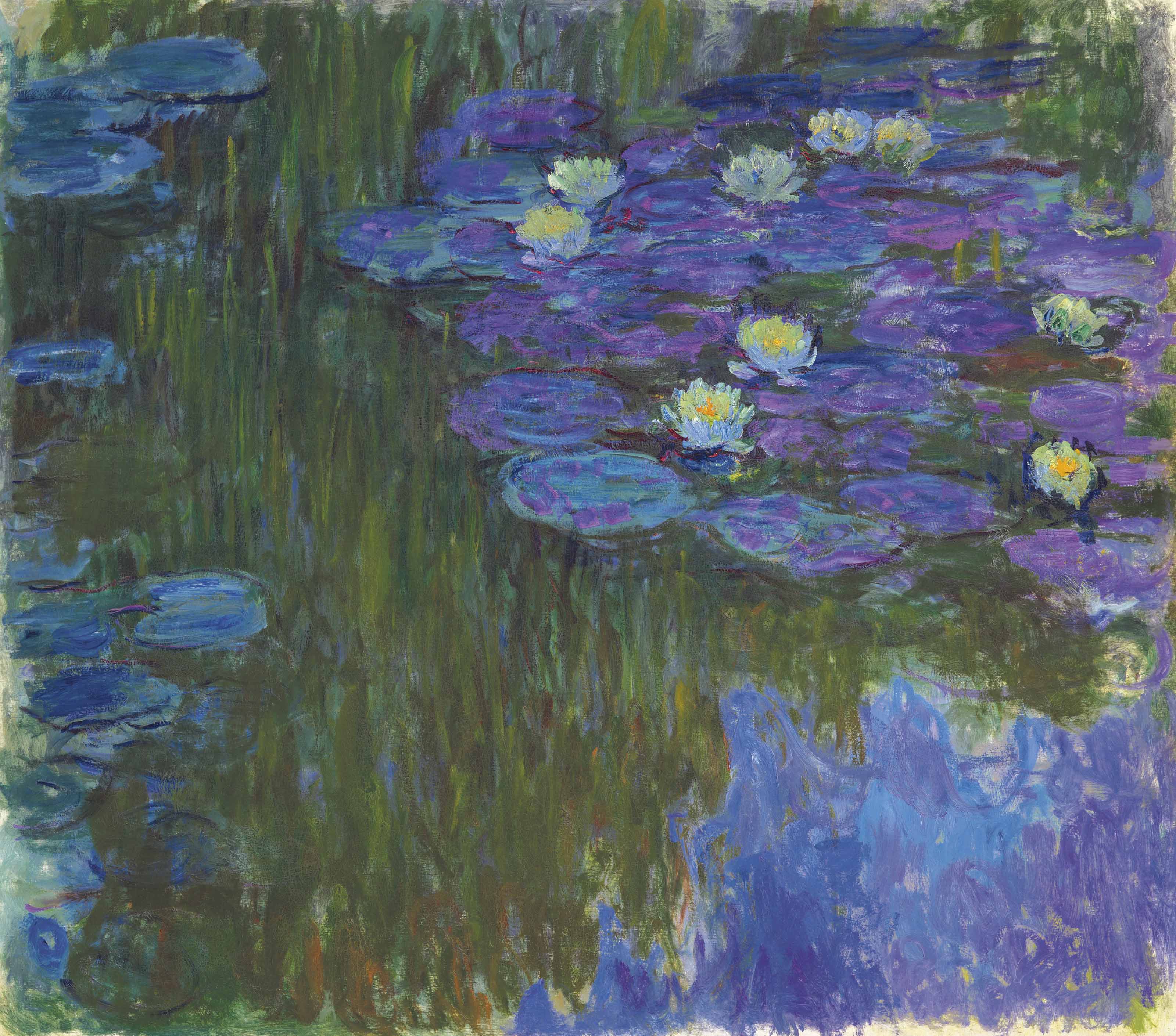
Nymphéas en fleur
Claude Monet · c. 1914–17
Also painted in 1916
The same year
Kindred works
You may also study
Weeping Willow (Columbus)
Claude Monet · 1918
Weeping Willow
Claude Monet · 1920–22
Water-Lilies, Reflection of a Weeping Willow
Claude Monet · 1916–19
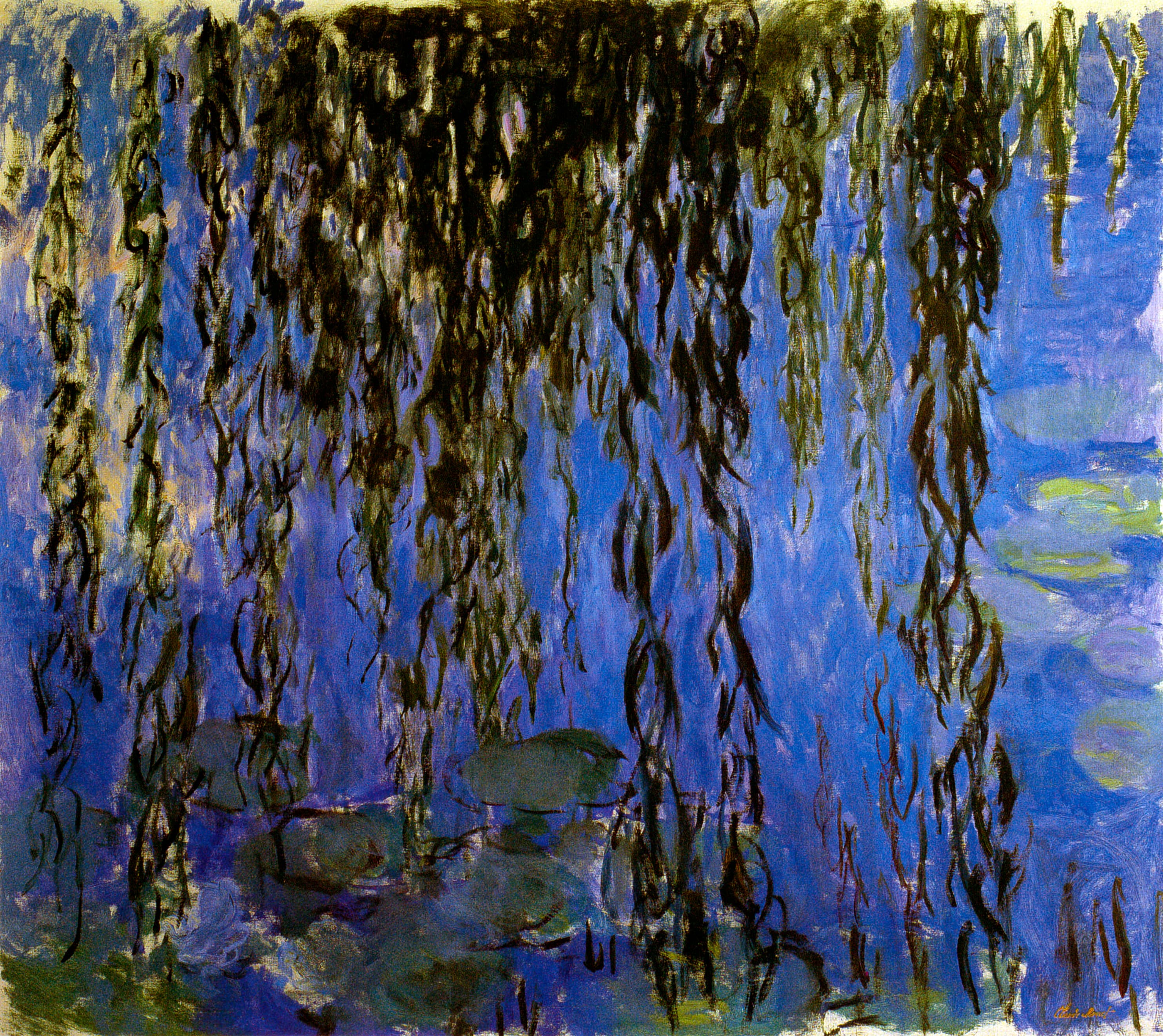
Water Lilies with Willow Branches
Claude Monet · c. 1916–17
Nymphéas (Oyamazaki Villa Museum)
Claude Monet · 1908
Water Lilies (1904, MuMa Le Havre)
Claude Monet · 1904

The Water Lilies: The Clouds
Claude Monet · c. 1914–26
Water Lilies: Setting Sun
Claude Monet · 1914–26