Impressionism
Irises in Monet's Garden at Giverny
Claude Monet, 1900
Irises in Monet's Garden at Giverny, titled The Artist's Garden at Giverny by its owner, is a 1900 Claude Monet painting of violet irises flooding his flower garden, the pink house glimpsed through trees. It belongs to the Musée d'Orsay, Paris.
- Artist
- Claude Monet
- Date
- 1900
- Medium
- Oil on canvas
- Dimensions
- 81.6 × 92.6 cm
- Collection
- Musée d'Orsay, Paris, France
- Movement
- Impressionism
- Catalogue
- Wildenstein W 1624
Painted at Giverny: Monet's House and GardenMore at Monet at the Musée d'Orsay
Claude Monet painted this view of his own flower garden at Giverny in 1900, when the irises were in full bloom. The canvas belongs to the Musée d'Orsay in Paris, which catalogues it as The Artist's Garden at Giverny (Le Jardin de l'artiste à Giverny), inventory RF 1983 6. It is widely reproduced as Irises in Monet's Garden, measures 81.6 by 92.6 centimeters, and is number 1624 in Wildenstein's catalogue.
What you are looking at
The lower two-thirds of the canvas is a sea of irises. Hundreds of violet, lilac and blue-purple flowers are massed in beds that spread from the lower left toward the right, over an underlayer of blue-green leaves. Monet does not paint individual blooms. Each flower is a quick twist or dab of violet, often touched with white where the light catches a petal, and the spiky leaves are single upright strokes of green and yellow.
A path of pinkish-brown earth enters at the lower right, curves up between the beds and swings off to the left, giving the eye a route into the garden. Its warm color is the complement of the violet around it, so the path glows. In the middle distance at left, a few low mounds of coral and pink flowers interrupt the purple; Monet gives no botanical detail, and they could be roses, peonies or another spring planting.
The upper third is dark and dense. A few thin trunks rise through the garden, the most prominent near the center, and their foliage hangs down like a curtain of rust, red, olive and green strokes, almost all vertical. Through a gap in the center we glimpse the house: a patch of salmon-pink wall, green shutters, a bit of white, and blue-green trellis, lit by sun. At the upper right the foliage opens into lighter, cooler greens.
The detail most viewers miss is how little of the house Monet allows us. The building he loved, and which visitors now queue to enter, is reduced to a few flat patches of color that serve the harmony of the picture, pink set against violet and green.
Where and when was it painted?
Monet rented the long pink farmhouse at Giverny in 1883 and bought it in 1890. In front of it he laid out the flower garden known as the Clos Normand, a grid of beds planted in dense, color-coordinated masses, and across the road he dug the water garden. By 1900 he spent most of his working life on the property, painting one or the other. More on the house and grounds is on our Giverny page.
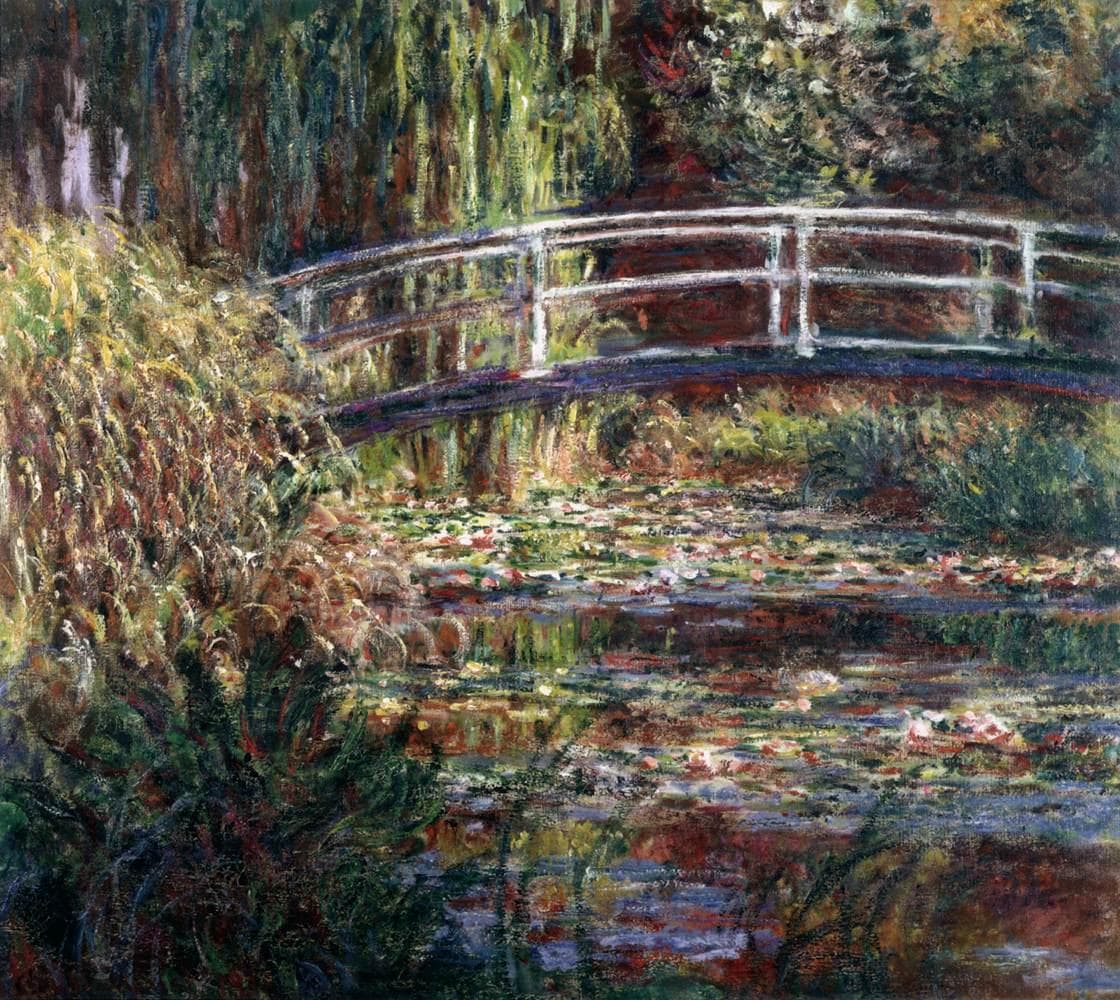
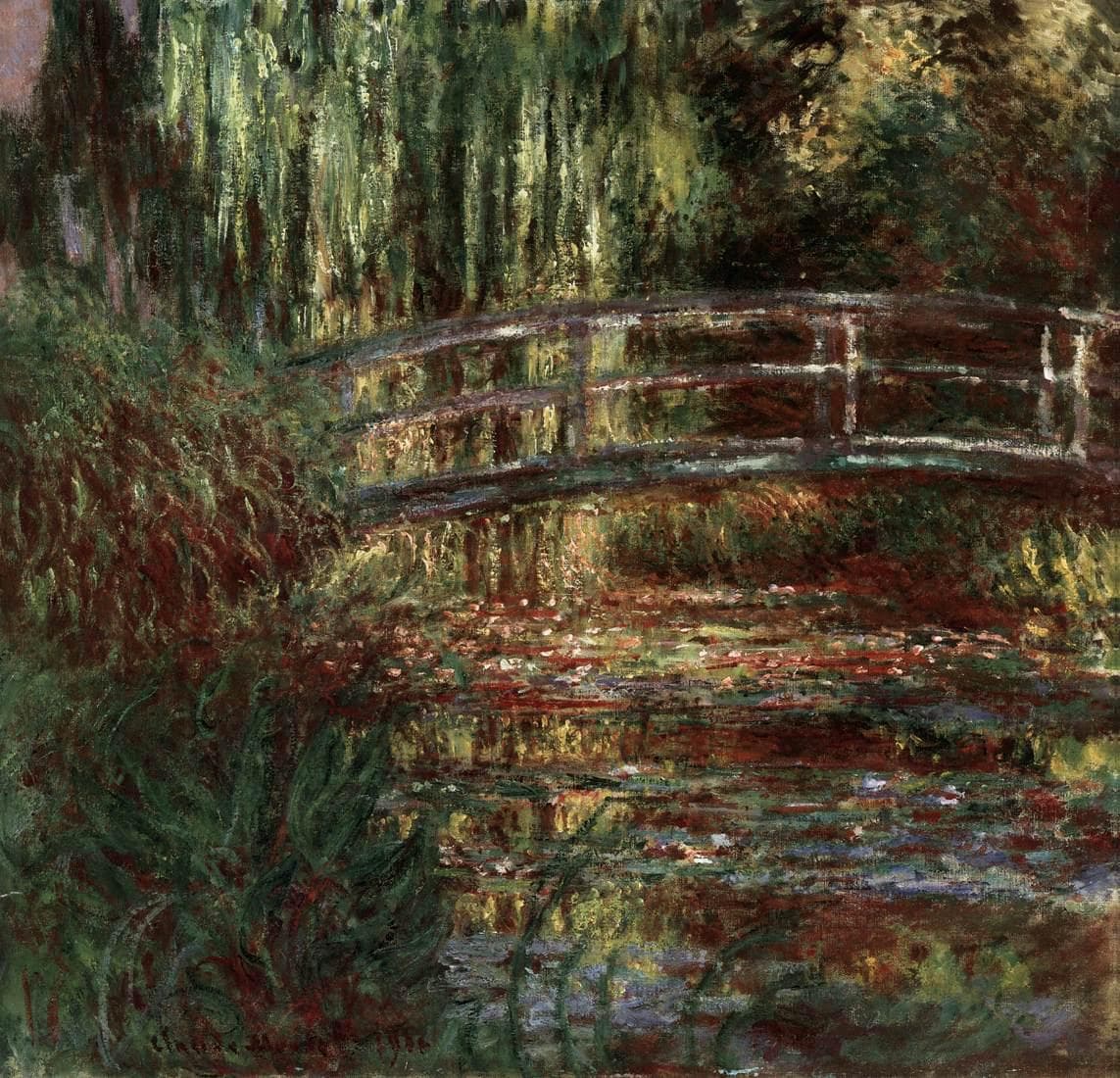
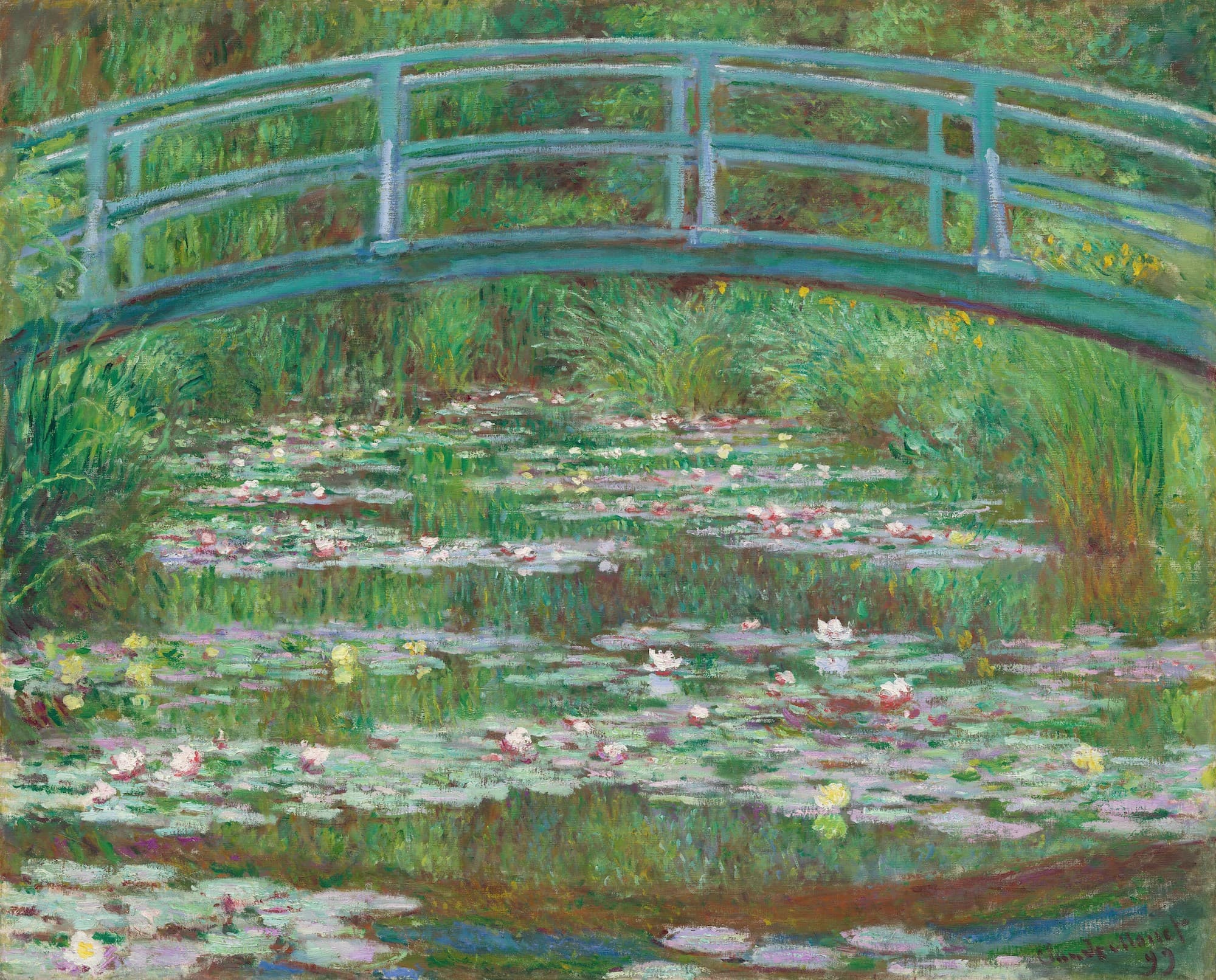
The same years produced the first group of pictures of the water garden's footbridge, such as The Japanese Footbridge, gathered on our Japanese Footbridge page. This canvas turns the other way, toward the house, and shows the flower garden at its springtime peak.
How was it painted?
Monet designed this garden like a painter, and here he paints it as he planned it: as a field of one dominant color. The violet of the irises sets off the pink of the house and the warm reds of the trees, and he keeps the yellow-greens of the leaves small so they sparkle rather than compete.
The brushwork is energetic and fairly thick. Short, curving strokes describe the flowers; long vertical strokes describe the hanging foliage, so the top and bottom halves of the picture have different rhythms. The composition is unusually closed. There is no sky at all, and the high, dark canopy presses down on the flowers, pulling us inside the garden rather than presenting it as a view.
How does it fit among Monet's iris paintings?
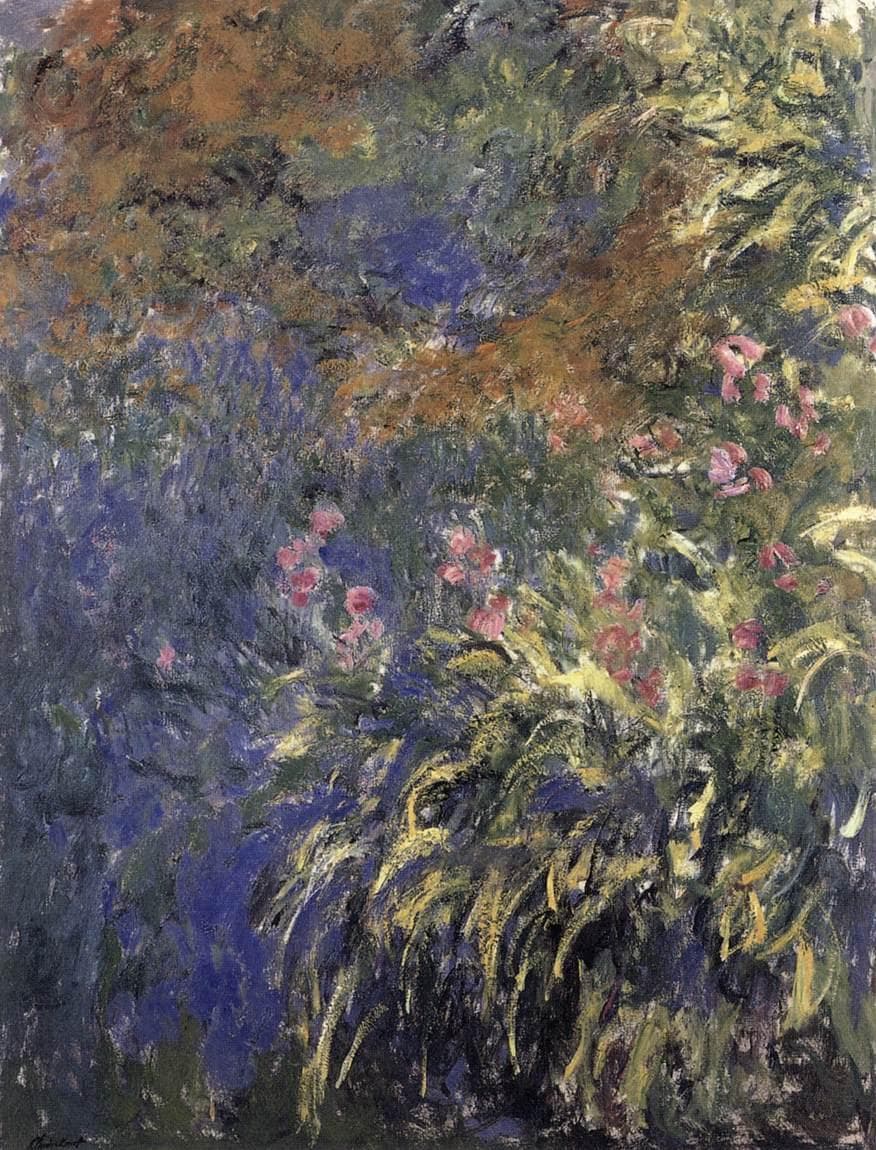
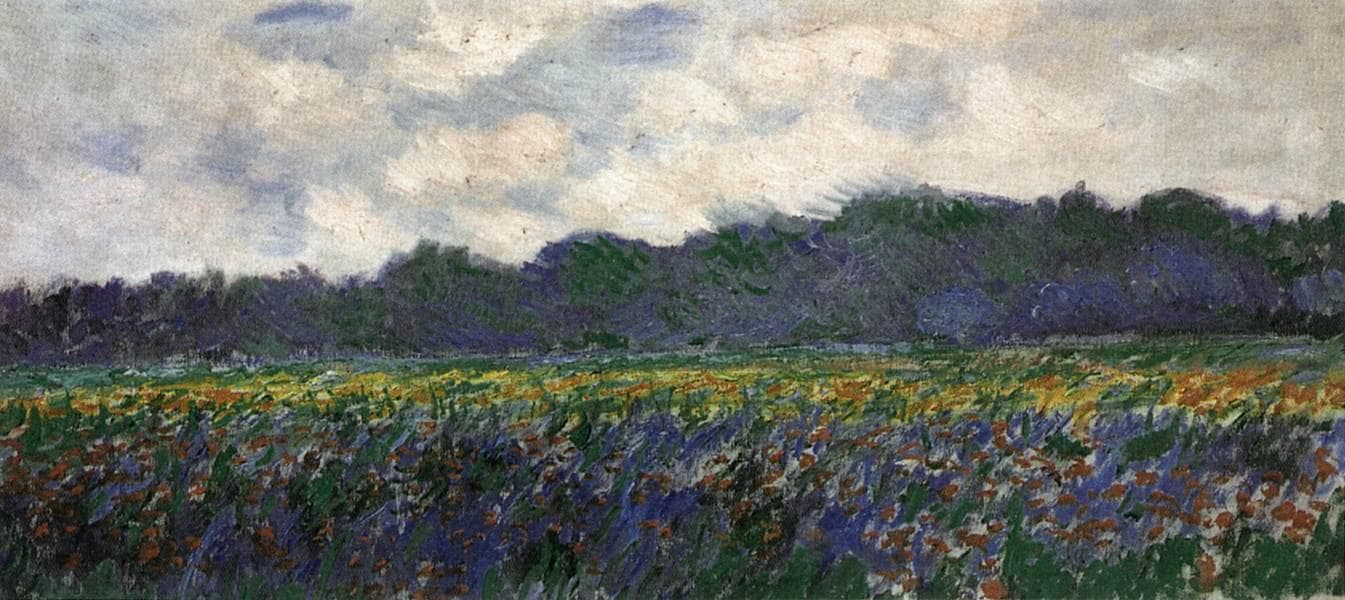
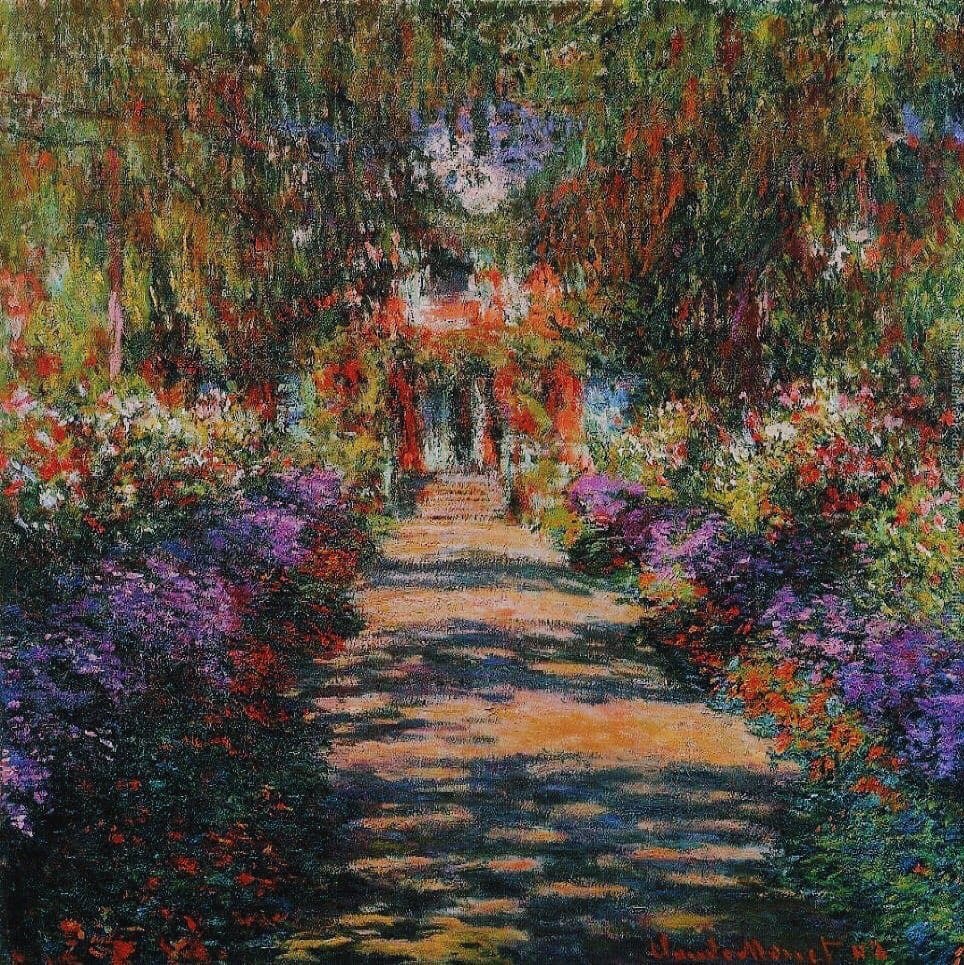
Irises appear throughout Monet's Giverny work. The earlier Field of Yellow Irises at Giverny of 1887 shows wild yellow flags in an open meadow. Two years after this picture, The Garden Path at Giverny of 1902 looks straight down the central walk of the same flower garden. In the 1910s the irises grow to monumental scale in close-up canvases like Irises by the Pond, where the house, path and trees have vanished and only leaves, blooms and water remain.
This 1900 picture sits halfway between those poles. It still describes a real place, with a path and a house, but the flowers have already become a mass of color rather than a collection of plants.
Where can you see it?
The painting belongs to the Musée d'Orsay in Paris, whose Monet holdings are among the richest anywhere. The garden itself, restored, is open to visitors at Giverny from spring to autumn. Irises usually flower there in May and early June, the best time to compare the scene with the painting.
Questions & answers
Where is Monet's painting of irises in his garden at Giverny?
This 1900 canvas belongs to the Musée d'Orsay in Paris, inventory RF 1983 6, where it is titled The Artist's Garden at Giverny. It measures 81.6 by 92.6 centimeters and shows violet irises filling the flower beds in front of Monet's pink house. A much larger, later iris painting is in the Virginia Museum of Fine Arts.
When and where did Monet paint this garden picture?
He painted it in 1900 in the Clos Normand, the flower garden he designed in front of his house at Giverny, in Normandy, where he had lived since 1883. The irises are shown at their peak, which in Giverny usually means May or early June. That year he was also painting the footbridge in his water garden across the road.
What does The Artist's Garden at Giverny show?
It shows beds of violet irises spreading across the lower part of the canvas, crossed by a curving pinkish-brown path, with mounds of coral flowers at left. Above, thin trees and hanging red and green foliage frame a glimpse of Monet's pink house with green shutters. The picture is built on the contrast of violet with pink and green.
Did Monet paint other pictures of irises?
Yes, many. Field of Yellow Irises at Giverny of 1887 shows wild irises in a meadow, The Garden Path at Giverny of 1902 shows the same flower garden from its central walk, and around 1914–17 he painted large close-up canvases of irises at the edge of his pond, such as Irises by the Pond in Richmond, Virginia.
More by the artist
Claude Monet

Bridge over a Pond of Water Lilies
Claude Monet · 1899

Woman with a Parasol – Madame Monet and Her Son
Claude Monet · 1875

Sunset in Venice
Claude Monet · 1908–12

La Grenouillère
Claude Monet · 1869

Beach in Pourville
Claude Monet · 1882

Springtime
Claude Monet · 1872

Boating on the River Epte
Claude Monet · 1890

The Seine at Asnières (Hermitage)
Claude Monet · 1873
Also painted in 1900
The same year
Kindred works
You may also study
Irises by the Pond
Claude Monet · c. 1914–17
Field of Yellow Irises at Giverny
Claude Monet · 1887
The Garden Path at Giverny
Claude Monet · 1902
The Japanese Footbridge
Claude Monet · 1899

The Scream
Edvard Munch · 1893

Ophelia
John Everett Millais · 1851–52

The Great Wave off Kanagawa
Katsushika Hokusai · c. 1830–32

Wanderer above the Sea of Fog
Caspar David Friedrich · c. 1817