Impressionism
The Grand Canal in Venice
Claude Monet, 1908
The Grand Canal (Le Grand Canal) is a 1908 painting by Claude Monet of mooring poles in the Grand Canal before the domes of Santa Maria della Salute, wrapped in violet haze. It is in the Museum of Fine Arts, Boston.
- Artist
- Claude Monet
- Date
- 1908
- Medium
- Oil on canvas
- Dimensions
- 73.7 × 92.4 cm
- Collection
- Museum of Fine Arts, Boston, Boston, United States
- Movement
- Impressionism
- Catalogue
- Wildenstein 1738
Painted at Monet in VeniceMore at Monet at the MFA Boston
What you are looking at
A row of wooden mooring poles stands in the water in the foreground: one tall and dark, almost black-violet, just left of center, running off the top of the canvas; others leaning at different angles to the left, striped rust, gold and blue. Behind them, across the Grand Canal, the domes of the church of Santa Maria della Salute rise in soft pink and lavender, the large dome and the smaller one beside it, with the cupola and statues of the Dogana and the buildings to the right dissolving into a warm, violet-gold haze. At far left, in the distance, a few gondolas and the shapes of more poles are just visible.
The water fills the lower third of the picture, a field of short, broken horizontal strokes of blue, green, mauve and gold, into which the reflections of the poles wriggle down. The sky is a hazy mix of lilac, rose and grey. Monet signed and dated the canvas at lower right.
Claude Monet painted the view in Venice in the autumn of 1908. This canvas measures 73.7 by 92.4 centimeters, is number 1738 in Wildenstein's catalogue, and belongs to the Museum of Fine Arts, Boston.
Where and when
Monet went to Venice only once, from early October to early December 1908, at the age of 68, with his wife Alice. They stayed first at the Palazzo Barbaro on the Grand Canal, as guests of the American hostess Ariana Curtis, and then at the Grand Hotel Britannia. The Barbaro, owned by the Boston-born Curtis family, had earlier welcomed Henry James and John Singer Sargent.
Monet had long resisted the trip, saying Venice was too beautiful to be painted. Once there, he worked steadily, beginning more than thirty canvases that he finished at Giverny. Twenty-nine were shown at the Bernheim-Jeune gallery in Paris in 1912, a year after Alice's death. See Monet in Venice.
The view looks down the Grand Canal toward the Salute and is usually said to have been painted from the water steps of the Palazzo Barbaro, a short way up the canal, so that the poles stand between the painter and the church. Monet painted the motif several times; another version is in the Fine Arts Museums of San Francisco.
How it was painted
The poles are the key. Their verticals set a rhythm that holds the picture together, and their dark color pushes the domes back into the haze. Monet makes the most solid building in Venice, a Baroque church of white Istrian stone, look like a cloud. Look at the large dome: its outline is soft, built from short curving strokes of pink and violet, with a single warm highlight on its left side.
The water is as carefully painted as anything in the picture. Each stroke is a separate color, laid side by side, and the reflections of the poles are zigzags that break apart as the water moves. Notice the color harmony: almost everything is a variation of violet, rose, blue and gold, with no strong contrasts of light and dark except the tall central pole. Monet was painting the Venetian atmosphere, not the city's architecture, the same approach he had taken in London a few years before.
The motif and its siblings
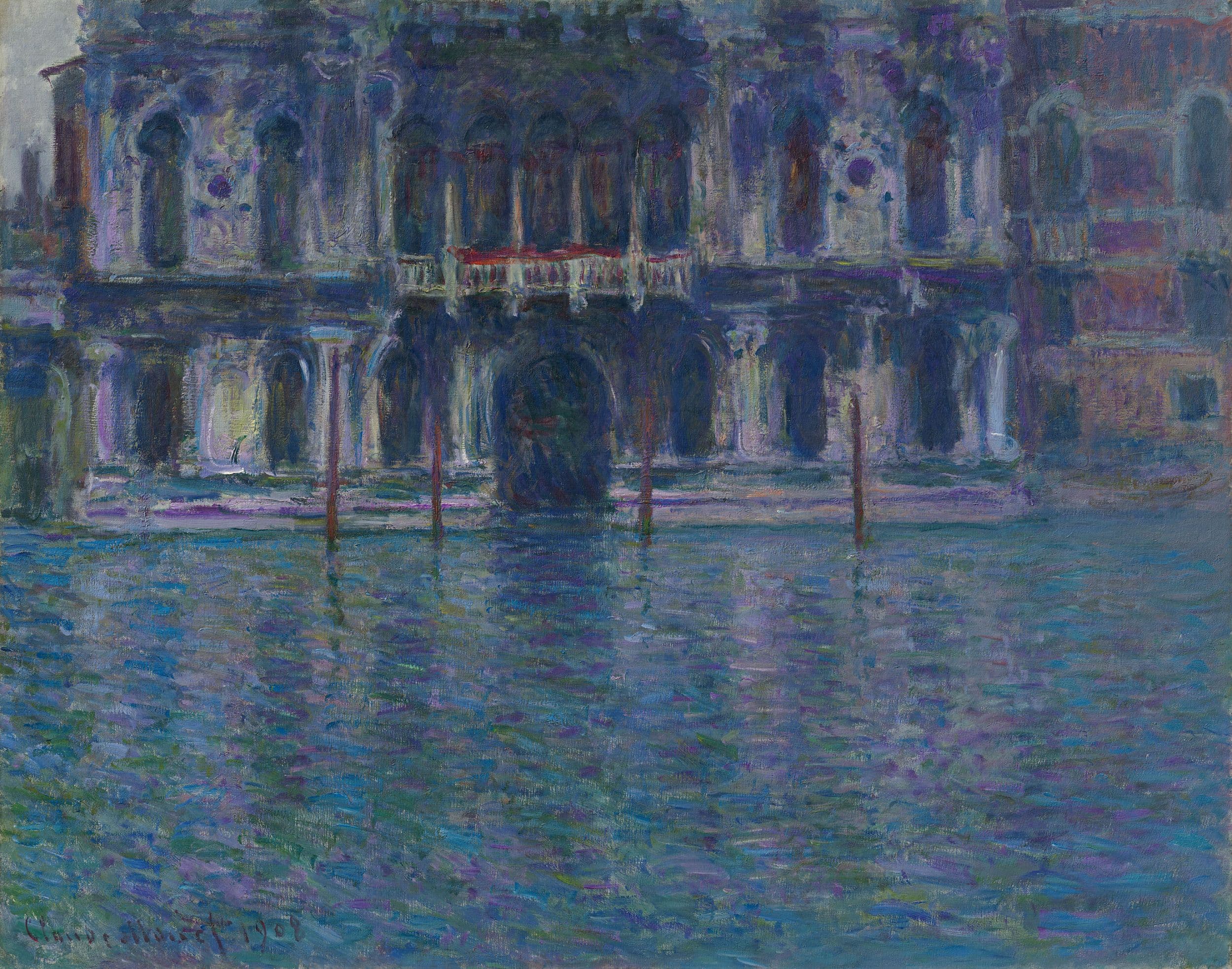
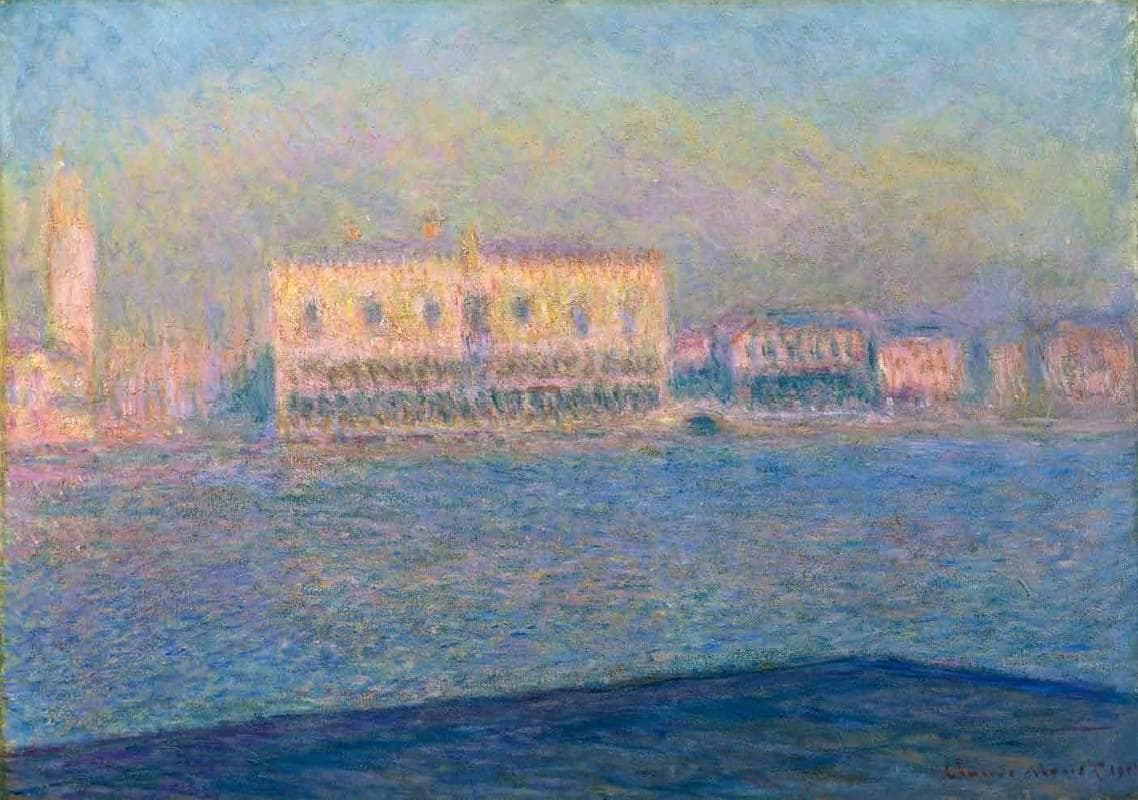
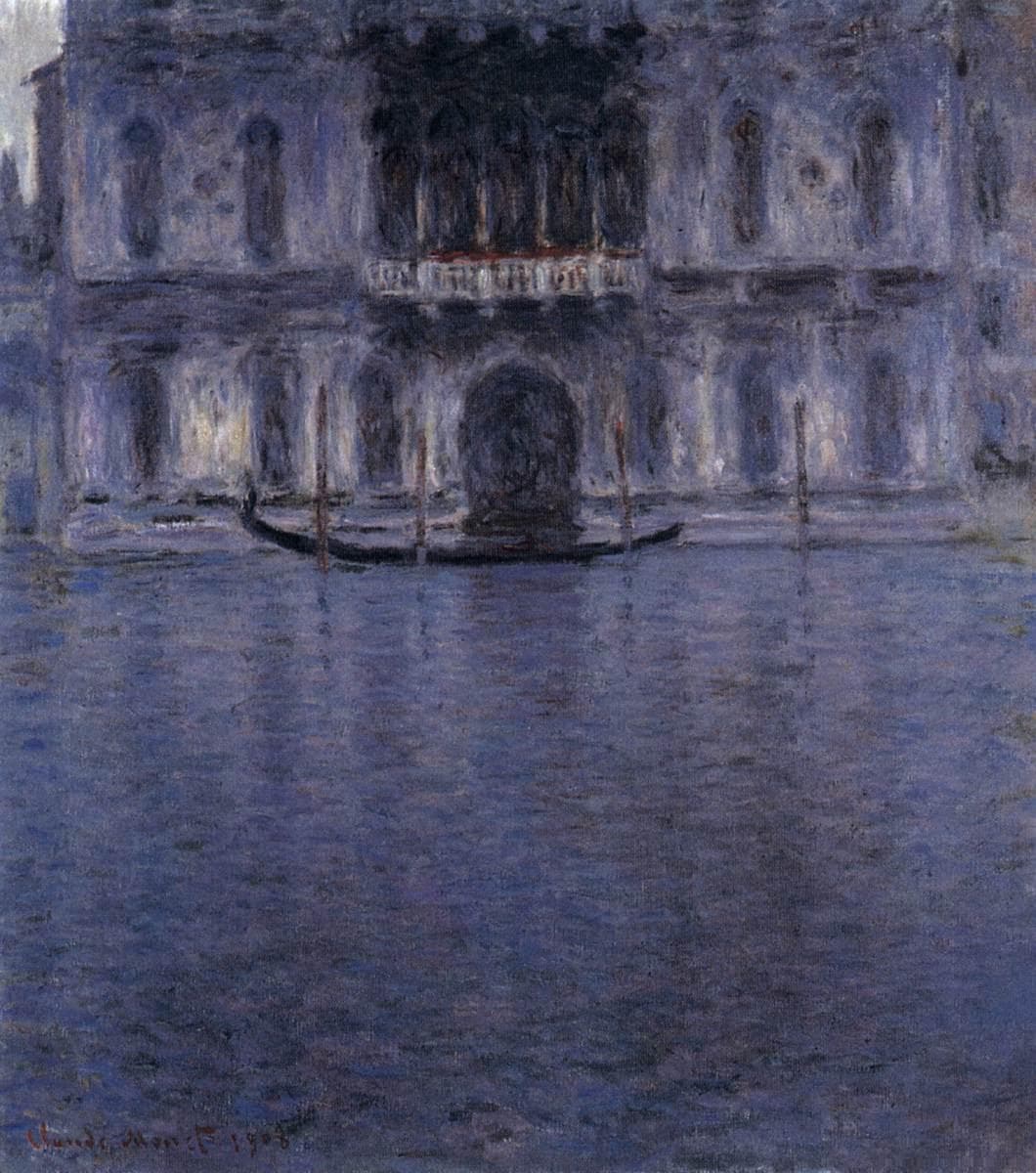
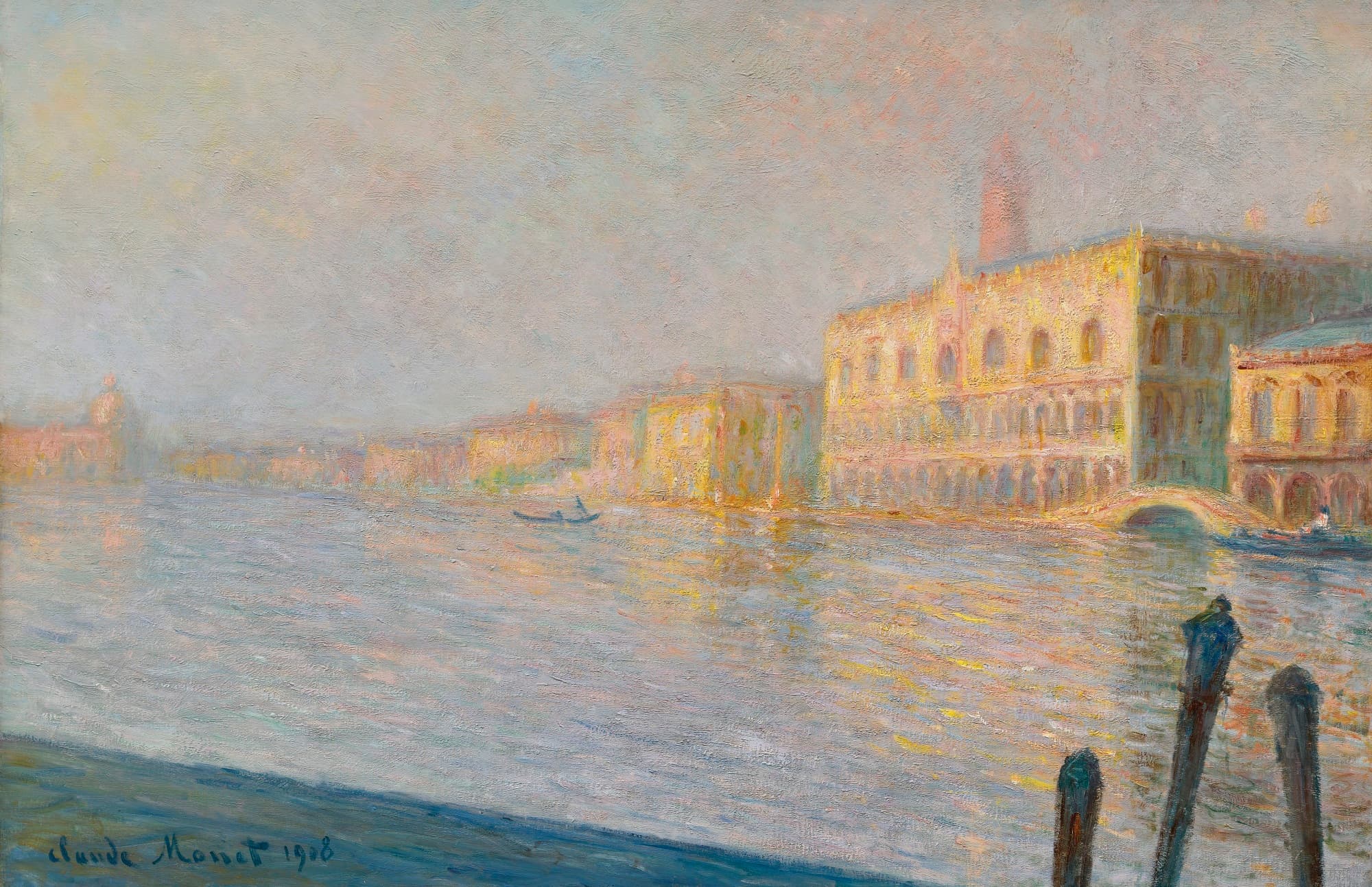
The Grand Canal and the Salute are one of several Venetian motifs Monet painted in series in 1908. The Doge's Palace appears in The Palazzo Ducale Seen from San Giorgio Maggiore and Le Palais ducal; the Gothic façade of Palazzo Contarini rises straight from the water; and San Giorgio Maggiore glows at dusk in Sunset in Venice in Cardiff. Compare too the hazy Thames views of the Houses of Parliament series.
Where to see it
The painting is in the Museum of Fine Arts, Boston, which has one of the largest Monet collections outside France: see Monet at the MFA Boston. For the artist's life and later work, see Claude Monet.
Questions & answers
Where is Monet's The Grand Canal?
This 1908 version is in the Museum of Fine Arts, Boston. It measures 73.7 by 92.4 centimeters and is catalogued by Wildenstein as number 1738. Monet painted the same view of the Salute several times; another version is in San Francisco.
When did Monet go to Venice?
Monet visited Venice once, from early October to early December 1908, with his wife Alice. He stayed at the Palazzo Barbaro and then the Grand Hotel Britannia, began more than thirty canvases and finished them at Giverny.
What does Monet's Grand Canal show?
Wooden mooring poles in the Grand Canal in the foreground, and beyond them the domes of the church of Santa Maria della Salute and the buildings around it, dissolved in a pink, violet and gold haze above shimmering water.
What is the church in Monet's Grand Canal?
It is Santa Maria della Salute, the domed Baroque church at the entrance to the Grand Canal, built in thanksgiving after the plague of 1630. Monet shows its two domes softened by haze behind the mooring poles.
More by the artist
Claude Monet

Bridge over a Pond of Water Lilies
Claude Monet · 1899

Woman with a Parasol – Madame Monet and Her Son
Claude Monet · 1875

Sunset in Venice
Claude Monet · 1908–12

La Grenouillère
Claude Monet · 1869

Beach in Pourville
Claude Monet · 1882

Springtime
Claude Monet · 1872

Boating on the River Epte
Claude Monet · 1890

The Seine at Asnières (Hermitage)
Claude Monet · 1873
Also painted in 1908
The same year
Kindred works
You may also study
The Palazzo Ducale Seen from San Giorgio Maggiore
Claude Monet · 1908
Palazzo Contarini
Claude Monet · 1908
The Palazzo Ducale (Le Palais Ducal), 1908
Claude Monet · 1908
Gondola in Venice
Claude Monet · 1908

Ophelia
John Everett Millais · 1851–52

The Great Wave off Kanagawa
Katsushika Hokusai · c. 1830–32
The Birth of Venus
Sandro Botticelli · c. 1484–1486
The School of Athens
Raphael · 1509–1511