Impressionism
Gare Saint-Lazare: the Train from Normandy
Claude Monet, 1877
Gare Saint-Lazare: the Train from Normandy is an 1877 painting by Claude Monet of a steam locomotive arriving under the glass-and-iron shed of the Paris station. One of his twelve Saint-Lazare canvases, it is in the Art Institute of Chicago.
- Artist
- Claude Monet
- Date
- 1877
- Medium
- Oil on canvas
- Dimensions
- 60.3 × 80.2 cm
- Collection
- Art Institute of Chicago, Chicago, United States
- Movement
- Impressionism
- Catalogue
- Wildenstein 440
What you are looking at
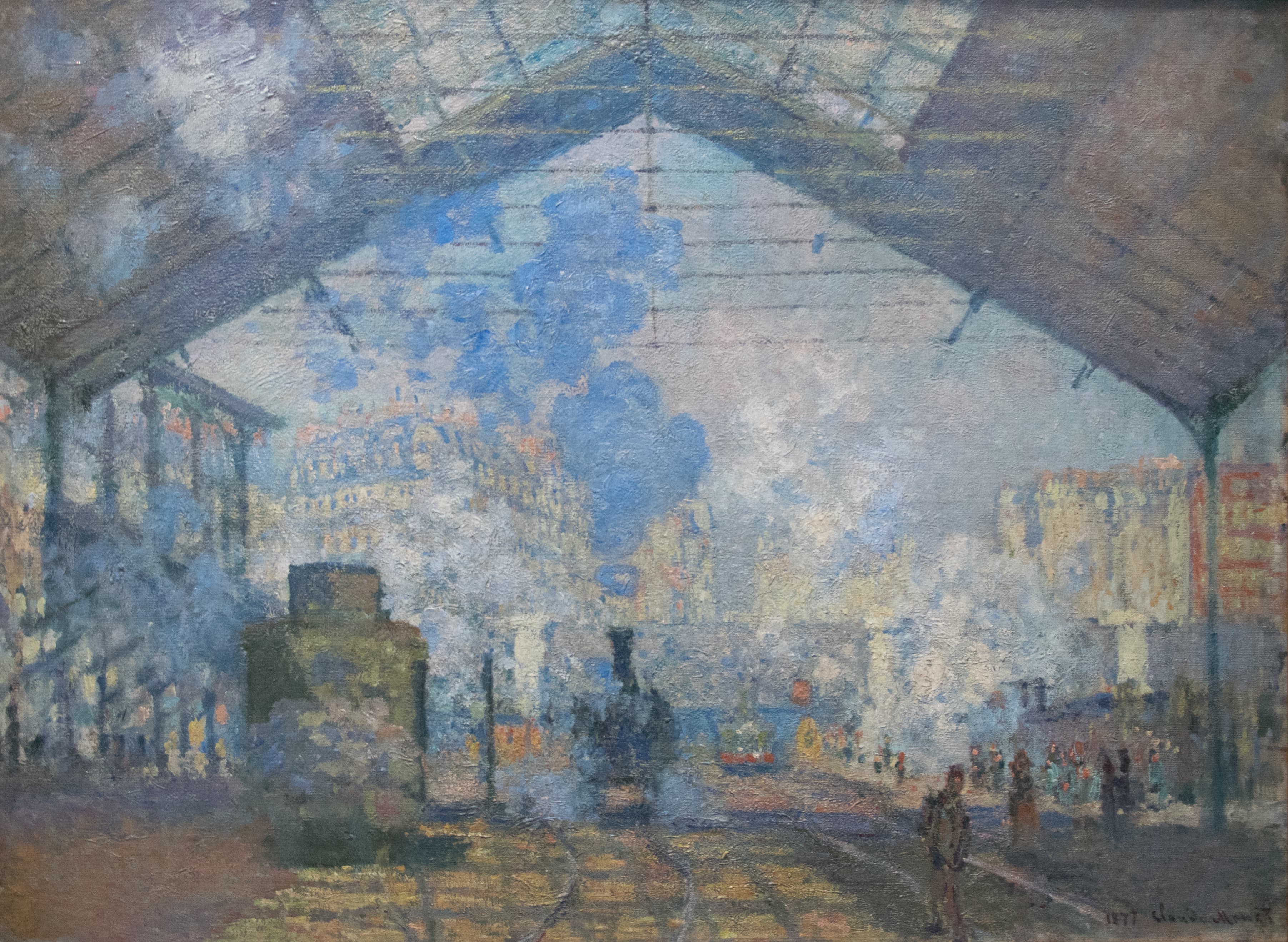
We stand on a platform inside a great railway shed. Overhead, the dark iron trusses of the roof slant down from left and right, their glazing grey-green with soot. A black locomotive has just pulled in at the center, and from its funnel a cloud of steam billows up into the roof, white and blue and grey, spreading under the glass. To the left, more trains and wagons stand on the tracks; to the right, a dense crowd of passengers waits along the platform. A single gas lamp on a slender post stands in the foreground. Beyond the open end of the shed, through haze, we glimpse the buildings of the city.
Claude Monet painted this picture in early 1877 at the Gare Saint-Lazare, the Paris terminus for trains from Normandy and the western suburbs. It is in the Art Institute of Chicago, which titles it Arrival of the Normandy Train, Gare Saint-Lazare. It measures 60.3 by 80.2 centimeters and is signed and dated "Claude Monet 77" at lower left.
Looking closely
The steam is the true subject. Monet paints it in thick, swirling strokes of white tinged with blue, lilac and grey, so dense in places it seems almost solid. Where it meets the roof it softens into the light coming through the glass. Where it drifts left across the open end of the shed, it dissolves the distant buildings into pale shapes.
Against this vapor the hard, dark forms of modern engineering stand out: the black bulk of the locomotive, the angled trusses, the thin vertical of the lamp post. The contrast between the solid and the vaporous, iron and air, is what gives the picture its drama.
Look at the floor. The platform is painted in broad greenish strokes with patches of brown and grey, the color of cinders and wet stone. The figures are a frieze of dark verticals, abbreviated almost to marks; Monet is interested in the crowd as a mass, not in individuals. A few stand out on closer inspection: a man walking along the tracks at left, a figure perched on top of a wagon, a cluster of porters near the engine. They give scale to the shed, which dwarfs them all, and they remind us that this is a working place, not a backdrop. And notice the composition: the roof forms a great inverted V that frames the steam cloud, an architecture of lines Monet uses to give structure to something formless.
Monet's Saint-Lazare series
In January 1877, Monet obtained permission from the Western Railway Company to paint inside the Gare Saint-Lazare. He took a small studio nearby and over a few months produced twelve canvases of the station: the shed from inside, the tracks from the platform ends, and the Pont de l'Europe, the iron bridge that crossed the tracks outside. Several of them, including works related to this one, were shown at the third Impressionist exhibition in April 1877.
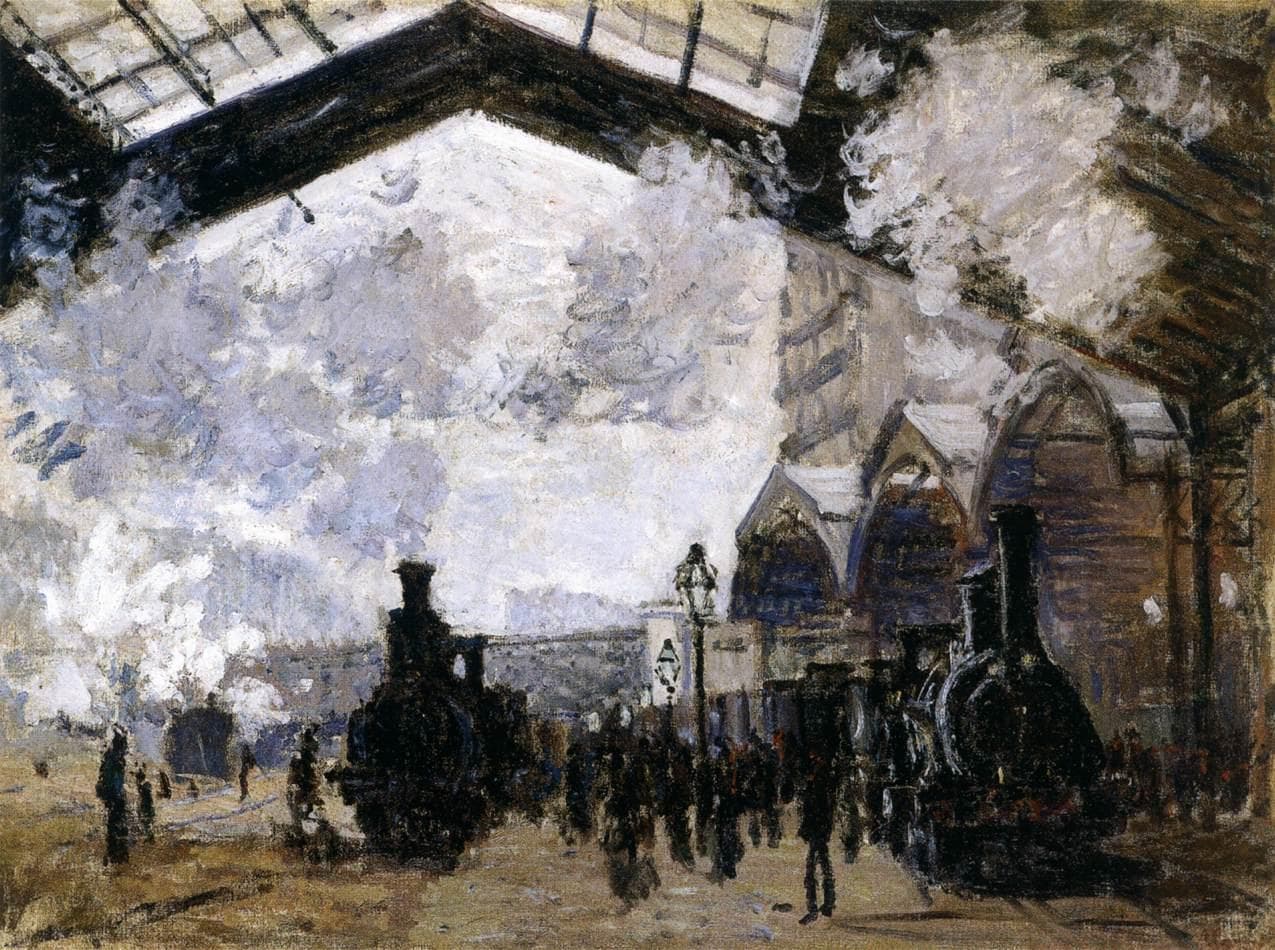
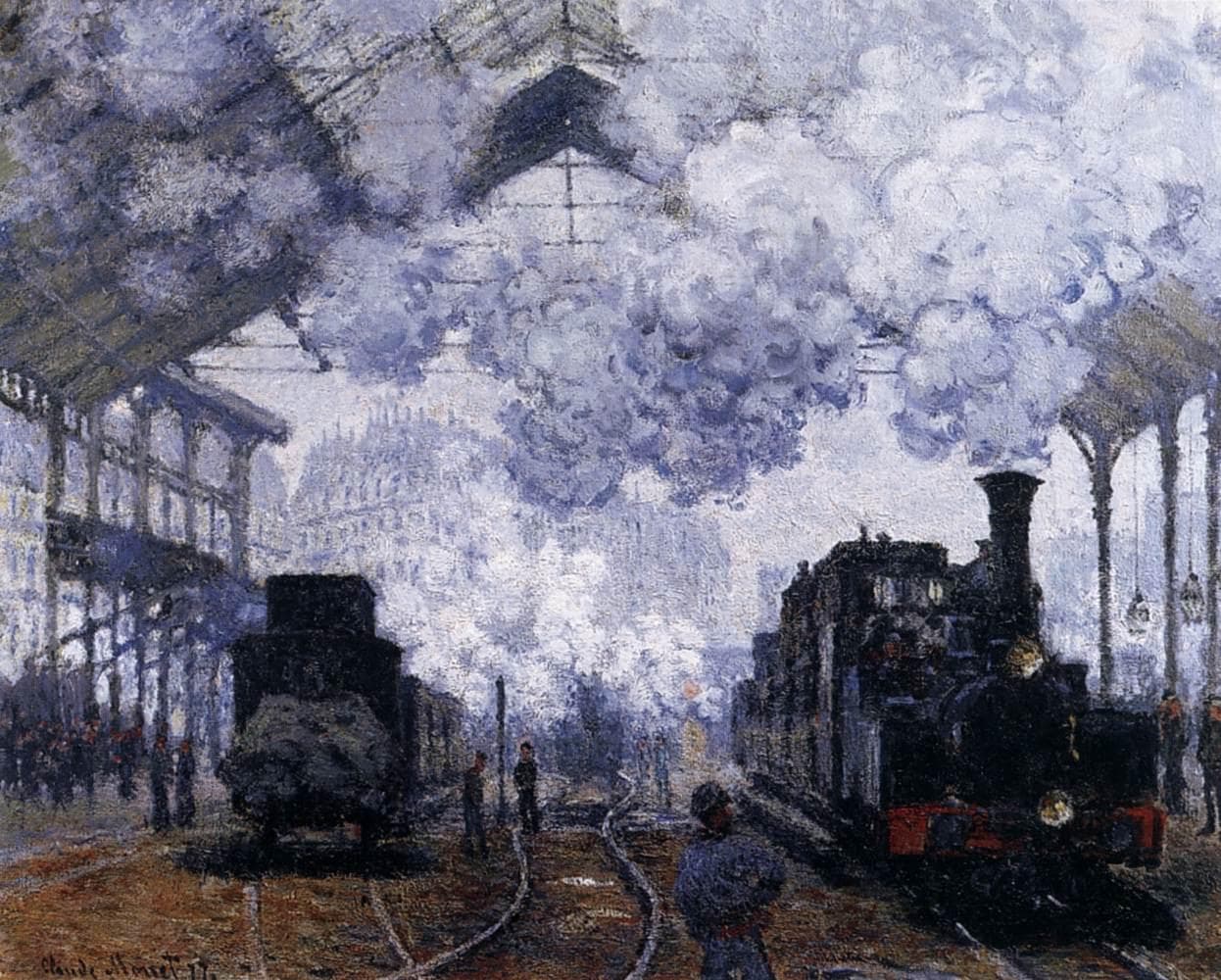
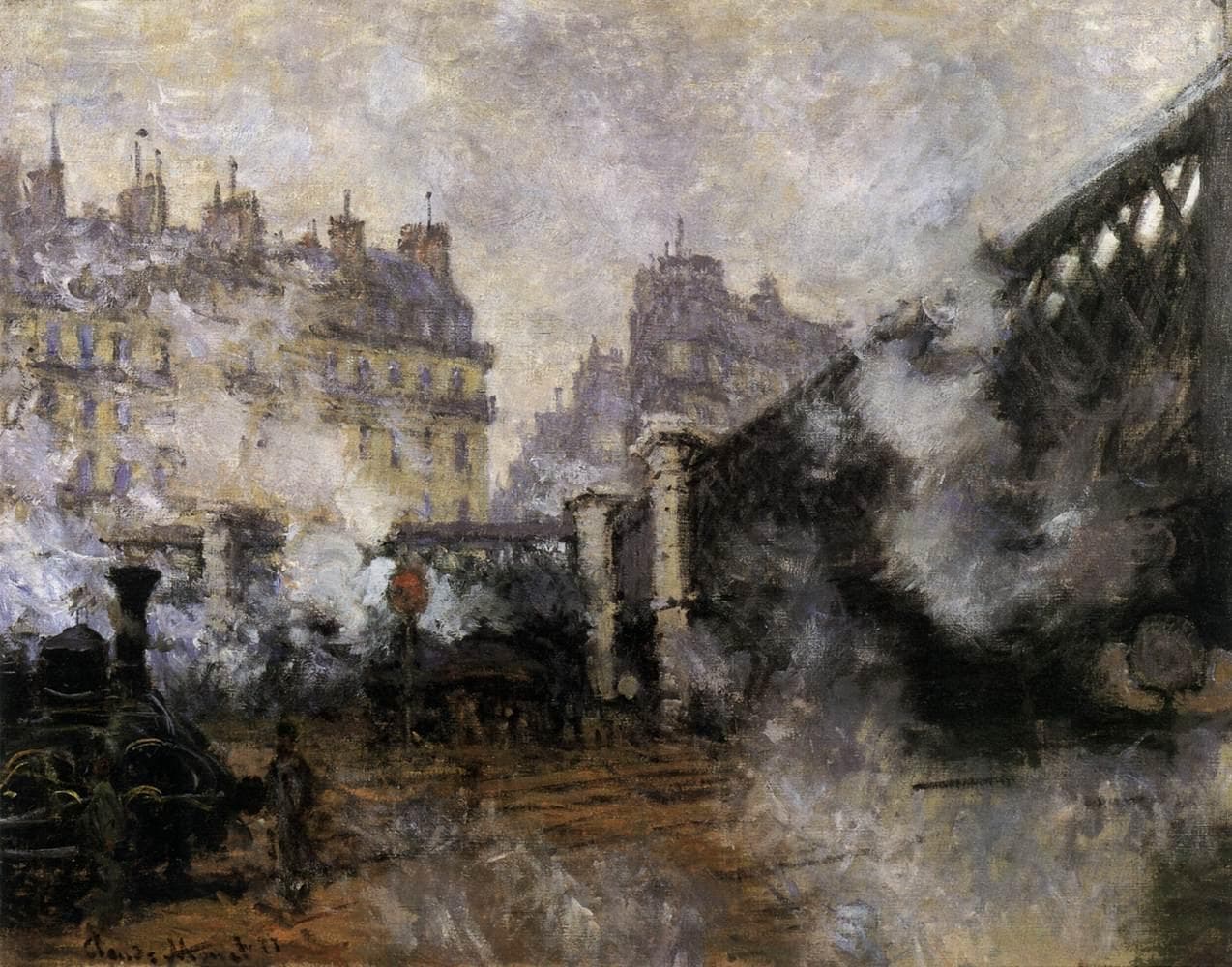
Compare the more famous version in the Musée d'Orsay, Gare Saint-Lazare, which shows the shed from a similar angle with a locomotive at left; the Harvard Art Museums' The Gare Saint-Lazare, Arriving a Train; and Pont de l'Europe, Gare Saint-Lazare, painted from the tracks outside. Together they are one of Monet's first true series, painting the same subject under shifting conditions.
What it meant in 1877
A train station was a startling subject for a painting. Railways had transformed France within a generation, and the Gare Saint-Lazare, rebuilt in the 1850s and 1860s, was one of the city's emblems of modernity. Painters had shown trains before, notably J. M. W. Turner in Rain, Steam and Speed (1844), which Monet may have seen during his stay in London in 1870–71. But few had made the interior of a station into a subject in its own right, and none had returned to it again and again, as Monet did, to see how the same space changed with the hour, the weather and the volume of steam.
Critics took notice. The novelist Émile Zola, a champion of the Impressionists, wrote that Monet's station pictures captured the roar of the arriving trains and the steam rolling under the vast sheds, and that this was the painting of the time, as earlier generations had found poetry in forests and rivers. That idea, that modern life deserved the attention once given to history and myth, is at the heart of Impressionism.
Where to see it
The painting is in the Art Institute of Chicago, part of the Mr. and Mrs. Martin A. Ryerson Collection (accession 1933.1158), and the museum makes its image available as public domain. The Art Institute has one of the world's great Monet collections, including canvases from the Grainstacks series. For more, see our guide to famous Monet paintings.
Questions & answers
Where is Monet's Gare Saint-Lazare: the Train from Normandy?
It is in the Art Institute of Chicago, which calls it Arrival of the Normandy Train, Gare Saint-Lazare. It is part of the Mr. and Mrs. Martin A. Ryerson Collection, measures 60.3 by 80.2 centimeters, and is signed and dated 1877.
How many Gare Saint-Lazare paintings did Monet make?
Monet painted twelve canvases of the Gare Saint-Lazare and its surroundings in early 1877. They are now divided among museums including the Musée d'Orsay, the Art Institute of Chicago, Harvard Art Museums, the National Gallery in London and the Musée Marmottan.
Why did Monet paint a train station?
The Impressionists wanted to paint modern life. The railway station, with its iron and glass architecture and its clouds of steam, embodied the new industrial city. It also gave Monet a perfect subject for studying changing light and atmosphere.
What is the Gare Saint-Lazare?
It is a major railway station in Paris, the terminus for trains from Normandy and the western suburbs. Monet himself traveled through it to and from Argenteuil and the Normandy coast, and it is still in use today.
More by the artist
Claude Monet

Bridge over a Pond of Water Lilies
Claude Monet · 1899

Woman with a Parasol – Madame Monet and Her Son
Claude Monet · 1875

Sunset in Venice
Claude Monet · 1908–12

La Grenouillère
Claude Monet · 1869

Beach in Pourville
Claude Monet · 1882

Springtime
Claude Monet · 1872

Boating on the River Epte
Claude Monet · 1890

The Seine at Asnières (Hermitage)
Claude Monet · 1873
Also painted in 1877
The same year
Kindred works
You may also study
The Gare Saint-Lazare
Claude Monet · 1877
The Gare Saint-Lazare: Arrival of a Train
Claude Monet · 1877
Pont de l'Europe, Gare Saint-Lazare
Claude Monet · 1877
Boulevard des Capucines
Claude Monet · 1873–74
The Railway Bridge at Argenteuil
Claude Monet · c. 1873–74
The School of Athens
Raphael · 1509–1511
Liberty Leading the People
Eugène Delacroix · 1830
The Night Watch
Rembrandt · 1642