Impressionism
The Turkeys
Claude Monet, 1877
The Turkeys (Les Dindons) is an 1877 painting by Claude Monet of white turkeys in a meadow before the Château de Rottembourg at Montgeron, made as a decoration for the collector Ernest Hoschedé. It is in the Musée d'Orsay, Paris.
- Artist
- Claude Monet
- Date
- 1877
- Medium
- Oil on canvas
- Dimensions
- 174.5 × 172.5 cm
- Collection
- Musée d'Orsay, Paris, France
- Movement
- Impressionism
- Catalogue
- Wildenstein 416
More at Monet at the Musée d'Orsay
What you are looking at
A flock of white turkeys wanders across a sloping green lawn. They are close and large, crowded into the front of the picture: some with heads down, pecking; one displaying its fanned tail; another striding toward us with its red wattles hanging. A bird at the bottom edge is cut off at the neck, and another at lower right is seen from behind.
Their feathers are painted in thick strokes of white, cream and pale blue. Behind them, at the top of the slope, is a long brick château with rows of tall windows, half screened by dark trees and a pair of pines. More turkeys are scattered at the far right, almost lost in shade.
The canvas is nearly square and very large, about 1.75 meters on each side, so the birds are close to life size. The sky, glimpsed through the trees, is streaked with late-afternoon cloud.
A decoration for Montgeron
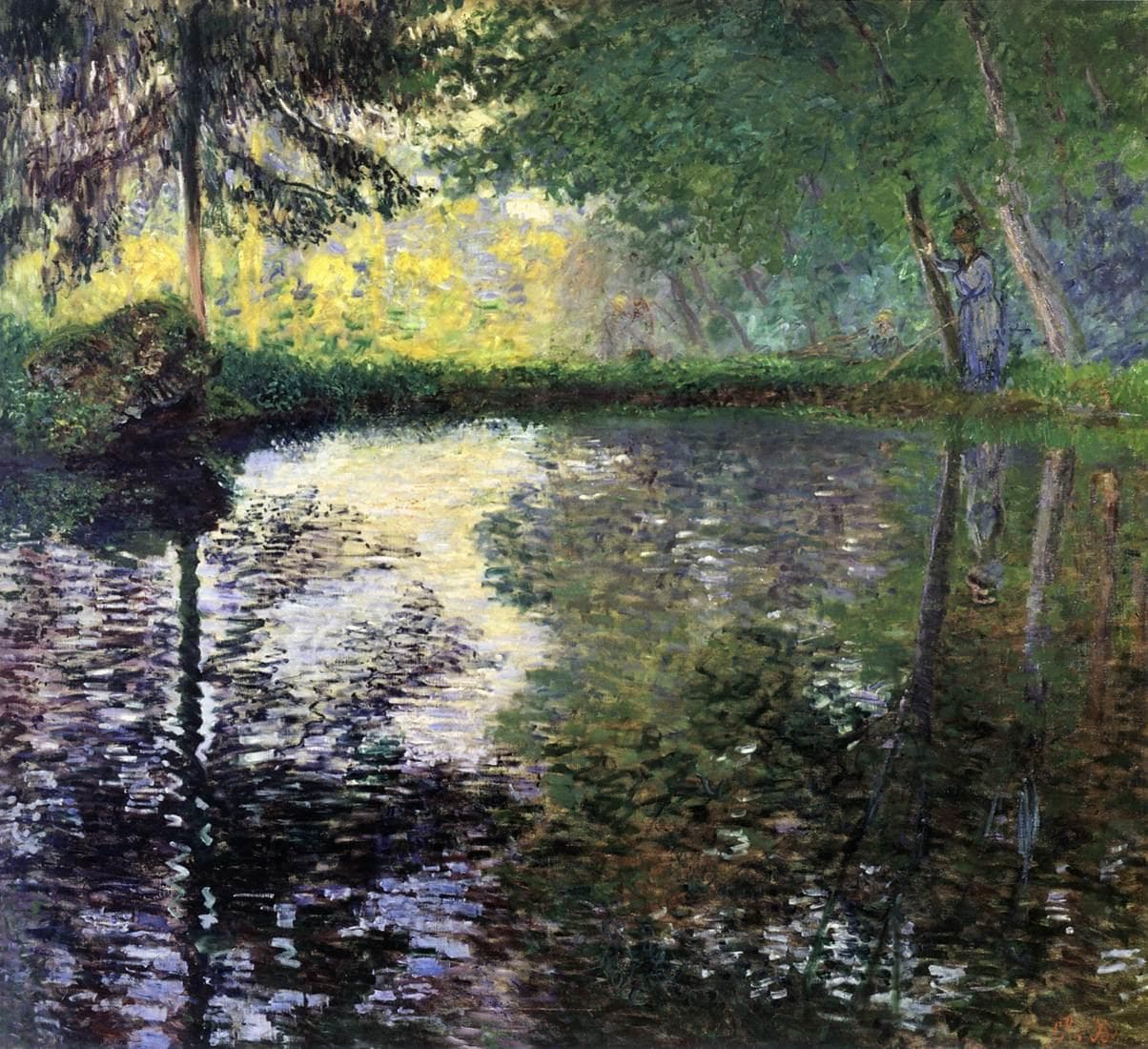
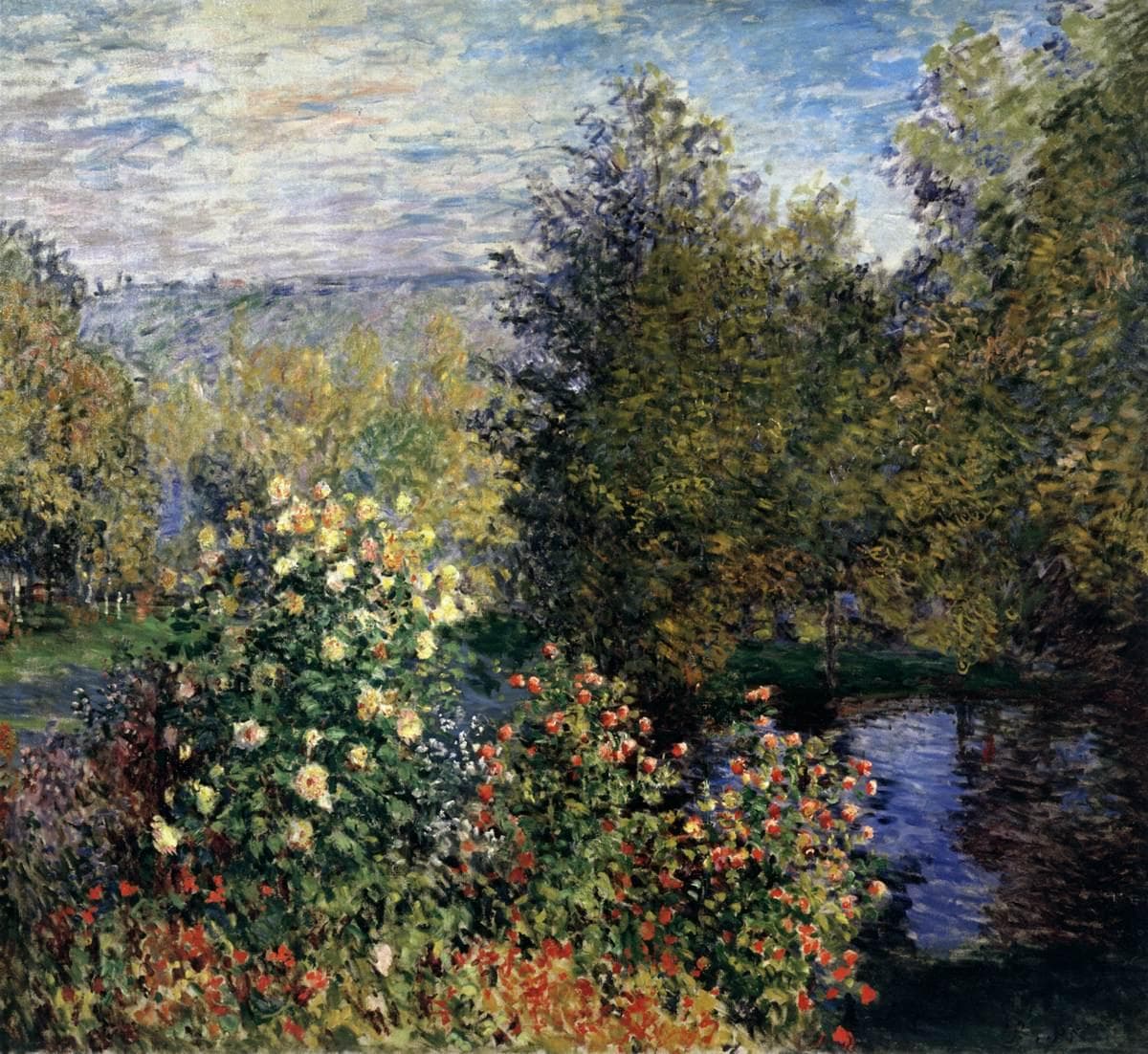
In 1876 Claude Monet was invited to stay at the Château de Rottembourg in Montgeron, southeast of Paris, by Ernest Hoschedé, a department-store owner and collector, and his wife Alice. Hoschedé commissioned four large decorative panels for the house. The Turkeys was one of them, and its subject is the estate itself: the château in the background is Rottembourg. The other panels were The Pond at Montgeron, A Corner of the Garden at Montgeron and a hunting scene in the park.
Monet showed The Turkeys at the third Impressionist exhibition in April 1877, listed as an unfinished decoration. Within a year Hoschedé was bankrupt, and his collection was sold at auction in 1878. The connection between the two families went far deeper than patronage: after Camille Monet's death in 1879, Alice Hoschedé and her children lived with Monet, and she became his second wife in 1892.
How it was painted
The choice of subject surprised visitors. Turkeys were farmyard animals, not the stuff of grand decorative painting, and critics in 1877 mocked the picture. Monet treats them seriously. Look at the bird in the lower center: its body is a mass of white strokes tinted with blue and lilac in the shadows and warmed with yellow where the sun hits, and its neck is a few stabs of red and brown.
The cropping is bold. The château is pushed to the top, a thin band of brick and slate, so the birds dominate the architecture, a reversal of the usual hierarchy of country-house portraiture. The meadow is painted in long, dark green strokes that run downhill, adding to the sense of slope, with patches of yellow-green where the low sun breaks through on the left.
Notice the displaying turkey at upper left: its fanned tail is a white disk ringed with small strokes, almost an ornament. Monet gives it a decorative role, like a flower in a woven hanging. The whole design, flat and all-over, with a high horizon and little depth, suits a panel meant to be set into a wall.
The Montgeron panels and how this one differs
The four panels were conceived as a set, but they differ widely. The Pond and the Corner of the Garden are lush, enclosed views of water and dahlias, closer to Monet's later garden pictures. The Turkeys is the oddest and most humorous of them, and the only one to show the house. Its scale and decorative purpose look ahead, very distantly, to the water-lily rooms of the Orangerie, Monet's last and greatest decoration.
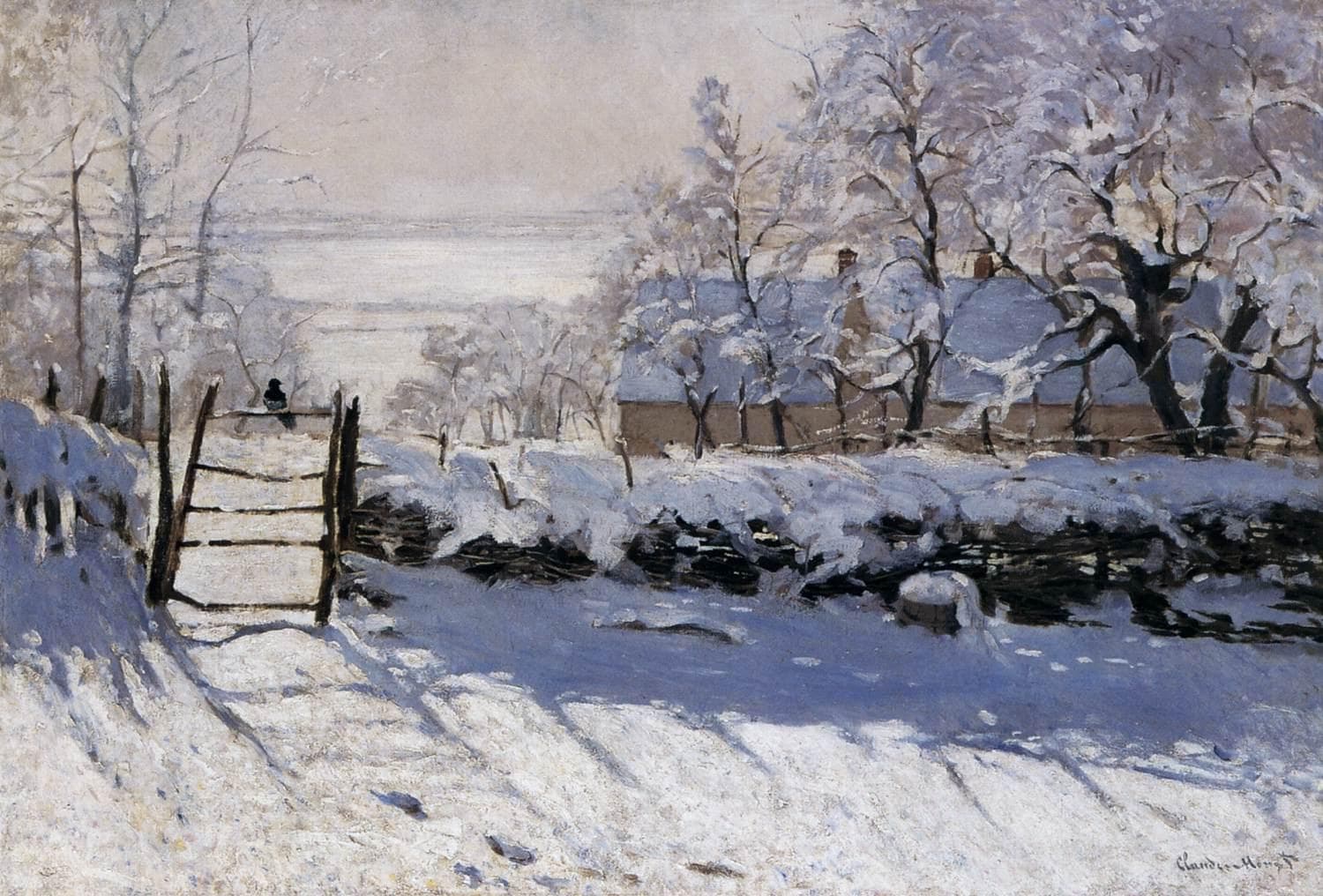
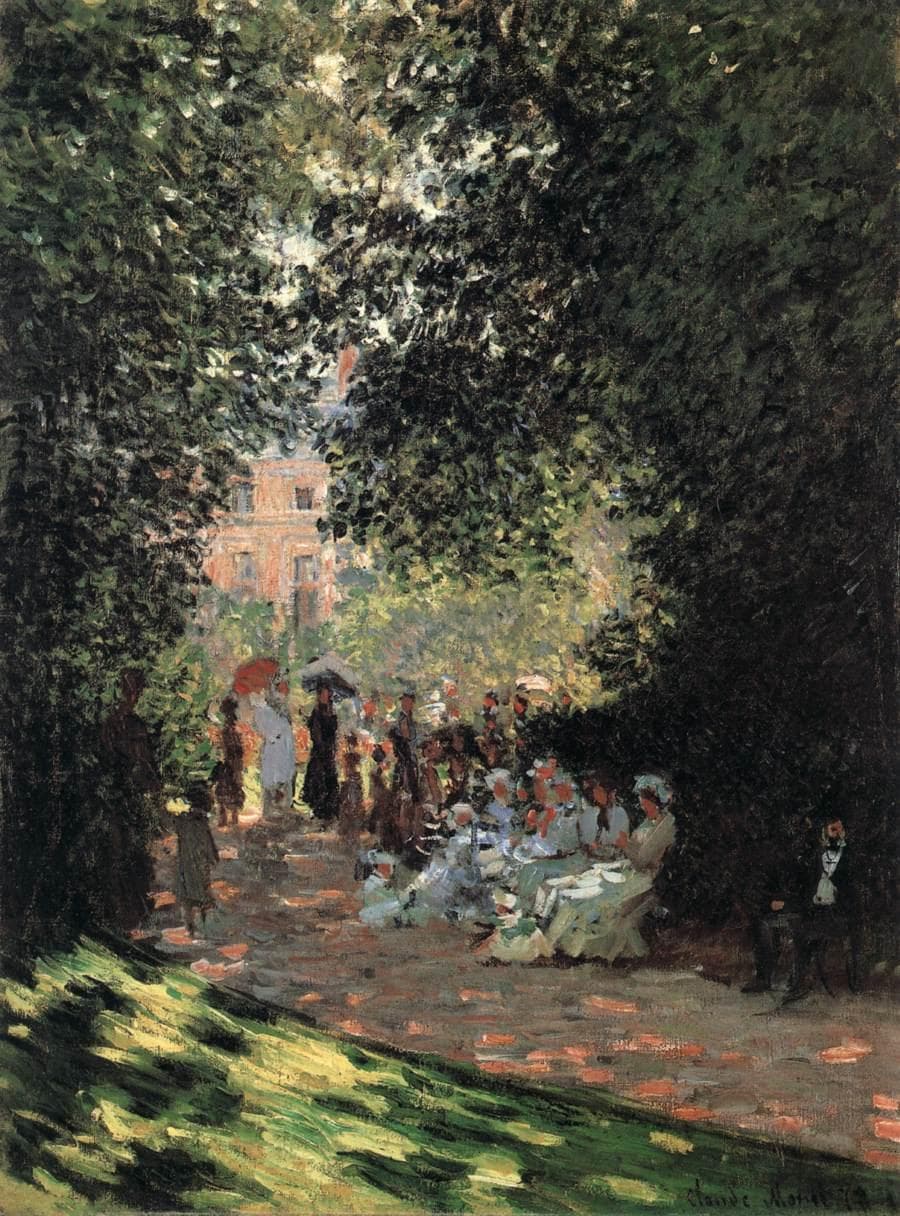
Monet's other animal subjects are few; the nearest in spirit is The Magpie, where a single bird perches on a gate in the snow. For a park in the city painted a year later, see The Parc Monceau.
Where to see it
The painting is in the Musée d'Orsay, Paris (RF 1944 18). Two of its companion panels are in the State Hermitage Museum, Saint Petersburg. More of the Orsay's Monets are described on Monet at the Musée d'Orsay.
Questions & answers
Where is Monet's The Turkeys?
The Turkeys (Les Dindons) is in the Musée d'Orsay in Paris (RF 1944 18). It is a large, nearly square canvas, about 174.5 by 172.5 centimeters, painted as a decoration for Ernest Hoschedé's château at Montgeron and shown at the third Impressionist exhibition in 1877.
When and where was it painted?
In 1876–77 on the Hoschedé estate, the Château de Rottembourg at Montgeron, southeast of Paris, where Monet stayed in the second half of 1876. He showed it, still described as unfinished, in April 1877. Wildenstein catalogues it as W.416.
Why did Monet paint turkeys?
The panels were meant to decorate the Hoschedés' house, so Monet painted the estate as it was, including the white turkeys that roamed its lawns. Critics found farm birds an odd subject for grand decoration, but he gave them the same careful study of light he gave landscapes.
Was The Turkeys part of a series?
It was one of four decorative panels commissioned by Ernest Hoschedé, along with The Pond at Montgeron, A Corner of the Garden at Montgeron and a hunting scene. The first two of those are now in the State Hermitage Museum, Saint Petersburg.
More by the artist
Claude Monet

Bridge over a Pond of Water Lilies
Claude Monet · 1899

Woman with a Parasol – Madame Monet and Her Son
Claude Monet · 1875

Sunset in Venice
Claude Monet · 1908–12

La Grenouillère
Claude Monet · 1869

Beach in Pourville
Claude Monet · 1882

Springtime
Claude Monet · 1872

Boating on the River Epte
Claude Monet · 1890

The Seine at Asnières (Hermitage)
Claude Monet · 1873
Also painted in 1877
The same year
Kindred works
You may also study
The Pond at Montgeron
Claude Monet · 1876–77
Corner of the Garden at Montgeron
Claude Monet · 1876–77
The Magpie
Claude Monet · 1868–69
The Parc Monceau
Claude Monet · 1878
Women in the Garden
Claude Monet · 1866–67

The Scream
Edvard Munch · 1893

Ophelia
John Everett Millais · 1851–52

The Great Wave off Kanagawa
Katsushika Hokusai · c. 1830–32