Impressionism
The Gare Saint-Lazare
Claude Monet, 1877
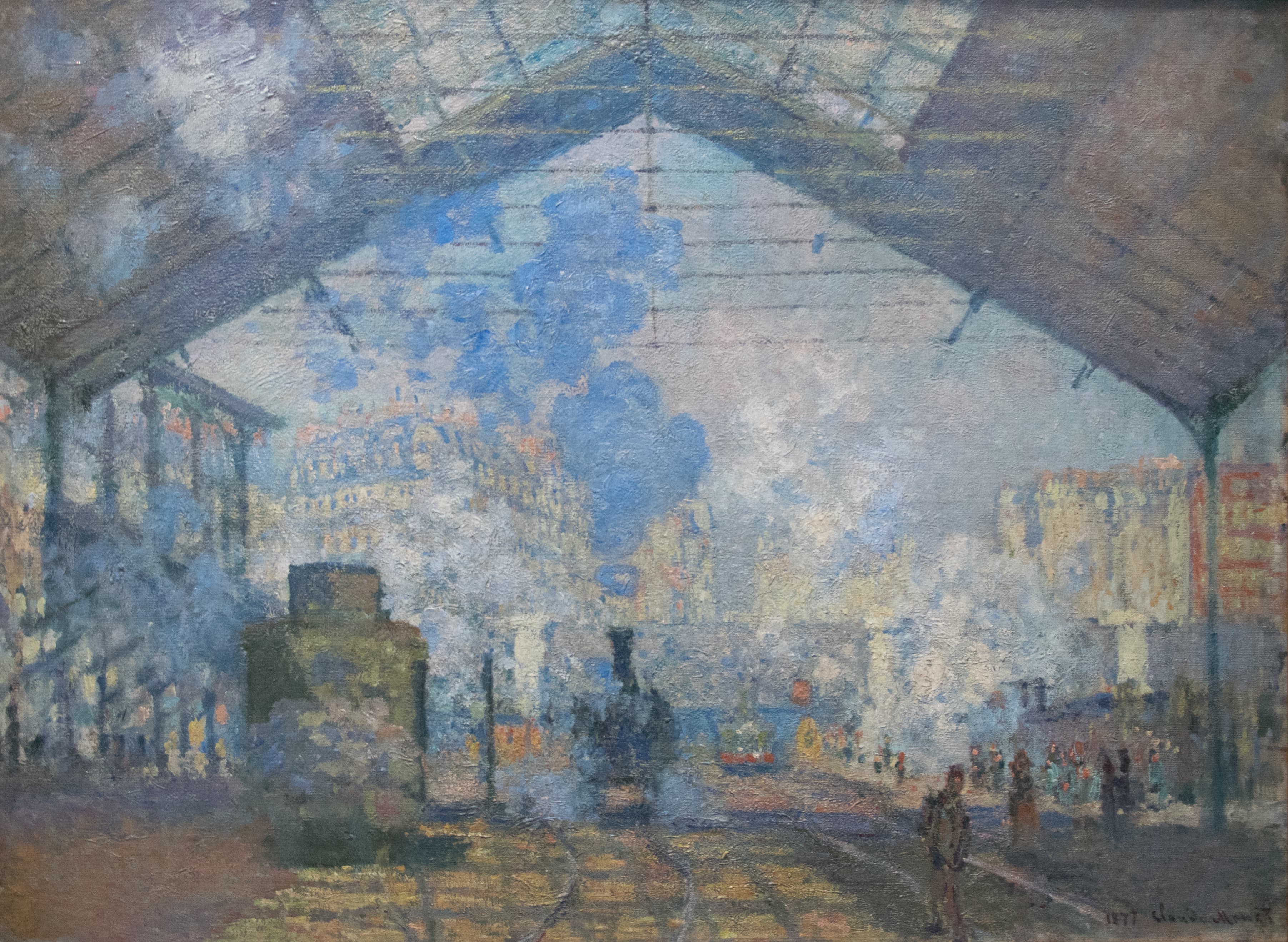
The Gare Saint-Lazare is a painting of steam locomotives under the glass roof of the Paris station by Claude Monet, made in early 1877. This version, one of about a dozen he painted there, is in the National Gallery, London.
- Artist
- Claude Monet
- Date
- 1877
- Medium
- Oil on canvas
- Dimensions
- 54.3 × 73.6 cm
- Collection
- National Gallery, London, United Kingdom
- Movement
- Impressionism
- Catalogue
- Wildenstein W 441
Claude Monet painted The Gare Saint-Lazare in the first months of 1877, inside the Paris terminus that served the suburbs and the Normandy coast. This canvas, 54.3 by 73.6 centimeters, is in the National Gallery in London (NG6479), which bought it in 1982; it is catalogued by Daniel Wildenstein as W 441. It is one of about a dozen views of the station Monet painted that winter, several of which he showed together at the third Impressionist exhibition in April 1877.
What you are looking at
We stand on a platform under the great iron-and-glass shed. Its roof cuts across the top of the picture as a dark, angled band of girders and panes, and through the open end of the shed we look out into bright daylight. Beyond the tracks, a long gray structure runs across the middle distance; on the right rise station buildings with three tall pointed gables.
Two black locomotives stand in the foreground, one left of center and one at the right, each little more than a cluster of dark verticals: a chimney, a dome, the round face of a boiler. Around them, passengers and railway workers are reduced to upright strokes of black and brown, a few with a touch of red. A gas lamp on a slender post stands near the center, and a smaller lamp below it, the only fine drawing in the picture. At far left, a third train waits half lost in vapor.
The smoke is the real subject. It billows up in thick, curling masses of white, gray and lilac that fill most of the upper left of the canvas and spill against the underside of the roof at top right. Some of it is lit almost pure white by the sun; some of it is in shadow, bluish and violet. It softens every edge it touches, so the solid machinery of the station seems to dissolve into weather.
How it was painted
The paint is applied quickly and thickly. Steam is laid in with loaded, swirling strokes of white over blue and lilac; the locomotives are a few dense blacks and dark blues; the platform is a warm, scrubbed ocher. The contrast between the heavy, motionless engines and the drifting vapor gives the picture its energy. The canvas is relatively small for the series, and the handling has the speed of a picture painted on the spot.
Monet took a small studio near the station, in the rue Moncey, with the rent paid by his friend and patron Gustave Caillebotte. According to a story later told by Renoir's son, the filmmaker Jean Renoir, Monet put on his best clothes and persuaded the station master to let him work on the platforms, and trains were held and stoked to make more smoke for him. Whether or not every detail is true, the canvases show close observation from several fixed points inside and around the station.
A modern subject
For Monet's generation, the railway was the emblem of the new Paris rebuilt under Baron Haussmann, and Saint-Lazare was the gateway to the suburbs and the coast where the Impressionists painted. Monet himself took the train from here to Argenteuil and to Normandy. Painting the station was a deliberate choice of contemporary life over history or myth, and Émile Zola praised the series for finding poetry in railway stations.
The Gare Saint-Lazare series
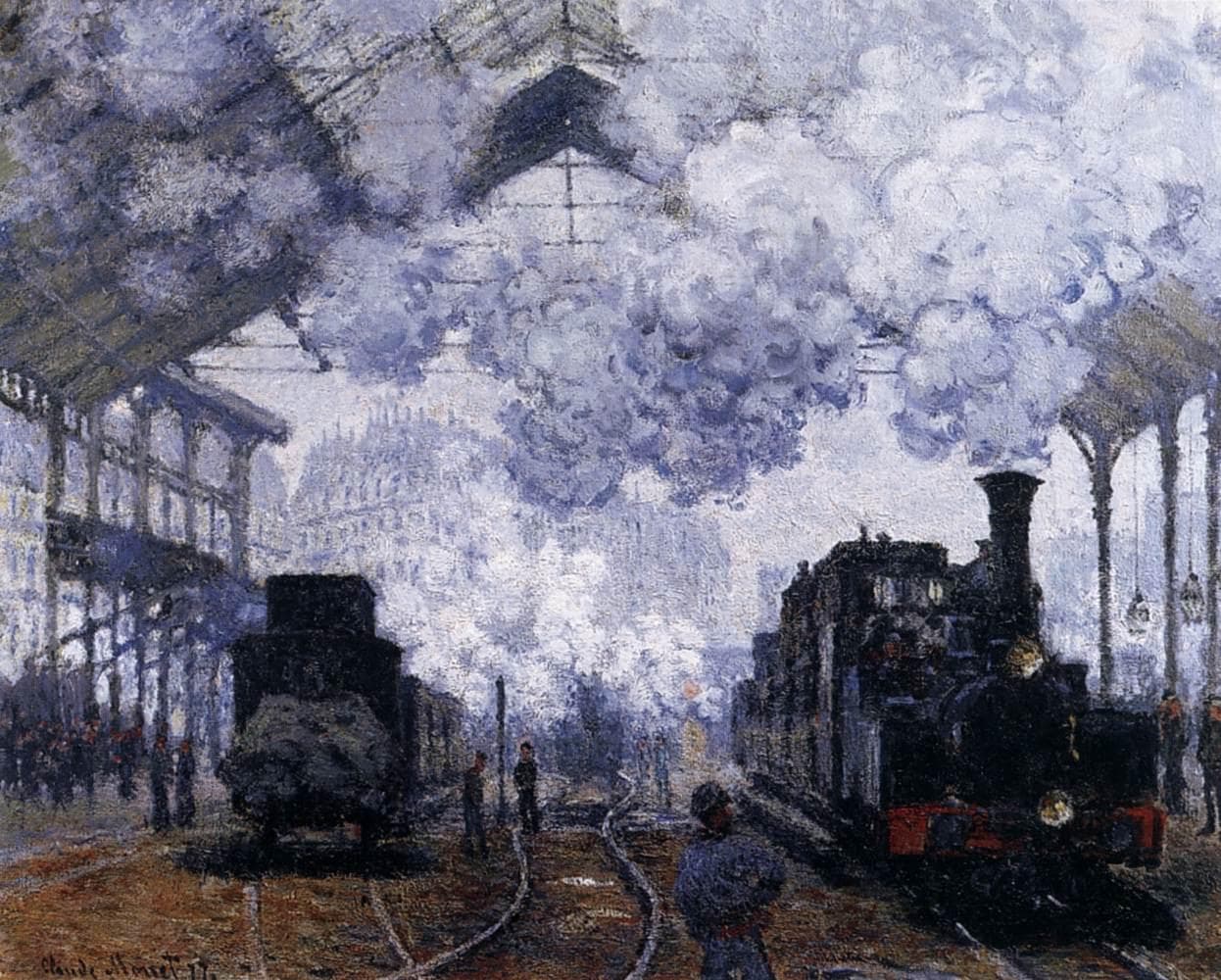
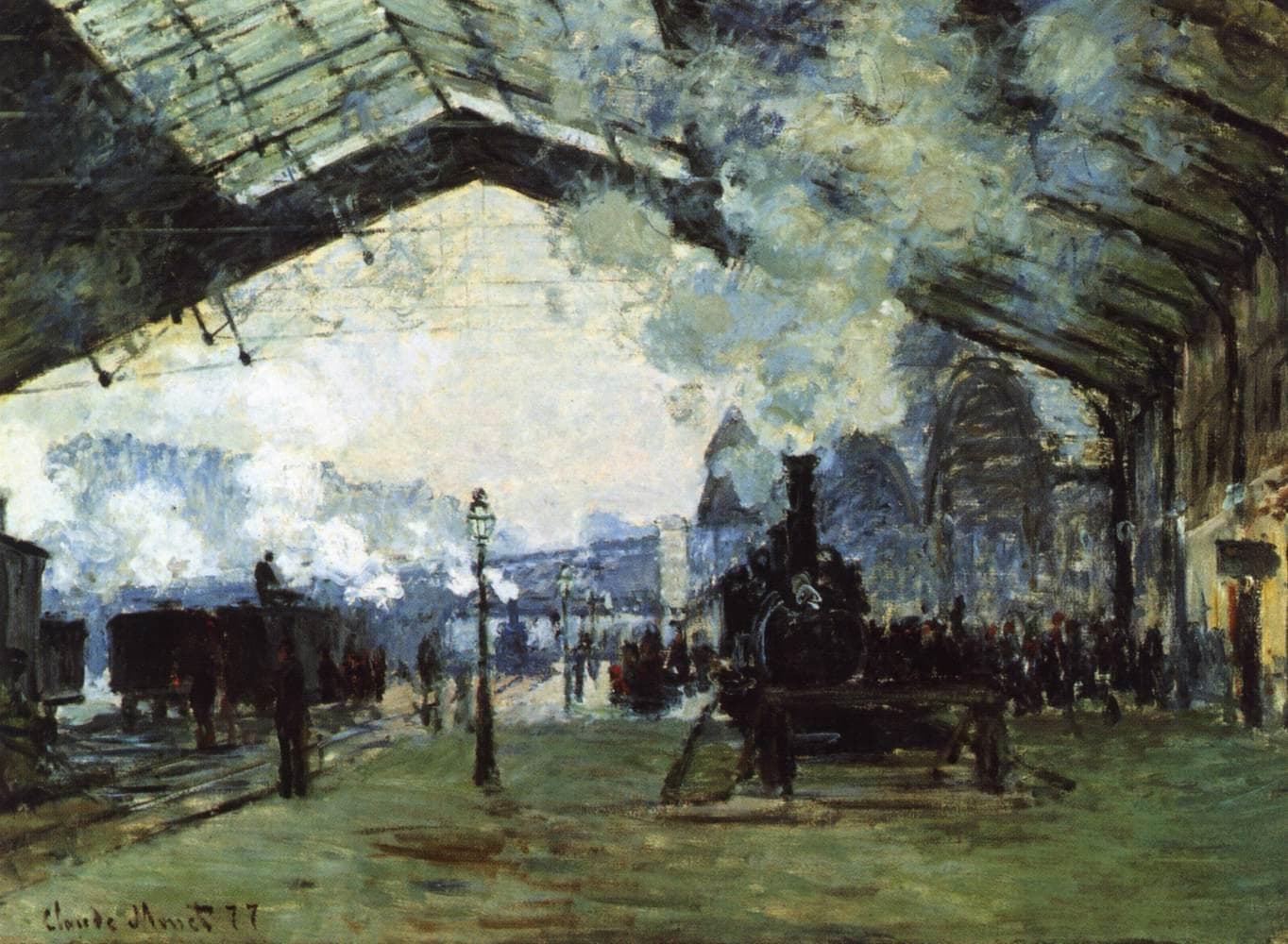
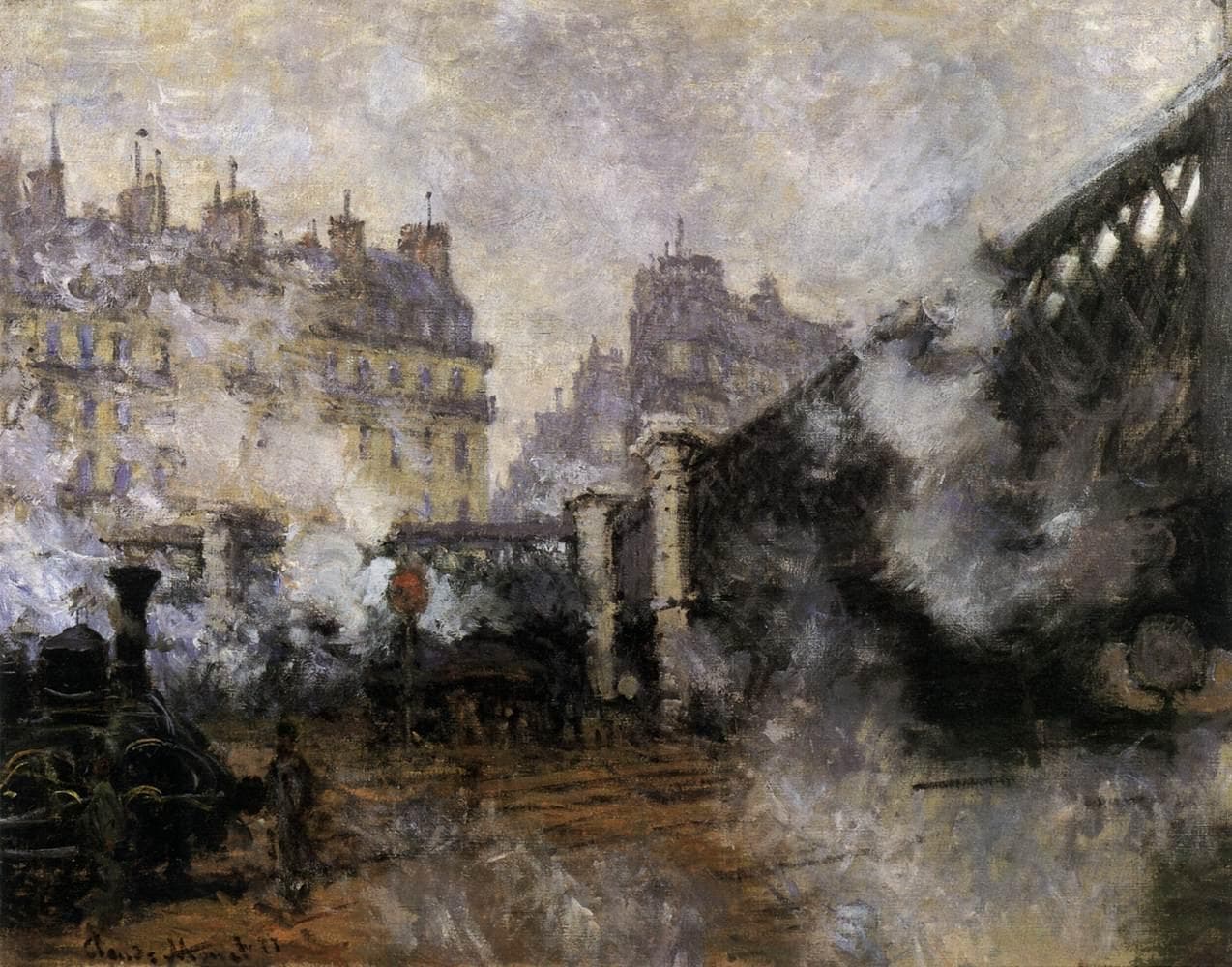
The canvases vary in viewpoint, weather and finish. The largest, now in the Musée d'Orsay, shows the full triangular roof from the platform; others move outside the shed. The Gare Saint-Lazare: Arrival of a Train, at Harvard, is a close neighbor of this view. The Train from Normandy, in Chicago, looks along the tracks to a waiting train. Pont de l'Europe, at the Musée Marmottan, looks up at the iron road bridge that crossed the tracks outside the station.
Seen together, they are an early version of the series method Monet would develop in the 1890s with the haystacks and Rouen Cathedral. Our Gare Saint-Lazare hub gathers the whole group.
What sets the London picture apart is its balance of light and dark: the black engines and crowd sit low and solid, while the upper half is almost entirely smoke and sky. It is one of the most open and luminous canvases of the series.
Where to see it
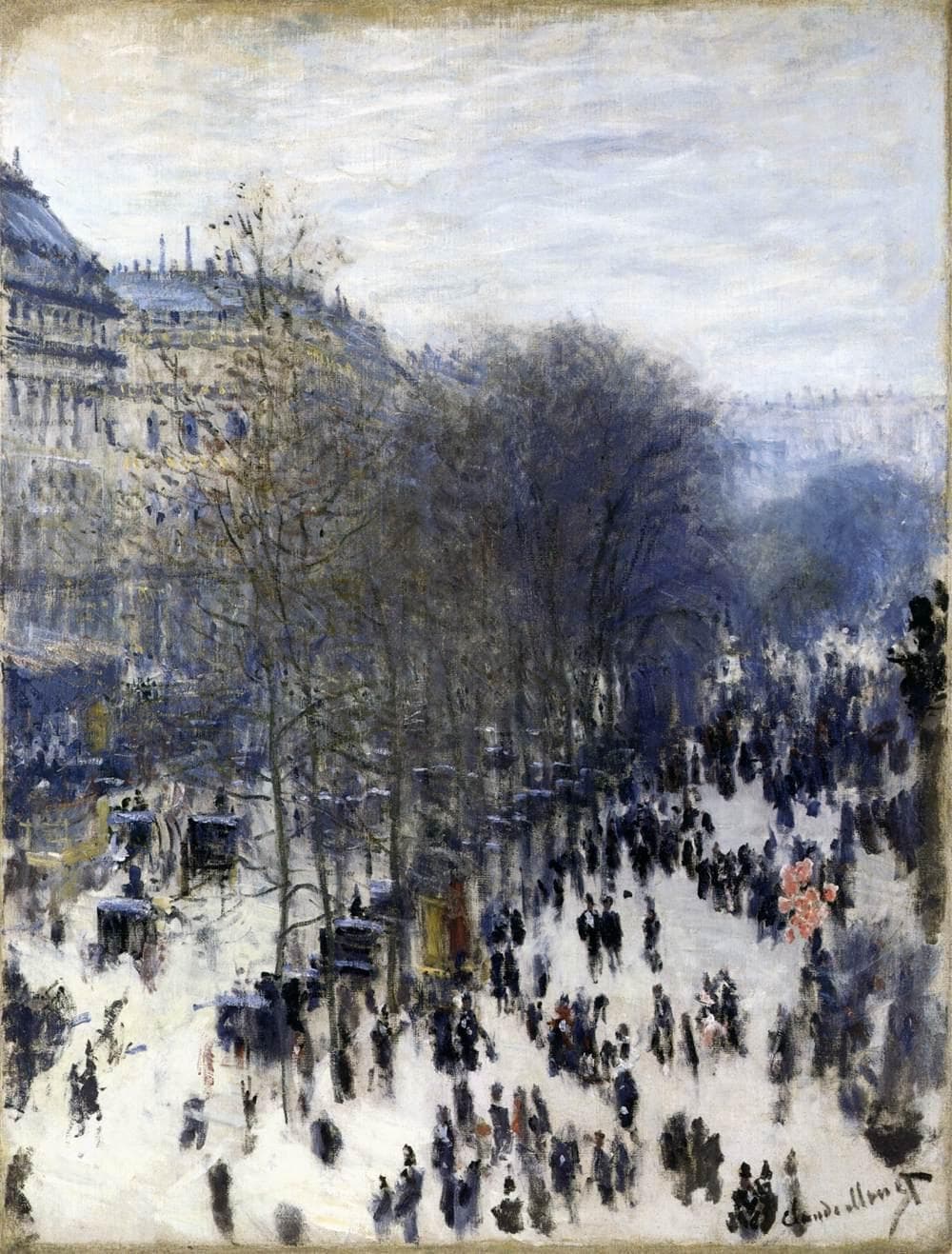
This version hangs in the National Gallery, London. For Monet's other views of Paris, see Boulevard des Capucines, and for the rest of the series and other museums, where to see Monet's paintings.
Questions & answers
Where is Monet's Gare Saint-Lazare?
Monet painted about a dozen views of the station in 1877, now spread across several museums. This version, with two locomotives under the glass roof, is in the National Gallery in London (NG6479), which bought it in 1982. The largest canvas is in the Musée d'Orsay, and others are in Chicago, Cambridge (Massachusetts), the Musée Marmottan and private collections.
When and where did Monet paint the Gare Saint-Lazare?
He painted the series in January to March 1877 at the Gare Saint-Lazare in Paris, the terminus for trains to the western suburbs and Normandy. He worked from a small studio nearby in the rue Moncey and, according to a later anecdote, persuaded the station master to let him paint on the platforms. Several canvases were shown that April.
What does Monet's Gare Saint-Lazare mean?
It treats the railway station, a symbol of modern Paris, as a fit subject for serious painting, in place of history or myth. Monet was drawn to the way smoke and steam caught the light under the glass roof and dissolved the iron structure. Émile Zola praised the series for finding poetry in railway stations.
How many Gare Saint-Lazare paintings did Monet make?
Monet painted around twelve views of the station and its approaches in early 1877 and showed several together at the third Impressionist exhibition that April. Counts vary slightly between scholars because some canvases are close variants or sketches. The views move from the platforms under the roof to the tracks and the Pont de l'Europe outside.
More by the artist
Claude Monet

Bridge over a Pond of Water Lilies
Claude Monet · 1899

Woman with a Parasol – Madame Monet and Her Son
Claude Monet · 1875

Sunset in Venice
Claude Monet · 1908–12

La Grenouillère
Claude Monet · 1869

Beach in Pourville
Claude Monet · 1882

Springtime
Claude Monet · 1872

Boating on the River Epte
Claude Monet · 1890

The Seine at Asnières (Hermitage)
Claude Monet · 1873
Also painted in 1877
The same year
Kindred works
You may also study
The Gare Saint-Lazare: Arrival of a Train
Claude Monet · 1877
Gare Saint-Lazare: the Train from Normandy
Claude Monet · 1877
Pont de l'Europe, Gare Saint-Lazare
Claude Monet · 1877
Boulevard des Capucines
Claude Monet · 1873–74
Impression, Sunrise
Claude Monet · 1872
Liberty Leading the People
Eugène Delacroix · 1830
The Night Watch
Rembrandt · 1642
Café Terrace at Night
Vincent van Gogh · September 1888