Impressionism
Pont de l'Europe, Gare Saint-Lazare
Claude Monet, 1877
Pont de l'Europe, Gare Saint-Lazare is an 1877 painting by Claude Monet of the iron bridge over the tracks outside Paris's Saint-Lazare station, half lost in locomotive steam. The 64 × 81 cm canvas (Wildenstein 442) is in the Musée Marmottan Monet, Paris.
- Artist
- Claude Monet
- Date
- 1877
- Medium
- Oil on canvas
- Dimensions
- 64 × 81 cm
- Collection
- Musée Marmottan Monet, Paris, France
- Movement
- Impressionism
- Catalogue
- Wildenstein 442
More at Musée Marmottan Monet
What you are looking at
We stand down on the tracks, just outside the great train shed of the Gare Saint-Lazare. At right the iron Pont de l'Europe crosses overhead on a sharp diagonal, its lattice girders a dark mesh that runs off the top edge of the canvas. It rests on heavy stone piers, and between them the light of the station yard shows through. At far left a black locomotive, its tall chimney topped by a flared cap, stands half buried in its own exhaust. Between engine and bridge a railway worker walks across the rails toward us, a small dark upright in a wide, empty foreground of brown ballast and cinders.
Beyond, through the steam, rise the cream-colored apartment blocks of the new Quartier de l'Europe, with their balconies, mansard roofs and crowded chimney pots. They catch a thin, smoky light, as if the sun were somewhere above the haze but never quite getting through.
The real subject is the steam. Monet paints it in thick, rapid strokes of white, lilac, blue-grey and a dirty yellow, so that it billows in front of the stone piers and dissolves the line between machine and building. In places it is opaque, a solid cloud; in others it thins enough to let a window or a cornice show through. Look for the single red signal disc on its post near the center of the picture: it is the brightest color on the canvas and the one sharp accent in a picture made of fog. The signature and the date '77 sit at lower left, scratched in quickly in dark paint.
Paris, January 1877
In January 1877 Monet, still living at Argenteuil, rented a small flat near the station and obtained permission to work inside the station and along the tracks. The Gare Saint-Lazare was the terminus for trains from Normandy and from Argenteuil, so he knew it as a commuter as well as a painter. Over roughly three months he painted about a dozen views of it, which together form the core of our Gare Saint-Lazare series hub.
The bridge itself was new. Completed in 1868 as part of Baron Haussmann's remaking of Paris, the Pont de l'Europe carried six streets over the railway cutting and was admired as a feat of modern engineering. Gustave Caillebotte, Monet's friend and patron, had painted it from the roadway above in 1876. Monet chose the opposite view: from underneath, among the trains, where the bridge is something that looms rather than something one strolls across.
How it was painted
The canvas is a standard landscape size, and much of it is painted wet into wet, at speed. The buildings are drawn with a few vertical and horizontal strokes over a pale ground; the bridge girders are dark lines dragged across lighter paint while it was still soft. The steam is laid on last and thickest, in curving, scumbled strokes that sit physically on top of everything behind them. That order of work is the picture's logic: first the solid city, then the vapor that eats it.
Its place in the series
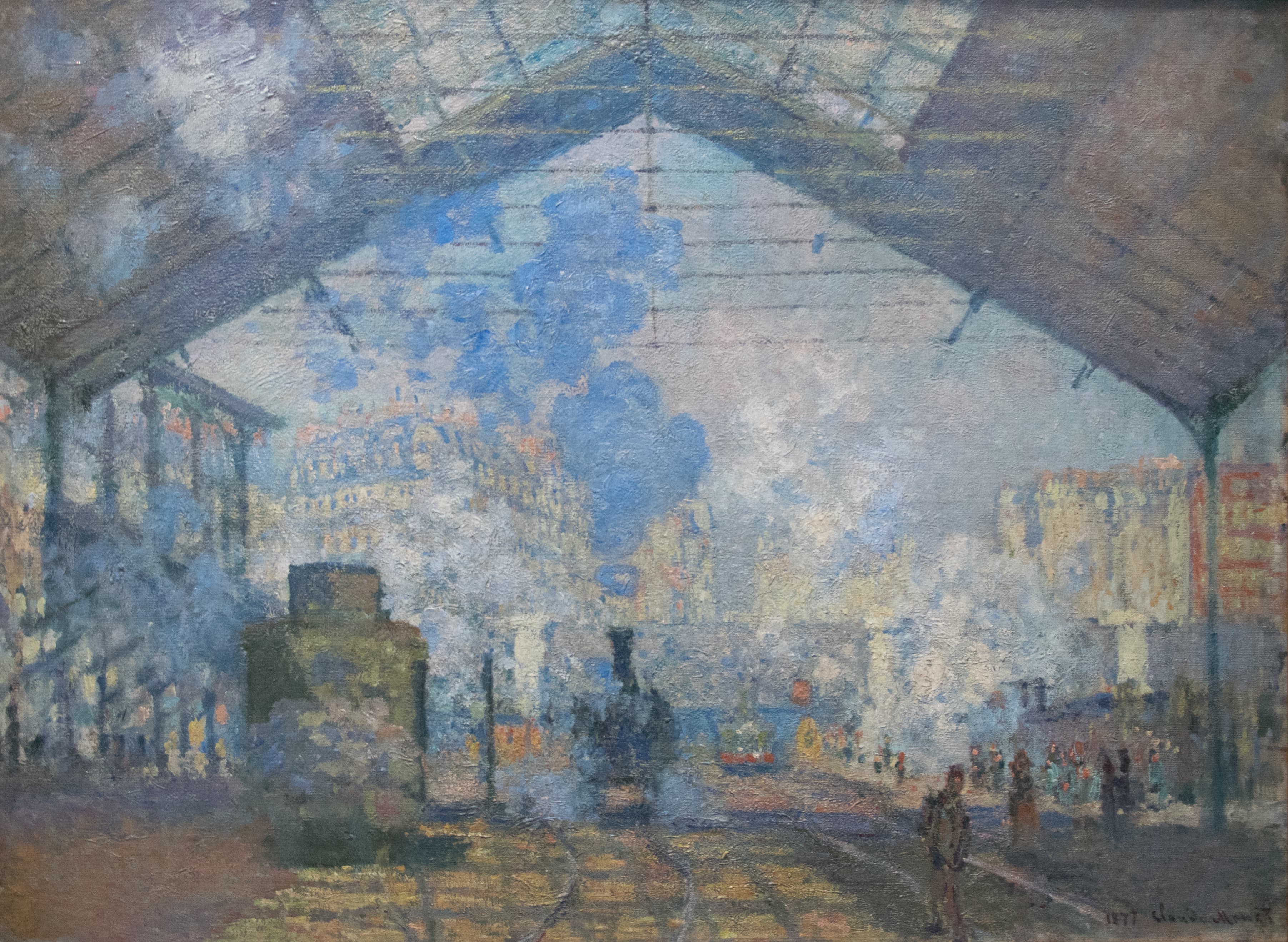
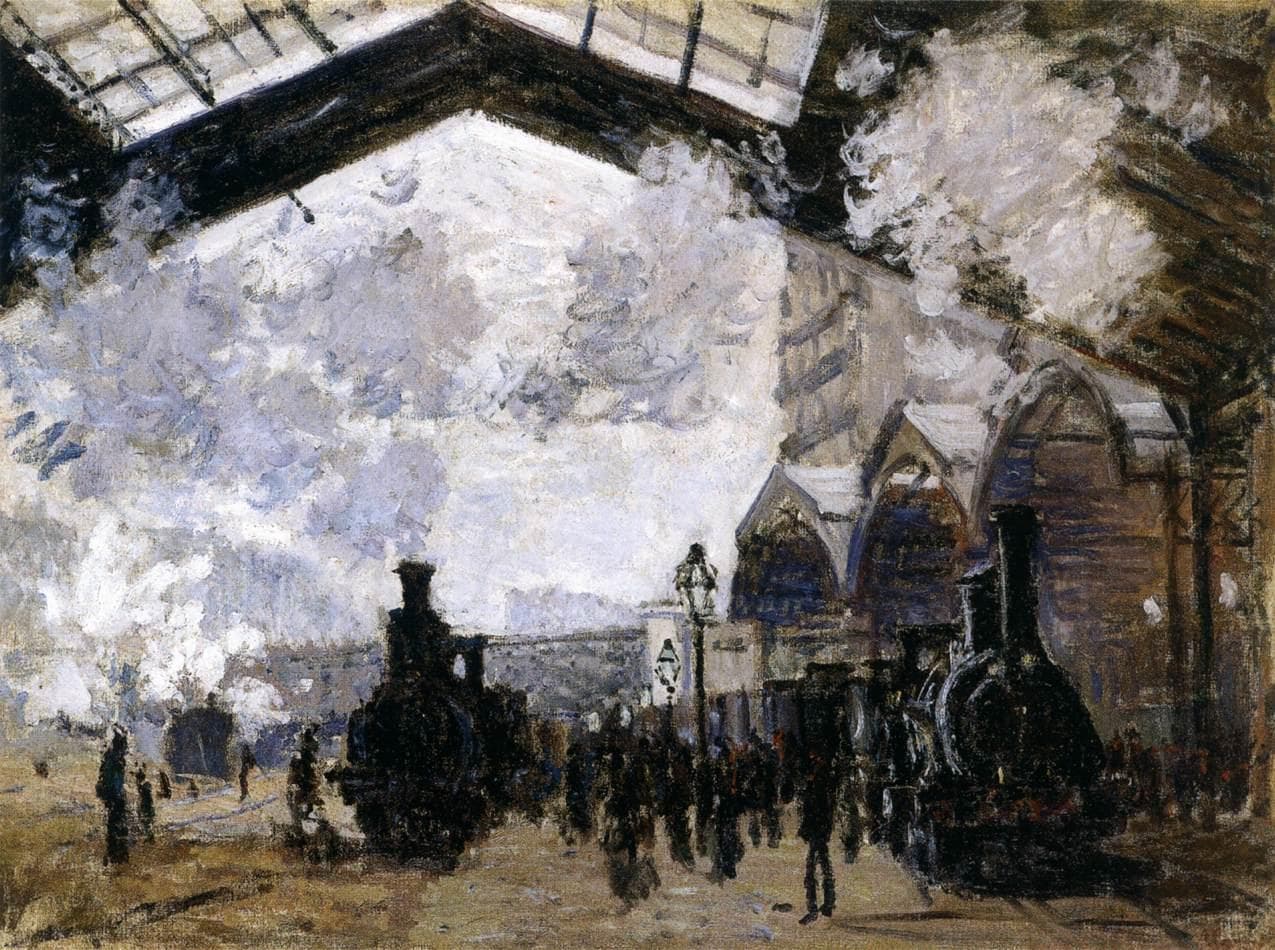
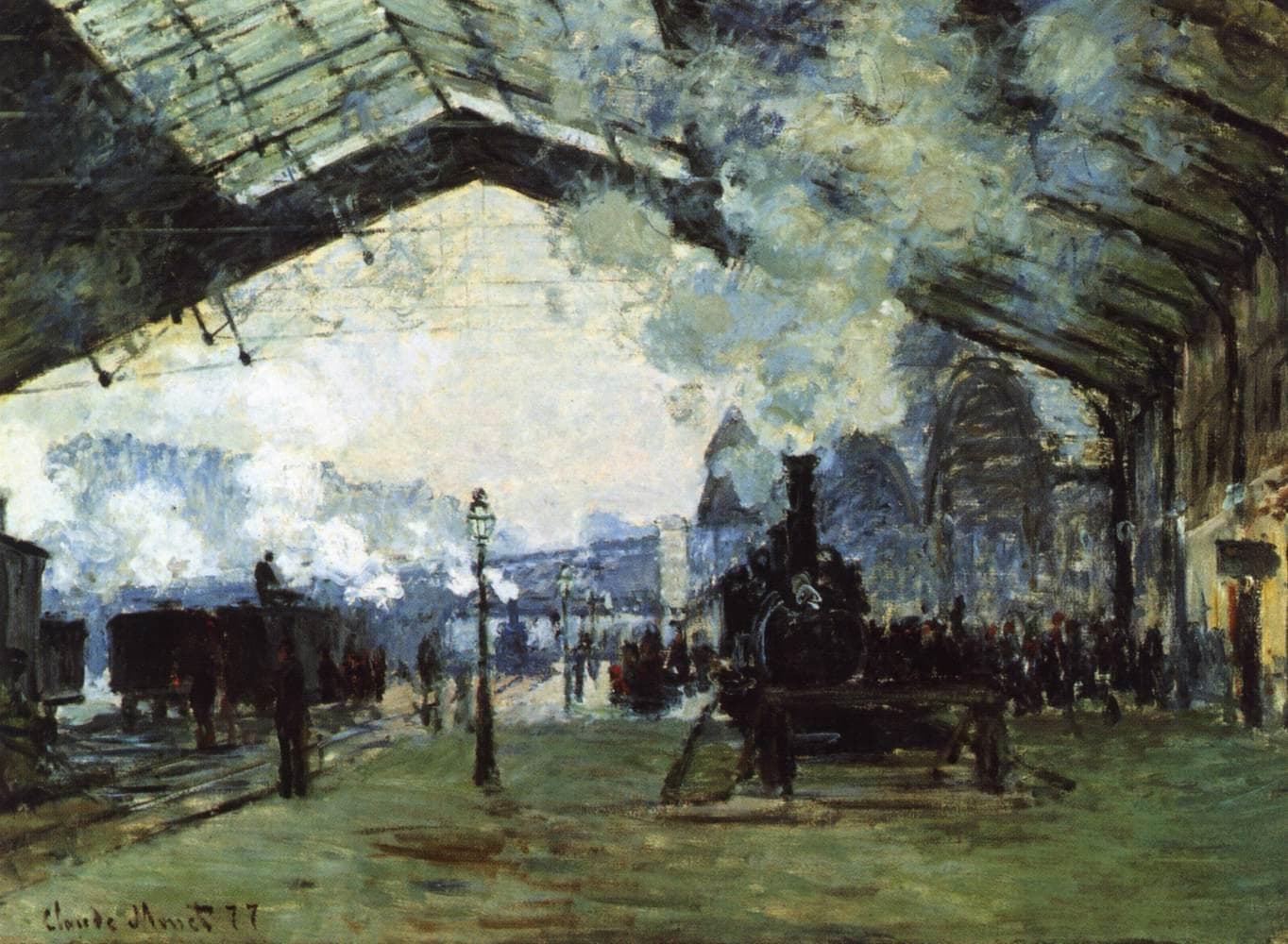
The station pictures fall into two groups: views inside the train shed, under the glass roof, and views outside it, toward the bridge and the tracks. This is one of the outdoor views. Compare it with La Gare Saint-Lazare in the Musée d'Orsay, where the iron and glass roof frames a locomotive arriving, or The Train from Normandy in Chicago. The London Gare Saint-Lazare at the National Gallery is another interior. Here, without the roof, the composition is looser and more open, and the bridge takes the place of the shed as the great piece of engineering.
Seven of the canvases appeared at the third Impressionist exhibition in April 1877. Critics were divided, but Émile Zola praised them as modern painting that could find poetry in a railway station, as earlier painters had found it in forests and rivers. The method, a single motif studied across many canvases under shifting conditions, looks forward to the haystacks and cathedrals of the 1890s.
Meaning
The picture celebrates the modern city without tidying it up. The bridge and the apartment blocks are new and imposing, yet the steam blurs them into weather. Industry becomes atmosphere, observed with the same eye that Claude Monet turned on fog over the Seine. The lone worker is anonymous, part of the machinery of the place rather than a character in a story.
Where to see it
The painting is in the Musée Marmottan Monet in Paris, which holds the largest single collection of the artist's work; see our guide to the Musée Marmottan Monet. For the same years in the city streets, compare Boulevard des Capucines.
Questions & answers
Where is Monet's Pont de l'Europe painting?
It is in the Musée Marmottan Monet in Paris. The canvas, painted in 1877, measures 64 by 81 centimeters and is catalogued as Wildenstein 442. It belongs to Monet's series of about a dozen views of the Gare Saint-Lazare, all painted in the first months of that year.
When and where did Monet paint Pont de l'Europe?
In early 1877, on the railway tracks just outside the Gare Saint-Lazare in Paris. Monet rented a small flat nearby in January and received permission to work in and around the station, painting about a dozen canvases there in roughly three months.
What is the Pont de l'Europe?
It is a large iron bridge over the railway tracks leading into the Gare Saint-Lazare, where six streets meet. Completed in 1868 during Haussmann's rebuilding of Paris, it was a symbol of modern engineering. Gustave Caillebotte painted it from the roadway above in 1876.
How is this different from Monet's other Gare Saint-Lazare paintings?
Most of the series is painted inside the train shed, under its iron and glass roof. This canvas is one of the outdoor views: the bridge replaces the roof, the city's apartment blocks fill the background, and steam drifts across the whole scene. Seven of the station pictures were shown at the 1877 Impressionist exhibition.
More by the artist
Claude Monet

Bridge over a Pond of Water Lilies
Claude Monet · 1899

Woman with a Parasol – Madame Monet and Her Son
Claude Monet · 1875

Sunset in Venice
Claude Monet · 1908–12

La Grenouillère
Claude Monet · 1869

Beach in Pourville
Claude Monet · 1882

Springtime
Claude Monet · 1872

Boating on the River Epte
Claude Monet · 1890

The Seine at Asnières (Hermitage)
Claude Monet · 1873
Also painted in 1877
The same year
Kindred works
You may also study
La Gare Saint-Lazare
Claude Monet · 1877
The Gare Saint-Lazare
Claude Monet · 1877
Gare Saint-Lazare: the Train from Normandy
Claude Monet · 1877
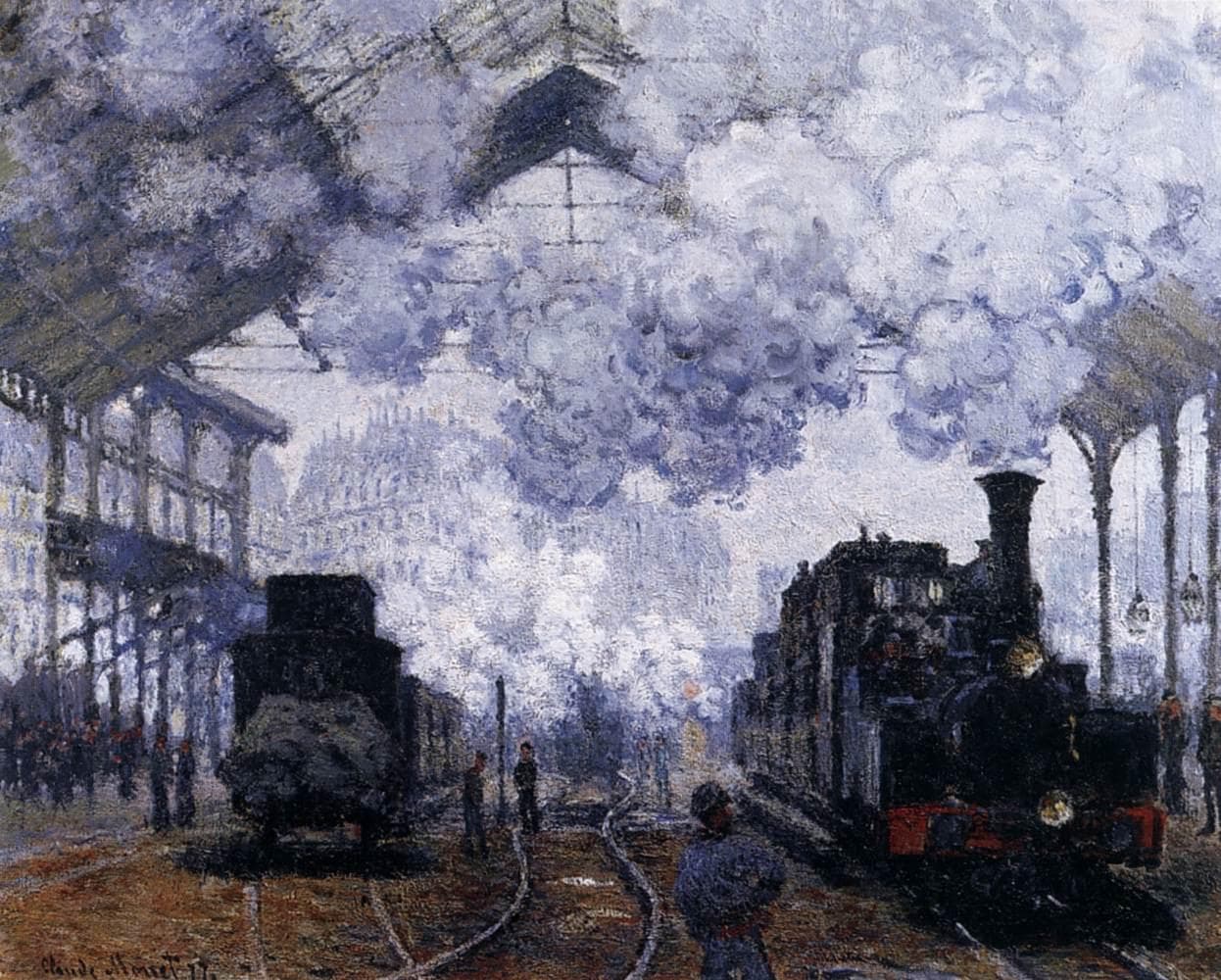
The Gare Saint-Lazare: Arrival of a Train
Claude Monet · 1877
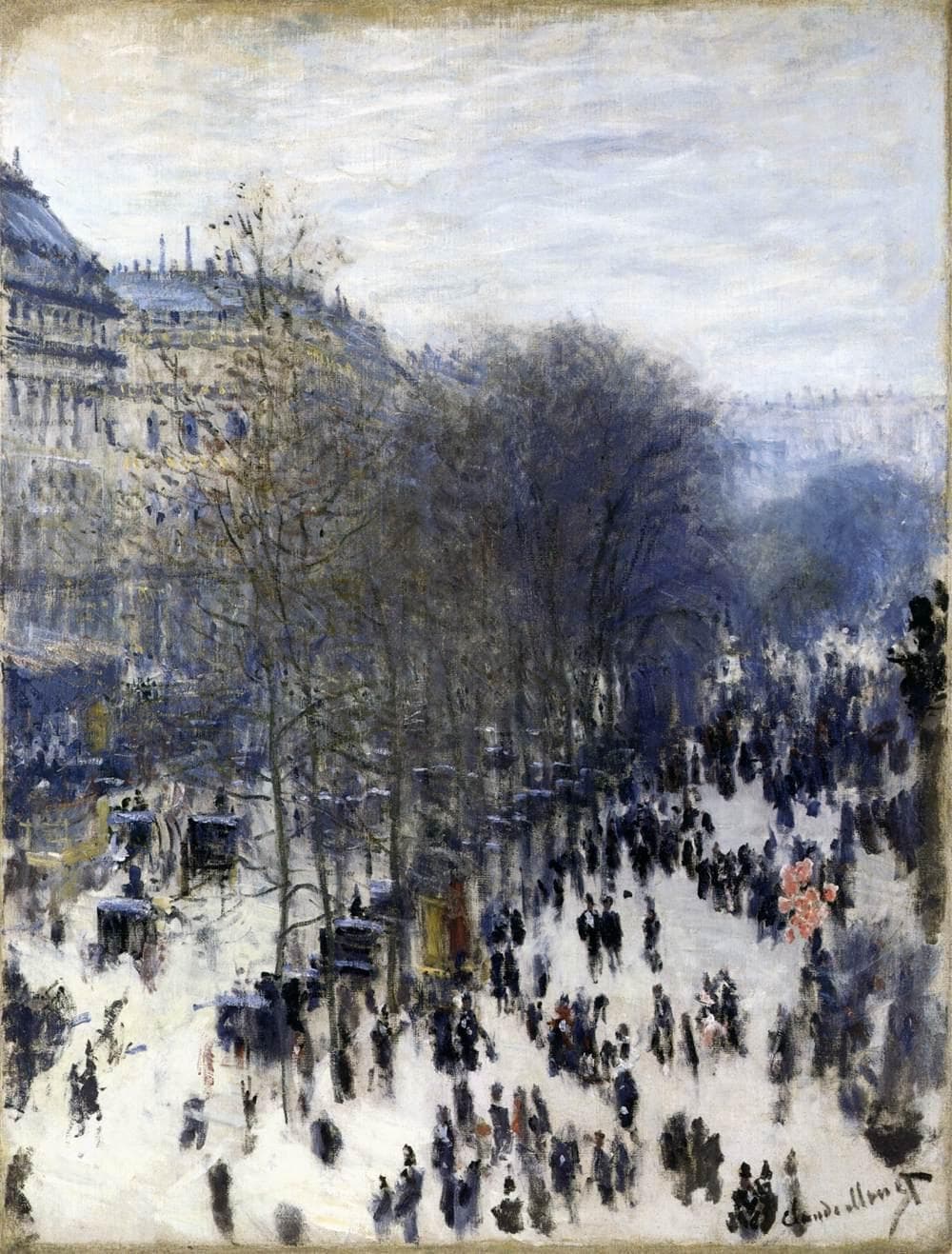
Boulevard des Capucines
Claude Monet · 1873–74
Liberty Leading the People
Eugène Delacroix · 1830
The Night Watch
Rembrandt · 1642
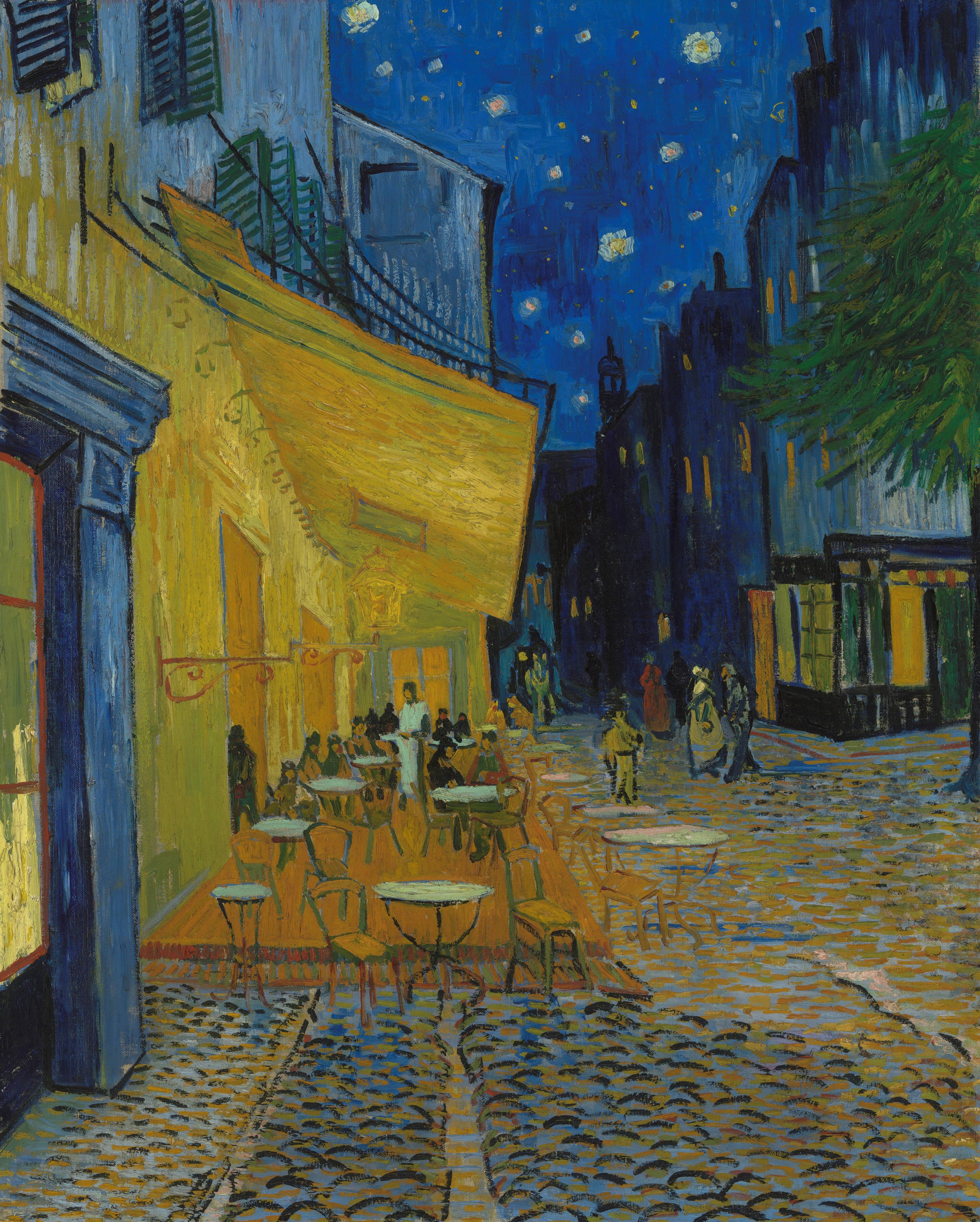
Café Terrace at Night
Vincent van Gogh · September 1888