Image: Scottish National Gallery, Edinburgh (Google Art Project) · Public domain · via Wikimedia Commons
Impressionism
Poplars on the Epte (Edinburgh)
Claude Monet, 1891
Poplars on the Epte is an 1891 painting from Claude Monet's Poplars series, showing a row of tall summer poplars curving along the river Epte near Giverny, mirrored in still water under white clouds. It is in the Scottish National Gallery, Edinburgh.
- Artist
- Claude Monet
- Date
- 1891
- Medium
- Oil on canvas
- Dimensions
- 81.8 × 81.3 cm
- Collection
- Scottish National Gallery, Edinburgh, United Kingdom
- Movement
- Impressionism
- Catalogue
- Wildenstein 1310
What you are looking at
The canvas is almost square. On the right, a line of tall, slender poplars rises from the riverbank, their trunks pale and their foliage a light, flickering green; the row bends away to the left in a gentle curve, the trees getting smaller and bluer until they meet the horizon in a soft band of green near the left edge. Above, a summer sky is filled with heaped white cumulus clouds over patches of blue. Below, the river Epte takes up the bottom half of the picture, and in it the trees and the clouds appear again, softer and broken by ripples.
Everything is light and warm. The palette is made of pale greens, yellows, creams and blues, with touches of pink and lilac in the trunks and the clouds. There is no figure, no boat and no building.
Look at the trunks. In the sky they are thin, separate verticals; in the water their reflections run down in wavering streaks of lilac and gold that are almost as strong as the trees themselves. The picture is close to symmetrical about the line of the far bank, and that doubling is what gives it its stillness.
The season is high summer: the leaves are full, the light is warm, and the clouds are the fair-weather kind that build over the Seine valley on hot afternoons. Other canvases in the series show the same trees in the pink and orange of autumn or under a grey, windy sky, which is the point of a series. The trees stay; the weather and the hour change.
Where and when it was painted
In the spring of 1891 Monet found his motif on the river Epte, which flows into the Seine near Giverny: a line of tall poplars on the bank at Limetz, a little upstream from his house, that curved along a bend in the river. He painted them from his studio boat, moored among the reeds, from spring into autumn, keeping several canvases on board and changing from one to another as the light shifted. When the local commune put the trees up for sale for timber, Monet paid the buyer to leave them standing until he had finished. The series runs to about two dozen canvases, and fifteen were shown together at Durand-Ruel's gallery in Paris in February and March 1892.
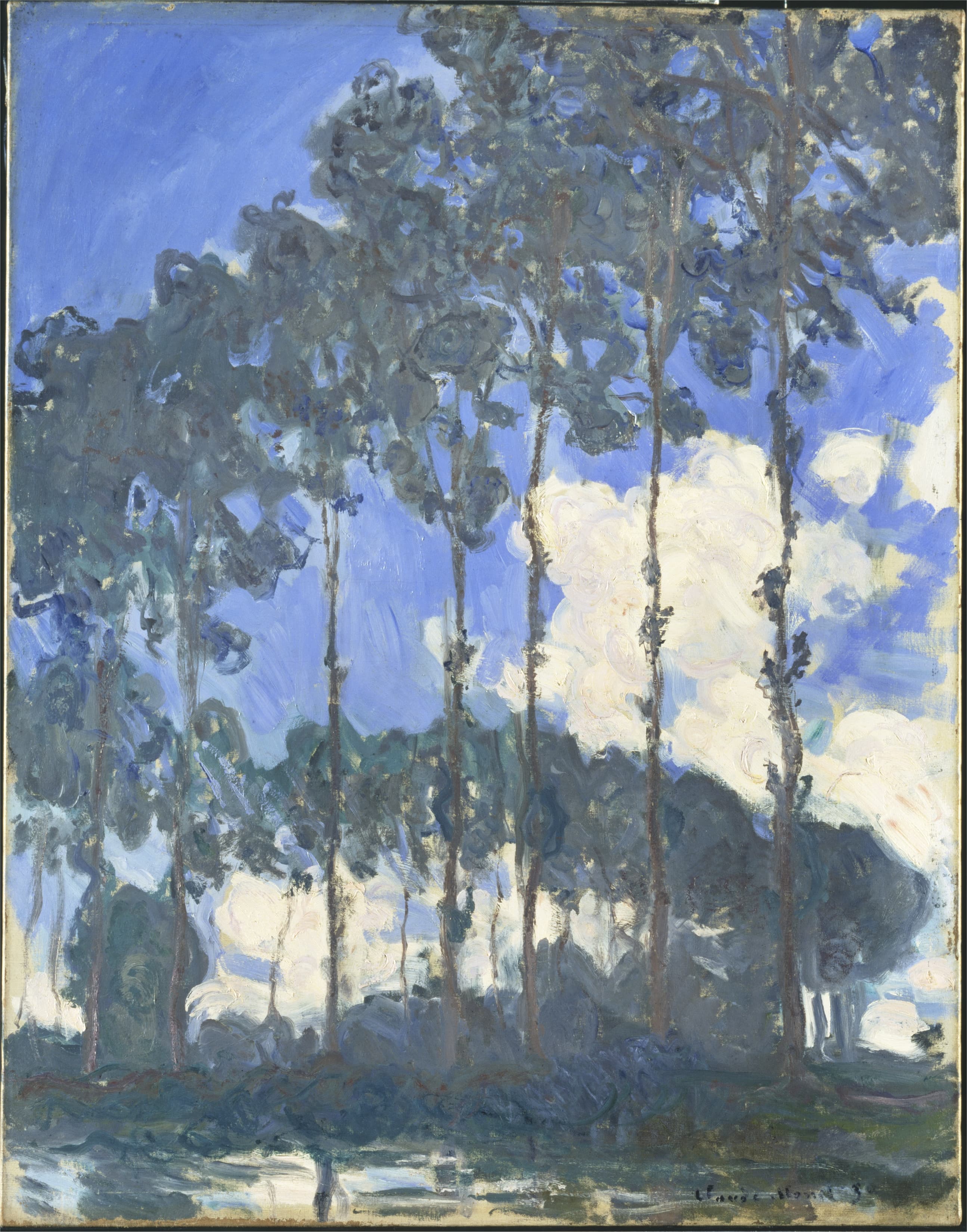
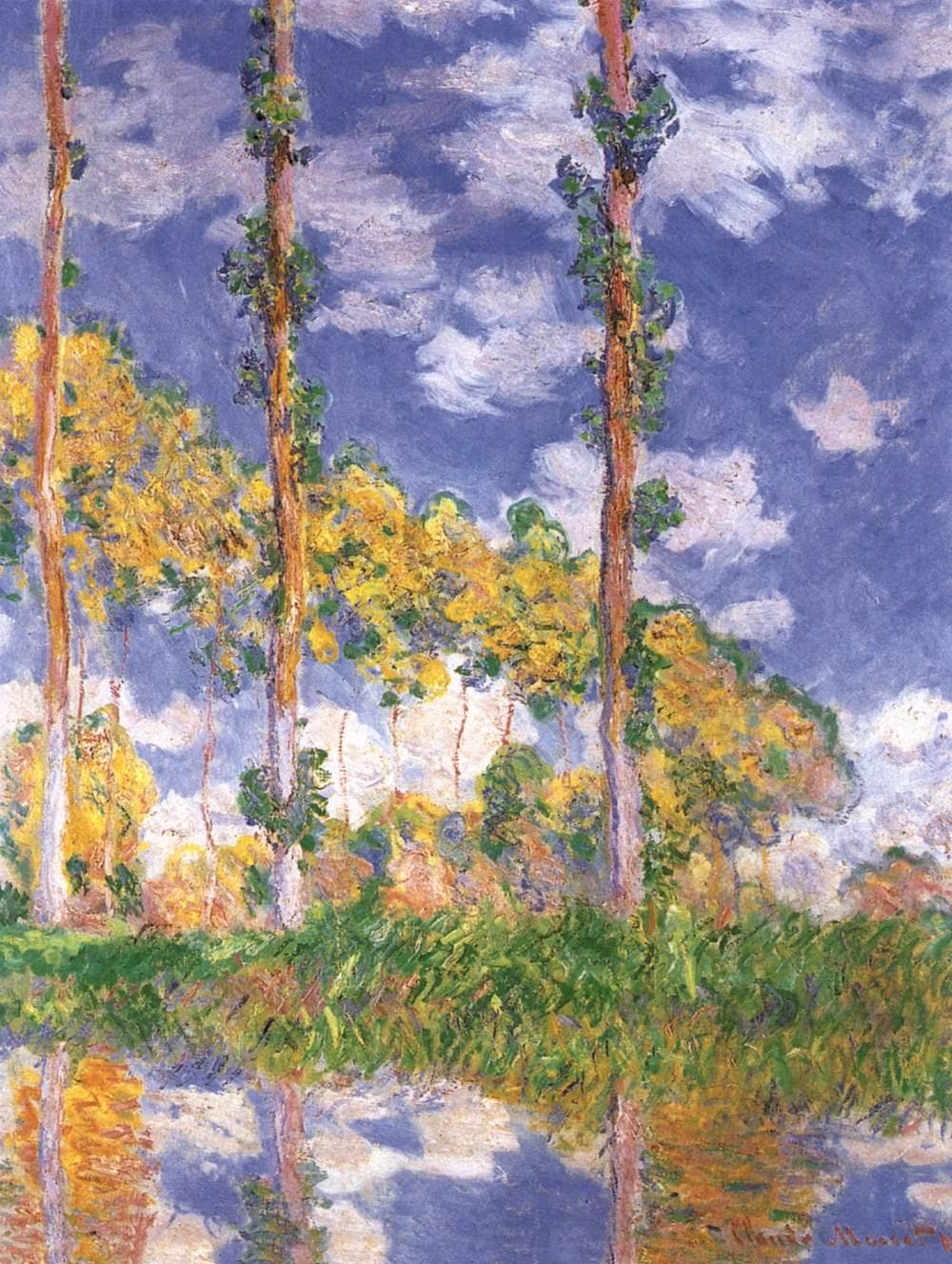
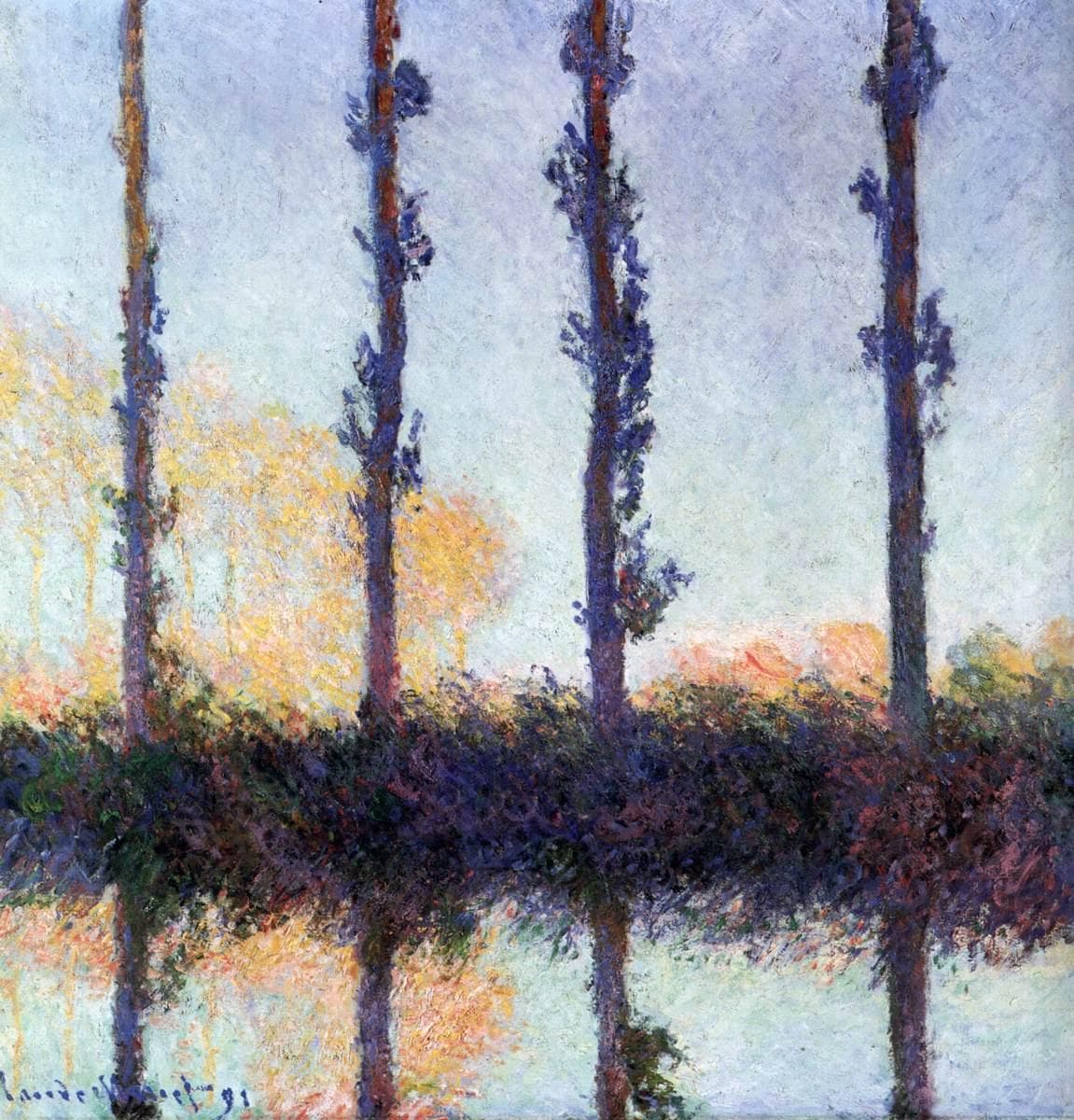
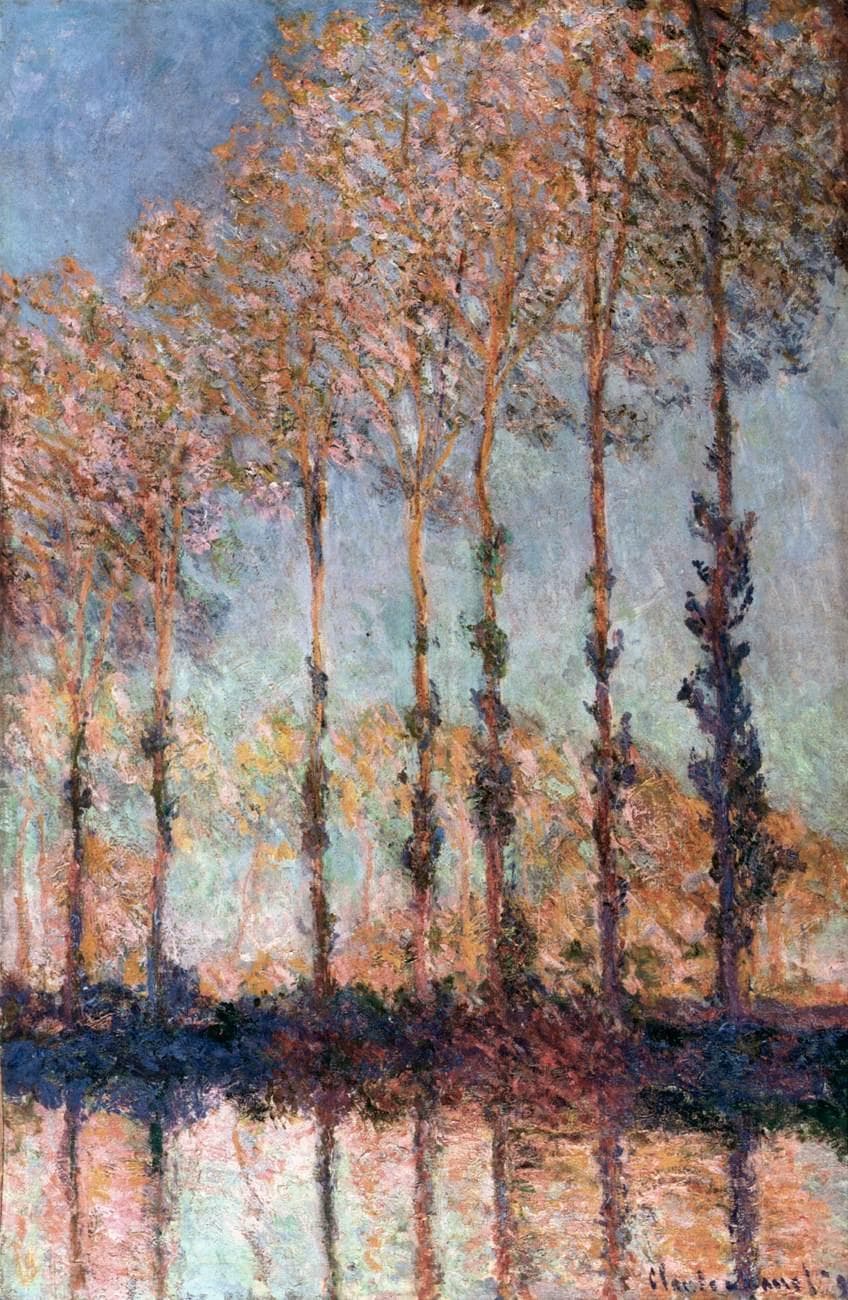
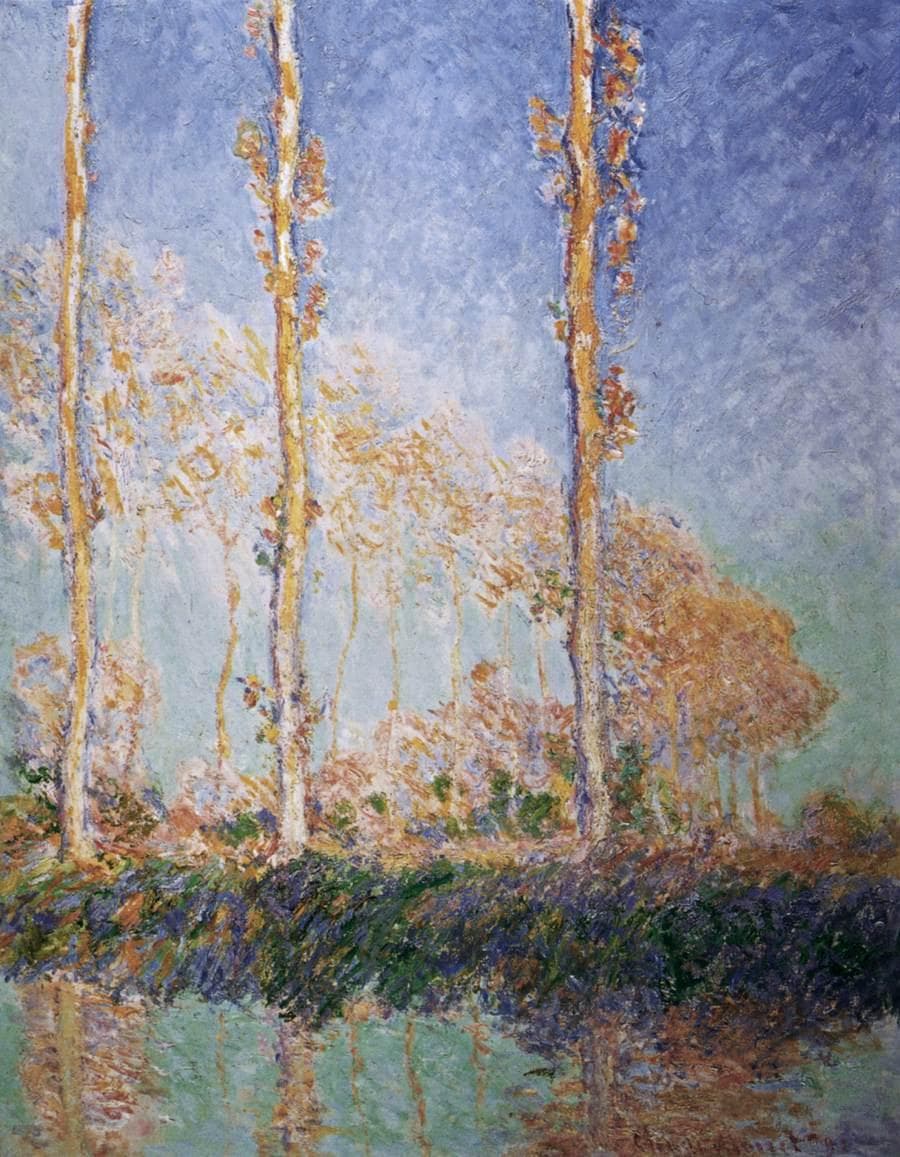
This canvas belongs to the group that shows the trees from the side, as a curving line along the bank, with their reflections taking half the picture. Others look up at the trunks from close to the water and cut off their tops, such as Poplars on the Epte in London, or reduce them to a few stripes against the sky, as in The Four Trees at the Met. Compare also the autumn colors of Poplars, Three Pink Trees, Autumn and Poplars on the Banks of the River Epte, both in Philadelphia. For the series, see Monet's Poplars.
How it was painted
The square format is unusual for Monet and suits the motif: it gives equal weight to sky and water and lets the curve of trees cross the middle of the canvas like a hinge. The paint is applied in short, separate strokes that sit side by side without blending, especially in the foliage and the water, so the surface shimmers. The clouds are thicker and creamier than the sky around them.
Painting from the boat put Monet at water level. That low viewpoint explains why the far bank is so close to the horizon and why the reflections dominate. It also links the Poplars to what came next: within a few years he would be painting the surface of his own water-lily pond at Giverny, where the reflected sky became the whole subject. For the village and its river, see Giverny: Monet's house and garden.
Where to see it
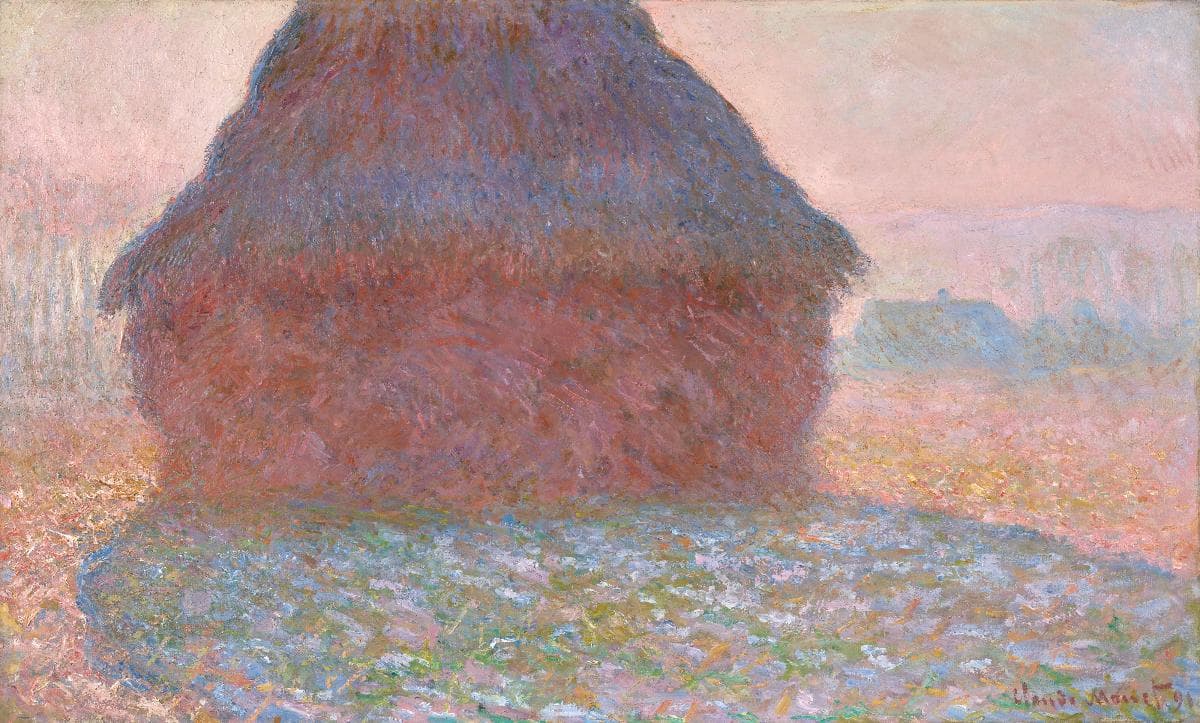
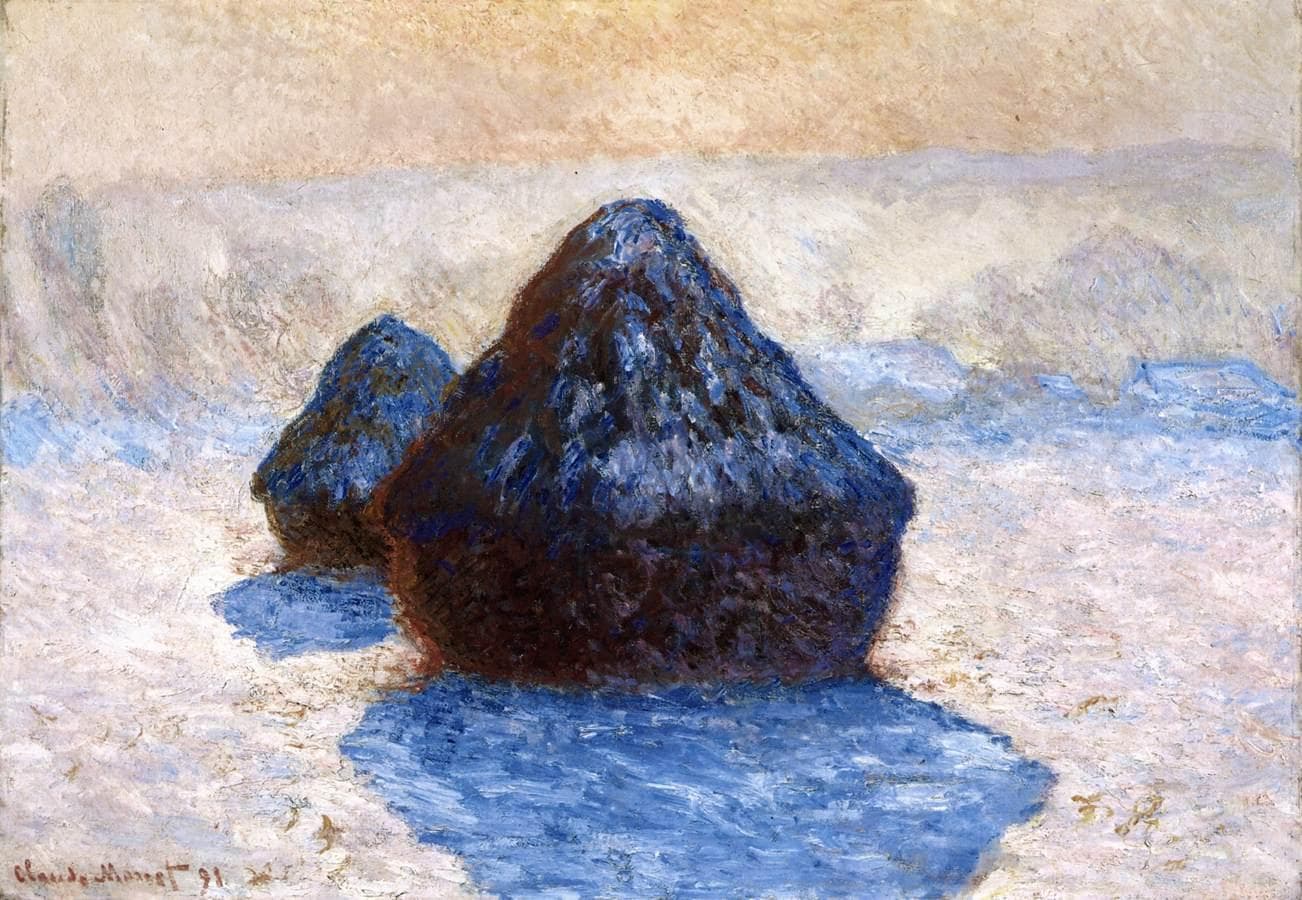
The painting, catalogued by Wildenstein as number 1310, has been in the collection of the National Galleries of Scotland since 1925 (NG 1651). It hangs in the Scottish National Gallery on the Mound in Edinburgh, which also owns one of Monet's grainstacks, Haystacks, Snow Effect. Admission to the permanent collection is free. See where to see Monet's paintings and the Claude Monet page.
Questions & answers
Where is Monet's Poplars on the Epte in Edinburgh?
It is in the Scottish National Gallery in Edinburgh (NG 1651), part of the National Galleries of Scotland since 1925. The square canvas measures 81.8 by 81.3 centimeters. A different Poplars on the Epte is in the Tate's collection in London.
When and where did Monet paint Poplars on the Epte?
In 1891, on the river Epte at Limetz near Giverny. He painted the trees from his studio boat between spring and autumn, working on several canvases at once as the light changed.
What does Poplars on the Epte show?
A row of tall summer poplars curving along the riverbank under a sky of white clouds, with the trees and clouds mirrored in the still water of the Epte, which fills the lower half of the square canvas.
How many Poplars paintings did Monet make?
About two dozen canvases, all painted in 1891. Monet paid a timber buyer to leave the trees standing until he finished, and fifteen were exhibited at Durand-Ruel's gallery in Paris in early 1892.
More by the artist
Claude Monet

Bridge over a Pond of Water Lilies
Claude Monet · 1899

Woman with a Parasol – Madame Monet and Her Son
Claude Monet · 1875

Sunset in Venice
Claude Monet · 1908–12

La Grenouillère
Claude Monet · 1869

Beach in Pourville
Claude Monet · 1882

Springtime
Claude Monet · 1872

Boating on the River Epte
Claude Monet · 1890

The Seine at Asnières (Hermitage)
Claude Monet · 1873
Also painted in 1891
The same year
Poplars on the Epte (London)
Claude Monet · 1891
Grainstack in Sunlight
Claude Monet · 1891
Three Poplars, Summer
Claude Monet · 1891
The Four Trees
Claude Monet · 1891
Grainstack (Snow Effect)
Claude Monet · 1891
Haystacks, Snow Effect
Claude Monet · 1891
Poplars at the Banks of Epte
Claude Monet · 1891–92
Poplars on the Banks of the River Epte
Claude Monet · 1891
Kindred works
You may also study
Poplars on the Epte (London)
Claude Monet · 1891
The Four Trees
Claude Monet · 1891
Poplars, Three Pink Trees, Autumn
Claude Monet · 1891
Poplars on the Banks of the River Epte
Claude Monet · 1891
Three Poplars, Summer
Claude Monet · 1891

The Scream
Edvard Munch · 1893

Ophelia
John Everett Millais · 1851–52

The Great Wave off Kanagawa
Katsushika Hokusai · c. 1830–32