Image: Staatsgalerie Stuttgart; via Wikimedia Commons · Public domain · via Wikimedia Commons
Impressionism
Poplars in the Sun
Claude Monet, 1887
Poplars in the Sun (Sous les peupliers, effet de soleil) is an 1887 painting by Claude Monet of a woman with a green parasol walking under tall poplars in a sunlit field near Giverny. It is in the Staatsgalerie Stuttgart.
- Artist
- Claude Monet
- Date
- 1887
- Medium
- Oil on canvas
- Dimensions
- 74.3 × 93 cm
- Collection
- Staatsgalerie Stuttgart, Stuttgart, Germany
- Movement
- Impressionism
- Catalogue
- Wildenstein 1135
Painted at Giverny: Monet's House and Garden
What you are looking at
A field of tall grass and wildflowers, yellow, gold and pale green, fills the lower third of the canvas. Four tall poplars rise from it on the right, their thin trunks dark against the light, their crowns a shimmering mass of blue-green and white leaves that runs off the top edge. A single rounded tree stands alone at the left, and behind it a line of smaller, upright poplars and blue hills marks the far edge of the plain.
In the middle of the field, under the poplars, a woman in a pale dress walks toward us holding a green parasol, her face shaded. To the left a small figure, a child, crouches in the grass, picking flowers. The sky is pale and hazy, almost white, and the whole picture is suffused with spring sunlight.
Where and when it was painted
By 1887 Monet had lived at Giverny for four years with Alice Hoschedé and their eight children. He still traveled to paint, to the Normandy coast, Belle-Île and Holland, but the fields around the village were becoming a constant source of motifs. This canvas shows the plain of Les Essarts at Limetz, just across the Epte from Giverny.
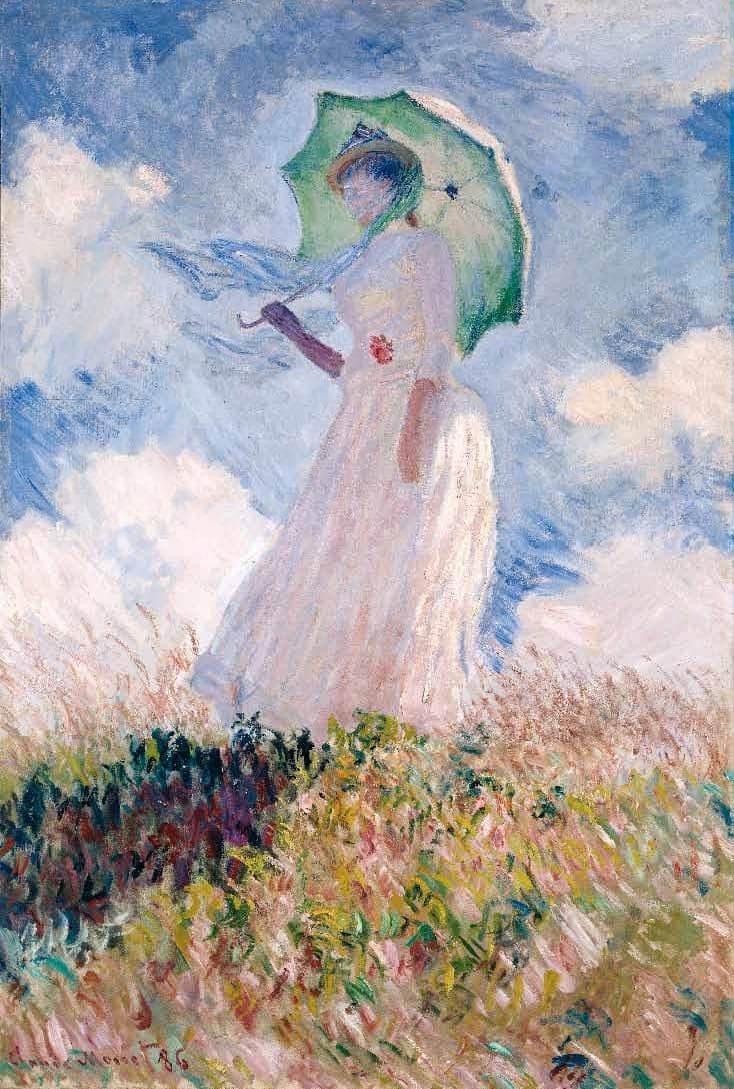
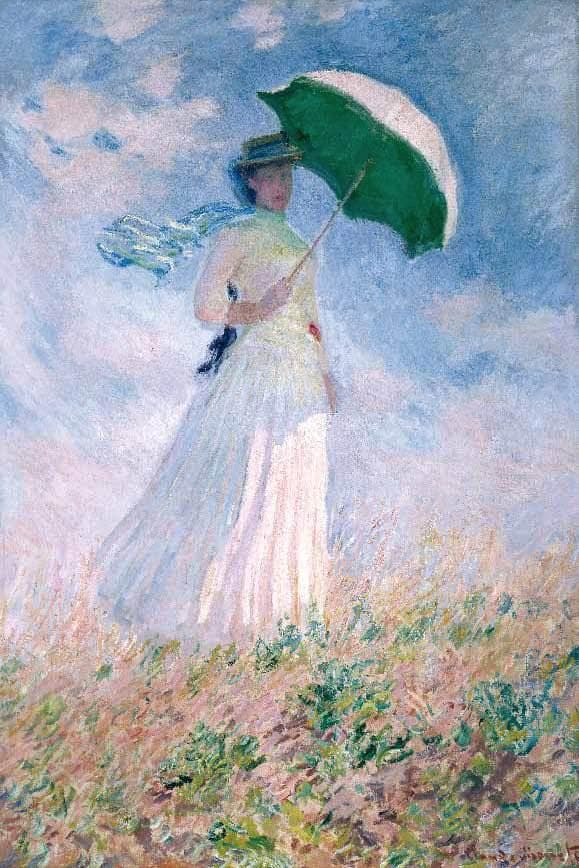
The woman is usually taken to be one of the Hoschedé daughters, who often posed for Monet in these years. Suzanne Hoschedé is the likeliest candidate: she had been the model for the two great figures with parasols of 1886, Woman with a Parasol Turned to the Left and Turned to the Right, and the flower detail on her hat appears to repeat one she wore in an earlier picture.
How it was painted
The foreground grass and the child are treated summarily, in quick, loose strokes of yellow and green, so that the eye passes over them to the woman at the center. She too is only suggested, her face and dress a few strokes, but she is placed exactly where the light is strongest, under the trees, with the green parasol as a single bright accent.
The poplars are the real structure of the picture. Their trunks are thin dark lines; their foliage is painted with countless small, flickering touches of blue, green and white that seem to move in the wind. Monet lets them run off the top of the canvas, so they seem taller than the frame can hold. A gradation of color, from warm yellows in front to cool blues in the distance, creates depth without any line of perspective.
The picture is a close cousin of the parasol figures of 1886, but calmer. There the figure stood on a rise against the sky, her dress whipped by the wind; here she walks through the field at the same level as the viewer, and the trees, not the figure, dominate. It is a step on the way from figure painting to pure landscape, which Monet would take fully in the series of the 1890s.
Toward the Poplars series
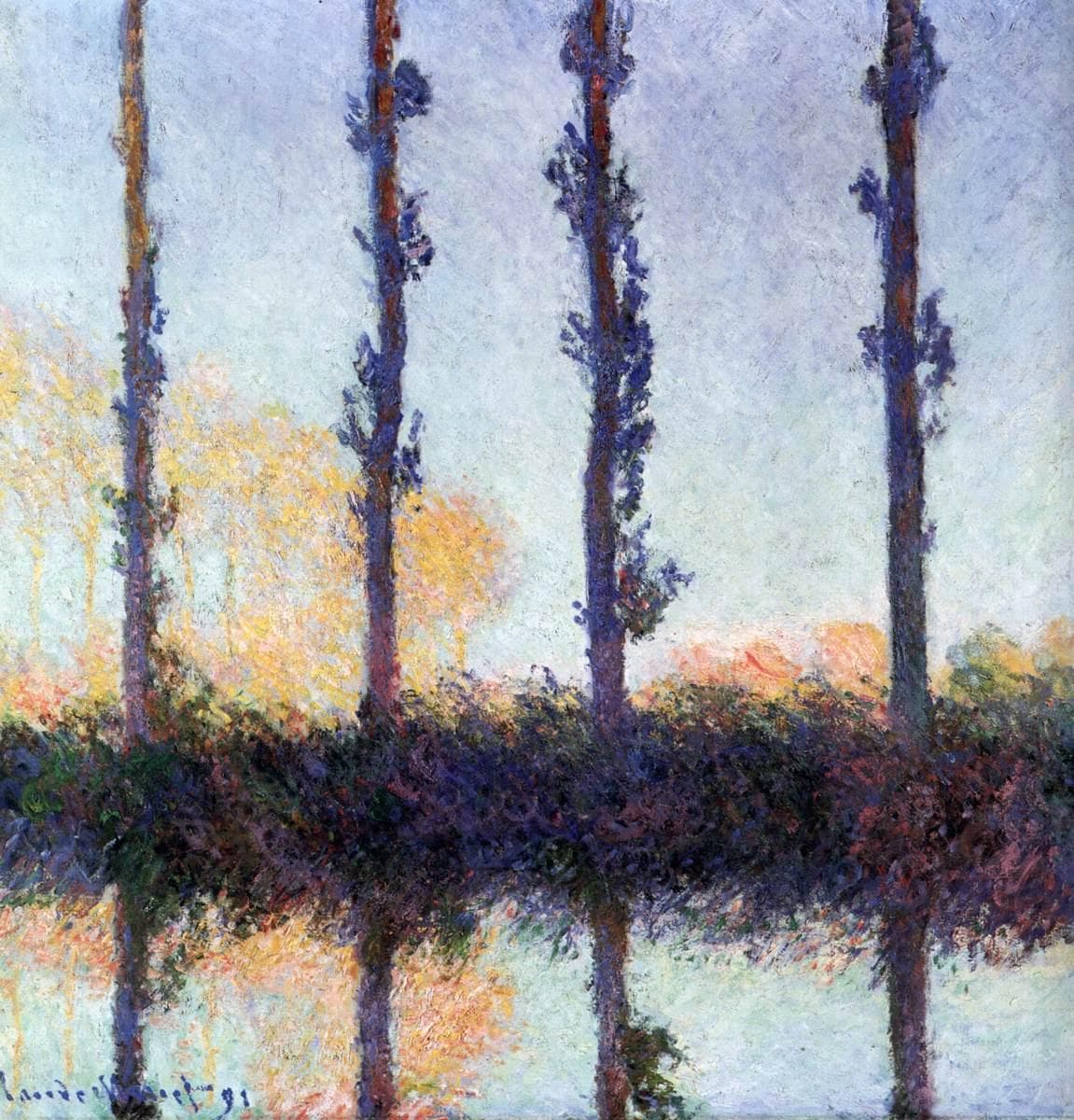
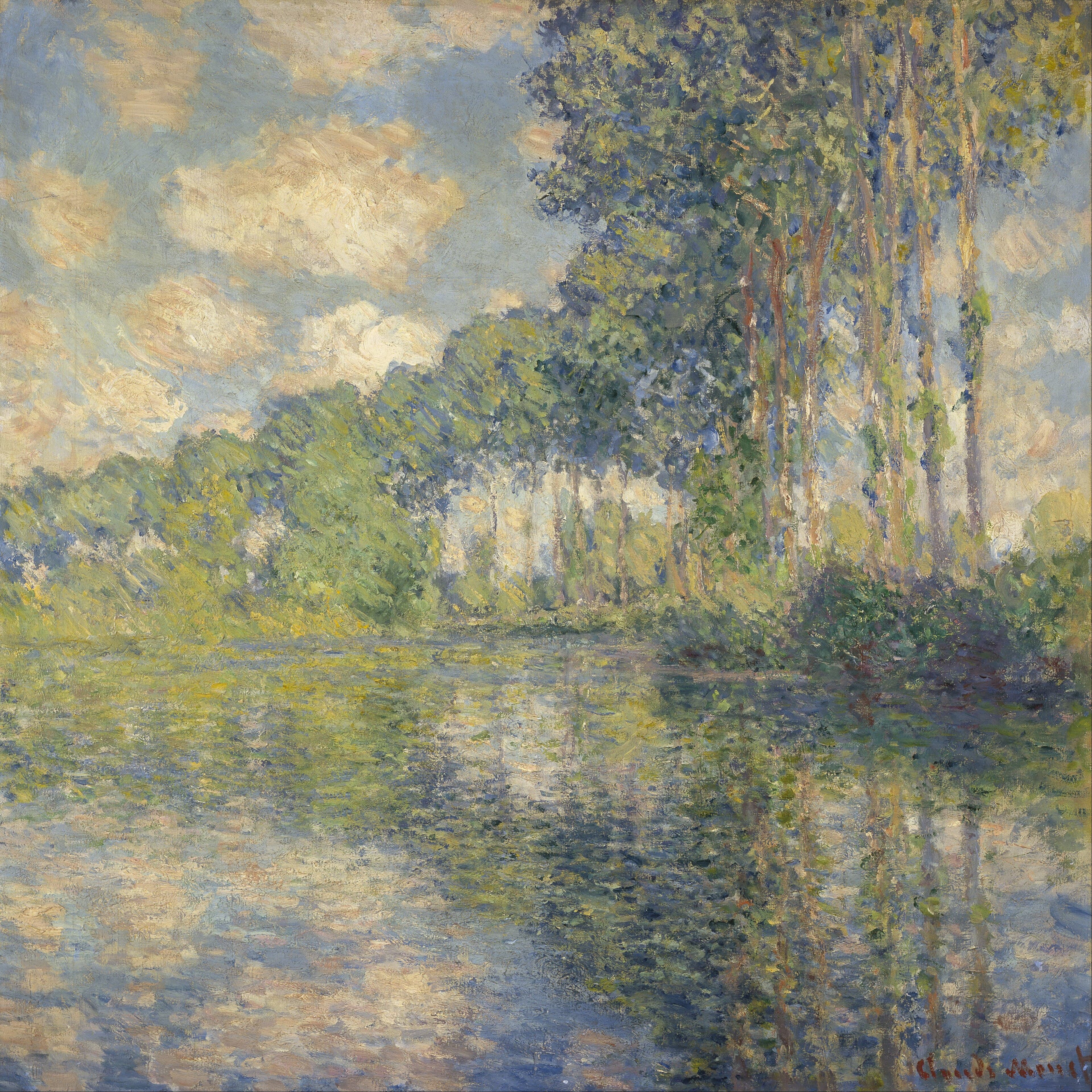
Four years later Monet would return to poplars along the Epte, a little upstream, and paint them as a series of more than twenty canvases, making the trees the sole subject. In those pictures, such as The Four Trees and Poplars on the Epte, the trunks become an almost abstract grid. In 1887 the poplars are still part of a pastoral scene with figures, but the idea of the tall row cut off by the frame is already here. See the Poplars series.
Ownership
The painting was probably bought from Monet by the baritone and collector Jean-Baptiste Faure, one of his earliest supporters. In 1906 it was acquired by the Stuttgarter Galerieverein, the friends' association of what is now the Staatsgalerie Stuttgart, as its first purchase (inventory GVL 16), an early instance of a German museum collecting Monet. The museum marked the centenary of the acquisition in 2006.
Where to see it
Poplars in the Sun is in the Staatsgalerie Stuttgart. For other museums with Monet's work, see where to see Monet's paintings.
Questions & answers
Where is Monet's Poplars in the Sun?
It is in the Staatsgalerie Stuttgart in Germany, inventory GVL 16. It was the first acquisition of the Stuttgarter Galerieverein in 1906. It is also known as Fields in Spring.
When and where was Poplars in the Sun painted?
Monet painted it in 1887 on the plain of Les Essarts at Limetz, next to Giverny, where he had lived since 1883.
Who is the woman with the parasol?
She is usually identified as one of Alice Hoschedé's daughters, most likely Suzanne Hoschedé, who posed for Monet's two Woman with a Parasol pictures of 1886. The child picking flowers is not identified.
Is Poplars in the Sun part of the Poplars series?
No. It predates the Poplars series of 1891 by four years. Here the poplars frame a figure in a field; in the series, painted along the Epte, the trees themselves are the subject.
More by the artist
Claude Monet

Bridge over a Pond of Water Lilies
Claude Monet · 1899

Woman with a Parasol – Madame Monet and Her Son
Claude Monet · 1875

Sunset in Venice
Claude Monet · 1908–12

La Grenouillère
Claude Monet · 1869

Beach in Pourville
Claude Monet · 1882

Springtime
Claude Monet · 1872

Boating on the River Epte
Claude Monet · 1890

The Seine at Asnières (Hermitage)
Claude Monet · 1873
Also painted in 1887
The same year
Kindred works
You may also study
Woman with a Parasol, Facing Left
Claude Monet · 1886
Woman with a Parasol, Facing Right
Claude Monet · 1886
The Four Trees
Claude Monet · 1891
Poplars on the Epte (Edinburgh)
Claude Monet · 1891
Spring
Claude Monet · 1886

Venus de Milo
Alexandros of Antioch · c. 150–125 BC

The Scream
Edvard Munch · 1893

Ophelia
John Everett Millais · 1851–52