Impressionism
The Boat at Giverny
Claude Monet, c. 1887
The Boat at Giverny (En norvégienne) is a painting of about 1887 by Claude Monet showing three of his stepdaughters fishing from a rowing boat on still water near Giverny. It is in the Musée d'Orsay, Paris.
- Artist
- Claude Monet
- Date
- c. 1887
- Medium
- Oil on canvas
- Dimensions
- 97.5 × 130.5 cm
- Collection
- Musée d'Orsay, Paris, France
- Movement
- Impressionism
- Catalogue
- Wildenstein 1151
Painted at Giverny: Monet's House and GardenMore at Monet at the Musée d'Orsay
What you are looking at
Three young women in white and pale blue sit in a long, pointed rowing boat, low on dark water. The one standing at left, in a straw hat with her hair loose down her back, holds a fishing rod out over the side, one hand on her hip. The two seated behind her wear wide hats, one yellow straw, one with a green band; the third also holds a rod, its line running out of the picture at right. Two thin mooring poles stand upright in the water beside the boat.
There is no sky and no horizon. The background is a wall of dense green foliage, worked with flecks of blue, rust and violet, and the lower half of the canvas is water so still that the boat and its passengers are repeated upside down beneath them, their white dresses turned into wavering pale shapes with warm orange-brown at their edges. At bottom left a few blue-violet touches suggest flowers or water plants at the bank.
The painting is known in French as En norvégienne, "in the Norwegian boat," after the light, pointed rowing boat of a type then fashionable on French rivers. Claude Monet painted it around 1887. It measures 97.5 by 130.5 centimeters, is number 1151 in Wildenstein's catalogue, and is in the Musée d'Orsay, Paris.
Where and when
Monet had moved to Giverny, a village where the river Epte meets the Seine some 75 kilometers northwest of Paris, in April 1883, with Alice Hoschedé and their combined family of eight children. By the later 1880s the household's boats were moored on the Epte and its backwaters near the house, and the Hoschedé daughters became his models on the water and in the meadows. See Giverny: Monet's House and Garden.
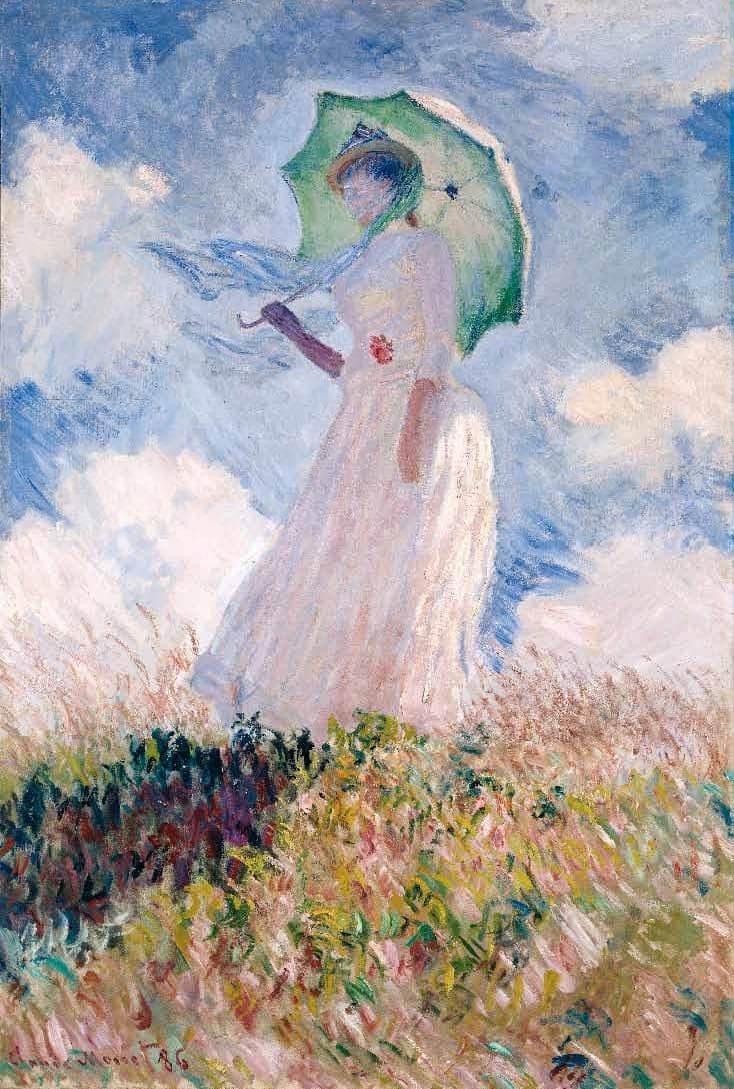
The three women are Alice's daughters, Monet's future stepdaughters (he married Alice in 1892). The Orsay identifies them, from left to right, as Germaine, Suzanne and Blanche Hoschedé. Suzanne was Monet's favorite model in these years, the figure under the parasol in Woman with a Parasol, Turned to the Left. Blanche, at the right, painted alongside Monet and later married his son Jean.
How it was painted
The composition is unusual and deliberate. The boat is cut off at the right edge and set high, and the space is flattened: foliage, figures and reflections are stacked up the canvas like the panels of a screen. That flatness and the high, cropped viewpoint owe something to the Japanese prints Monet collected and hung on the walls at Giverny.
Look at how differently he treats the three zones. The foliage is a mass of short, crossing strokes in many greens with no single leaf described. The figures are painted more broadly, with the white dresses built from cream, lilac and blue rather than pure white. The reflections are longer and softer, laid in vertical drags that break up at the edges, so the water reads as faintly moving even though the scene is calm.
The rods and poles are the only hard, straight lines in the picture. They cut across the soft surfaces and give it a framework. Given the size of the canvas, Monet probably began it outdoors and finished it in the studio.
The motif and its siblings
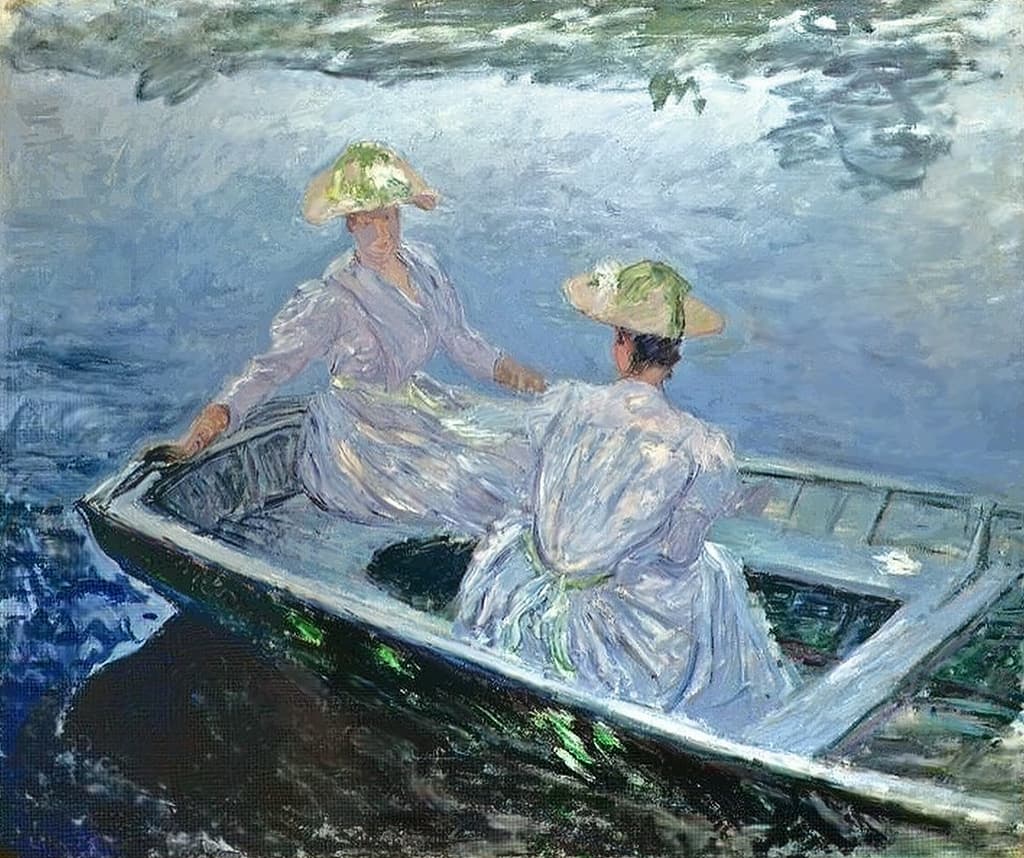
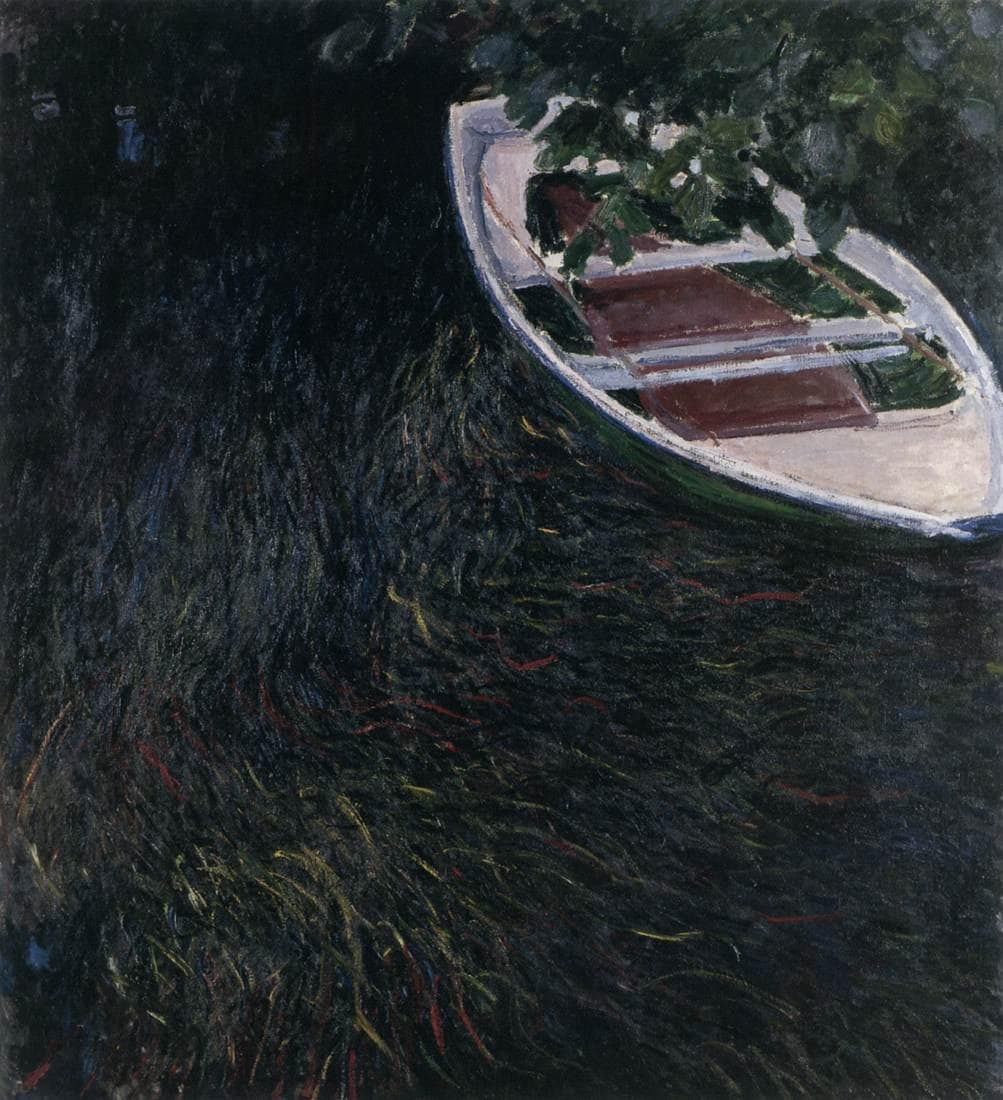
In the late 1880s Monet painted a group of boating pictures on the Epte, often with the Hoschedé girls as models: The Blue Boat, the empty rowing boat of The Barque in the Musée Marmottan, and later Boating on the River Epte in São Paulo, which uses the same boat and steep viewpoint. They were among his last major figure paintings before he turned to the series of haystacks and poplars.
The theme of a picture without sky, built from reflections in still water, leads directly to the water garden he dug in 1893 and to the Water Lilies.
Where to see it
The painting is in the Musée d'Orsay: see Monet at the Musée d'Orsay. For Monet's life at Giverny and earlier, see Claude Monet.
Questions & answers
Where is The Boat at Giverny (En norvégienne)?
Monet's En norvégienne, known in English as The Boat at Giverny, is in the Musée d'Orsay in Paris. It is a large canvas, 97.5 by 130.5 centimeters, painted around 1887 and catalogued by Wildenstein as number 1151.
Who are the women in Monet's The Boat at Giverny?
They are the daughters of Alice Hoschedé, who became Monet's second wife in 1892. The Musée d'Orsay identifies them, from left to right, as Germaine, Suzanne and Blanche Hoschedé. Suzanne was his favorite model; Blanche later became a painter and married Monet's son Jean.
When and where was The Boat at Giverny painted?
Around 1887 on the river Epte or one of its backwaters near Monet's house at Giverny, where he had lived since 1883. The family kept boats there, and the Hoschedé daughters posed in them for several pictures in the late 1880s.
Why is there no sky in The Boat at Giverny?
Monet chose a high viewpoint that fills the canvas with foliage and water, so the boat floats between a green wall and its own reflection. The flattened, cropped design recalls Japanese prints and anticipates the skyless Water Lilies of his later years.
More by the artist
Claude Monet

Bridge over a Pond of Water Lilies
Claude Monet · 1899

Woman with a Parasol – Madame Monet and Her Son
Claude Monet · 1875

Sunset in Venice
Claude Monet · 1908–12

La Grenouillère
Claude Monet · 1869

Beach in Pourville
Claude Monet · 1882

Springtime
Claude Monet · 1872

Boating on the River Epte
Claude Monet · 1890

The Seine at Asnières (Hermitage)
Claude Monet · 1873
Also painted in 1887
The same year
Kindred works
You may also study
The Blue Boat
Claude Monet · 1887
The Barque
Claude Monet · 1887
Woman with a Parasol, Facing Left
Claude Monet · 1886
Meadow at Giverny
Claude Monet · 1888

Venus de Milo
Alexandros of Antioch · c. 150–125 BC

The Scream
Edvard Munch · 1893

Ophelia
John Everett Millais · 1851–52

The Great Wave off Kanagawa
Katsushika Hokusai · c. 1830–32