Image: Museo Soumaya, Mexico City; photograph by José Luiz (Wikimedia Commons) · CC BY-SA 4.0 · via Wikimedia Commons
Impressionism
Giverny Landscape
Claude Monet, 1887
Giverny Landscape (Paysage à Giverny) is an 1887 painting by Claude Monet of a windswept tree above a ruddy field, with the village and valley of Giverny dissolving in mist behind. It is in the Museo Soumaya in Mexico City.
- Artist
- Claude Monet
- Date
- 1887
- Medium
- Oil on canvas
- Collection
- Museo Soumaya, Mexico City, Mexico
- Movement
- Impressionism
- Catalogue
- Wildenstein 1123
Painted at Giverny: Monet's House and Garden
What you are looking at
A single tree stands at the far left, its thin trunk rising almost to the top of the canvas and its branches thrown out to the right in looping, calligraphic lines of dark brown, green and blue. Behind it a broad band of rust-red field crosses the picture, probably plowed earth or a ripening crop. Beyond the field, a valley opens in a haze of grey-green and lilac: low roofs and walls, the rounded shapes of trees or stacks, and a hillside that fades into a sky of the same misty color. Along the very bottom runs a strip of green growth. The signature is at lower left.
The weather is the real subject. The sky is laid in with long, slanting strokes that run down to the right, and the branches seem to stream the same way, as though a gust of wind and rain were sweeping across the valley. The far village is barely more than a few pale rectangles.
Look at the branches closely. They are not modeled at all but drawn with the brush in quick curling lines, some ending in small hooks and loops. Few passages in Monet's work of the 1880s are this close to pure drawing in paint.
Where and when it was painted
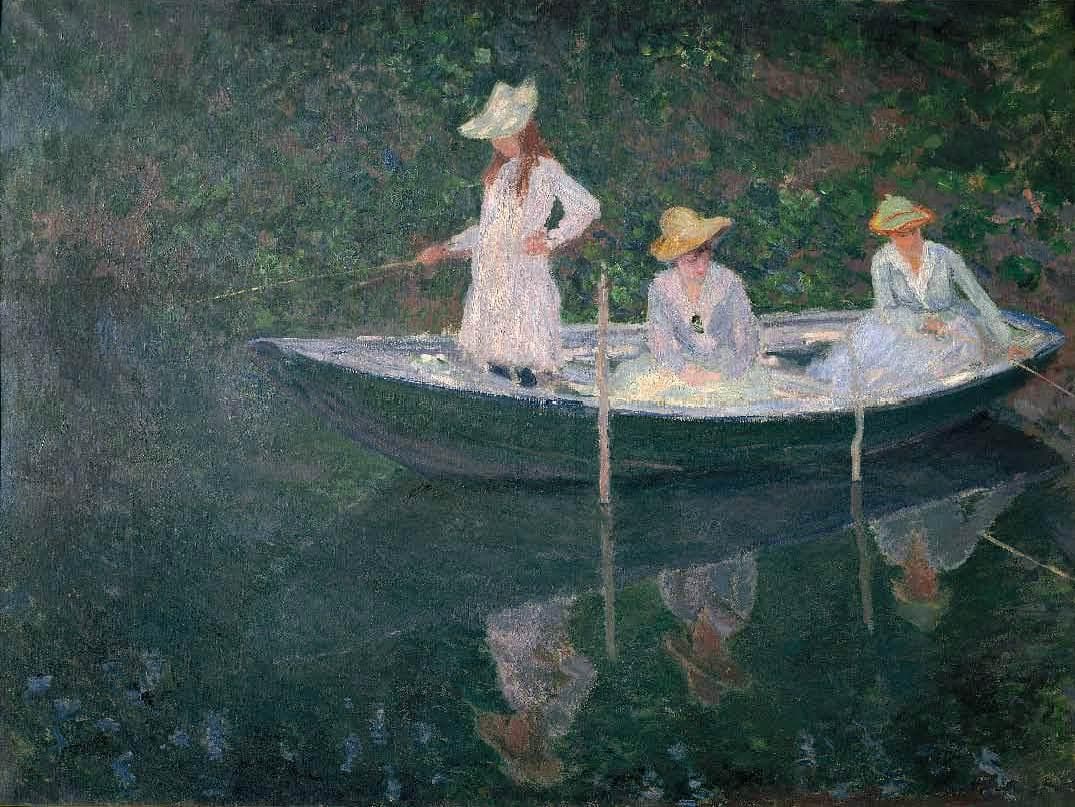
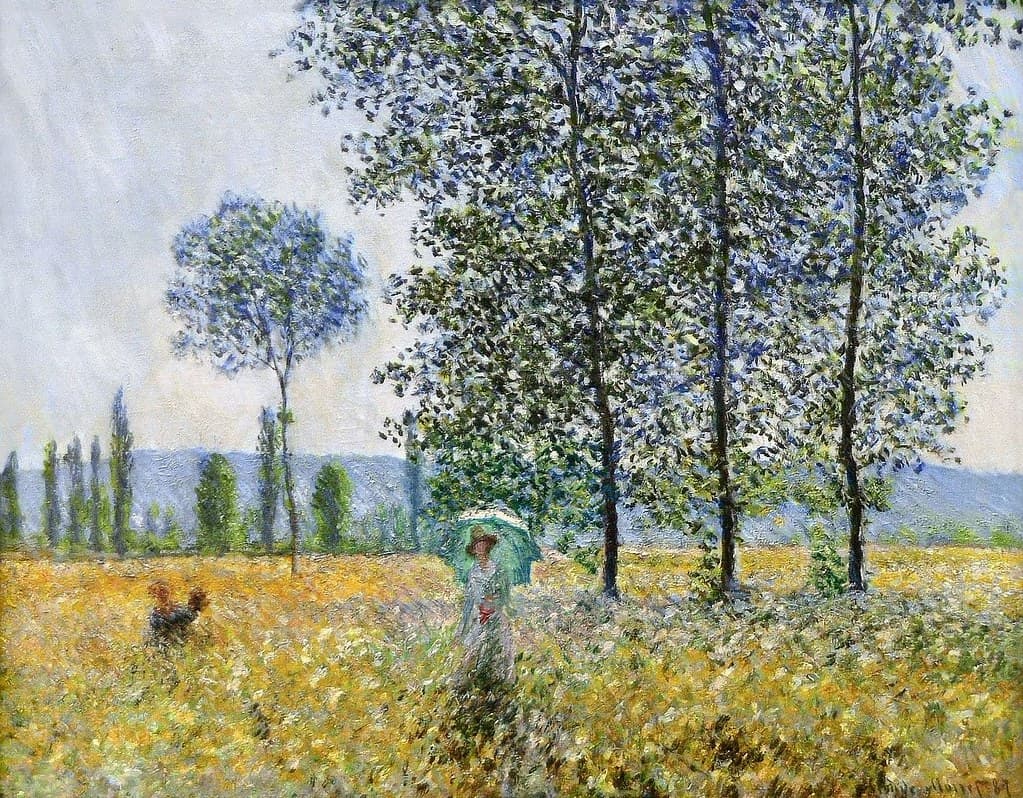
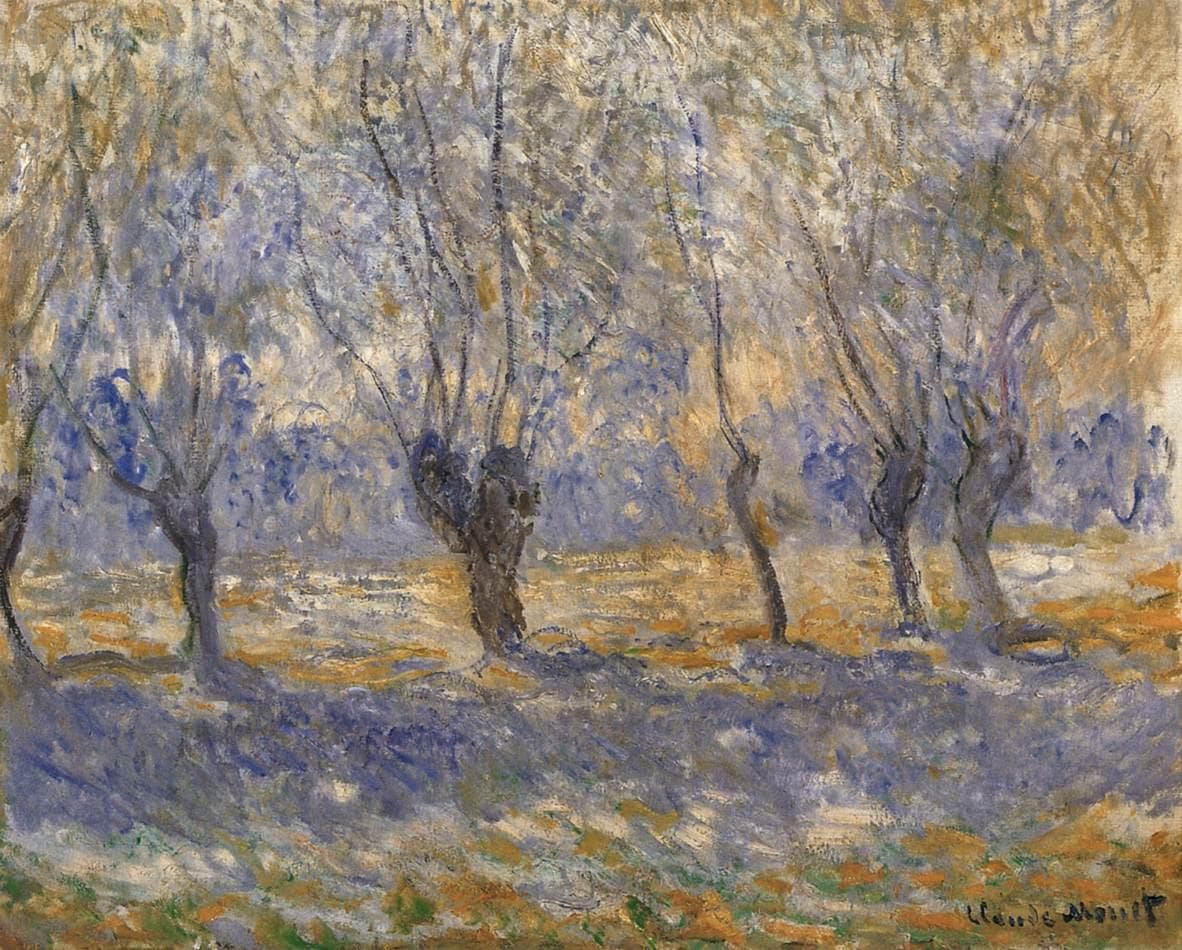
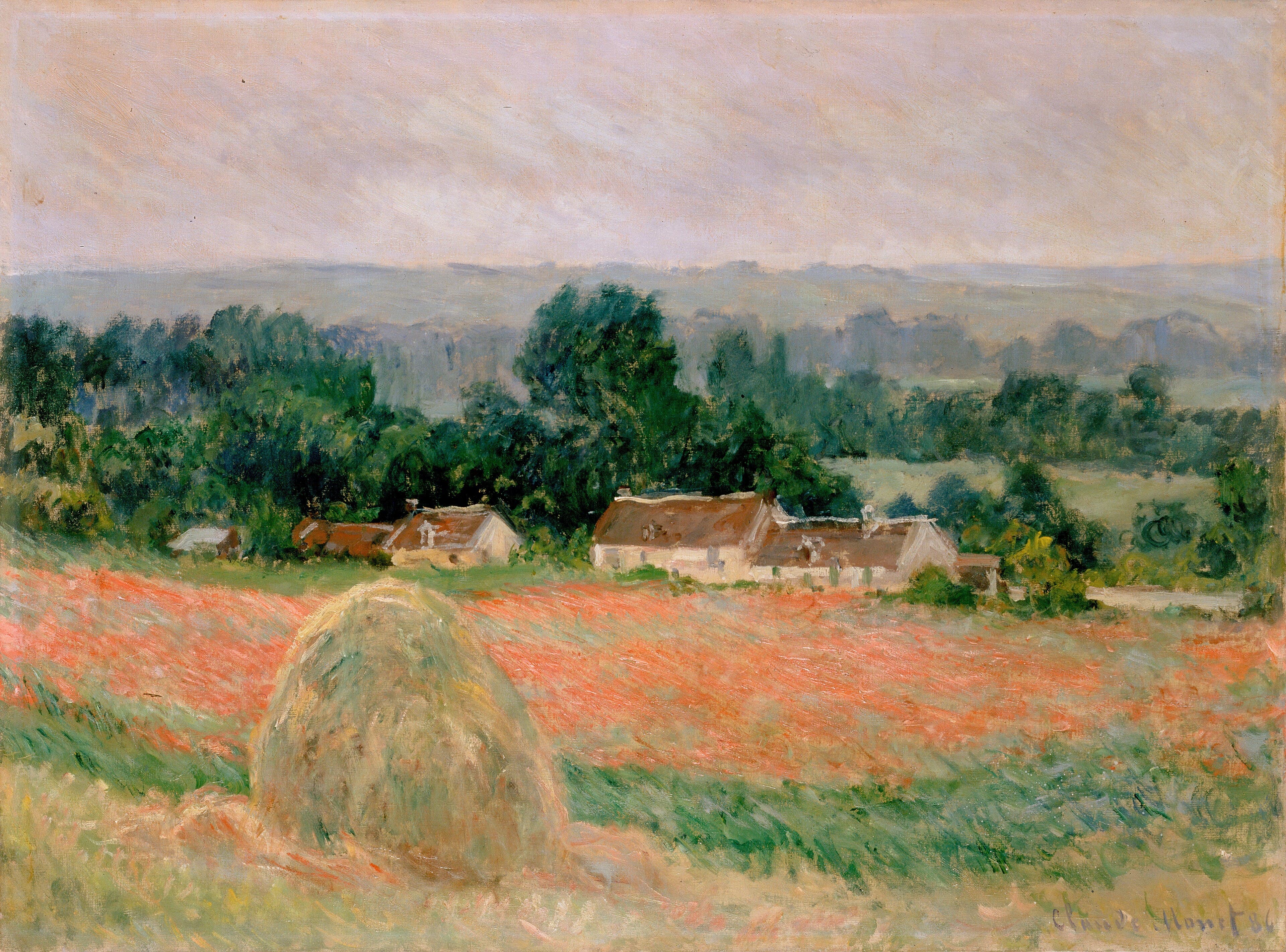
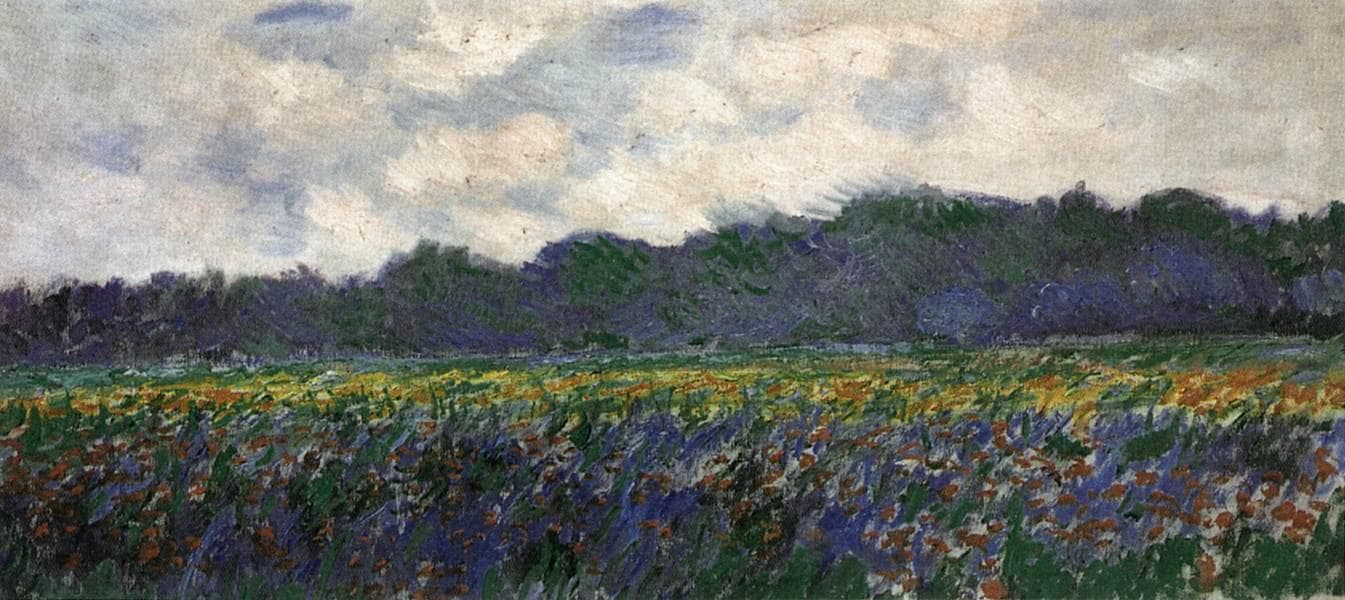
Monet had settled at Giverny, in the Seine valley about 75 kilometers from Paris, in 1883. In his first years there he painted the meadows, poplars, willows and fields around the village rather than his garden, often in changing weather. In 1887 he worked on the meadows and on figures in boats on the river Epte; the same year produced Poplars in the Sun and Field of Yellow Irises at Giverny. A year earlier he had painted Willows at Giverny and Haystack at Giverny. For the village and its subjects, see Giverny: Monet's house and garden.
How it was painted
The composition is built on a strong contrast between the near and the far: one dark, linear tree against a soft, nearly formless background. The red field is a horizontal band that separates them. This device, a single tree pushed to the edge and cut by the frame, goes back to Monet's study of Japanese prints, which he collected, and it reappears in his Mediterranean pictures and in the poplars of 1891.
The handling is fast. The field is scrubbed in with horizontal strokes, the sky with diagonal ones, and the tree is drawn on top when the paint beneath was already laid. It reads as a picture made in one or two sessions.
A tradition repeated in some Spanish-language sources says Monet saw this view from a train window and links its mood to his relationship with Alice Hoschedé; there is no documentary support for either claim, and they are best treated as legend.
Ownership and where to see it
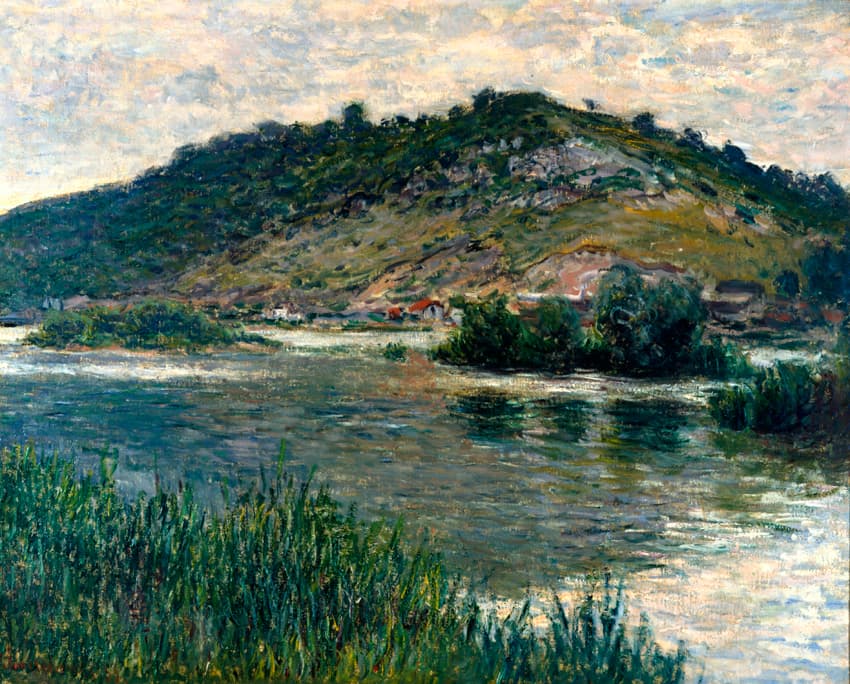
The painting is catalogued by Wildenstein as number 1123 and is now in the Museo Soumaya in Mexico City, the museum of the Carlos Slim Foundation, which has a substantial group of French Impressionist and Post-Impressionist works. The museum also owns Monet's Landscape in Port-Villez. Its dimensions are not published in the sources consulted here. See where to see Monet's paintings and the Claude Monet page.
Questions & answers
Where is Monet's Giverny Landscape?
Giverny Landscape (Paysage à Giverny) is in the Museo Soumaya in Mexico City, the museum of the Carlos Slim Foundation at Plaza Carso. The museum also owns Monet's Landscape in Port-Villez.
When did Monet paint Giverny Landscape?
It is dated 1887 and catalogued by Wildenstein as number 1123. Monet had moved to Giverny in 1883 and in these years painted the fields, meadows and river around the village.
What does Giverny Landscape show?
A single windswept tree at the left edge, its branches drawn in looping strokes, in front of a band of rust-red field and a misty valley with the roofs of Giverny, under a sky streaked as if by wind and rain.
Did Monet paint this view from a train?
Some sources repeat a tradition that he saw the view from a train window, but there is no documentary evidence for it. The handling suggests a quick study made outdoors in changing weather.
More by the artist
Claude Monet

Bridge over a Pond of Water Lilies
Claude Monet · 1899

Woman with a Parasol – Madame Monet and Her Son
Claude Monet · 1875

Sunset in Venice
Claude Monet · 1908–12

La Grenouillère
Claude Monet · 1869

Beach in Pourville
Claude Monet · 1882

Springtime
Claude Monet · 1872

Boating on the River Epte
Claude Monet · 1890

The Seine at Asnières (Hermitage)
Claude Monet · 1873
Also painted in 1887
The same year
Kindred works
You may also study
Poplars in the Sun
Claude Monet · 1887
Willows at Giverny
Claude Monet · 1886
Haystack at Giverny
Claude Monet · 1886
Field of Yellow Irises at Giverny
Claude Monet · 1887
Landscape in Port-Villez
Claude Monet · 1883

The Scream
Edvard Munch · 1893

Ophelia
John Everett Millais · 1851–52

The Great Wave off Kanagawa
Katsushika Hokusai · c. 1830–32