Impressionism
The Barque
Claude Monet, 1887
The Barque (La Barque) is an 1887 painting by Claude Monet of an empty rowing boat on the river Epte near Giverny, seen from above among reflections and water plants. It is in the Musée Marmottan Monet, Paris, and foreshadows his Water Lilies.
- Artist
- Claude Monet
- Date
- 1887
- Medium
- Oil on canvas
- Dimensions
- 146 × 133 cm
- Collection
- Musée Marmottan Monet, Paris, France
- Movement
- Impressionism
- Catalogue
- Wildenstein 1154
Painted at Giverny: Monet's House and GardenMore at Musée Marmottan Monet
What you are looking at
An empty rowing boat floats at the top of a large, nearly square canvas. There is no shore, no sky and no horizon: the whole picture is water, seen from above, filled with long, trailing strands of weed that sway in the current and with the shifting colors of reflected light. The boat is the only solid thing in the scene, and it is cut off by the edge of the frame, as if it were drifting out of view.
Claude Monet painted La Barque in 1887 at Giverny, on the river Epte, where he had settled with Alice Hoschedé and their combined family four years earlier. The canvas measures 146 by 133 centimeters and is in the Musée Marmottan Monet in Paris, which received it in 1966 with the bequest of the painter's son Michel Monet.
Looking closely
The first thing to notice is what is missing. Monet removes every reference point we normally use to read a landscape. Without a horizon, the water becomes a vertical surface, a wall of color. The boat, tilted and cropped, sits near the top like an object placed on a tabletop. This high, flattened viewpoint owes a good deal to Japanese prints, which Monet collected and hung throughout his house at Giverny.
The water is painted with long, sinuous strokes that follow the movement of the weed beneath the surface. The water is very dark, close to black in places, a deep mass of blue-black and green; through it run thin, flickering strokes of red, ochre and yellow-green, the weed catching the light under the surface. It is hard to tell what is reflection, what is plant and what is the riverbed showing through. The surface reads as a single living field rather than a view into depth.
At the top of the canvas a mass of green leaves hangs down over the boat from a bank we cannot see, the only hint that land is near. The boat itself is the lightest thing in the picture: a pale, almost white hull seen from above, with reddish-brown floorboards and grey seats, painted in firm, flat strokes that contrast with the restless water. It is empty. The absence of the rowers, whom Monet painted elsewhere, gives the picture a stillness that some viewers find melancholy and others simply contemplative.
Monet's boating pictures of 1887
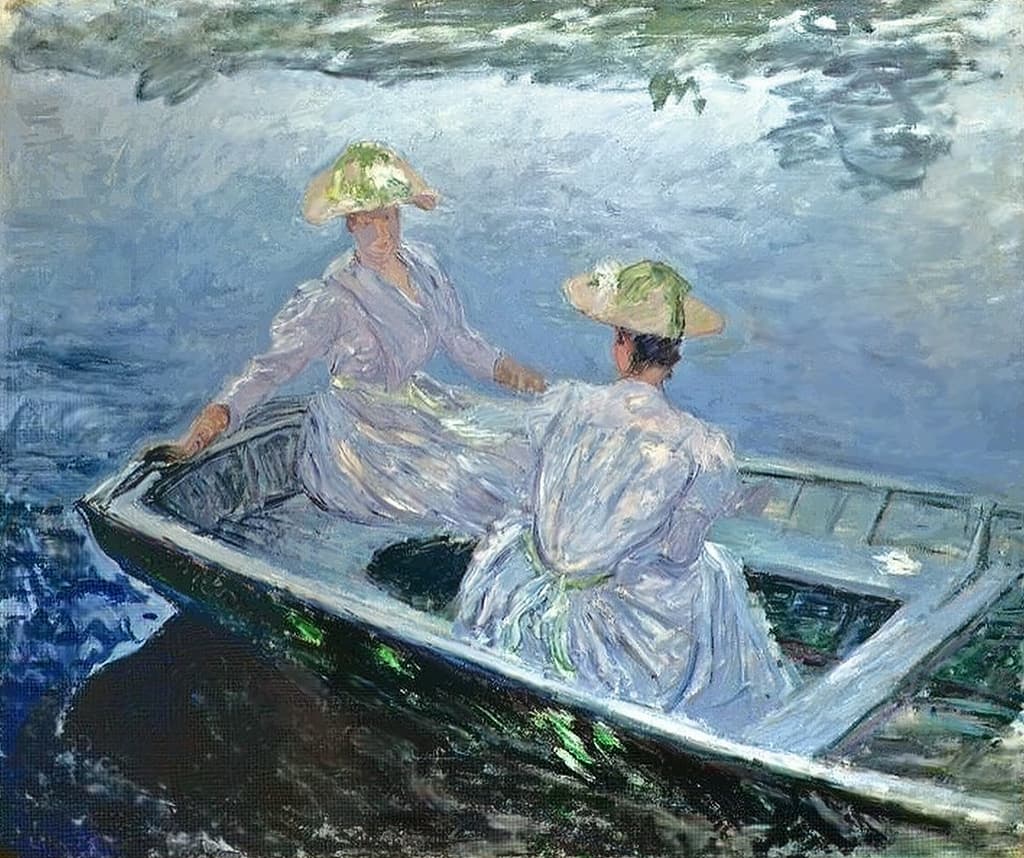
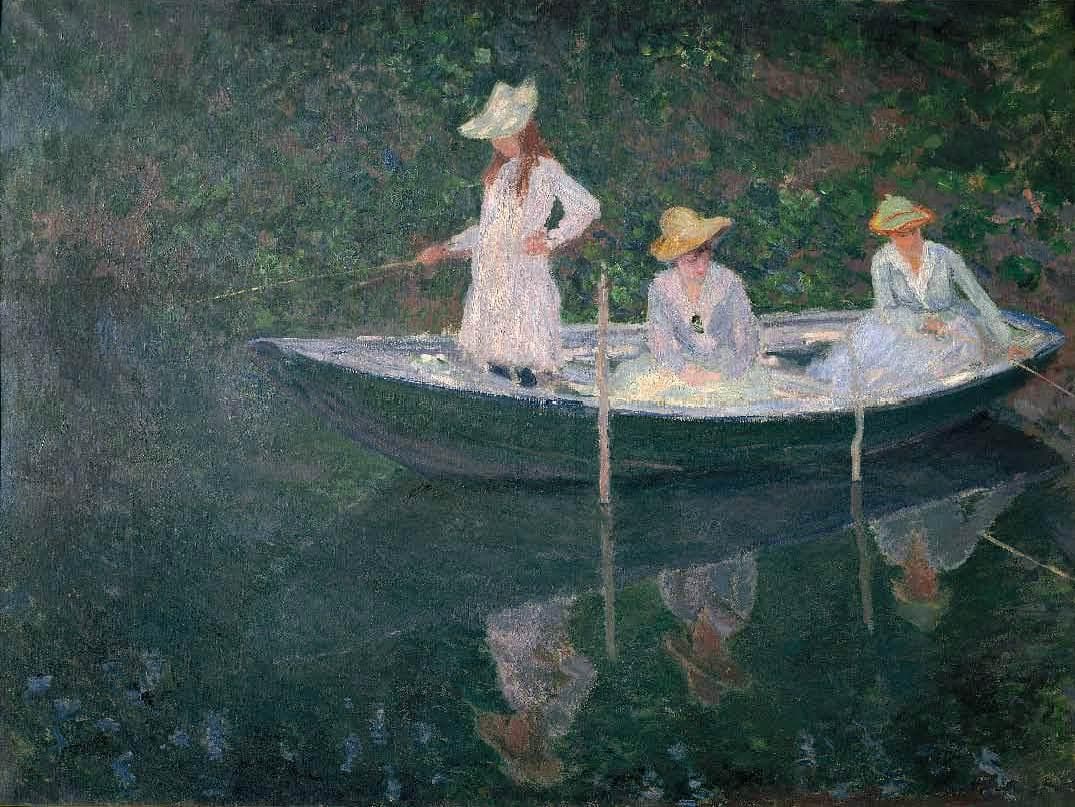
Monet's sketchbooks show the boat motif first appearing in 1887. That summer and the next he painted several large canvases of the Hoschedé daughters, Suzanne and Blanche, boating and fishing on the Epte. The best known are in the Musée d'Orsay and elsewhere; see The Boat at Giverny, in which three young women in white sit in a skiff above their reflections.
La Barque is the most radical of the group. Having painted the boat with its passengers, Monet painted it again without them, and let the water take over. The Marmottan describes it as prefiguring the experiments with the Water Lilies that would occupy him from the late 1890s.
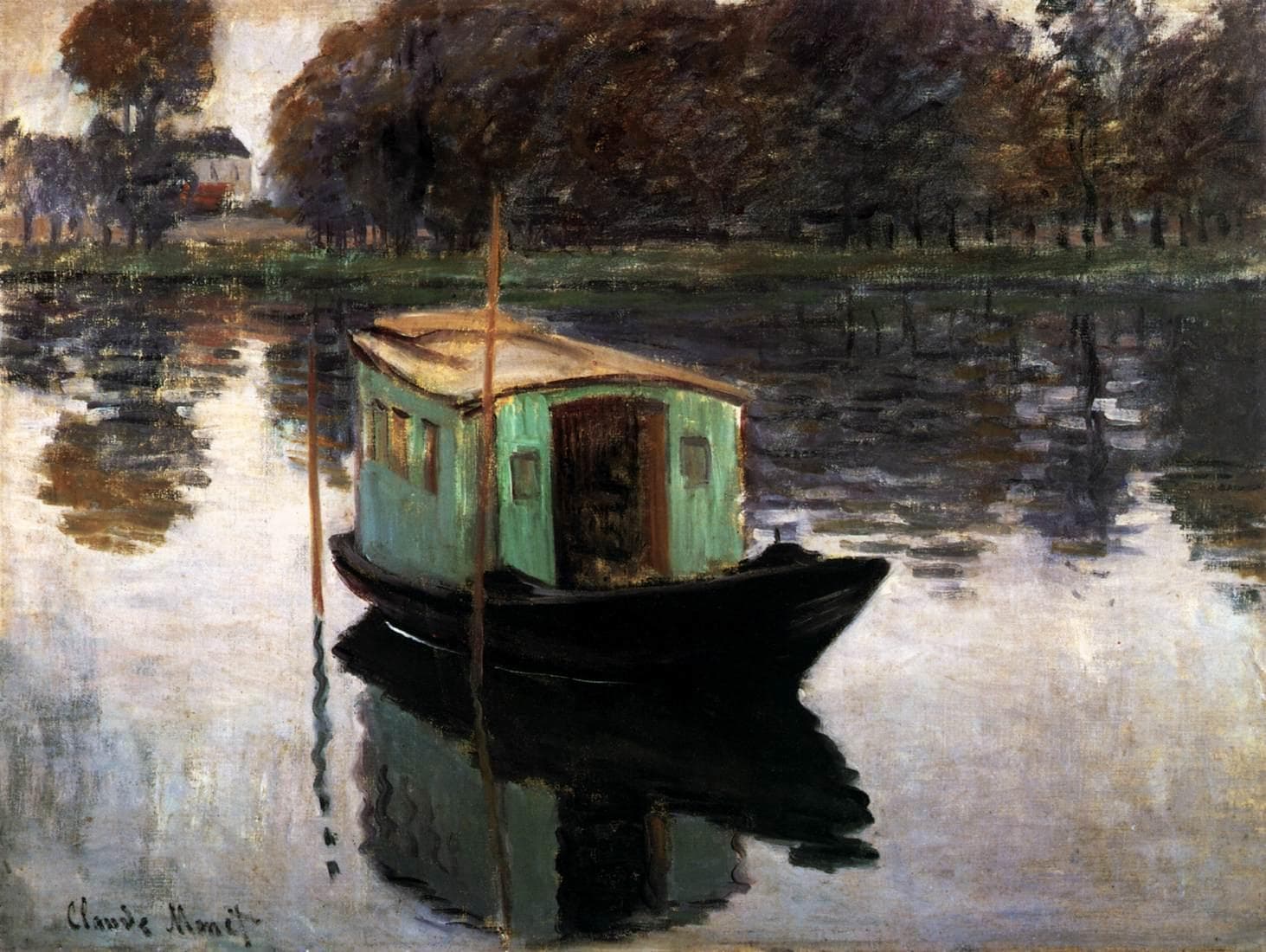
The boat also links to Monet's past. At Argenteuil in the 1870s he had a floating studio built, which he painted in The Studio Boat, and boats on the Seine run through his work of that decade. At Giverny the boat becomes less a subject than a way of looking: from the water, close to the surface, with the bank left out.
What does it mean?
Monet left no statement about this picture, and it is best not to over-read it. But its interest is clear from the composition. By removing the horizon and the figures, Monet turns a river scene into an image about looking itself: the eye moving over a surface that mixes depth and reflection. Art historians have often traced a line from paintings like this to the immersive, edgeless water lily canvases and, beyond them, to the large-scale abstraction of the twentieth century.
There is also a personal dimension. The Hoschedé daughters were central to Monet's life at Giverny; Suzanne was his favorite model, and Blanche, herself a painter, later married his son Jean and looked after Monet in old age. An empty boat, in a series otherwise full of them, is hard to see without thinking of the people who usually sat in it.
From the Epte to the water lily pond
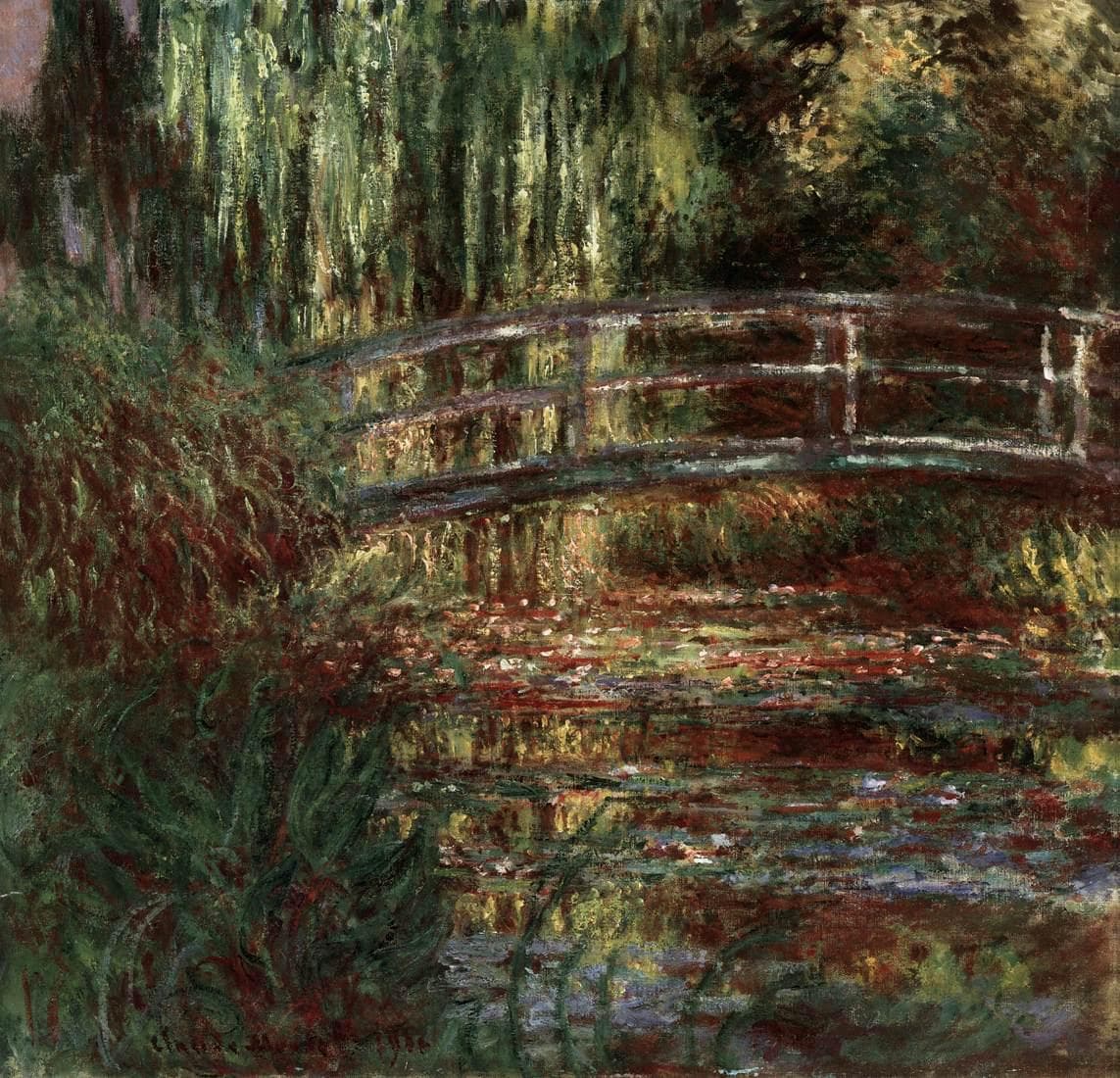
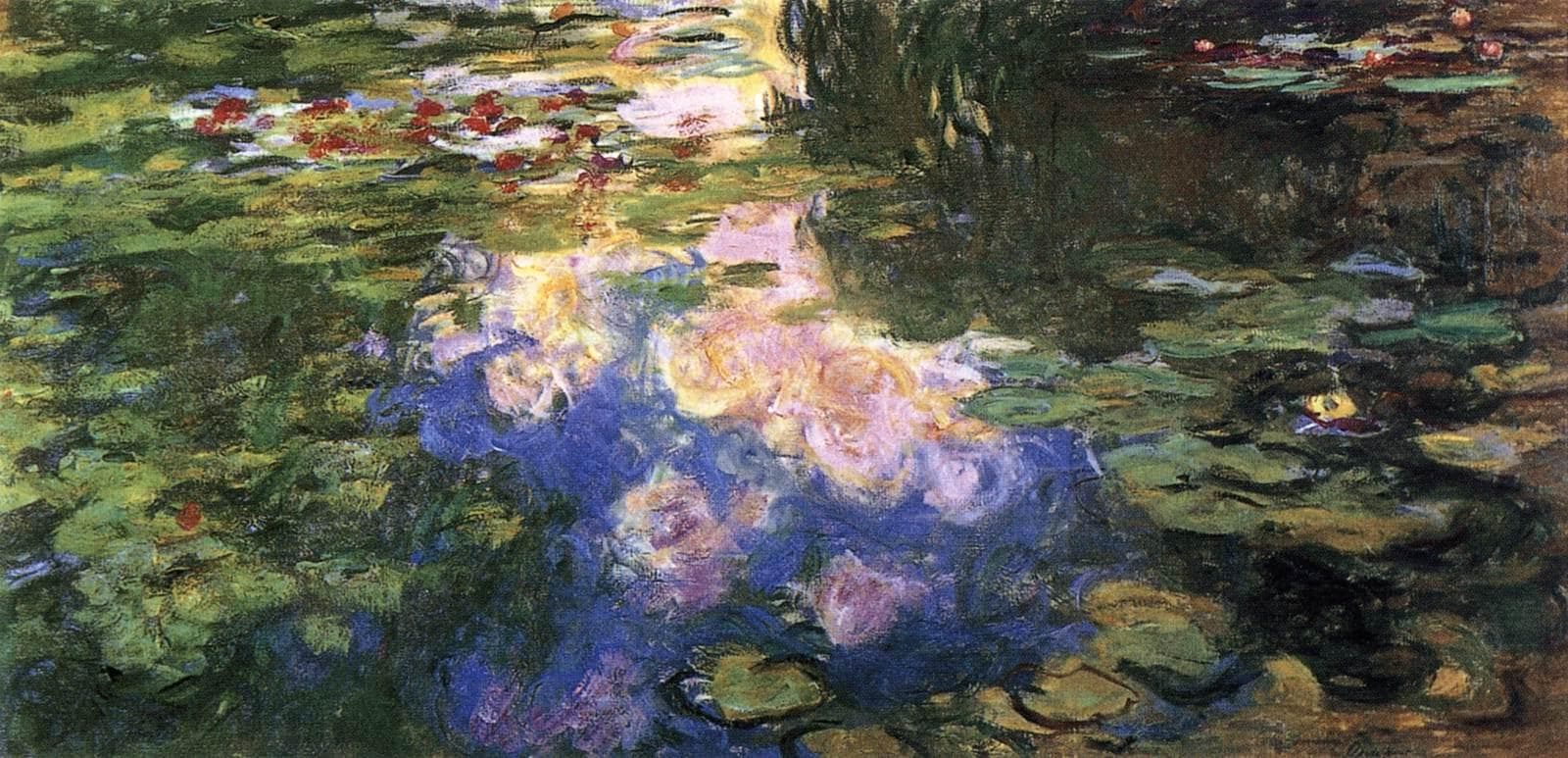
A few years later Monet bought land across the road from his house, diverted a branch of the Epte, and created the pond that he would paint for the rest of his life. Pictures such as The Water Lily Pond and the later Water Lilies carry forward exactly what La Barque introduced: the high viewpoint, the lost horizon, and water as a field of reflection and growth.
Where to see it
The painting is in the Musée Marmottan Monet in Paris, in the 16th arrondissement, which holds the largest collection of Monet's work in the world, much of it from Michel Monet's 1966 bequest. It is usually displayed in the museum's lower-level Monet galleries, alongside many of the late Giverny canvases. For more of his river pictures, see our guide to famous Monet paintings.
Questions & answers
Where is Monet's The Barque (La Barque)?
It is in the Musée Marmottan Monet in Paris. The museum received it in 1966 as part of the bequest of Michel Monet, the painter's younger son. The canvas measures 146 by 133 centimeters, making it one of Monet's larger works from the 1880s.
When and where did Monet paint La Barque?
He painted it in 1887 on the river Epte at Giverny, where he had lived since 1883. That summer he painted several large boating scenes with his stepdaughters Suzanne and Blanche Hoschedé; this canvas shows the boat empty.
Why is there no horizon in The Barque?
Monet looks down at the water from a high viewpoint, a device he admired in Japanese prints. Removing the horizon flattens the scene and turns the river into a surface of color and reflection, an approach he developed further in the Water Lilies.
How is La Barque connected to Monet's Water Lilies?
The Musée Marmottan describes it as prefiguring the Water Lilies. Like those later paintings, it fills the canvas with water seen from above, mixing reflections and plant life, with no shore or sky to anchor the view.
More by the artist
Claude Monet

Bridge over a Pond of Water Lilies
Claude Monet · 1899

Woman with a Parasol – Madame Monet and Her Son
Claude Monet · 1875

Sunset in Venice
Claude Monet · 1908–12

La Grenouillère
Claude Monet · 1869

Beach in Pourville
Claude Monet · 1882

Springtime
Claude Monet · 1872

Boating on the River Epte
Claude Monet · 1890

The Seine at Asnières (Hermitage)
Claude Monet · 1873
Also painted in 1887
The same year
Kindred works
You may also study
The Boat at Giverny
Claude Monet · c. 1887
The Studio Boat
Claude Monet · 1874
The Water Lily Pond
Claude Monet · 1900
Water-Lily Pond (Le Bassin aux nymphéas), 1917–19
Claude Monet · 1917–19
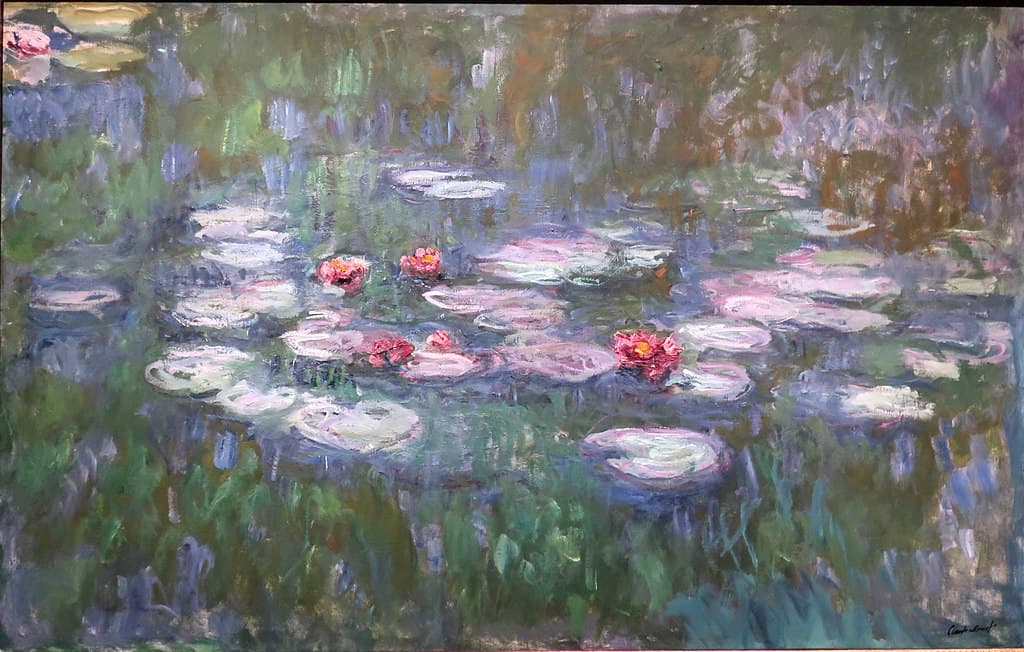
Nymphéas (Water Lilies)
Claude Monet · c. 1914–1919

The Scream
Edvard Munch · 1893

Ophelia
John Everett Millais · 1851–52

The Great Wave off Kanagawa
Katsushika Hokusai · c. 1830–32