Image: Museo Soumaya, Mexico City; via Wikimedia Commons · Public domain · via Wikimedia Commons
Impressionism
Landscape in Port-Villez
Claude Monet, 1883
Landscape in Port-Villez is an 1883 painting by Claude Monet of the Seine and the wooded hill of Port-Villez, a short walk from his new home at Giverny. It is in the Museo Soumaya, Mexico City.
- Artist
- Claude Monet
- Date
- 1883
- Medium
- Oil on canvas
- Dimensions
- 65 × 81.5 cm
- Collection
- Museo Soumaya, Mexico City, Mexico
- Movement
- Impressionism
- Catalogue
- Wildenstein 836
Painted at Giverny: Monet's House and Garden
What you are looking at
A broad, slow river crosses the picture from left to right. On its far side a steep, rounded hill rises almost to the top edge, its slopes covered in dark green scrub broken by patches of pale rock and dry grass. At its foot a few houses with orange-red roofs half hide behind trees and the low, bushy islands that sit in the river. The sky is pale and overcast, a creamy white streaked with lilac.
The water is the liveliest part. It takes the colors of the sky in long horizontal strokes of white, gray and violet, and the reflections of the islands drop into it as darker green blocks. Across the bottom of the canvas, on our side of the river, a band of tall green grass and reeds is painted in quick upright flicks, so that we seem to look across the Seine from a bank thick with vegetation.
Where and when it was painted
Monet moved to Giverny in late April 1883 with Alice Hoschedé and their combined family of eight children, renting the house he would later buy and make famous. Port-Villez lies on the right bank of the Seine less than two kilometers from his house, where the river bends below a chalk hill. In his first months at Giverny he explored the surroundings and painted the river from several points nearby.
In November 1883 Monet wrote to his dealer Paul Durand-Ruel about this picture and six others; Durand-Ruel acquired it and later exhibited it in Paris and New York. It is one of the first canvases of the long Giverny period, painted before the water garden existed and before the serial projects that would make his name in the 1890s.
How it was painted
The composition is built in three horizontal bands: grass, water, hill, with a narrow strip of sky above. Monet keeps the palette to greens, blues and violets and then places one small accent of complementary color at the center: the orange roof of a house. The touch of warm color against the blue-green surroundings makes the whole canvas vibrate, an application of the law of simultaneous contrast that the Impressionists had absorbed from color theory.
The brushwork changes with the subject. The grass is all vertical flicks, the water all horizontal strokes, the hill a dense mosaic of short dabs that follow its contour. Pale rock outcrops are left almost as bare patches of light paint. It is a picture of an ordinary gray day, and its interest lies in how many different greens Monet can find in it.
Look at the edge where the islands meet the water. There is no clean line: the bushes dissolve into their own reflections, and the sky reflected in the river is painted with the same creamy white as the sky itself. The surface of the river is almost a second sky. The near bank is equally loose, with the tips of the reeds standing out against the bright water as dark green slashes. Overcast light suited Monet here, because it removes hard shadows and lets the color of each thing come through evenly.
A new home on the Seine
Giverny gave Monet something he had lacked since Argenteuil: a settled base with the river on his doorstep. In the next decades he would paint the meadows, poplars, haystacks and finally his own garden within walking distance of the house. Port-Villez, on the first bend downstream, is one of the places where that long engagement began.
Related works
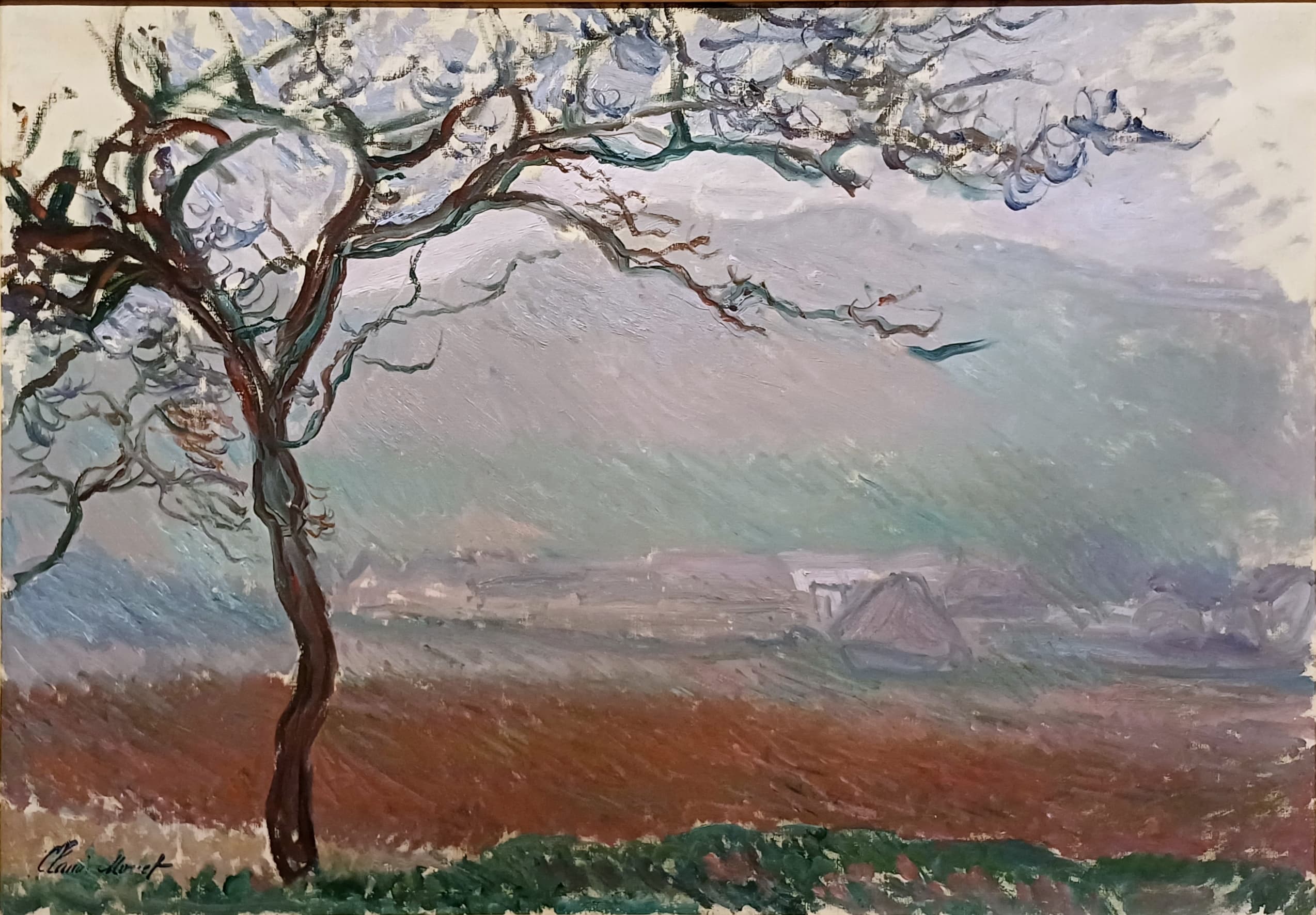
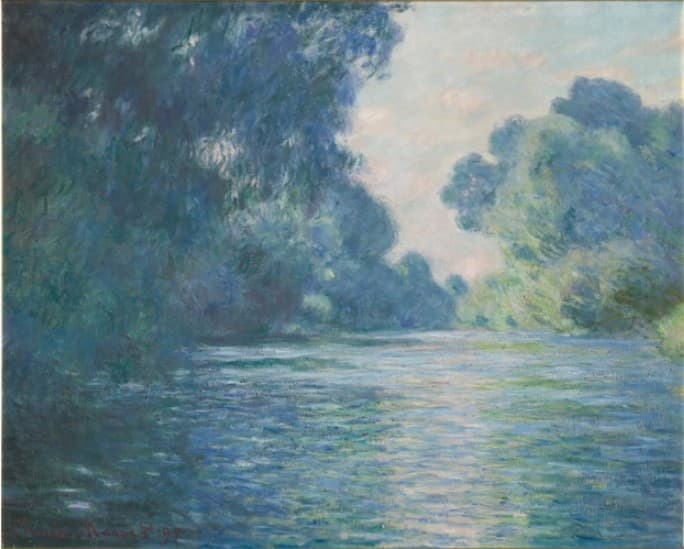
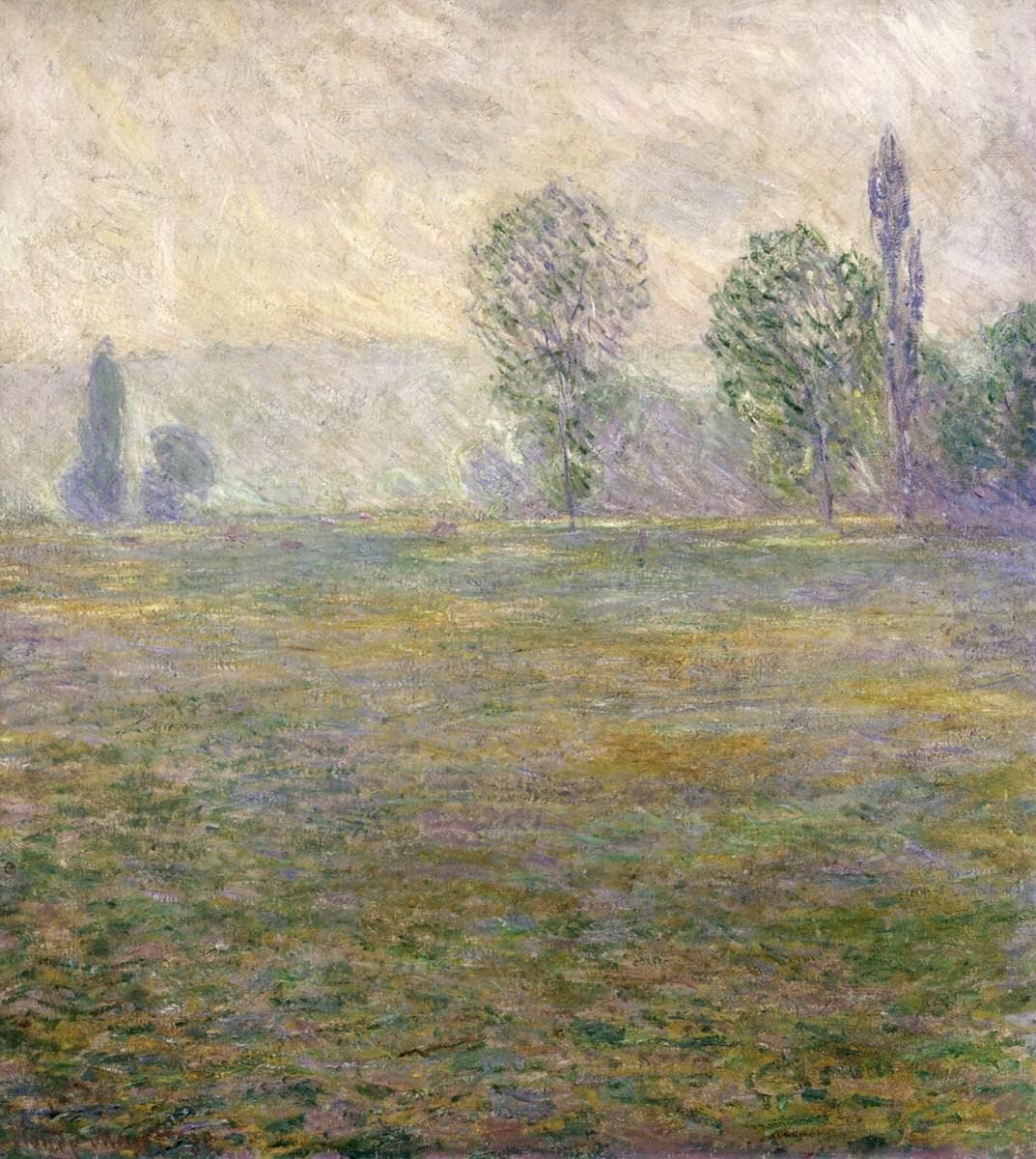
The river near Giverny returns again and again in Monet's work: the reedy foreground anticipates Arm of the Seine near Giverny from the Mornings on the Seine series of 1896–97, and the wider valley views of the 1880s include Giverny Landscape, also in the Museo Soumaya, and Meadow at Giverny.
Where to see it
The painting is in the Museo Soumaya in Mexico City, the museum founded by Carlos Slim, which holds a group of Impressionist works. Admission to the Plaza Carso building is free. For other museums, see where to see Monet's paintings.
Questions & answers
Where is Monet's Landscape in Port-Villez?
It is in the Museo Soumaya in Mexico City, the museum of the Carlos Slim Foundation, which also holds Monet's Giverny Landscape of 1887.
When and where was Landscape in Port-Villez painted?
Monet painted it in 1883, his first year at Giverny. Port-Villez is a village on the Seine less than two kilometers from his house, below a steep wooded hill on the river's bend.
What does Landscape in Port-Villez show?
It shows the Seine from a reedy bank, with small islands and the wooded hill of Port-Villez opposite, a few orange-roofed houses at its foot, and an overcast sky reflected in the water.
Did Monet paint Port-Villez more than once?
Yes. He painted the river and the hills around Port-Villez several times in the 1880s and 1890s, and the stretch of the Seine near Giverny later became the subject of his Mornings on the Seine series.
More by the artist
Claude Monet

Bridge over a Pond of Water Lilies
Claude Monet · 1899

Woman with a Parasol – Madame Monet and Her Son
Claude Monet · 1875

Sunset in Venice
Claude Monet · 1908–12

La Grenouillère
Claude Monet · 1869

Beach in Pourville
Claude Monet · 1882

Springtime
Claude Monet · 1872

Boating on the River Epte
Claude Monet · 1890

The Seine at Asnières (Hermitage)
Claude Monet · 1873
Also painted in 1883
The same year
Kindred works
You may also study
Giverny Landscape
Claude Monet · 1887
Arm of the Seine near Giverny
Claude Monet · 1897
Meadow at Giverny
Claude Monet · 1888

The Scream
Edvard Munch · 1893

Ophelia
John Everett Millais · 1851–52

The Great Wave off Kanagawa
Katsushika Hokusai · c. 1830–32
The Birth of Venus
Sandro Botticelli · c. 1484–1486
Wanderer above the Sea of Fog
Caspar David Friedrich · c. 1817